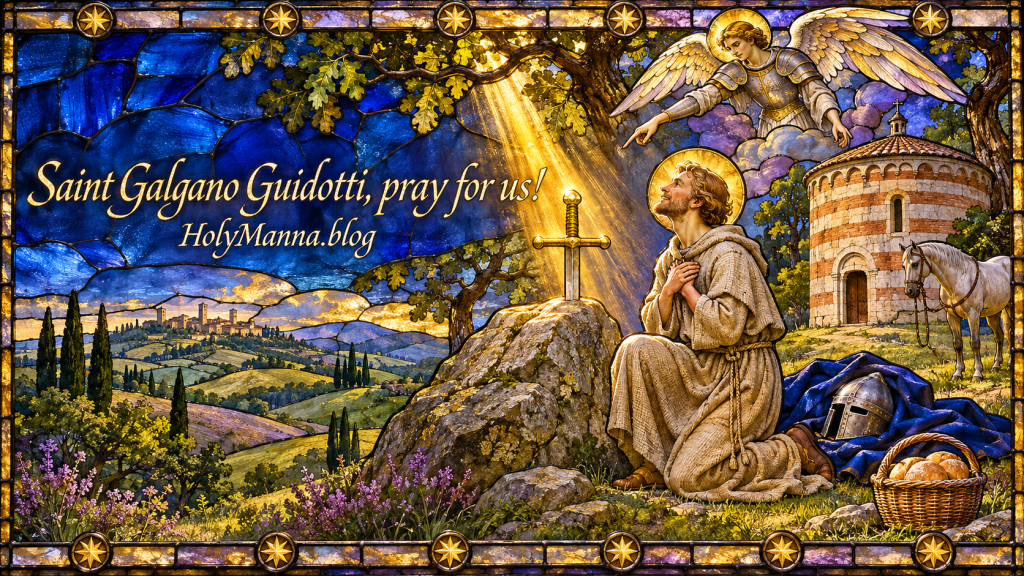
The Knight Who Planted His Sword and Found a Cross
On November 30th, the Church remembers Saint Galgano Guidotti, a 12th century Tuscan knight who rode up a wooded hill near Siena, drove his sword into the ground, and knelt before it as a cross. He lived as a hermit for less than a year, and he died when he was only about 30 years old. More than 8 centuries later, the hilt of a medieval sword still rises from the rock inside a small round chapel at Montesiepi, and pilgrims still climb the hill to pray beside it.
The Roman Martyrology remembers him as a hermit of Monte Siepi in Tuscany who “converted to God after a dissipated youth” and who spent the rest of his life in voluntary penance. He shares his day with the Apostle Saint Andrew, whose feast takes precedence in the liturgy, so Galgano is one of those quiet saints whose name is rarely heard from the pulpit.
A sword in a stone invites tall tales, yet the heart of this story rests on unusually solid ground. In August of 1185, only 4 years after his death, a papal commission gathered at Montesiepi and heard 20 witnesses, and the first to speak was his own mother. Historians regard the record as one of the oldest surviving sets of acts from a canonization process. The Catechism teaches that in canonizing some of the faithful, the Church solemnly declares that they lived the virtues heroically and remained faithful to the grace of God, and she holds them up as models and intercessors (CCC 828). Galgano is that kind of model. He shows what a complete and irreversible conversion looks like.
A Widow’s Son in the Hills of Chiusdino
Galgano was born in Chiusdino, a fortified hill town about 30 kilometers from Siena, in what was then the diocese of Volterra. The year usually given is 1148, but that date comes from a 16th century biographer, and historians prefer to say that he was born between 1148 and 1152. His mother was named Dionisia. His father is called Guido or Guidotto only in writings from the 14th century onward, so the surname Guidotti was attached to the saint long after his death. The family belonged to the minor nobility and served the bishops of Volterra, who were the feudal lords of Chiusdino. A boy born into such a house was raised for the saddle and the sword, and Galgano became a knight.
Later accounts describe his youth as proud, violent, and given over to pleasure, and the Roman Martyrology itself speaks of a dissipated youth. His mother, the earliest witness of all, said nothing about this in her sworn testimony, and some historians suspect that later writers darkened the picture. What can be said with confidence is that Galgano was a young man formed for arms and worldly honor, and that God had other plans for him.
Those plans began in his sleep. Dionisia testified that after the death of his father, her son dreamed that Saint Michael the Archangel asked her to hand the boy over to be made a soldier. In the dream she agreed, and the archangel said to Galgano, “Follow me.” She took it as a good sign, since a widow and an orphan were being entrusted to the archangel whom her husband had served with devotion. The Catechism teaches that the care and intercession of the angels accompany each human life from its first moment to its last (CCC 336).
Years later the archangel returned. In a second dream, Saint Michael led Galgano to a river spanned by a great bridge that was hard to cross, with a mill turning beneath it. On the far side lay a meadow full of fragrant flowers. From there he seemed to pass underground and to come out on Monte Siepi, a hill not far from his home. On the hilltop he found the 12 Apostles standing in a round house, beautifully made and full of fragrance. They handed him an open book, which he could not read. Then he lifted his eyes, saw an image of the divine majesty above him, and asked what it was. The Apostles answered with a command: “After the likeness of this one, you shall have a house built there to the honor of God.” His mother added that the house was also to honor the Blessed Virgin Mary, Saint Michael, and the Apostles themselves.
The Catechism explains that private revelations do not belong to the deposit of faith, and that they exist to help believers live the Gospel more faithfully in a given age (CCC 67). Nobody is obliged to believe that Galgano saw the Apostles in a round house. What can be observed is the fruit, and the fruit was a changed man.
The change did not come easily. Dionisia testified that her son wept in anguish. His friends laughed at him and accused him of scheming to collect money. When he begged his mother to come with him to the hill and bring master builders, she answered like a mother: “My son, the cold is too great, the hunger is fierce, and the place is nearly inaccessible.” A different future had been planned for him, and he was sent toward the castle of Civitella, where his biographers say a prospective bride was waiting.
On the road his horse stopped and would not take another step, no matter how hard he used his spurs. He spent that night at a nearby parish church. The next day the horse stopped again. This time Galgano let the reins fall on the animal’s neck and prayed that God would lead him to the place where he was meant to rest. The horse carried him to Montesiepi, to the very spot the Apostles had shown him. His biographers place these events at Christmas of 1180.
What happened next is the scene for which he is known across the world. Galgano wanted a cross to pray before, and he could not manage to make one out of wood. So he drew his sword and, in the words of his mother’s testimony, fixed it in the ground “as a cross.” She swore that by the power of God it held fast in the stony earth, and that no one had been able to pull it out. He tried 3 times to go home and settle his affairs, and on the third attempt he heard a voice: “Galgano, stay your step, for this shall be your place, this your rest.” He obeyed. The words echo the song of the Lord over Zion: “This is my rest for ever and ever: here will I dwell, for I have chosen it” (Psalm 132:14). The knight had found his post, and he never abandoned it.
Raw Herbs, Bare Ground, and Six Loaves
The life Galgano embraced on the hill was severe. A witness named Paganus told the papal commission that he had seen the hermit eating only raw herbs and drinking only water. Galgano slept on the bare ground in a rough woolen garment, and he fasted every day until evening, except on Sundays. Paganus remembered that the hermit drank wine once, on the feast of the Epiphany, and that he was sorry for it afterward. The Catechism describes this vocation when it speaks of hermits, who withdraw more strictly from the world and give themselves to silence, solitude, constant prayer, and penance for the praise of God and the salvation of the world (CCC 920).
It is fair to ask why a modern Catholic should remember a man who lived on wild plants for 11 months. The answer is planted in the rock at Montesiepi. A knight’s sword, turned point down, has the shape of a cross. Galgano did not throw his weapon away. He turned it over, and the thing that had defined him became the sign of the One who now commanded him. Jesus said, “If any man will come after me, let him deny himself, and take up his cross, and follow me” (Matthew 16:24). Galgano took those words with a soldier’s literalness.
His penances were not a performance. The Catechism says that the call of Jesus to conversion aims first at the heart, and that without interior conversion outward penances remain empty (CCC 1430). It also says plainly: “There is no holiness without renunciation and spiritual battle” (CCC 2015). Galgano is worth imitating because the same road, in a form suited to each state of life, lies open to every baptized person.
People from the surrounding country soon began to climb the hill, and many came to see the sword. Paganus testified that he watched one visitor try 3 times to pull it out of the ground without success.
The inquiry of 1185 records only 2 miracles worked during Galgano’s lifetime, and both are small, homely, and full of compassion. Soon after his conversion, Galgano gave 3 loaves of good bread to a man named Giovanni of Chiusdino and asked him to give them to the first 3 poor people he met. Giovanni found no one, so he handed the loaves to his wife, who put them away in a chest. The next morning she found 6 loaves, different in color and in taste from the ones she had stored, and the people of the town came running to carry them off. The miracle fits the man. The Catechism counts feeding the hungry among the works of mercy and singles out almsgiving to the poor as a leading sign of brotherly love (CCC 2447). The Lord Himself said, “Amen I say to you, as long as you did it to one of these my least brethren, you did it to me” (Matthew 25:40).
The second miracle was a healing. Paganus saw women from the region of Arezzo bring to the hermit a girl whose hands were contracted and useless. Galgano had her stretch out her fingers and pick up 3 coins and a piece of candle, and he told the women to pray for her beside the sword. The next morning the girl was found healed. The Catechism teaches that the Holy Spirit grants to certain people a particular gift of healing, which shows the power of the risen Christ at work (CCC 1508). Galgano did not draw attention to himself. He sent the women to pray at the foot of his cross.
His own voice survives in one more testimony. A father named Girardino came to ask whether his son, whose arms and legs were contracted, could ever recover. Galgano answered, “Son, trust in the Lord; your son will be set free and will yet work with his own hands.” The healing came only after the hermit’s death, when the boy was carried to the hill on a donkey, walked to the tomb, and later returned home fully restored.
Mocked, Tempted, and Robbed of His Cross
Galgano was not a martyr. No persecutor demanded his life, and he died of natural causes on his hill. His hardships were of a quieter kind, and they began with the people closest to him. His friends mocked his vocation, and his mother tried to steer him toward marriage and comfort. Then came the hill itself, with its cold, its hunger, and its loneliness, exactly as Dionisia had warned.
There was also the enemy that every hermit meets in solitude. Dionisia told the commission that her son once described a night in the woods, when he was sheltering between 2 hornbeam trees and heard the devil approaching. Galgano stepped into the open to face him, and the devil fled with a great howl. The account comes from Galgano himself by way of his mother, and an experience of this kind cannot be verified. Its lesson agrees with the faith of the Church, which teaches that the power of Satan has limits, because he is a mere creature (CCC 395).
The bitterest trial came from envy. In 1181 Galgano left his hill to go to Pope Alexander III. One early Life says that he went to present requests to the pope, while other accounts describe a pilgrimage to Rome. Historians point out that Alexander III had left Rome in 1179 and died in August of 1181, so any meeting must have taken place outside the city. While the hermit was away, his mother testified, certain men “stirred by the torches of envy” came to the place where the sword stood, dug around it, and broke it. Dionisia stated simply that the punishment of God fell on them.
Later writers filled in what she left unsaid. According to a tradition that developed from the 14th century onward, the envious men were 3 churchmen of the neighborhood. The story says that one drowned in a river, that another was struck by lightning, and that the third was attacked by a wolf that tore at his arms, and that he survived to repent after calling on the name of Galgano. A pair of mummified forearms displayed at Montesiepi is linked to this story, and testing reported in 2001 dated them to the 12th century. Another version tells of an assassin disguised as a monk, who was brought down by wolves that kept company with the hermit. The identity of the men and the manner of their punishment cannot be verified.
The Catechism lists envy among the capital sins and describes it as the sorrow a person feels at the good fortune of another (CCC 2539). It is sobering that a penitent who owned nothing but a woolen tunic could still be envied. Galgano came home, found his cross destroyed, and grieved. Then, his mother said, the Lord consoled him 3 times in dreams and told him to set the sword back in the same place, where it would hold more firmly than before. He did so, and Dionisia told the commission that it could still be seen there.
His time was short. Galgano died at Montesiepi, most probably on November 30th of 1181, less than a year after he first climbed the hill. An older tradition gives December 3rd, which may have been the day of his burial or of a later solemn exhumation of his relics, and his feast was kept for centuries on that date. Later accounts say that bishops and abbots were present when he was laid in the earth beside his sword. This detail cannot be verified. What is certain is that he persevered to the end, and that he honored the hard saying of the Lord: “No man putting his hand to the plough, and looking back, is fit for the kingdom of God” (Luke 9:62).
Cords on the Chapel Wall
The grave beside the sword became a place of pilgrimage almost at once. Bishop Ugo of Volterra made a first inquiry into the hermit’s virtues and miracles, and he approved the building of a chapel around the tomb and the sword. In 1185 his successor, Bishop Ildebrando Pannocchieschi, obtained from Pope Lucius III a commission of 3 delegates, led by Cardinal Conrad of Wittelsbach. Their record survives in a transcription made in the 16th century by the Sienese historian Sigismondo Tizio.
Galgano is usually said to have been canonized in 1185 by Lucius III. The sources are not unanimous, since some early biographies credit Pope Urban III or Pope Gregory VIII, and no papal document of canonization has survived. The veneration of the Church, however, has never been interrupted, and his name stands in the Roman Martyrology to this day.
The testimonies are a window into the faith of ordinary medieval people. Pietruzzo of Montarrenti told how his son, 8 years old, fell into water and was pulled out as if dead. He and his wife dedicated the child to God and to Saint Galgano, and the boy lived. When the commissioners asked whether he had also used medicine, Pietruzzo admitted that he had, and his honesty became part of the record. Ermanno of Frosini described his son Raniero lying at the point of death while the priests began the prayers for the dying. Ermanno vowed to wind a silver thread around the altar, and soon afterward the child began to speak.
Others spoke of fevers that lifted at the tomb, of a throat swollen for 10 years that healed within a month, and of a woman from Piacenza whose hand had been clenched for 8 years, who was told in a vision at Rome to seek out Galgano and was healed at his oratory. Two hermits of the hill, Strinato and the priest Isacco, testified about Sibilla of Massa, who had been tormented by a demon for 7 years and who wore the hermit’s habit for the rest of her life after her deliverance. Strinato also described a man with leprosy who found relief after calling on the saint.
The most striking witnesses were prisoners. This was a violent corner of a violent century, and several men told of being bound, locked in chests, or tied in sacks by feudal lords and passing soldiers. Guido of Canneto was shut in a chest under heavy boards and a block of stone. He called on Saint Galgano 3 times, heard the lock snap, and went home free. Martino of Gualtra was held under guard when a girl said to him, “May Saint Galgano help you.” That night he heard a voice in a dream say, “Martin, rise and take off your shoes.” He woke, worked his hands free, cut the bonds on his feet with a small knife, and walked out through the door. A man of Chiusdino named Ghiottone, bound for 3 days by German troops, carried the cords that had tied him to the oratory, where they were hung up as proof. These accounts are preserved as sworn testimony from 1185, and they cannot be independently verified today.
The Catechism explains why such stories never surprised the Church. Because the saints in heaven are united so closely to Christ, they never stop praying to the Father for those still on earth (CCC 956).
The relics of the saint were dispersed over the centuries, and what remains is his head, which is venerated at Chiusdino. It was kept for centuries in Siena, at the church known as the Santuccio, and it returned to his hometown in 1977. An old tradition holds that the hair on the relic continued to grow, that the nuns who guarded it trimmed it, and that the sick were healed by touching it. This tradition cannot be verified.
The sword has been studied as well. In 2001 a team coordinated by Luigi Garlaschelli of the University of Pavia concluded that the metal and the style of the weapon are compatible with the 12th century, and a radar survey detected a cavity nearby that may be the original tomb. After acts of vandalism, the blade was sealed in place with molten lead in 1924, and today it rests under a transparent dome.
Around the sword rose one of the most beautiful sacred places in Tuscany. The round chapel of Montesiepi was built in the 1180s, in the shape of the round house that Galgano saw in his dream, and a side chapel holds frescoes painted by Ambrogio Lorenzetti between 1334 and 1336. In the valley below, Cistercian monks began a great Gothic abbey in 1218. It grew rich, declined under absentee abbots, and lost its roof in the late 18th century, so that its nave now stands open to the Tuscan sky. In Chiusdino, the Confraternity of Saint Galgano, founded in 1185, is counted among the oldest Catholic confraternities still in existence, and the town continues to celebrate its saint on December 3rd. Several thousand pilgrims climb Montesiepi every year. The Catechism counts the veneration of relics, visits to sanctuaries, and pilgrimages among the authentic forms of popular piety (CCC 1674).
Some writers have suggested that the sword of Montesiepi inspired the famous sword of the Arthurian romances. The connection cannot be proven, and the difference between the two stories is the better lesson. Arthur pulls a sword out of a stone in order to take up power. Galgano drives a sword into a stone in order to lay power down.
Where Is Your Sword?
Very few people are called to live on raw herbs on a hilltop. What the life of Galgano does suggest is that conversion eventually has to become concrete. For years he had dreams, and tears, and good intentions. Holiness began on the day he drove something into the ground and refused to pull it back out.
Everyone carries a sword of some kind. It is the thing a person relies on for identity, security, or control. It might be a career, a reputation, a bank balance, a phone, or a habit of sin that has come to feel like part of the self. What is the sword in your own hand, and what would it mean to turn it upside down so that it becomes a cross? Saint Paul wrote, “But God forbid that I should glory, save in the cross of our Lord Jesus Christ; by whom the world is crucified to me, and I to the world” (Galatians 6:14). Galgano did not despise his knighthood. He handed it over, and God gave it back to him transformed.
The Catechism teaches that Christ keeps calling the baptized to conversion, and that this second conversion is a work the whole Church never finishes (CCC 1428). You do not need a vision of the Apostles to begin. You can begin with one clear renunciation that you do not negotiate with afterward. Is there a decision for God that you keep making halfway, with the reins still tight in your hands? Galgano found his place only when he let the reins drop and prayed to be led.
There are simple ways to bring his lessons home. You can choose one day each week for a real fast, remembering that fasting, prayer, and almsgiving are the classic forms in which interior penance is expressed (CCC 1434). You can set aside your own small Montesiepi, a fixed corner and a fixed time for silence with God. You can practice the mercy of the 3 loaves by setting something aside for the poor before the week’s spending begins. When someone you love is sick or struggling, you can make the hermit’s counsel your own, which is to trust in the Lord.
His hardships offer guidance too. If friends or family smile at your faith, remember that his did the same, and that he answered them with perseverance. If the blessings of someone else make you sad, call the feeling by its name, which is envy, and ask for the grace to rejoice in the good of another. If something you built for God is broken while your back is turned, do what Galgano did. Grieve, pray, and plant the cross again in the same place. The Catechism holds up the daily carrying of the cross behind Jesus as the most reliable penance of all (CCC 1435). Where has your cross been knocked down lately, and what would it take to set it upright again?
Engage With Us!
Share your thoughts and reflections in the comments below. The story of a knight who traded his sword for a cross tends to stir something different in every reader, and your insight may be the encouragement someone else needs today.
- What is the sword in your life, the thing you rely on most for identity or security, and how could you surrender it to Christ?
- Galgano’s friends mocked him and his mother worried about him. How do you respond when the people closest to you do not understand your faith?
- The voice on the hill told Galgano that he had found his place and his rest. Where do you find true rest in God during an ordinary week?
- Envious men broke the sword, and Galgano simply planted it again. What good work in your life needs to be patiently rebuilt?
- Galgano told a worried father to trust in the Lord. Who in your life needs to hear those words from you this week?
May the example of Saint Galgano give you the courage to stop negotiating with grace and to plant your whole life at the foot of the Cross. Keep the faith, stay close to the sacraments, and do everything with the love and mercy that Jesus taught us.
Saint Galgano Guidotti, pray for us!
Follow us on YouTube, TikTok, Instagram and Facebook for more insights and reflections on living a faith-filled life.


Leave a Reply