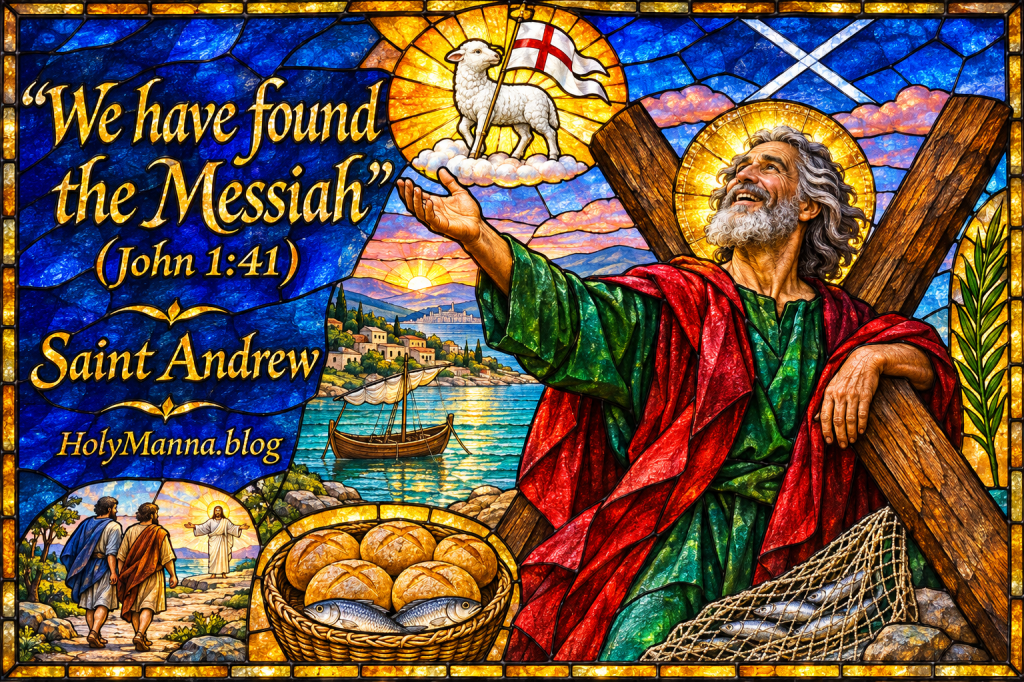
The First Apostle Who Could Not Keep Jesus to Himself
Every family seems to have one person who hears good news and cannot rest until somebody else has heard it too. Among the Twelve Apostles, that person was Saint Andrew. He was a fisherman from Galilee, the brother of Saint Peter, and a disciple of Saint John the Baptist before he ever met Jesus. According to The Gospel of John, he was also the very first of the Apostles to follow the Lord, which is why the Christian East has honored him for centuries with the Greek title Protokletos, the First-Called. Pope Benedict XVI devoted his General Audience of June 14th, 2006 to him under that title and described him as “the Apostle of the Greek world.”
The Church celebrates him on November 30th with the rank of a Feast, at the very doorway of Advent.
Saint Andrew is revered for one habit above all others. Nearly every time the Gospels show him doing something, he is bringing someone to Jesus. He brings his own brother, he brings a boy carrying a small lunch, and he brings a group of foreigners who have asked to meet the Lord. Ancient tradition then follows him into the Greek-speaking world, and the Roman Martyrology words that tradition carefully, noting that he is said to have preached in Achaia and to have been crucified at Patras.
His patronage is wide. He is honored as the patron saint of fishermen, of Scotland, Russia, Greece, Romania, and Ukraine, of the Ecumenical Patriarchate of Constantinople, and of the cities of Patras and Amalfi. The Church holds up saints like him for a reason. By recognizing and venerating her holy ones, she proposes them to believers as models and intercessors, and she sustains the hope of the faithful (CCC 828). In the case of this Apostle, the model is wonderfully simple. He met Jesus, and then he went and found his brother.
From the Nets of Bethsaida to the Lamb of God
The documented facts of his early life are few, and all of them come from Scripture. The Gospel of John gives his hometown in a single line: “Now Philip was of Bethsaida, the city of Andrew and Peter” (Jn 1:44). His father was named Jona, or John, and his brother was Simon, the future Saint Peter. The 2 brothers worked as fishermen on the Sea of Galilee, and by the time Jesus began His public ministry they shared a house in Capharnaum (Mk 1:29). No source records the year of his birth, and Scripture never says which brother was older, so confident claims in either direction cannot be verified.
One small detail stands out. His name is not Hebrew but Greek, from a word meaning manliness or courage. Pope Benedict XVI saw in that name a sign of a certain cultural openness in the family, which suits a Galilee where Greek language and culture were part of daily life. Long before he met Jesus, he was a seeker. He left his nets often enough to become a disciple of Saint John the Baptist, the prophet who was calling Israel to repentance at the Jordan.
That is where everything changed. The Gospel of John records that the Baptist was standing with 2 of his disciples when Jesus walked by, and he said, “Behold the Lamb of God” (Jn 1:36). The 2 disciples followed Jesus at once. He turned and asked them, “What seek you?” They answered with a question of their own, “where dwellest thou?” His reply was an invitation: “Come and see” (Jn 1:38 to 39). The evangelist then adds a detail that sounds like a treasured memory: “They came, and saw where he abode, and they stayed with him that day: now it was about the tenth hour” (Jn 1:39). The tenth hour was about 4 in the afternoon. One of those 2 disciples, the Gospel says, was Andrew.
What he did next defines him. “He findeth first his brother Simon, and saith to him: We have found the Messias, which is, being interpreted, the Christ. And he brought him to Jesus” (Jn 1:41 to 42). Saint John Chrysostom, preaching on this passage in his Homily 19 on the Gospel of John, admired that the new disciple “kept not the treasure to himself,” and he summed up the whole scene in one line: “This is the part of brotherly affection.” The man who would become the rock of the Church and the first Pope came to Christ because his brother went looking for him.
The Gospel of Matthew tells of a second moment, on the shore of the Sea of Galilee, when Jesus saw the 2 brothers casting a net and said, “Come ye after me, and I will make you to be fishers of men” (Mt 4:19). They left their nets immediately. The Church has long read the meeting at the Jordan as the first encounter and the call at the lakeside as the summons to leave everything. The Catechism places that call at the heart of the Church’s story. It teaches, “Jesus is the Father’s Emissary,” and it explains that from the beginning of His ministry He chose the Twelve to be with Him and to be sent out to preach (CCC 858). In every list of the Apostles in the New Testament, Andrew is named among the first 4.
The Apostle Who Kept Bringing People to Jesus
The Gospels mention him by name on only a handful of other occasions, and each one shows the same instinct. The first comes on a hillside in Galilee, with about 5,000 hungry men and no food. Andrew has been looking around, and he reports what he has found: “There is a boy here that hath five barley loaves, and two fishes; but what are these among so many?” (Jn 6:9). He is honest about how little it is, yet he brings the boy forward anyway, and Jesus feeds the whole multitude. The Catechism teaches that the multiplication of the loaves prefigures the superabundance of the Eucharist (CCC 1335). One of the great Eucharistic signs of the Gospel begins with this Apostle noticing a child whom everyone else had overlooked.
The second comes in Jerusalem, days before the Passion. Some Gentiles who had come up for the feast approach Philip with a request: “Sir, we would see Jesus” (Jn 12:21). Philip goes straight to the man who always knows where to take people. “Philip cometh, and telleth Andrew. Again Andrew and Philip told Jesus” (Jn 12:22). The Lord’s answer looks ahead to the Cross: “Amen, amen I say to you, unless the grain of wheat falling into the ground die, itself remaineth alone. But if it die, it bringeth forth much fruit” (Jn 12:24 to 25). Pope Benedict XVI heard in these words a prophecy of the Church of the Greeks and of the whole world, the harvest that would spring from the death and Resurrection of Christ.
He appears once more on the Mount of Olives, where he joins Peter, James, and John in asking Jesus privately about the destruction of the Temple (Mk 13:3). After the Ascension he is named among the Apostles gathered in prayer in the upper room (Acts 1:13), and he received the Holy Spirit with them at Pentecost. After that, Scripture never mentions him again.
As for miracles during his lifetime, the documented record is brief but real. The Gospel of Mark relates that Jesus sent the Twelve out 2 by 2, and that they preached repentance, cast out many demons, and anointed and healed many who were sick (Mk 6:7 to 13). The Catechism explains that Christ made His disciples share in His own ministry of compassion and healing (CCC 1506). Andrew was one of those sent, so he took part in those works, although no Gospel describes a particular healing by his hands.
Where he went after Pentecost is a matter of tradition and not of documented history, and the ancient witnesses do not agree. Eusebius of Caesarea, apparently relying on Origen, assigns him Scythia, the lands north of the Black Sea. Saint Gregory Nazianzen names Epirus, Saint Jerome names Achaia, and Theodoret names Greece. The Catholic Encyclopedia admits that there is no certainty about the extent or place of his labors. Later traditions add that he founded the Church at Byzantium, the future Constantinople, although Father Alban Butler observed in his Lives of the Saints that no trace of this appears in antiquity, and that he traveled up the Dnieper River to the hills where Kyiv would one day rise. These traditions cannot be verified.
The same caution applies to the many miracle stories told of his missionary years. In the late 500s, Saint Gregory of Tours compiled a Book of the Miracles of the Blessed Apostle Andrew, drawing on a much older work known as the Acts of Andrew. The Church never received that older book as Scripture, and Eusebius listed it among the writings to be rejected, so its stories must be handled as stories. In Saint Gregory’s telling, the Apostle drives 7 demons out of the city of Nicaea, restores to life a company of men drowned in a storm at sea, heals a paralyzed man lying on a dunghill at Patras, and cures Maximilla, the wife of the Roman governor. These stories cannot be verified.
What can be said with confidence is why he matters. The Catechism teaches that handing on the Christian faith means, first of all, proclaiming Jesus Christ so that others may come to believe in Him (CCC 425). Andrew did exactly that, one person at a time. He was not part of the inner circle of 3 who witnessed the Transfiguration, even though he had met the Lord before any of them. He never seems to have minded. His greatness was to introduce people to Jesus and then step aside.
The Cross He Greeted Like a Friend
Following Christ cost him everything he had known. He left a family business, a home, and the security of a trade. As one of the Twelve, he shared in the arrests and beatings that The Acts of the Apostles describes in the first years of the Church in Jerusalem (Acts 5:17 to 41). Then, if the ancient traditions are right, he spent decades on the roads of the Greek world, far from Galilee.
The tradition of his death is ancient and consistent on the essentials. He was crucified at Patras, in the Greek region of Achaia, by order of a Roman governor named Aegeas or Aegeates. The Catholic Encyclopedia places the martyrdom during the reign of Nero, on November 30th in the year 60, although other accounts place it anywhere between 60 and 70, and no document from the period survives to settle the matter. The same source calls it generally agreed that he was bound to the cross and not nailed, so that his suffering would last longer.
The famous X-shaped cross deserves an honest word. Pope Benedict XVI relayed the tradition that he asked for a cross different from that of his Master. The Catholic Encyclopedia notes, however, that the evidence for the diagonal shape seems to be no older than the 1300s, and Father Butler admitted that the form of the cross is not clearly proven. The shape belongs to later tradition, even though the crucifixion itself is attested by early writers.
The most beloved account of his final hours comes from a text called the Passion of Andrew, which Pope Benedict XVI dated to the beginning of the 500s. In this account, the governor’s wife has embraced the faith, the governor is furious, and the Apostle is questioned about his preaching. He answers by explaining the mystery of the Cross, and he is condemned to die on one. When he sees it waiting for him, he does not flinch, and he greets it as a friend. The words have been sung in the Roman liturgy on his feast for centuries, and from the Latin they may be rendered this way: “O good Cross, made beautiful by the limbs of the Lord, long desired, anxiously loved, sought without ceasing, and now at last made ready for a longing soul: take me from among men and give me back to my Master, so that He who redeemed me through you may receive me through you.” The account goes on to say that he hung there for 2 days, preaching to the crowd the entire time, that the people demanded his release, and that he begged not to be taken down before a great light surrounded him and he gave up his spirit. The speech and these details come from a text written centuries after the event, and they cannot be verified as his actual words and experiences.
The older Acts also tell of prison doors opening and of a daring rescue of a fellow Apostle from a city of man-eaters, but these episodes of miraculous escape cannot be verified.
What is certain is the meaning of such a death. The Catechism teaches, “Martyrdom is the supreme witness given to the truth of the faith” (CCC 2473). Whether or not the Apostle spoke those exact words to his cross, the spirituality they express is the Church’s own. The Catechism says it plainly: “The way of perfection passes by way of the Cross” (CCC 2015). It also hands on a saying of Saint Rose of Lima: “Apart from the cross there is no other ladder by which we may get to heaven” (CCC 618). The first man called to follow Jesus followed Him all the way.
A Fisherman’s Bones and the Nations That Love Him
His story did not end at Patras. Around the year 357, his relics were carried to Constantinople and placed in the Church of the Holy Apostles, together with those of Saint Luke and Saint Timothy. Father Butler records that Saint Paulinus and Saint Jerome mention miracles on the occasion of that translation.
The earliest detailed miracle reports come from Saint Gregory of Tours. In his Glory of the Martyrs, written in the late 500s, he says that on the Apostle’s feast day the tomb at Patras gave forth “manna in the manner of flour, and oil with a fragrance like nectar,” and that the people read the abundance of the oil as a sign of the coming harvest. He also tells of a Frankish envoy named Mummolus, who fell gravely ill at Patras on his way to Constantinople, was carried to the tomb at the urging of the local bishop, and was healed. These reports come from a 6th-century bishop passing on what he had heard, and they cannot be verified today.
The relics kept traveling. After Crusaders seized Constantinople in 1204, Cardinal Peter of Capua brought the body to his home city of Amalfi, in southern Italy, where it was solemnly received on May 8th, 1208. Most of the relics remain in the crypt of the cathedral of Amalfi to this day. There, according to local tradition, a liquid known as the manna of Saint Andrew has been gathered at the tomb since November 29th, 1304. The Church has made no formal pronouncement on it. The people of Amalfi also credit their patron with a rescue. On June 27th, 1544, the fleet of the corsair Barbarossa bore down on the coast, the townspeople prayed to their patron, and a sudden storm scattered the ships. Amalfi still keeps that date as a feast of thanksgiving. The storm is part of the remembered history of the city, but its attribution to the intercession of the saint cannot be verified.
The head of the Apostle has its own story. In 1462, as the Turks overran Greece, the exiled ruler Thomas Palaeologus carried it to Rome, where Pope Pius II received it with great solemnity and enshrined it in Saint Peter’s Basilica. It remained for 5 centuries in the church built over the tomb of his brother. Then, in September of 1964, Pope Saint Paul VI sent it home to Patras as a gesture of love toward the Orthodox Church. In January of 1980, relics of the cross that had been kept for centuries at the Abbey of Saint Victor in Marseille were returned to Patras as well. The Catechism teaches that the communion of the Catholic Church with the Orthodox Churches is so deep that very little is missing for a shared celebration of the Eucharist (CCC 838). The 2 brothers have become the patrons of that hope. Every year Rome and Constantinople exchange delegations for their patronal feasts on June 29th and November 30th, and in 2025 Pope Leo XIV took part in person at the Patriarchal Church of Saint George.
No nation has embraced him quite like Scotland. An old tradition tells of a monk named Saint Regulus, or Rule, who carried relics of the Apostle from Patras to the Scottish coast in the 300s. The cathedral of the Archdiocese of Saint Andrews and Edinburgh considers it more likely that Bishop Acca of Hexham brought them north in 732. The town that grew around the shrine took his name, and its cathedral became one of the great pilgrimage destinations of medieval Europe. Another tradition holds that in 832 a king named Angus, outnumbered on the eve of battle at Athelstaneford, prayed for help and saw a white diagonal cross against the blue sky, which became the Scottish flag. This story cannot be verified. What is documented is that the Declaration of Arbroath, sent to Pope John XXII on April 6th, 1320, called him “the most gentle Saint Andrew, the Blessed Peter’s brother.” The relics at the cathedral were destroyed on June 14th, 1559, during the Reformation. In 1879 the Archbishop of Amalfi sent a portion of the shoulder of the Apostle to Edinburgh, and in 1969 Pope Saint Paul VI gave a second relic to Cardinal Gordon Gray with the words “Peter greets his brother Andrew.” Pope Saint John Paul II prayed before both relics in 1982 at what is now the National Shrine of Saint Andrew.
Medieval Christians also loved a story preserved in the 13th-century collection of saints’ lives by Blessed James of Voragine. A bishop devoted to the Apostle is being tempted by the devil, who has come to his table disguised as a beautiful woman. A pilgrim knocks at the door, answers 3 riddles sent out to him, and exposes the visitor, who vanishes. The bishop later learns that the pilgrim was Saint Andrew. This story cannot be verified.
His feast also lends its name to a beloved Advent devotion, the Saint Andrew Christmas Novena, a short prayer traditionally recited 15 times a day from November 30th until Christmas. The prayer is not addressed to the Apostle and was not written by him, and its origins are unknown.
The Catechism counts the veneration of relics, visits to sanctuaries, and pilgrimages among the forms of piety that surround the sacramental life of the Church (CCC 1674), and it asks for pastoral discernment so that such devotion is sustained and, where needed, purified (CCC 1676). That is the right spirit for all of these stories. Beneath them lies a truth the Church teaches without hesitation, that those who dwell in heaven “fix the whole Church more firmly in holiness” and do not cease to intercede for her (CCC 956).
Come and See, Then Go and Tell
The life of Saint Andrew can be told in 2 movements. He came and saw, and then he went and told. Everything else grew out of an afternoon spent with Jesus and a walk to find his brother.
That order matters for you. He began by staying with the Lord, and what he said to Simon afterward was simply what he had found. When was the last time you stayed with Jesus long enough to have something to tell? An hour of Eucharistic adoration, a slow reading of the Gospel of the day, or 10 quiet minutes before work can become your own tenth hour.
Then comes the brother. The Catechism is direct about this. It teaches that the disciple of Christ must not only keep the faith and live on it, but must also profess it, “confidently bear witness to it, and spread it” (CCC 1816). It also teaches that lay people evangelize by word and by the testimony of life (CCC 905). Andrew shows how ordinary that can be, because he started at home. Who is the Simon in your life, the brother, sister, friend, or coworker who is one honest invitation away from meeting Christ? You could invite that person to Mass during Advent, share what a recent confession meant to you, or simply say that you have been praying for them.
Notice also what he did with the lunch of that boy. He saw how small it was, he said so, and he brought it to Jesus anyway. What are the 5 loaves and 2 fish in your life that seem too small to matter? Your limited time, modest talents, and tired prayers are exactly the kind of offering the Lord multiplies.
He was the first to be called, and he was quickly overshadowed by the brother he introduced, yet he never appears jealous. Can you rejoice when someone you helped along the way goes further than you? Resilience often looks like that kind of hidden faithfulness.
Few people will face martyrdom, but everyone meets a cross, whether it is an illness, a strained marriage, a disappointment at work, or a long loneliness. The tradition remembers him greeting his cross as the place where he would meet his Master. What would change if you greeted the cross of today as a meeting place with Christ and not as an interruption? You can unite a hardship to the sacrifice of the Lord, offer it for another person, and carry it with compassion for those who suffer nearby.
Engage With Us!
Your thoughts and reflections are warmly welcome in the comments below. These questions may help you begin.
- Who first brought you to Jesus, and how did that person do it?
- Who is the one person you could invite to come and see this Advent, and what would that invitation look like?
- What small offering, like the 5 loaves and 2 fish, is the Lord asking you to place in His hands right now?
- How do you respond when your efforts go unnoticed, and what does the quiet faithfulness of Saint Andrew teach you about it?
- What cross are you carrying today, and how might you greet it with faith and not with fear?
Saint Andrew spent his life pointing away from himself and toward the Lamb of God. May his example and his prayers help you to stay close to Jesus, to bring someone along, and to carry your cross with courage. Live a life of faith, and do everything with the love and mercy that Jesus taught.
Saint Andrew, pray for us!
Follow us on YouTube, TikTok, Instagram and Facebook for more insights and reflections on living a faith-filled life.


Leave a Reply