Feast of Saint Andrew, Apostle – Lectionary: 684
The First to Hear, the First to Tell
Every believer can trace the gift of faith back to a voice. Somebody spoke, perhaps a grandmother, a priest, or a persistent friend, and something in the heart woke up. The Church celebrates that mystery on November 30th with the Feast of Saint Andrew, Apostle, the Galilean fisherman whom the Byzantine tradition honors as the Protokletos, the first-called. In 2026 the feast lands on the Monday after the First Sunday of Advent, so the liturgical year has barely begun when the Church sets the first-called Apostle before her children.
The central theme uniting today’s readings is that faith is born from hearing the voice of Christ, and that everyone who truly hears is sent to carry that voice to others. In The Letter to the Romans, Saint Paul traces the chain link by link: salvation requires calling on the Lord, calling requires believing, believing requires hearing, hearing requires a preacher, and a preacher must be sent. Psalm 19 sings about why the message is worth carrying at all, because the word of the Lord is perfect, trustworthy, and sweeter than honey. Then The Gospel of Matthew shows the chain being forged in real time on the shore of the Sea of Galilee, where 4 fishermen hear a single sentence and walk away from everything.
Andrew stands at the heart of that story. The Gospel of John remembers him as a disciple of John the Baptist who spent an afternoon with Jesus and then ran to find his brother Simon. Ancient tradition holds that he later preached in Greece and died on a cross at Patras. From the first day to the last, he was a man who heard and then told.
First Reading — Romans 10:9-18
The Chain That Carries Salvation
Saint Paul wrote The Letter to the Romans around A.D. 57, most likely from Corinth, to a community he had not yet visited, a church where Jewish and Gentile Christians were learning to share one table. Chapters 9 through 11 hold some of his most personal writing, because Paul is wrestling with a question that broke his heart, namely why so many of his own people had not accepted their Messiah. In the middle of that anguish he lays out how salvation actually reaches a human soul, as a word that is preached, heard, believed, and confessed. The Church reads this passage on the Feast of Saint Andrew because Andrew spent his life as one of the messengers Paul describes.
Romans 10:9-18
Brothers and sisters:
If you confess with your mouth that Jesus is Lord
and believe in your heart that God raised him from the dead,
you will be saved.
For one believes with the heart and so is justified,
and one confesses with the mouth and so is saved.
The Scripture says,
No one who believes in him will be put to shame.
There is no distinction between Jew and Greek;
the same Lord is Lord of all,
enriching all who call upon him.
For everyone who calls on the name of the Lord will be saved.But how can they call on him in whom they have not believed?
And how can they believe in him of whom they have not heard?
And how can they hear without someone to preach?
And how can people preach unless they are sent?
As it is written,
How beautiful are the feet of those who bring the good news!
But not everyone has heeded the good news;
for Isaiah says, Lord, who has believed what was heard from us?
Thus faith comes from what is heard,
and what is heard comes through the word of Christ.
But I ask, did they not hear?
Certainly they did; forTheir voice has gone forth to all the earth,
and their words to the ends of the world.
Detailed Exegesis
Verse 9: “If you confess with your mouth that Jesus is Lord and believe in your heart that God raised him from the dead, you will be saved.”
This is one of the earliest creeds of the Church, and it fits into 3 short words: Jesus is Lord. In the Greek Old Testament the word Kyrios stood in for the sacred name of God (CCC 446), which is why the Catechism teaches that “to confess or invoke Jesus as Lord is to believe in his divinity” (CCC 455). In a Roman world where Caesar claimed that title, the confession was also dangerous. Saint John Chrysostom noticed how Paul ties the title to Easter: “That He is Lord then, is plain from the resurrection.”
Verse 10: “For one believes with the heart and so is justified, and one confesses with the mouth and so is saved.”
Heart and mouth belong together. Paul has just quoted Moses, who told Israel that the word of God is “something very near to you, in your mouth and in your heart” (Deuteronomy 30:14). Interior faith that never reaches the lips is incomplete, and words without a believing heart are empty noise. The Church guards both at every Sunday Mass, when the whole assembly stands and professes the Creed out loud.
Verse 11: “The Scripture says, No one who believes in him will be put to shame.”
Paul is quoting Isaiah 28:16, where the prophet speaks of a precious cornerstone laid in Zion. Whoever builds on Christ will not be left humiliated on the day of judgment.
Verse 12: “There is no distinction between Jew and Greek; the same Lord is Lord of all, enriching all who call upon him.”
The oldest dividing wall in Paul’s world comes down in one sentence. The generosity of God is not rationed by ancestry. Chrysostom delighted in this line, preaching that God counts the rescue of sinners as His own wealth: “For He who considers it as riches to Himself to save us, will not cease to be rich.”
Verse 13: “For everyone who calls on the name of the Lord will be saved.”
This line comes from the prophet Joel (Joel 3:5), who was speaking about the God of Israel. Paul applies it directly to Jesus, which is a quiet and stunning claim about who Jesus is.
Verse 14: “But how can they call on him in whom they have not believed? And how can they believe in him of whom they have not heard? And how can they hear without someone to preach?”
Here Paul walks the chain backward, one link at a time. Nobody invents the Gospel in private. It has to arrive from outside, in a human voice, which is why God has always worked through messengers.
Verse 15: “And how can people preach unless they are sent? As it is written, How beautiful are the feet of those who bring the good news!”
The Greek verb for sent is the root of the word apostle, so preachers do not appoint themselves. Paul borrows the image from Isaiah 52:7, where a runner crosses the mountains to announce that the exile is over. Dusty and blistered feet become beautiful because of the news they carry.
Verse 16: “But not everyone has heeded the good news; for Isaiah says, Lord, who has believed what was heard from us?”
Paul is honest that preaching does not guarantee faith. The quotation opens the song of the Suffering Servant in Isaiah 53:1, a reminder that even the Messiah was met with unbelief.
Verse 17: “Thus faith comes from what is heard, and what is heard comes through the word of Christ.”
This verse is the hinge of the whole passage. Faith is a response to a word that Christ Himself speaks through His messengers. The Christian faith is received before it is fully understood, much as a child receives a mother tongue.
Verse 18: “But I ask, did they not hear? Certainly they did; for Their voice has gone forth to all the earth, and their words to the ends of the world.”
Paul answers the objection with Psalm 19:5. The psalm originally described the silent preaching of the sun and stars, and Paul hears in it a prophecy of the Apostles fanning out across the world. Chrysostom summed up the reply this way: “Why the whole world, and the ends of the earth, have heard.”
Teachings
The Catechism builds its teaching on apostolic ministry directly on this passage. After repeating Paul’s chain of questions, it concludes that “no one can give himself the mandate and the mission to proclaim the Gospel” (CCC 875). The Gospel is always handed on by someone who was sent, which is why the Church traces her bishops back to the Apostles, Andrew among them.
The passage also guards against a thin reading of faith, as though reciting one sentence settled everything. The Church teaches that faith deprived of hope and love does not fully unite the believer to Christ (CCC 1815), and that the disciple “must not only keep the faith and live on it, but also profess it” (CCC 1816).
Saint Paul VI echoed Paul’s urgency in Evangelii Nuntiandi, teaching that the Church exists in order to evangelize. The life of today’s saint bears that out, since tradition holds that Andrew carried the Gospel far from Galilee and into Greece.
Reflection
This reading asks a very practical question. Who was the voice that first carried the faith to you? A good first step this week is to thank God for that person by name, and to thank the person directly if that is still possible.
The second step is harder. Confessing with the mouth means that faith cannot stay locked in private. That might look like making the Sign of the Cross before a meal at a restaurant, mentioning Sunday Mass when a coworker asks about the weekend, or inviting a friend who has drifted away to come along during Advent. Where does the name of Jesus tend to go silent in your daily routine? Is there one person who might be waiting to hear from you what you once heard from someone else? None of this requires a theology degree. It only requires a believing heart and a willing mouth.
Responsorial Psalm — Psalm 19:8-11
Sweeter Than Honey, Worth More Than Gold
Psalm 19 is a hymn in 2 movements, and its heading attributes it to King David. The first half listens to creation, where the heavens declare the glory of God without a single spoken word. The second half, which the Church prays today, turns to a clearer revelation, the Torah, the instruction God gave to Israel. The pairing with the First Reading is deliberate. Paul has just quoted the first half of this psalm to describe the apostolic preaching, and now the liturgy answers with the second half, a love song to the word being preached. If Romans explains how the message travels, the psalm explains why it is worth the trip. The Lectionary even offers a refrain drawn from The Gospel of John: “Your words, Lord, are Spirit and life.”
Psalm 19:8-11
R. (10) The judgments of the Lord are true, and all of them are just.
or:
R. (John 6:63) Your words, Lord, are Spirit and life.
The law of the LORD is perfect,
refreshing the soul;
The decree of the LORD is trustworthy,
giving wisdom to the simple.
R. The judgments of the Lord are true, and all of them are just.
or:
R. Your words, Lord, are Spirit and life.
The precepts of the LORD are right,
rejoicing the heart;
The command of the LORD is clear,
enlightening the eye.
R. The judgments of the Lord are true, and all of them are just.
or:
R. Your words, Lord, are Spirit and life.
The fear of the LORD is pure,
enduring forever;
The ordinances of the LORD are true,
all of them just.
R. The judgments of the Lord are true, and all of them are just.
or:
R. Your words, Lord, are Spirit and life.
They are more precious than gold,
than a heap of purest gold;
Sweeter also than syrup
or honey from the comb.
R. The judgments of the Lord are true, and all of them are just.
or:
R. Your words, Lord, are Spirit and life.
Detailed Exegesis
Verse 8: “The law of the LORD is perfect, refreshing the soul; The decree of the LORD is trustworthy, giving wisdom to the simple.”
The Hebrew word behind law is torah, which means instruction more than legislation, the way a father teaches a child how to live. The psalmist says it refreshes the soul, the way cold water revives a tired traveler. Saint Augustine read the verse as a portrait of Christ: “The law of the Lord, therefore, is Himself who came to fulfil the law, not to destroy it; an undefiled law, ‘Who did no sin, neither was guile found in His mouth,’ not oppressing souls with the yoke of bondage, but converting them to imitate Him in liberty.” The simple who receive wisdom are not the unintelligent. They are the humble and teachable, like fishermen willing to learn a new trade.
Verse 9: “The precepts of the LORD are right, rejoicing the heart; The command of the LORD is clear, enlightening the eye.”
Modern ears often hear commandments as a fence, but the psalmist hears them as a source of joy. The precepts of God are right in the sense of straight, like a well-marked road through confusing country. Augustine described the command of the Lord as “lucid, with no veil of carnal observances,” because in Christ the meaning of the Law finally comes into focus. Clear sight is its own kind of freedom.
Verse 10: “The fear of the LORD is pure, enduring forever; The ordinances of the LORD are true, all of them just.”
Fear of the Lord is not terror before a tyrant. Augustine was careful to say that it is “not that distressing fear under the law,” but the reverence of a heart that loves God and dreads being separated from Him. The Church numbers it among the 7 gifts of the Holy Spirit (CCC 1831). The second line supplies the main refrain for today, a confession that the judgments of God can be trusted even when they are hard to understand.
Verse 11: “They are more precious than gold, than a heap of purest gold; Sweeter also than syrup or honey from the comb.”
The psalmist reaches for 2 of the most desirable things in the ancient world, wealth and sweetness, and says the word of God surpasses both. Anyone who has left something valuable behind in order to follow Christ, as Andrew left his nets, has made this same calculation.
Teachings
The Catechism describes the moral law in language that could serve as a commentary on this psalm. It calls the law “fatherly instruction, God’s pedagogy” (CCC 1950), firm in what it commands and lovable in what it promises. That is the opposite of an arbitrary rulebook. It is a Father teaching His children the way home.
The Church also teaches that Scripture is never a dead letter. Drawing on the Second Vatican Council’s constitution Dei Verbum, the Catechism says that in the sacred books “the Father who is in heaven comes lovingly to meet his children” (CCC 104). Every time the Scriptures are proclaimed at Mass, that meeting takes place again.
This is why the saints treated the Bible as daily bread. Saint Jerome, the great translator of Scripture, insisted that ignorance of the Scriptures is ignorance of Christ, a conviction the Catechism makes its own (CCC 133).
Reflection
The psalm quietly asks how the word of God actually tastes to you. For many busy adults, Scripture is something heard for a few minutes on Sunday and forgotten by the parking lot. Advent, which began yesterday, is a good season to change that. One realistic step is to read the daily Gospel before opening any app in the morning, which takes about 3 minutes. Another is to pick a single verse from this psalm and repeat it during a commute or a walk until it settles in. A third is to bring the commandment that feels heaviest to prayer and ask the Lord to show the love hidden inside it. What currently gets treated as more precious than gold in your schedule and your budget? When was the last time a verse of Scripture truly refreshed your soul?
Holy Gospel — Matthew 4:18-22
The Nets They Left Behind
The Gospel of Matthew places this scene at the very start of the public ministry. John the Baptist has been arrested, Jesus has settled in Capernaum, and His first act after announcing the Kingdom is to gather companions. The Sea of Galilee supported a serious fishing trade, so these were working men with boats, gear, family businesses, and bills. The moment also turned custom upside down, because a student in that world normally sought out a rabbi and asked to follow him. Here the Teacher does the choosing. This is not their first meeting, either. The Gospel of John records that Andrew had already spent a day with Jesus and had brought Simon to Him with the words “We have found the Messiah” (John 1:41). Saint John Chrysostom concluded that Matthew is describing “a second call.” The men on the shore had already heard, and now they are being sent.
Matthew 4:18-22
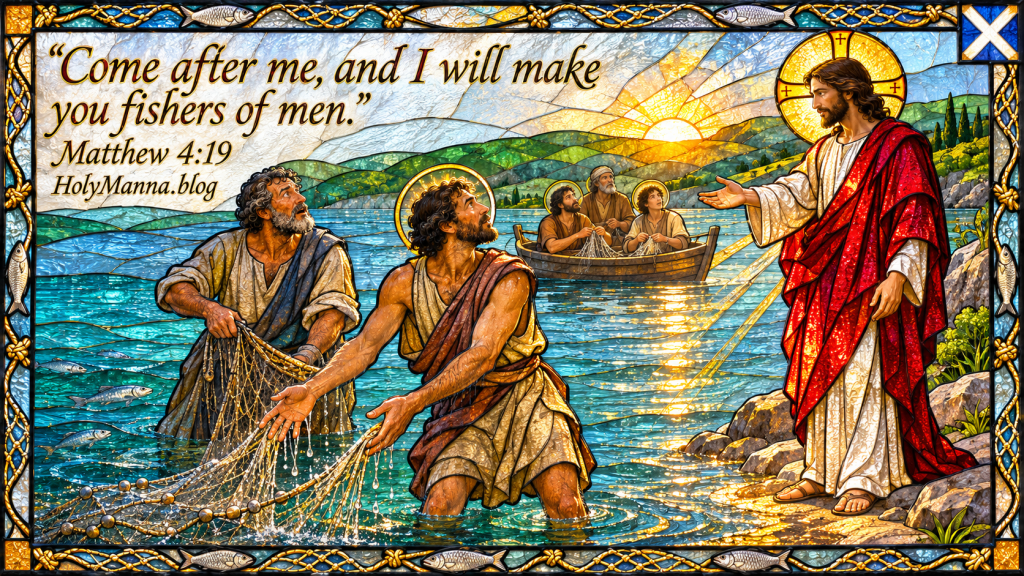
As Jesus was walking by the Sea of Galilee, he saw two brothers,
Simon who is called Peter, and his brother Andrew,
casting a net into the sea; they were fishermen.
He said to them,
“Come after me, and I will make you fishers of men.”
At once they left their nets and followed him.
He walked along from there and saw two other brothers,
James, the son of Zebedee, and his brother John.
They were in a boat, with their father Zebedee, mending their nets.
He called them, and immediately they left their boat and their father
and followed him.
Detailed Exegesis
Verse 18: “As Jesus was walking by the Sea of Galilee, he saw two brothers, Simon who is called Peter, and his brother Andrew, casting a net into the sea; they were fishermen.”
Everything begins with the gaze of Jesus. He sees them before they notice Him, and He finds them at work, in the middle of a cast, on an ordinary day. The name Andrew is Greek, a small sign of the mixed culture of Galilee, and The Gospel of John says he came from Bethsaida. Matthew’s plain comment that they were fishermen matters. Saint Augustine marveled that Christ “sought not to gain fishermen by orators, but gained an Emperor by a fisherman.”
Verse 19: “He said to them, ‘Come after me, and I will make you fishers of men.’”
The call is a command joined to a promise. Jesus does not offer a syllabus or a contract. He offers Himself, and He takes responsibility for the transformation, since He is the one who will make them into something new. The prophet Jeremiah had spoken of God sending fishermen to gather His scattered people (Jeremiah 16:16), and now that gathering begins. Grace does not erase what these men already are. It takes their patience, their teamwork, and their knowledge of deep water and points all of it toward souls.
Verse 20: “At once they left their nets and followed him.”
Matthew stresses the speed. Chrysostom contrasted this moment with the earlier meeting in The Gospel of John, when Andrew had listened to Jesus at length: “but here, having heard one bare word, they followed immediately.” Pope Saint Gregory the Great observed that the brothers “had seen Christ work no miracle, had heard from him no word of the promise of the eternal reward,” and yet they went. The nets were their income and their identity, and they set them down without negotiating.
Verse 21: “He walked along from there and saw two other brothers, James, the son of Zebedee, and his brother John. They were in a boat, with their father Zebedee, mending their nets. He called them,”
A second pair of brothers is found doing maintenance, the unglamorous side of any trade. Chrysostom saw their poverty in the detail: “So exceeding great was their poverty, that they were mending what was worn out, not being able to buy others.” Their father is sitting right there in the boat. The call of Jesus reaches into a family business and a family bond at the same time.
Verse 22: “and immediately they left their boat and their father and followed him.”
The sacrifice deepens. Peter and Andrew left nets, while James and John leave a boat and a father. The Lord is not despising family, since He Himself commands that parents be honored. He is revealing that He comes first, even before the dearest human ties. These 4 men became the first of the Twelve, and all of them left something real on that beach.
Teachings
The Catechism teaches that this vocation is always personal. Each of those whom Christ sends receives the call individually and carries personal responsibility for a mission shared with the whole Church (CCC 878).
Pope Saint Gregory the Great devoted his fifth homily on the Gospels to this passage, and Saint Thomas Aquinas preserved its heart in the Catena Aurea. Gregory anticipated the obvious objection that poor fishermen had very little to give up. His answer was that God weighs the heart and not the price tag: “He leaves much who keeps nothing for himself.” He added, “The kingdom of God is not to be valued at a certain price, but whatever a man has, much or little, is equally available.”
Chrysostom, preaching on The Gospel of John, captured Andrew’s signature move: “Andrew, after having tarried with Jesus and learned what He did, kept not the treasure to himself, but hastens and runs quickly to his brother, to impart to him of the good things which he had received.” The pattern continues whenever Andrew appears. He brings the boy with the loaves and fish to Jesus, and he helps bring the Greek pilgrims who wanted to see the Lord.
Pope Benedict XVI summarized his witness in a General Audience on June 14th, 2006: “The Apostle Andrew, therefore, teaches us to follow Jesus with promptness.” A later tradition, which Benedict also recalled, holds that Andrew was crucified at Patras on an X-shaped cross and greeted that cross with joy. The Catechism calls martyrdom “the supreme witness given to the truth of the faith” (CCC 2473).
Reflection
Most readers will never be asked to walk away from a career on a Monday morning. The call is real all the same, and it usually arrives in the middle of ordinary work, exactly where it found Andrew. The first lesson is promptness. Is there something the Lord has been asking of you for months that keeps getting pushed to next week? It might be a confession long overdue, a habit of daily prayer, a reconciliation with a family member, or a serious conversation about a vocation. The second lesson is honesty about nets. A net is anything that provides security and identity apart from Christ, such as a salary, a reputation, a screen, or a carefully managed image. Which net would be hardest for you to set down if Jesus asked today? The third lesson is pure Andrew. He rarely gets the spotlight, yet he keeps quietly bringing people to Jesus, beginning with his own brother. Who is the Simon in your life, the person who might become a great saint if you simply made the introduction?
Beautiful Feet on an Advent Road
The Feast of Saint Andrew tells one story in 3 movements. Saint Paul explains that nobody is saved in isolation, because faith comes from hearing, and hearing requires someone who was sent. The psalmist explains why the message deserves a lifetime of carrying, since the word of the Lord is perfect, trustworthy, more precious than gold, and sweeter than honey. Then Saint Matthew opens a window onto the shore of Galilee, where that word walks up to 4 tired fishermen and speaks, and where nets, a boat, and a father are left behind without a backward glance.
Andrew holds the whole day together. He heard the Baptist point to the Lamb of God, he heard Jesus call him by the sea, and from that point on he could not keep the treasure to himself. His first convert was his own brother, and the Church has been living off that introduction for nearly 2,000 years. Tradition says that his road ended on a cross in Greece, which means the feet that Paul called beautiful were finally fixed in place for love of the One who called him.
The season of Advent has just begun, and the first-called Apostle stands at its doorway like a friend holding the door open. The same Lord is still walking the shoreline of ordinary life, still seeing people at their work, and still speaking the same invitation. He is still looking for voices and feet to carry His good news. This feast is an invitation to hear Him again, to answer at once, and to bring one more person along.
Engage With Us!
Share your reflections in the comments below. The conversation grows richer with every voice that joins it, and your insight might be exactly what another reader needs to hear today.
- First Reading, Romans 10:9-18: Who first brought the faith to you, and how are you confessing with your mouth what you believe in your heart?
- Responsorial Psalm, Psalm 19:8-11: Which of the Lord’s words or commands has become sweeter than honey for you, and which one still feels like a burden?
- Holy Gospel, Matthew 4:18-22: What nets is Jesus asking you to leave behind so that you can follow Him at once?
- The whole message of the day: Who is one person you can bring to Jesus this Advent, the way Andrew brought his brother Simon Peter?
Keep walking in faith this week, and do not be discouraged by small beginnings. Saint Andrew started with one conversation with one brother. Live each day with your ears open to the voice of Christ, and do everything with the love and mercy that Jesus taught.
Sacred Heart of Jesus, we trust in You!
Immaculate Heart of Mary, pray for us!
Saint Michael the Archangel, defend us in battle!
Follow us on YouTube, TikTok, Instagram and Facebook for more insights and reflections on living a faith-filled life.


Leave a Reply