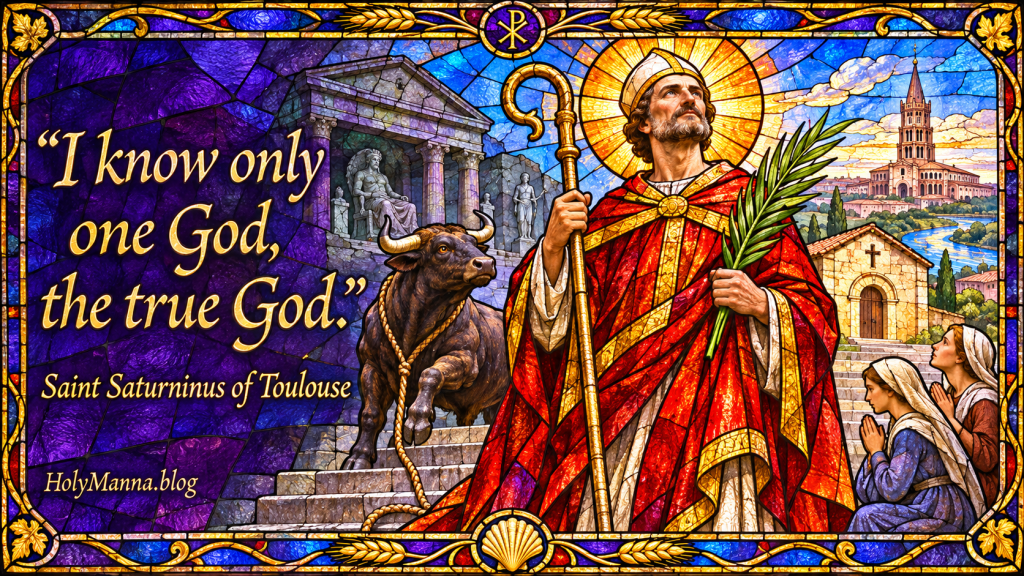
The Shepherd Who Would Not Run
Every Christian city has a founding story, and the story of Toulouse begins with a man walking to church. Saint Saturninus, known in France as Saint Sernin, was the first bishop of Toulouse, a missionary shepherd of the 3rd century who was killed because he would not offer sacrifice to the gods of Rome. The Church remembers him every year on November 29th as a bishop and martyr. The French historian Tillemont, quoted in The Catholic Encyclopedia, called him “one of the most illustrious martyrs France has given to the Church.”
Saturninus left behind no books, no letters, and no collection of homilies. What he left behind is a single unforgettable scene: a bishop deserted by his own clergy, standing in front of an angry crowd and a restless bull, calmly refusing to betray the one true God. The Catechism teaches that “Martyrdom is the supreme witness given to the truth of the faith” (CCC 2473). Saturninus is that paragraph of The Catechism with a face, a city, and a street address.
He is the patron saint of Toulouse, where his body rests inside one of the greatest pilgrimage churches in Europe. He is also the patron of the city of Pamplona in Spain, where he is affectionately called San Cernin. In Christian art he is easy to recognize, because he is the bishop who appears with a bull at his side.
A word about sources belongs at the start. Almost everything known about Saturninus comes from an ancient account of his death called the Passio Sancti Saturnini, which reached its present form in the early 5th century, roughly 150 to 200 years after he died. Saint Gregory of Tours used that account in the 6th century and added details of his own, and later centuries added many more stories. This post keeps the early record and the later traditions clearly apart.
A Missionary Without a Biography
The birthplace of Saint Saturninus is unknown. His family is unknown, and so is the year of his birth. The Passio introduces him already at work, as the first bishop of a small Christian flock in the Roman city of Tolosa, in the south of Gaul.
His name is Latin and was especially common in Roman North Africa, and some accounts, including the Saint of the Day page published by Vatican City State, describe him as arriving from Africa. In a much later medieval tradition, Saturninus was a Greek born in Patras, the son of a royal family, who was ordained by Saint Peter himself and sent west with companions. The story shows how deeply Toulouse wanted its first bishop to stand close to the Apostles. It cannot be verified, and it does not fit the date that the earliest account gives for his ministry.
That date is the firmest fact in his whole life. The Passio places Saturninus in Toulouse during the consulship of Decius and Gratus, which is the year 250. Saint Gregory of Tours repeats the date in The History of the Franks and adds that 7 bishops were sent to preach in Gaul at that time: Gatianus to Tours, Trophimus to Arles, Paul to Narbonne, Saturninus to Toulouse, Dionysius to Paris, Stremonius to Clermont, and Martial to Limoges. A long standing tradition, repeated by Alban Butler and still told in Toulouse today, says that Pope Saint Fabian sent them. Neither the Passio nor the list that Gregory gives names the pope, so that detail belongs to tradition.
Whatever road brought him, the world he entered was hard ground. The Passio describes a region where the Gospel had arrived late and slowly, where a few churches were rising through the devotion of a handful of believers, and where the smoke of sacrifice still rose from many temples. The year 250 was also the year in which the emperor Decius demanded that the people of the empire offer sacrifice to the Roman gods, which made it a dangerous moment to be a Christian bishop.
No conversion story survives for Saturninus. What survives is the fruit of a faith already mature: a man willing to be the first, in a city that did not want him. The Catechism teaches that the bishops are the successors of the Apostles (CCC 861 to 862) and that the Church on earth is missionary by her very nature (CCC 849 to 850). Saturninus is what that teaching looked like in a pagan city with 1 tiny church.
The Man Who Walked Past the Temple
The daily life of Bishop Saturninus, as the Passio tells it, was almost shockingly ordinary. He had a house, and he had a small church. Between the two stood the Capitol of Tolosa, the high temple precinct that the Vatican City State account identifies as the sanctuary of Jupiter. Every time the bishop went to pray with his people, he had to walk past the most important pagan shrine in town.
According to the Passio, something began to happen as he came and went. The oracles of the temple fell silent. The priests offered their sacrifices and asked their questions, and the answers stopped coming. The author explains it plainly: the demons who hid behind the idols could not endure the presence of the holy bishop. This is the only wonder that the earliest account attaches to his lifetime, and it is worth noticing how quiet it is. He simply walked by, faithfully, on his way to the altar of the living God, and the false gods lost their voice.
That detail carries real doctrine. The psalmist sings, “For all the gods of the Gentiles are devils: but the Lord made the heavens” (Ps 95:5, in the numbering of the Douay-Rheims Bible, which is Psalm 96 in most modern editions). The Catechism teaches that the first commandment rules out polytheism and forbids belief in, or worship of, any divinity other than the one true God (CCC 2112). It adds that idolatry did not end with the pagan temples and remains a standing temptation, present any time something created takes the place that belongs to God (CCC 2113). The silence of the oracles in Toulouse is a picture of what happens when Christ is truly present in a place through His people.
The 6th century poet Saint Venantius Fortunatus, who wrote 2 poems in honor of Saturninus, says that the bishop won many pagans to Christ through his preaching and his miracles. He gives no list of those miracles, and neither does anyone else from the early centuries. The Catechism explains that the miracles of Christ and of the saints, together with the growth and holiness of the Church, are signs that help the human mind recognize that faith is reasonable (CCC 156).
Later tradition sends Saturninus on long missionary journeys. In these stories he founds the churches of Eauze and Auch in Gascony, and he crosses the Pyrenees with his disciple Honestus to preach in Pamplona, where he is said to have baptized the first Christians of the city at a well, among them the future Saint Fermin. The people of Pamplona still point to the spot, known as the pocico de San Cernin, in front of the church that bears his name. The Catholic Encyclopedia judges that these accounts of foundations outside Toulouse have no historical basis, and the usual dating of Saint Fermin places his birth after the death of Saturninus. The story of the Pamplona mission cannot be verified.
Saturninus deserves to be remembered because he shows that holiness is often a matter of routine: the same road, the same prayers, and the same small congregation, in full view of a world that worships something else. When the test finally came, it found a man who had already been choosing God every single morning.
Bound to the Bull
The test came on an ordinary day. The Passio says that a large crowd had gathered at the Capitol around a bull that was being prepared for sacrifice, in the hope of winning back the favor of the silent gods. As Saturninus passed by, someone in the crowd recognized him and shouted that here was the enemy of their gods and the leader of the new faith, the man whose presence had shut the mouths of their idols.
The crowd seized him. At that moment the clergy who had been walking with him ran away. The Passio counts 1 priest and 2 deacons, while Saint Gregory of Tours speaks of 2 priests. Either way, the bishop was dragged up to the Capitol entirely alone. The Lord had said: “I am the good shepherd. The good shepherd giveth his life for his sheep” (Jn 10:11). Saturninus was the shepherd who stayed.
Saint Gregory of Tours adds that Saturninus, seeing himself abandoned, prayed that the Church of Toulouse would never have a bishop chosen from among its own citizens, and he remarks that this had held true down to his own day. Gregory presents the prayer as something handed down by report, and it does not appear in the older Passio. It is a tradition that cannot be verified.
Inside the temple precinct the demand was simple. He was to offer sacrifice to the gods or pay for the insult with his life. His answer, as the Passio preserves it, was just as simple: “I know only one God, the true God.” According to the same account, he added that to this God alone he would offer a sacrifice of praise, and he told the crowd that their gods were demons. Then, in the words of an older English rendering found in Butler’s Lives of the Saints, he asked the question that sealed his fate: “How can I fear gods who, as you say, are afraid of me?” These words come from an account written long after the event, so they are best received as the faithful memory of the Church of Toulouse. The promise of Saturninus echoes the psalm: “Offer to God the sacrifice of praise: and pay thy vows to the most High” (Ps 49:14, Douay-Rheims numbering).
The crowd did not debate him. They took the rope that held the bull, tied the loose end around the feet of the bishop, and goaded the animal into a run from the height of the Capitol. The bull plunged down the steps, and on those steps the head of Saturninus was shattered. The Passio says simply that Christ received his soul. The animal kept running, dragging the broken body behind it, until the rope snapped and the body was left lying in the open. The Roman Martyrology remembers him on November 29th as the bishop of Toulouse who was seized by the pagans in the time of Decius and hurled down the steps of the Capitol, and who in that way gave his soul back to Christ.
No miraculous escape came for Saturninus. The divine protection in this story is of another kind. The Catechism teaches that fortitude is the virtue that keeps a person firm in hardship and constant in seeking the good, to the point of overcoming even the fear of death (CCC 1808). That grace held a lonely man steady in front of a mob. The Lord promised, “Every one therefore that shall confess me before men, I will also confess him before my Father who is in heaven” (Mt 10:32), and Saturninus took Him at His word.
The Christians of the city were too frightened to claim the body. Only 2 women found the courage, and the Passio praises them for showing more bravery than any man in Toulouse. They laid the remains of their bishop in a wooden coffin and buried it in a very deep pit, so that no one could find it and desecrate it. A later local tradition calls these women the Saintes Puelles, the Holy Maidens, and says that they were driven out of Toulouse for their deed and took refuge in a village of the Lauragais that still carries their name, Mas Saintes Puelles. The burial belongs to the early account, while the title and the exile belong to later tradition and cannot be verified.
The date deserves an honest note. The Passio ties Saturninus to the year 250, and The Catholic Encyclopedia places his death around that year, under Decius, while Alban Butler preferred the year 257, under Valerian. The sources do not settle the question, although 250 is the more probable year.
The meaning of his death is clearer than its date. Around the year 197, the African writer Tertullian told the persecutors of the Church that “the blood of Christians is seed” (Apology, chapter 50). The Catechism recalls that the Church has always taken great care to preserve the acts of the martyrs as a lasting record of the truth (CCC 2474). In Toulouse, the seed went into the ground at the bottom of a flight of temple steps.
A Tomb That Would Not Stay Hidden
For about a century the grave of Saturninus was a secret kept by a persecuted flock. Then the persecutions ended, and the Church of Toulouse went looking for its father. The Passio relates that Bishop Saint Hilary of Toulouse uncovered the wooden coffin and built a vault of brick over it, together with a very small wooden church.
Toward the end of the 4th century, Bishop Saint Silvius began a larger and more beautiful basilica to receive the relics, but he died before it was finished. His successor, Saint Exuperius, completed it. Saint Jerome praised his generosity, and in the year 405 Pope Saint Innocent I sent him a famous letter that lists the books of Sacred Scripture, the same canon that the Church professes today (CCC 120). The Passio reports that Exuperius hesitated out of reverence to move the body of the martyr, until he was warned in a dream to stop hesitating and to act on the faith he professed. He asked the emperors for permission, received it quickly, and solemnly carried the relics into the new basilica in the first years of the 5th century.
The author of the Passio ends by insisting that the saints are to be honored as people who are alive, because they intercede for those who are still on the journey. The Catechism teaches the same thing: the blessed in heaven keep on praying to the Father for the Church on earth (CCC 956), and the veneration of relics, pilgrimages, and processions are among the forms of piety through which the faithful express their faith (CCC 1674).
Stories of his help were soon being told across Gaul. Saint Gregory of Tours records several of them in The Glory of the Martyrs. In the first, some devout men were carrying relics of Saturninus to another region and stopped for the night at the house of a poor man near Brioude. The following night the man was told in a vision to leave the place, because the relics had made it holy. Misfortune then fell upon him, and at last he pulled down his house and built a wooden oratory on the spot. Gregory says that the man soon recovered everything he had lost, and more. This story rests on the testimony of Gregory alone and cannot be verified.
Gregory tells a second story about a monastery at Pauliac, whose oratory held relics of the saint. During the reign of King Chlothar, a man named Plato tried to turn that oratory into an ordinary building for secular use. According to Gregory, he died soon afterward, and the house of God was left to the martyr in whose name it had been consecrated. This story also depends on Gregory alone and cannot be verified. Gregory adds a memory of his own as well. He kept relics of Saturninus in his private oratory at Tours, and he writes in The Glory of the Confessors that when the relics of the saints were carried into it, a terrifying flash of light filled the building. That account is the personal testimony of a bishop and saint, and it cannot be independently verified.
Saint Venantius Fortunatus sang of the wonders worked at the tomb in Toulouse, and he celebrated a new church of Saint Saturninus built between 565 and 576 by Duke Launebod and his wife Beretrude at the place connected with the martyrdom. Tradition identifies that place with the church now called Notre Dame du Taur, Our Lady of the Bull, which was known at first as Saint Sernin du Taur and which stands where the body is said to have been left when the rope broke. The street that runs from the present Capitole square to the basilica is still named the rue du Taur, the Street of the Bull.
The relics themselves rest in the Basilica of Saint Sernin, the largest Romanesque church still standing in France. The present building was begun around 1080 to welcome the crowds of pilgrims who stopped at the tomb on their way to Santiago de Compostela. Pope Blessed Urban II consecrated its marble altar on May 24th, 1096. In 1258 the canons of the basilica raised the sarcophagus of the martyr into the sight of the faithful, beneath a great canopy shaped like a miniature church. Solemn processions around the holy bodies still take place there at Pentecost and on All Saints’ Day. Since 1998 it has been inscribed on the UNESCO World Heritage list as part of the Routes of Santiago de Compostela in France.
His name traveled far beyond his city. It became Sernin in French, Sarnin in Occitan, Cernin in Navarre, Sadurní in Catalan, and Saturnino in Spanish, and many towns and parish churches carry it. In Pamplona, the old borough of San Cernin grew up around his church, and every November 29th the city honors its patron with a solemn Mass, a procession of the city council, and the famous parade of giants and big heads. A grain of wheat fell into the ground in Toulouse, and the harvest is still coming in. As the Lord said, “Amen, amen I say to you, unless the grain of wheat falling into the ground die, itself remaineth alone. But if it die, it bringeth forth much fruit” (Jn 12:24 to 25).
Walking Past the Capitol Today
The life of Saint Saturninus fits in a few paragraphs, and yet it reaches straight into the 21st century. Most Christians today will never face a mob or a bull. Almost every Christian, however, walks past a Capitol on the way to church. It may be an office where faith is treated as an embarrassment, a group of friends where the name of Jesus is only ever a punchline, or a screen that offers a hundred small gods for every waking hour. The Catechism warns that idolatry is not only a matter of ancient statues. It happens whenever a created thing, such as power, pleasure, money, or the state, is given the reverence owed to God alone (CCC 2113).
The first lesson of Saturninus is faithful presence. He won Toulouse by showing up, by walking the same road to the same altar, and by letting Christ be present in him. You can do the same. Make the Sign of the Cross before a meal in a restaurant. Keep Sunday Mass fixed in your week when everything else moves around it. When was the last time someone could tell, just by watching your ordinary routine, that you belong to Jesus Christ?
The second lesson is courage when the room empties. The Catechism teaches that a follower of Christ is called to do more than hold the faith privately. The faith must be professed, witnessed to with confidence, and passed on (CCC 1816). Saturninus did that with no one standing beside him. There will be moments when you are the only person in the room who is willing to say the true thing kindly and clearly. What would it look like for you to stay, like the good shepherd, when it would be easier to slip away with the crowd?
The third lesson belongs to the 2 women who buried him. They could do one small, brave, merciful thing, and they did it while everyone else hid. The Catechism teaches that the bodies of the dead must be treated with respect and charity, and that burying the dead is a corporal work of mercy (CCC 2300). Who has been left by the side of the road in your life, and what small act of mercy is within your reach this week?
The fourth lesson is hidden in the clergy who ran. Fear does not have to be the end of a Christian story, because Saint Peter also fled and was restored by the risen Christ. If you have ever stayed silent when you should have spoken, the Sacrament of Penance exists to reconcile the baptized who have fallen (CCC 1446). Go to Confession, and then walk past the Capitol again.
Finally, ask for his help. Saturninus is alive in Christ, and the Church has been asking for his prayers for more than 17 centuries. The psalm says it best: “Precious in the sight of the Lord is the death of his saints” (Ps 115:15, Douay-Rheims numbering). Saint Saturninus, pray that the idols of this age fall silent wherever a Christian passes by.
Engage With Us!
Share your thoughts and reflections in the comments below. The story of Saint Saturninus is still worth talking about after more than 17 centuries.
- Where is the Capitol on your own daily road, the place where living your faith openly feels most uncomfortable?
- Which modern idol, such as money, comfort, approval, or control, most often asks for the sacrifice of your time and attention?
- Saturninus was abandoned by the people who should have stood with him. How do you respond when you feel alone in doing what is right?
- The 2 women performed a hidden act of mercy at great risk. What quiet work of mercy could you offer this week without anyone knowing?
- What is one concrete habit, such as daily prayer, Sunday Mass, or regular Confession, that would make your faith as steady as the daily walk of Saint Saturninus?
Take heart from the first bishop of Toulouse. Holiness does not require a famous name or a long biography. It requires showing up for God every day and staying when it counts. Live a life of faith, walk past every idol with your eyes fixed on Christ, and do everything with the love and mercy that Jesus taught.
Saint Saturninus of Toulouse, pray for us!
Follow us on YouTube, TikTok, Instagram and Facebook for more insights and reflections on living a faith-filled life.


Leave a Reply