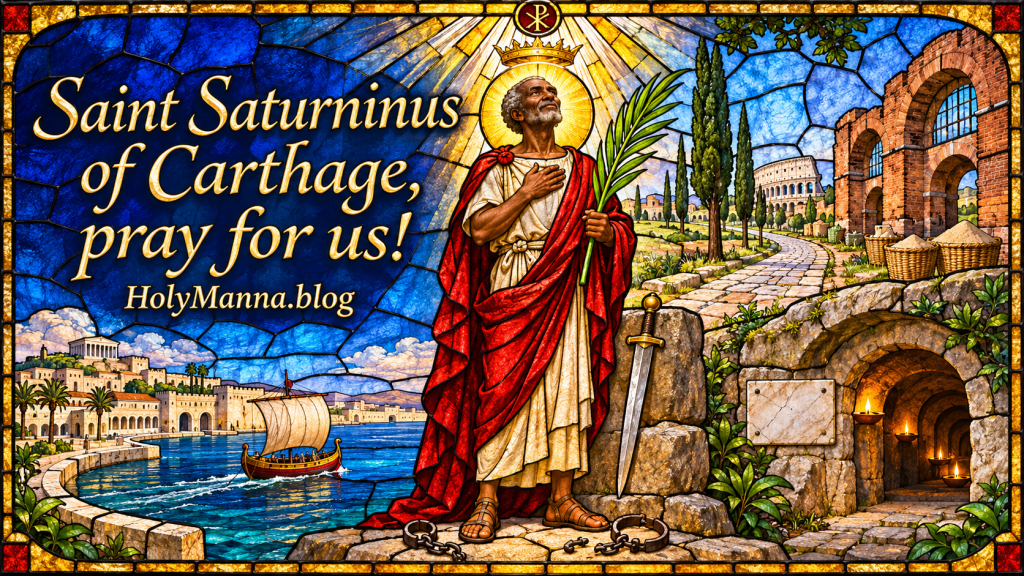
The Stranger Who Became a Citizen of Heaven
On the northern edge of ancient Rome, the Via Salaria Nova ran out past the city walls toward the Sabine hills, and beneath the fields beside it lay a Christian burial ground known as the cemetery of Thraso. There, on November 29th, the early Church of Rome gathered every year at the grave of a martyr named Saturninus. He was not a pope, a bishop, or a celebrated preacher. He was a foreigner from Carthage in North Africa who had been tortured for Christ in his homeland, driven into exile, and finally beheaded in the capital of the empire that tried to break him.
What makes Saint Saturninus remarkable is how early and how firmly the Church remembered him. The oldest surviving calendar of the Roman Church, the Depositio Martyrum, was compiled by the year 336 and preserved in a document called the Chronograph of 354. Its list of martyrs is short, and his name is on it. The entry, translated from the Latin, simply reads, “November 29th: Saturninus, in the cemetery of Thraso.” A few decades later, Pope Saint Damasus I, the great poet of the martyrs, composed a verse inscription for his tomb. The Roman Martyrology still honors him on this day and sums up his story in a few strokes. He was racked for Christ in his own country under the Emperor Decius, he was sent into exile in Rome, he overcame further torments there, he brought a persecutor named Gratianus to the faith, and he won the crown of martyrdom by the sword.
He should not be confused with Saint Saturninus of Toulouse, the bishop and martyr of Gaul who shares the same feast day, nor with the several other martyrs who carried this very common Roman name.
The Church holds witnesses like him in the highest honor. The Catechism teaches, “Martyrdom is the supreme witness given to the truth of the faith” (CCC 2473). The historical record for Saturninus is thin, and an honest telling has to admit that much about him is simply unknown. What survives is still enough to love him: a man who would not deny Christ, who prayed for the one who tortured him, and whom Rome adopted as one of her own.
A Son of Carthage in the Age of Decius
Saturninus came from Carthage, on the coast of what is now Tunisia. In the 3rd century it was one of the greatest cities of the Roman world and the beating heart of Latin Christianity in Africa. This was the Church of Tertullian, of the martyrs Perpetua and Felicity, and of the great bishop Saint Cyprian. A Christian formed in Carthage belonged to a community that already knew exactly what martyrdom cost.
Beyond that, the sources fall silent. Nothing reliable is recorded about the year of his birth, his parents, his trade, or the circumstances in which he came to believe. No ancient writer describes his baptism or a dramatic conversion. Damasus opens his poem with a single line about his origins, translated here from the Latin: “Now a dweller with Christ, he was once a dweller of Carthage.”
The turning point of his life came with the persecution of the Emperor Decius. In the year 250, Decius ordered the inhabitants of the empire to offer sacrifice to the Roman gods and to obtain a certificate proving that they had done so. For Christians, this was a direct demand to commit idolatry, and the Catechism is blunt about what that means: “Idolatry consists in divinizing what is not God” (CCC 2113). Many Christians in Carthage gave way under the pressure. Others refused, and they were imprisoned, starved, and tortured. The Roman Martyrology places Saturninus among those who refused, recording that he was stretched on the rack in his homeland and then banished to Rome.
There is a fascinating possible echo of him in the letters preserved with the correspondence of Saint Cyprian. In the year 250, a Carthaginian confessor named Celerinus wrote from Rome to his friend Lucian in Carthage, and he passed along greetings from a fellow African named Saturninus. Celerinus describes this man as one “who also bravely confessed the name of Christ” and who did so “under the torture of the grappling claws” (Epistles of Cyprian, the letter of Celerinus to Lucian). A Carthaginian named Saturninus, tortured at home and living in Rome in the year 250, fits the martyr of the Via Salaria remarkably well, and the connection has often been made. It remains a likely identification and not a proven one, because the name was so common.
What can be said with confidence is that his faith was not a matter of inherited comfort. It was tested in his body. The Catechism teaches that the disciple of Christ must not only keep the faith but also “profess it, confidently bear witness to it, and spread it” (CCC 1816). Saturninus professed it on the rack, and then he carried it across the sea into exile.
An Exile and a Persecutor Won for Christ
Saturninus arrived in Rome as a stranger. He was a displaced African with the marks of torture on his body and no standing in the city. Nothing certain is known about how he lived there, and the sources disagree sharply about how long his exile lasted, which is a problem that returns when the story of his death is told.
A later text fills that silence with a vivid story. The Passion of Pope Marcellus, a Roman account probably written in the 5th or 6th century, tells that the Emperor Maximian forced Christians to labor on the enormous Baths of Diocletian. A wealthy Christian named Thraso quietly supplied the prisoners with food through helpers named Sisinnius and Cyriacus, whom Pope Marcellus ordained as deacons. When the 2 deacons were arrested, they were condemned to dig sand and to carry it on their shoulders to the building site. Working beside them was an old man named Saturninus, who was too weak for his load, and the deacons carried his burden along with their own. The same account says that Saturninus and Sisinnius were then thrown into prison, where pagans came to visit them and left as baptized Christians. It adds that when a metal tripod was set before them for sacrifice, the hard metal dissolved like clay at the old man’s word, and that 2 soldiers named Papias and Maurus were so shaken by the sight that they confessed Christ on the spot. This story was written long after the events, it places Saturninus under a different emperor than the earliest sources do, and it cannot be verified.
Even told as a tradition, the scene on the sand heaps is worth holding onto. Younger men bending down to lift an old man’s load is a living picture of what Saint Paul commands: “Bear ye one another’s burdens; and so you shall fulfil the law of Christ” (Gal 6:2). Thraso, risking his fortune to feed prisoners, was doing what the Catechism lists among the corporal works of mercy, which include “visiting the sick and imprisoned, and burying the dead” (CCC 2447). He would end up doing both for Saturninus. The Lord’s own words stand behind that kind of courage: “I was in prison, and you came to me” (Mt 25:36).
There is a striking footnote to this tradition. The ruins of the Baths of Diocletian still stand in Rome, and in the 16th century a great hall of the complex became the Basilica of Saint Mary of the Angels and of the Martyrs, dedicated in memory of the Christians whom tradition says were forced to build it.
The one extraordinary event in his life that rests on early testimony is quieter than a melting tripod, and far more beautiful. Pope Damasus, writing within roughly a century of the martyr’s death, says that the man who tortured Saturninus was converted by his victim’s prayers. Addressing the saint directly, the pope writes of Gratianus, in lines translated from the Latin: “He could not force you, holy one, to deny Christ. He himself, through your prayers, merited to depart this life confessing the faith.” No other source identifies this Gratianus, and nothing more is known about him. Still, the claim comes from a pope who made it his mission to gather the memories of the Roman martyrs and carve them in stone. The conversion of a persecutor through the prayer of the man he was tearing apart is a miracle of grace, and it is the reason Saturninus deserves to be remembered and imitated. The Catechism describes exactly this movement of the heart, saying that the heart that offers itself to the Holy Spirit turns injury into compassion, “transforming the hurt into intercession” (CCC 2843).
The Rack, the Fire, and the Sword
Damasus does not soften what was done to Saturninus. He writes, “While he tore the holy limbs, Gratianus raged like an enemy.” The older editions of the Roman Martyrology, which followed the Passion of Pope Marcellus, describe the sufferings of Saturninus and the deacon Sisinnius in a single unflinching sentence: “After a long imprisonment, they were, by order of the prefect of the city, placed on the rack, distended with ropes, scourged with rods and whips garnished with metal, then exposed to the flames, taken down from the rack and beheaded.”
The Passion supplies the rest of the scene as tradition received it. Saturninus and Sisinnius were held in prison for 42 days, and they were brought before a prefect named Laodicius barefoot and in chains. They refused to worship the gods, they were stretched on the rack, they were beaten with cudgels and with the barbed whips called scorpions, and fire was held against their sides. They were finally led out to the 2nd milestone of the Via Nomentana and beheaded. Thraso and a priest named John gathered the bodies and buried them on Thraso’s own estate along the Via Salaria. The soldiers Papias and Maurus, according to the same account, were baptized by Pope Marcellus and died under the scourge a short time later. These details belong to the later tradition, and they cannot be verified.
No miraculous rescue is recorded for Saturninus. He was not spared the rack, the fire, or the blade. His victory was of another kind, the kind the Catechism has in mind when it says, “The virtue of fortitude enables one to conquer fear, even fear of death, and to face trials and persecutions” (CCC 1808).
Honesty requires a word about what remains unsettled. The Roman Martyrology, drawing on Damasus, ties his torture in Africa to the persecution of Decius, around the year 250. It does not give the year of his death. Some historians have suggested that he died in Rome during the persecution of Valerian, between 257 and 260. The later tradition, which Vatican News also follows in its brief notice of the saint, places his beheading in 304 under Maximian. If both the Decian exile and the later date are accepted, Saturninus lived for more than 50 years as an exile in Rome and died a very old man, which would fit the older Roman Martyrology, where he is called “an aged man.” The sources also disagree about the persecutor, since Damasus names Gratianus and the Passion names Laodicius. The later tradition calls Saturninus a priest, but the earliest witnesses give him no title at all. Sisinnius, who stands beside him in the older Martyrology, is not named in the current entry for November 29th, which commemorates Saturninus alone.
What does stand on solid ground is the core. A Carthaginian Christian named Saturninus died for the faith in Rome, he was buried in the cemetery of Thraso, and by the year 336 the Roman Church was already keeping his feast on November 29th. The Catechism says that the Church has carefully collected the records of those who persevered to the end, and it calls those records “the archives of truth written in letters of blood” (CCC 2474). The entry for Saturninus is one of the oldest lines in that archive. The promise attached to it is older still: “Be thou faithful until death: and I will give thee the crown of life” (Rev 2:10).
A Tomb the Popes Kept Rebuilding
The story of Saturninus after his death begins with a pope on his knees. Damasus ends his poem with a personal appeal and a personal offering. He writes, “This is the voice of Damasus the suppliant: venerate this tomb.” Then he closes with a line that reads like a note left at a shrine: “To you, martyr Saturninus, I repay my vows.” The poem is an offering of thanks from a bishop of Rome who had asked for the martyr’s help. It does not say what Damasus had prayed for, and no specific accounts of healings or other wonders at the tomb have come down in the ancient sources. What the record does show is centuries of confident prayer at his grave, which is exactly what the Catechism means when it says of the saints in heaven, “They do not cease to intercede with the Father for us” (CCC 956).
A basilica rose above the catacomb, and the popes kept returning to it. The Liber Pontificalis, the ancient book of papal biographies, records under Pope Felix IV, who reigned from 526 to 530, a line translated here from the Latin: “In his time the basilica of the holy martyr Saturninus on the Via Salaria was consumed by fire, and he rebuilt it from the ground up.” Pope Hadrian I restored it again in the 8th century, and Pope Gregory IV did so in the 9th. Around the year 600, oil from the lamps burning at the tomb of Saturninus was among the relics from the Roman martyrs’ graves sent to Queen Theodelinda of the Lombards, a collection still associated with the cathedral of Monza. Pilgrim guides of the 7th century directed visitors to his grave along the Via Salaria. The old Gelasian Sacramentary contains prayers for his feast, and in the 8th century Saint Bede entered his name in his Martyrology in faraway Northumbria. A Carthaginian exile had become a saint of the whole Latin Church.
As the catacombs were abandoned in the Middle Ages, the basilica on the Via Salaria fell into ruin and eventually disappeared. Relics of the martyr were venerated at the Basilica of Saints John and Paul on the Caelian Hill, where an altar is dedicated to him. Pope Gregory XIII granted a plenary indulgence in 1581 to those who visited that church on his feast, and the relics were formally examined and recognized in 1726 and again in 1949. A local tradition in the town of Toffia, in the Sabine hills, holds that the bodies of Saturninus and Sisinnius were carried there in the year 558. That tradition cannot be verified.
The most recent chapter is surprisingly modern. In the 1930s, under Pope Pius XI, a new parish dedicated to San Saturnino Martire was established in the Trieste quarter of Rome, in the neighborhood that had grown up between the Via Nomentana and the Via Salaria, the 2 roads that tradition links to his martyrdom and his burial. On November 29th, 1987, his relics were solemnly carried from the Caelian Hill to that parish church, where the poem of Damasus is carved in marble. Since 2003 the church has also been the titular church of a cardinal. In 2002, Pope Saint John Paul II quoted the entire poem of Damasus in a message marking the 150th anniversary of the Pontifical Commission for Sacred Archaeology, holding it up as a voice from the catacombs that still speaks.
For many centuries the Roman Missal also carried a commemoration of Saint Saturninus on November 29th. The general calendar as revised in 1969 no longer includes it, but the Roman Martyrology keeps his name on this day. Saturninus was never canonized through a formal process, because he lived long before such processes existed. His place among the saints rests on the ancient and unbroken veneration of the Church, the same Church that, in proclaiming her saints, “recognizes the power of the Spirit of holiness within her” (CCC 828). When she keeps the memory of the martyrs through the year, the Catechism teaches, “she proclaims the Paschal mystery” in those who have suffered and been glorified with Christ (CCC 1173). The veneration of relics and the practice of pilgrimage, which kept Christians walking out to his tomb for centuries, belong to the piety that the Church encourages among the faithful (CCC 1674).
The deepest part of his legacy, however, is the idea Damasus carved over his grave. Looking at this African buried in Roman soil, the pope wrote: “By his blood he changed his homeland, his name, and his lineage; his birth among the saints made him a Roman citizen.” For Damasus, martyrdom was a kind of birth, and the foreigner who died in exile had become more truly Roman than the officials who condemned him. The early Christians had already said of their martyrs, in words the Catechism preserves, “we love the martyrs as the Lord’s disciples and imitators” (CCC 957). Rome loved this one enough to call him her own.
Finding Your True Citizenship
Most people will never face a rack or a tribunal. The life of Saint Saturninus still speaks, because the pressures he faced come in quieter forms in every age.
The first lesson is about belonging. Saturninus lost his city, his standing, and his home, and he found that none of those things had ever been his deepest identity. Saint Paul says it to every baptized person: “Now therefore you are no more strangers and foreigners; but you are fellow citizens with the saints, and the domestics of God” (Eph 2:19). If you have ever felt out of place, whether in a new city, a new job, a family that does not share your faith, or a culture that finds your convictions strange, this saint is a companion for you. Where do you look for your sense of belonging, and what would change if you looked first to your baptism?
The second lesson is about the long haul. Whatever the exact dates, Saturninus stayed faithful through torture, exile, and years of obscurity, and the tradition remembers him as an old man at the end. Scripture promises that the just “shall still increase in a fruitful old age” (Ps 92:15). Faithfulness is rarely one heroic moment. It is usually a long series of ordinary days in which a person keeps praying, keeps going to Mass, and keeps choosing Christ when nobody is watching. Is there a commitment in your spiritual life that you have let slide because it stopped feeling exciting?
The third lesson is about carrying one another. The tradition of the deacons lifting the old man’s load and of Thraso feeding the prisoners shows a Church that survived because its members would not let each other fall. You can live this today in very plain ways. You can drive an elderly parishioner to Mass, bring a meal to a family in crisis, visit someone who is homebound, or simply notice the coworker who is quietly overwhelmed. Whose burden could you pick up this week without being asked?
The last lesson is the hardest and the most beautiful. Saturninus prayed for the man who tortured him, and that man died a Christian. The Lord commands exactly this: “Love your enemies: do good to them that hate you: and pray for them that persecute and calumniate you” (Mt 5:44). You probably do not have a Gratianus in your life, but you may have someone who has wounded you, betrayed you, or mocked your faith. Try praying for that person by name every day for a week, asking God to bless them and draw them to Himself. The prayer may or may not change them, but it will certainly change you. Who is the person you find it hardest to pray for, and are you willing to begin today?
The Catechism teaches, “Because of Christ, Christian death has a positive meaning” (CCC 1010). Saturninus believed that, and so the grave of an exile became a place of joy. His life invites you to hold your comforts loosely, to hold your faith tightly, and to trust that God wastes nothing, including the hidden years and the unanswered questions.
Engage With Us!
Share your thoughts and reflections in the comments below. Saint Saturninus left behind no writings and very few certain facts, yet his witness has been honored for some 17 centuries. His story is a good one to pray with and to talk about.
- Saint Saturninus was a foreigner who found his true home in the Church. Where have you experienced the Church as a home when you felt like a stranger?
- The tradition remembers younger Christians carrying the old man’s burden. Who has carried a burden for you, and how could you do the same for someone else?
- Pope Damasus says that the persecutor was converted through the martyr’s prayers. Is there someone who has hurt you for whom you could begin to pray by name?
- Much of this saint’s life is unknown, and yet the Church never forgot him. How does that shape the way you think about the hidden and unnoticed parts of your own life?
- What is 1 concrete act of mercy, such as visiting, feeding, or comforting someone, that you can commit to this week in honor of the martyrs?
May the example of Saint Saturninus give you courage to stay faithful in every season, to carry the burdens of the people beside you, and to pray even for those who oppose you. Live a life of faith, and do everything with the love and mercy that Jesus taught.
Saint Saturninus of Carthage, pray for us!
Follow us on YouTube, TikTok, Instagram and Facebook for more insights and reflections on living a faith-filled life.


Leave a Reply