First Sunday of Advent – Lectionary: 2
A Porch Light Left On for the King
Every family knows the feeling of leaving the porch light on for someone who has not come home yet. The First Sunday of Advent, celebrated this year on November 29th, 2026, asks the whole Church to live in that feeling on purpose. A new liturgical year begins today, and with it comes Year B of the Sunday Lectionary, in which The Gospel of Mark takes the lead. The altar is dressed in violet, the Gloria falls silent, and the Church starts her year by looking toward the end of time before she looks back to Bethlehem.
CCC 524 teaches that Advent makes Israel’s long wait for the Messiah present again, so that Catholics who relive the preparation for Christmas grow hungrier for the return of Christ in glory. Saint Cyril of Jerusalem said it plainly to his catechumens in the 4th century: “We preach not one advent only of Christ, but a second also, far more glorious than the former.”
The central theme that binds these readings together is simple. The faithful Father comes to His people, and His people are asked to stay awake for Him. In Isaiah, a wounded nation begs God to tear open the sky and come down. In Psalm 80, the same people ask the Shepherd to turn them back and show His face. In 1 Corinthians, Saint Paul promises that the God who called His people will keep them firm until the day of the Lord. In The Gospel of Mark, Jesus gives the season its marching order in a single word. Each reading is a different room in the same house, and in every room somebody is waiting at the window.
First Reading — Isaiah 63:16b-17, 19b; 64:2-7
A Homesick People Cry Out to Their Father
This reading comes from one of the rawest prayers in the Old Testament, a communal lament that runs from Isaiah 63:7 through Isaiah 64:11. Most scholars place it in the hard years after the Babylonian exile, when the people had come home to a ruined Jerusalem and a burned Temple. The prophet responds boldly. He calls God “father”, a title the Old Testament uses sparingly, and he asks Him to come in person. That plea is the opening note of Advent. A people who know they cannot save themselves are waiting on a Father who can.
Isaiah 63:16b-17, 19b; 64:2-7
You, LORD, are our father,
our redeemer you are named forever.
Why do you let us wander, O LORD, from your ways,
and harden our hearts so that we fear you not?
Return for the sake of your servants,
the tribes of your heritage.
Oh, that you would rend the heavens and come down,
with the mountains quaking before you,
while you wrought awesome deeds we could not hope for,
such as they had not heard of from of old.
No ear has ever heard, no eye ever seen, any God but you
doing such deeds for those who wait for him.
Would that you might meet us doing right,
that we were mindful of you in our ways!
Behold, you are angry, and we are sinful;
all of us have become like unclean people,
all our good deeds are like polluted rags;
we have all withered like leaves,
and our guilt carries us away like the wind.
There is none who calls upon your name,
who rouses himself to cling to you;
for you have hidden your face from us
and have delivered us up to our guilt.
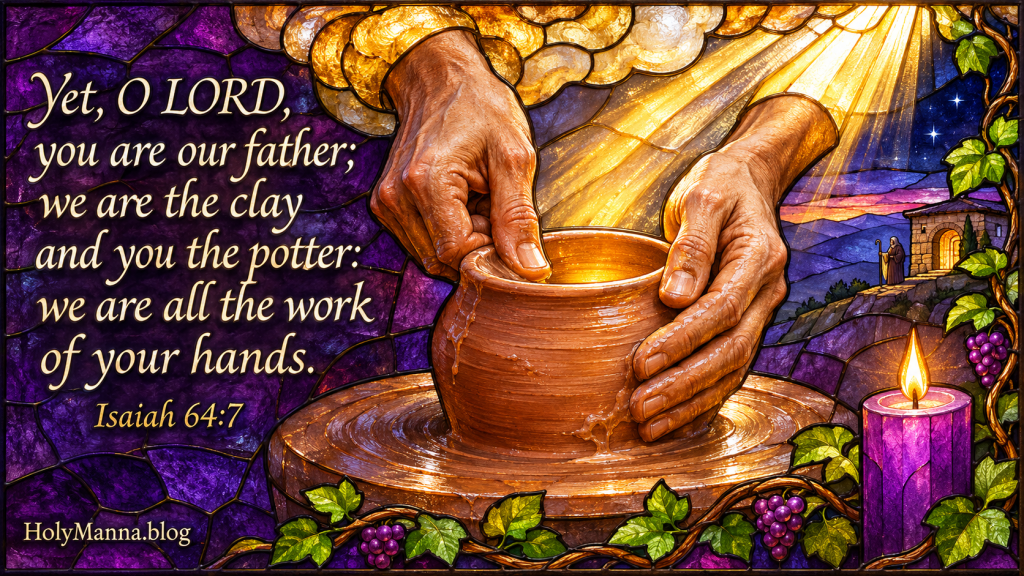
Yet, O LORD, you are our father;
we are the clay and you the potter:
we are all the work of your hands.
Detailed Exegesis
Isaiah 63:16b: “You, LORD, are our father, our redeemer you are named forever.”
The prayer starts with identity before it reaches the problem. The Hebrew word behind “redeemer” is go’el, the relative who was duty bound to buy back a family member from slavery or debt. CCC 238 notes that Israel called God Father as Creator, and even more because of the covenant.
Isaiah 63:17: “Why do you let us wander, O LORD, from your ways, and harden our hearts so that we fear you not? Return for the sake of your servants, the tribes of your heritage.”
This is heartbreak more than blame. In biblical speech, God is said to harden hearts when He permits sinners to feel the weight of their own choices. The people sense that the worst punishment for wandering is being allowed to keep wandering, so they beg Him to “return”.
Isaiah 63:19b: “Oh, that you would rend the heavens and come down, with the mountains quaking before you,”
Here is the heart of the reading. The memory in the background is Mount Sinai, where the mountain shook when God came near. The people want that again, only closer. The Gospel of Mark shows the answer at the Jordan, where Jesus “saw the heavens being torn open” at His Baptism in Mark 1:10. God did rend the heavens, and He came down as a man.
Isaiah 64:2: “while you wrought awesome deeds we could not hope for, such as they had not heard of from of old.”
The prophet is remembering the Exodus and the Red Sea. Biblical waiting is never wishful thinking, because it rests on what God has already done.
Isaiah 64:3: “No ear has ever heard, no eye ever seen, any God but you doing such deeds for those who wait for him.”
Saint Paul loved this verse enough to borrow it in 1 Corinthians 2:9. These deeds belong to “those who wait for him”, which makes waiting itself an act of faith.
Isaiah 64:4: “Would that you might meet us doing right, that we were mindful of you in our ways! Behold, you are angry, and we are sinful;”
The people wish God would find them busy with goodness when He arrives. That same wish becomes a command in the Gospel.
Isaiah 64:5: “all of us have become like unclean people, all our good deeds are like polluted rags; we have all withered like leaves, and our guilt carries us away like the wind.”
This verse does not teach that good works are worthless. It teaches that works cut off from God’s grace cannot make anyone clean. CCC 2011 recalls Saint Thérèse of Lisieux, who wanted to stand before God at the end of her life with empty hands, trusting His justice and not her own.
Isaiah 64:6: “There is none who calls upon your name, who rouses himself to cling to you; for you have hidden your face from us and have delivered us up to our guilt.”
The real sickness is spiritual sleep. Nobody “rouses himself” to pray. The language of waking up will return in the Gospel, and the hidden face of God will return in the Psalm.
Isaiah 64:7: “Yet, O LORD, you are our father; we are the clay and you the potter: we are all the work of your hands.”
Everything turns on the word “Yet”. The prayer ends where it began, with the Father. Clay cannot shape itself, but clay can stay soft, and that is the whole posture of Advent.
Teachings
Saint Irenaeus of Lyons, a Doctor of the Church who wrote in the 2nd century, gave a beautiful commentary on the potter and the clay in Against Heresies (Book IV, Chapter 39): “If, then, thou art God’s workmanship, await the hand of thy Maker which creates everything in due time.” He continued: “Offer to Him thy heart in a soft and tractable state, and preserve the form in which the Creator has fashioned thee, having moisture in thyself, lest, by becoming hardened, thou lose the impressions of His fingers.”
The Catechism speaks the same way. CCC 1432 teaches that the human heart is heavy and hardened, and that conversion is first a work of grace by which God brings hearts back to Himself. Israel’s lament is therefore not despair. It is the prayer of children who know exactly whose hands they are in.
Reflection
This reading gives permission to pray honestly. If your faith has felt dry, or God has seemed far away, Isaiah hands you words for it. Start Advent by telling the Father the truth, including the parts that are not flattering. Then make one concrete move toward softness. Go to Confession in the first 2 weeks of Advent instead of the last 2 days. Set aside 10 minutes of silence each morning before the phone comes out. Pray the line “we are the clay and you the potter” slowly when the day slips out of your control.
Where has your heart grown hard over the past year? What would it look like to ask God to come down into that exact place?
Responsorial Psalm — Psalm 80:2-3, 15-16, 18-19
The Vine That Begs to See the Shepherd’s Face
Psalm 80 is a national lament attributed to Asaph, the line of Temple singers. The full psalm names Joseph, Ephraim, Benjamin, and Manasseh, which points to the northern tribes, and many interpreters connect it with the collapse of the Northern Kingdom under Assyria in the 8th century before Christ. It pictures Israel as a vine that God transplanted from Egypt and then left exposed. Saint Augustine heard Advent in it from the first line. “The song here is of the Advent of the Lord and of our Saviour Jesus Christ, and of His vineyard,” he told his people.
Psalm 80:2-3, 15-16, 18-19
R. (4) Lord, make us turn to you; let us see your face and we shall be saved.
O shepherd of Israel, hearken,
from your throne upon the cherubim, shine forth.
Rouse your power,
and come to save us.
R. Lord, make us turn to you; let us see your face and we shall be saved.
Once again, O LORD of hosts,
look down from heaven, and see;
take care of this vine,
and protect what your right hand has planted
the son of man whom you yourself made strong.
R. Lord, make us turn to you; let us see your face and we shall be saved.
May your help be with the man of your right hand,
with the son of man whom you yourself made strong.
Then we will no more withdraw from you;
give us new life, and we will call upon your name.
R. Lord, make us turn to you; let us see your face and we shall be saved.
Detailed Exegesis
Psalm 80:4 (Response): “Lord, make us turn to you; let us see your face and we shall be saved.”
The refrain admits something humbling. The people cannot even turn around without help. Isaiah mourned that God had hidden His face, and the psalm asks to see it again.
Psalm 80:2: “O shepherd of Israel, hearken, from your throne upon the cherubim, shine forth.”
Two images sit side by side. God is the Shepherd who walks with the flock, and He is the King enthroned above the cherubim of the Ark of the Covenant.
Psalm 80:3: “Rouse your power, and come to save us.”
In Isaiah nobody would rouse himself to pray. Here the people ask God to rouse Himself. The plea “come” is the Advent prayer in its simplest form.
Psalm 80:15: “Once again, O LORD of hosts, look down from heaven, and see; take care of this vine,”
The vine is Israel, planted by God and now trampled. The request is tender, because a gardener is being asked to visit his own vineyard.
Psalm 80:16: “and protect what your right hand has planted the son of man whom you yourself made strong.”
In its first setting, “son of man” likely meant Israel itself or its anointed king. The Church hears more. Jesus used “Son of Man” as His own title, and He told His disciples in John 15:5, “I am the vine, you are the branches.”
Psalm 80:18: “May your help be with the man of your right hand, with the son of man whom you yourself made strong.”
The right hand is the place of honor and strength. The Creed confesses that Christ is seated at the right hand of the Father, so the hope of the psalm lands on one Man who carries the whole vine.
Psalm 80:19: “Then we will no more withdraw from you; give us new life, and we will call upon your name.”
The order matters. New life comes first, and faithfulness follows as its fruit. Isaiah said no one called on God’s name, and the psalm promises that a revived people will.
Teachings
Saint Augustine, in his Exposition on Psalm 80, explained the refrain with a sentence that guards against every do-it-yourself spirituality: “For averse we have been from You, and unless You convert us, we shall not be converted.” The Church teaches the same truth in CCC 1432, which describes conversion as God’s gift before it is anyone’s achievement, and in CCC 2001, which adds that grace is already at work when a person first begins to get ready for it. On the vine, CCC 755 gathers the biblical images of the Church as God’s field and vineyard and names Christ as the true vine who gives life to the branches. A branch does not manufacture its own sap, because its whole job is to stay attached.
Reflection
This psalm is a ready-made Advent prayer, and its refrain is short enough to memorize. Try praying it each morning this week before the first cup of coffee. Stay attached to the vine in the ordinary ways the Church provides, which means Sunday Mass, a daily moment with Scripture, and regular Confession.
What has been pulling your attention away from God lately? Do you believe He can turn you back, or have you been trying to do the turning alone? Where do you most need new life this Advent?
Second Reading — 1 Corinthians 1:3-9
Held Firm by a Faithful God
Saint Paul wrote 1 Corinthians from Ephesus around the year 56 to a young and gifted church with serious problems. Corinth was a wealthy port city, proud of its eloquence and its status, and the Christians there had carried those habits into the Church. Even so, Paul opens with thanksgiving, as letters of that time usually did. He thanks God for the gifts of the Corinthians and then points those gifts toward a horizon, the day when Christ is revealed. For Advent, this reading supplies a missing piece. The people who wait are not waiting alone, because God Himself keeps them standing.
1 Corinthians 1:3-9
Brothers and sisters:
Grace to you and peace from God our Father
and the Lord Jesus Christ.I give thanks to my God always on your account
for the grace of God bestowed on you in Christ Jesus,
that in him you were enriched in every way,
with all discourse and all knowledge,
as the testimony to Christ was confirmed among you,
so that you are not lacking in any spiritual gift
as you wait for the revelation of our Lord Jesus Christ.
He will keep you firm to the end,
irreproachable on the day of our Lord Jesus Christ.
God is faithful,
and by him you were called to fellowship with his Son,
Jesus Christ our Lord.
Detailed Exegesis
1 Corinthians 1:3: “Grace to you and peace from God our Father and the Lord Jesus Christ.”
Paul blends the Greek greeting of grace with the Hebrew blessing of peace, and he names the Father and Jesus together as their source. The Father whom Isaiah called upon now has a people gathered in His Son.
1 Corinthians 1:4: “I give thanks to my God always on your account for the grace of God bestowed on you in Christ Jesus,”
Gratitude comes before correction. Everything good in Corinth was “bestowed”, never earned.
1 Corinthians 1:5: “that in him you were enriched in every way, with all discourse and all knowledge,”
The Corinthians prized fine speech and insight. Paul agrees that they are rich, but he locates the wealth “in him”. Later in the letter he will insist that these gifts mean nothing without charity.
1 Corinthians 1:6: “as the testimony to Christ was confirmed among you,”
The Gospel that Paul preached took root and proved itself in changed lives.
1 Corinthians 1:7: “so that you are not lacking in any spiritual gift as you wait for the revelation of our Lord Jesus Christ.”
Here is the Advent verse. The Christian life is defined as waiting, and the gifts are provisions for the wait. Saint John Chrysostom noticed the word Paul chose in his Homily 2 on First Corinthians: “‘Revelation’ is his word; implying that although He be not seen, yet He is, and is present even now.”
1 Corinthians 1:8: “He will keep you firm to the end, irreproachable on the day of our Lord Jesus Christ.”
The prophets spoke of the day of the LORD as the day of God’s judgment. Paul calls it the day of Jesus Christ, which is a quiet confession of His divinity. The promise is that Christ Himself steadies His people until then.
1 Corinthians 1:9: “God is faithful, and by him you were called to fellowship with his Son, Jesus Christ our Lord.”
The whole paragraph rests on this sentence. The Greek word for “fellowship” is koinonia, a real sharing in the life of the Son. Isaiah’s people feared they had been abandoned. Paul answers that God does not abandon those He has called.
Teachings
Chrysostom, a Doctor of the Church, lingered over that final verse with open amazement. “Into the fellowship of the Only-Begotten have you been called, and do you addict yourselves unto men?” he asked, taking aim at the Corinthian factions. Then he explained why the promise can be trusted: “‘God is faithful,’ i.e. ‘true.’ Now if ‘true,’ what things He has promised He will also perform.”
The Catechism builds on the same ground. CCC 799 and CCC 800 teach that charisms are graces of the Holy Spirit given for the good of the Church and are to be received with gratitude. CCC 2016 teaches that Catholics have every reason to hope that God will grant them perseverance to the end. Nobody reaches the last day blameless by willpower. The saints get there by leaning on a God who keeps His word.
Reflection
Take a short inventory this week. Write down 3 gifts God has given you, whether a talent, a relationship, or a hard-won virtue, and thank Him for each one by name. Then ask how each gift could serve somebody else before Christmas. If anxiety about the future has been loud lately, pray 1 Corinthians 1:9 as an act of trust. The phrase “God is faithful” is only 3 words long, and it fits inside a single breath.
Which of your gifts have you been treating as your own accomplishment? Where do you need God to keep you firm right now? How would your Advent change if you trusted His faithfulness more than your own track record?
Holy Gospel — Mark 13:33-37
The Doorkeeper Who Stays Up for the Master
These 5 verses close the longest speech Jesus gives in The Gospel of Mark, the discourse on the Mount of Olives. He is sitting across from the Temple, days before His Passion, and 4 disciples have asked Him privately when the end will come. He has just told them in Mark 13:32 that no one knows the day or the hour. What follows is a posture and not a timetable. In the ancient world, a householder who traveled left his servants in charge, and the doorkeeper had the duty of staying alert to open for him. Jesus takes that everyday arrangement and makes it a picture of the Church between His Ascension and His return. Isaiah’s people asked God to come. Jesus says He is coming, and He tells His friends how to wait.
Mark 13:33-37
Jesus said to his disciples:
“Be watchful! Be alert!
You do not know when the time will come.
It is like a man traveling abroad.
He leaves home and places his servants in charge,
each with his own work,
and orders the gatekeeper to be on the watch.
Watch, therefore;
you do not know when the lord of the house is coming,
whether in the evening, or at midnight,
or at cockcrow, or in the morning.
May he not come suddenly and find you sleeping.
What I say to you, I say to all: ‘Watch!’”
Detailed Exegesis
Mark 13:33: “Be watchful! Be alert! You do not know when the time will come.”
Both commands describe wakefulness, and the reason given is ignorance of the hour. CCC 1040 teaches that only the Father knows the day and determines the moment. God hides the date so that every generation will live ready.
Mark 13:34: “It is like a man traveling abroad. He leaves home and places his servants in charge, each with his own work, and orders the gatekeeper to be on the watch.”
The traveler is Christ, and the house is the Church. Each servant receives a task, so nobody in the household is a spectator. Waiting, in this parable, looks like work. The gatekeeper stands in a particular way for the shepherds of the Church, and for every soul guarding the door of its own heart.
Mark 13:35: “Watch, therefore; you do not know when the lord of the house is coming, whether in the evening, or at midnight, or at cockcrow, or in the morning.”
Jesus names the 4 watches of the Roman night. Readers of The Gospel of Mark soon meet those hours again in the Passion. The Last Supper begins in the evening, the agony in Gethsemane unfolds in the deep of night, Peter denies Jesus at cockcrow, and Jesus is handed over to Pilate in the morning.
Mark 13:36: “May he not come suddenly and find you sleeping.”
In Gethsemane the disciples do exactly this. Jesus returns from prayer and asks Peter in Mark 14:37, “Simon, are you asleep? Could you not keep watch for one hour?” Spiritual sleep is the danger Isaiah lamented, the state of a heart that no longer rouses itself to cling to God.
Mark 13:37: “What I say to you, I say to all: ‘Watch!’”
The private lesson for 4 disciples becomes a command for every Christian in every century. This single word is the motto of Advent.
Teachings
The Catena Aurea of Saint Thomas Aquinas gathers the ancient commentary on this parable. There Saint Bede the Venerable, a Doctor of the Church, identifies the traveling householder as Christ, who ascended to His Father after the Resurrection and “left His Church, as to His bodily presence, but has never deprived her of the safeguard of His Divine presence.” The same collection cites Saint Augustine’s Letter 199, which applies the warning to each person’s own death: “every Christian ought to watch, lest the Advent of the Lord find him unprepared.”
Saint John Henry Newman, proclaimed a Doctor of the Church by Pope Leo XIV on November 1st, 2025, preached on this very text during his Oxford years, before his reception into the Catholic Church. He described the watchful Christian this way: “He watches for Christ who has a sensitive, eager, apprehensive mind; who is awake, alive, quick-sighted, zealous in seeking and honouring Him; who looks out for Him in all that happens, and who would not be surprised, who would not be over-agitated or overwhelmed, if he found that He was coming at once.”
CCC 2849 calls this vigilance “custody of the heart”, and CCC 2612 teaches that the disciple keeps watch in prayer, remembering the first coming of Christ in lowliness and hoping for His second in glory. Pope Benedict XVI, in his Angelus of November 30th, 2008, offered the consoling side of the command. God has time for His people, and watchfulness means detachment from earthly goods, sincere repentance, active charity, and humble trust in the Father.
Reflection
Staying awake does not mean living on edge. It means living on purpose. Pick the task the Master has left in your charge, whether that is your marriage, your children, your work, or your parish, and do it this week as if He might walk in during the middle of it. Guard the door of your heart by choosing what gets in. Trade 15 minutes of scrolling each night for an examination of conscience and a short prayer.
If Christ returned tonight, what would He find you doing? Which part of your life has quietly fallen asleep? What work has He entrusted to you, and how faithfully are you carrying it?
Keep the Light On
Set the 4 readings side by side and a single story appears. A weary people look up at a closed sky and beg their Father to tear it open. They sing to the Shepherd to turn them around and show His face. Centuries later the sky does open over the Jordan, the face of God is seen in Galilee, and an Apostle writes to a struggling church that the God who called them will hold them steady to the end. Then the Lord Himself, seated on the Mount of Olives with His Passion only days away, looks at 4 friends and at every believer since, and gives one command: “Watch!”
Advent is the season for taking that word seriously. The Church does not wait the way people wait in a checkout line, bored and scrolling. She waits the way a family waits for someone beloved, with the house in order and the light on. The Father is still the potter, and soft clay is all He asks for. The vine still lives by staying attached. The gifts are still given for the journey, and God is still faithful.
So begin the new year of grace awake. Go to Confession early. Do the work at hand with love, and let the 4 weeks ahead become a long, steady turning toward the One who is coming. He has never once failed to keep a promise.
Engage With Us!
Share your reflections in the comments below. Your insight may be exactly what another reader needs as Advent begins.
- First Reading, Isaiah 63:16b-17, 19b; 64:2-7: Where do you most need the Father to come down into your life right now, and what would help you offer Him a softer heart?
- Responsorial Psalm, Psalm 80:2-3, 15-16, 18-19: In what area do you need God to turn you back toward Him, and how can you stay closer to the vine this week?
- Second Reading, 1 Corinthians 1:3-9: Which gifts has God given you for this season of waiting, and how does His faithfulness change the way you face the future?
- Holy Gospel, Mark 13:33-37: What specific work has the Master left in your charge, and what habit would help you stay spiritually awake?
- Looking at all of the readings together, how is God inviting you to wait for Him with greater trust, honesty, and attention this Advent?
Keep walking in faith, one ordinary day at a time. Stay awake, stay close to the sacraments, and do everything with the love and mercy that Jesus taught, so that whenever He comes, He finds His people ready and glad to open the door.
Sacred Heart of Jesus, we trust in You!
Immaculate Heart of Mary, pray for us!
Saint Michael the Archangel, defend us in battle!
Follow us on YouTube, TikTok, Instagram and Facebook for more insights and reflections on living a faith-filled life.


Leave a Reply