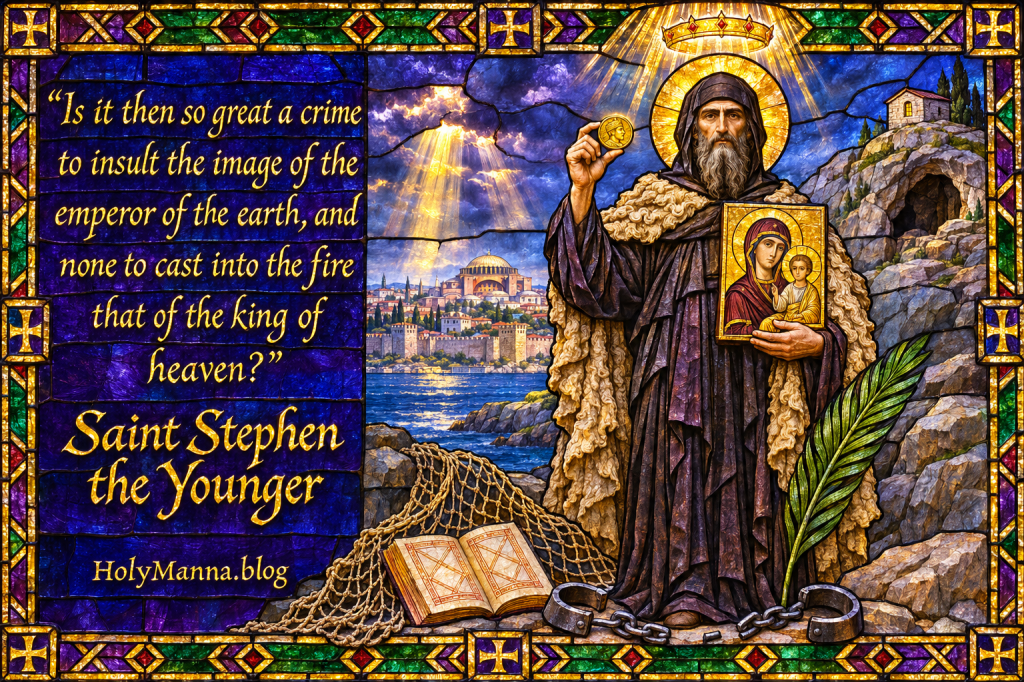
The Monk, the Emperor, and the Coin
Every Catholic church tells a story before a single word is spoken. There is the crucifix above the altar, the Stations of the Cross along the walls, and a statue of the Blessed Mother with candles flickering at her feet. Most Catholics have never stopped to wonder whether any of that is allowed. In Constantinople during the 700s, that question was a matter of life and death, and Saint Stephen the Younger answered it with his blood.
The Church remembers him on November 28th. The Roman Martyrology records that at Constantinople, under the emperor Constantine Copronymus, the monk Stephen endured many tortures for defending the veneration of sacred images. The traditional English text of the Martyrology says that he and the monks who suffered in the same persecution “confirmed the Catholic truth with the shedding of their blood.”
He is called the Younger, or sometimes the New, to distinguish him from Saint Stephen the deacon, the first martyr of the Church, whose death is told in The Acts of the Apostles. The two men share more than a name. In Greek, Stephanos means crown, and both of them won theirs the hard way.
Stephen the Younger was a monk, a hermit, and the abbot of a community on Mount Saint Auxentius, a mountain near Chalcedon, across the water from the imperial capital. He is revered as the most celebrated martyr of the iconoclast persecution, the long campaign by several Byzantine emperors to strip images of Christ, the Mother of God, and the saints out of Christian life. The Church teaches that the veneration of sacred images rests on the mystery of the Word made flesh, and that the seventh ecumenical council, held at Nicaea in 787, defended that veneration against the iconoclasts (CCC 2131). Stephen never saw that council. He died roughly 23 years before it met, which means that he held the line at a moment when holding it looked exactly like losing.
Promised to God Before His First Breath
Stephen was born in Constantinople in the early 700s. The sources do not agree on the year. Alban Butler, in Lives of the Saints, gives 714. The oldest biography, The Life of Saint Stephen the Younger, written by a deacon of Constantinople who was also named Stephen, places the birth in August of 715, and some historians argue for 713.
His father was named Gregory and his mother was named Anna. The Life describes Gregory as a craftsman, while Butler describes the family as wealthy. The couple already had two daughters, and Anna was nearing the end of her childbearing years when she began to beg God for a son. According to the Life, she prayed before the Mother of God at the famous church of Blachernae and promised that the child would belong to the Lord. Forty days after his birth, Anna carried him back to Blachernae and presented him there.
The Life adds a detail that readers have loved for centuries. It says that the baby was baptized at Easter by the Patriarch of Constantinople, Saint Germanus I, and that the patriarch held up Saint Stephen the first martyr as the model for the child. This detail comes from the Life alone, and historians caution that it cannot be verified.
From about the age of 6 he was studying the Scriptures and keeping night vigils in church at his mother’s side, soaking in the lives of the saints and the homilies of Saint John Chrysostom, whose writings would remain his favorite commentary on the Bible for the rest of his life.
Then the world around him changed. In the years from 726 to 730, Emperor Leo III the Isaurian turned the power of the state against sacred images, and Patriarch Germanus was forced from his see for refusing to go along. Gregory and Anna decided that the capital was no place to raise a boy who had been promised to God. They took Stephen across the water to Mount Saint Auxentius and placed him in the care of a hermit named John. Butler says that Stephen was 15 at the time, while the Life says that he was about 16. Either way, he received the monastic habit as a teenager and began at the very bottom, hauling the daily provisions up the mountain for the older monks.
There is no dramatic conversion in this story. Stephen’s conversion was the slow kind, the kind that happens when a person keeps saying yes to God. One of those moments came when his father died. Stephen went down to Constantinople for the funeral, sold everything that he had inherited, and gave the money to the poor. He then brought his mother and one of his sisters to a convent on the mountain. His other sister was already a nun in the city. An entire family had handed itself over to God.
The Cave Above the City
When the old hermit John died, the monks of the mountain chose Stephen to lead them, although he was only about 30 years old. He moved into the cave that Saint Auxentius himself had once used, and Butler describes how he lived there: “His only garment was a thin sheep’s skin, and he wore an iron girdle round his loins.” He supported himself by copying books and by making fishing nets, and whatever he earned beyond his own bread went to the poor.
Disciples found him in spite of his solitude. He accepted 12 monks, and then the community grew to 20, forming the first real monastery for men on the mountain. A young widow of high rank named Anne came to him for spiritual direction and became a nun in the convent at the foot of the mountain.
Around the age of 42, by the reckoning of the Life, Stephen handed the daily running of the monastery to a monk named Marinus and climbed even higher. Near the summit he built a cell that Butler describes as “much narrower than his cave, so that it was impossible for him to lie or stand up in it at his ease.” That can sound extreme, yet the Church understands it well. She teaches that hermits devote their lives to the praise of God and the salvation of the world through silence, solitude, constant prayer, and penance, and that their hidden life shows everyone the interior heart of the Church, which is personal intimacy with Christ (CCC 920 to 921). The Church also teaches that there is no holiness without renunciation and spiritual battle (CCC 2015). Stephen was not punishing himself. He was clearing away everything that competed with God.
Stephen never went looking for a fight with an emperor. He went looking for God, and the long years of hidden fidelity are what made him unbreakable when the fight came to him.
The Life also remembers him as a healer, and most of these accounts belong to his later years as a prisoner and an exile. While he was confined in a monastery at Chrysopolis, the abbot of the house lay sick with a fever that was expected to kill him, and Stephen is said to have cured him. On the island of Proconnesus, the Life says that he restored the sight of a blind man, freed a possessed boy from the city of Cyzicus, healed a woman from Heraclea of a hemorrhage, and saved sailors from storms through his prayers. The most pointed account involves a sick soldier, also named Stephen, who came begging for relief. The saint is said to have had him venerate the images of Christ and His Mother, and the soldier was restored. The lesson was hard to miss, since the healing came through the very thing that the emperor had outlawed. All of these accounts come from the Life, which was written 42 years after the saint’s death, and none of them can be independently verified.
A Coin on the Palace Floor
Leo III died in 741, and his son, Constantine V, took the campaign against images much further. His opponents gave him the mocking nickname Copronymus, which the Roman Martyrology still uses. In 754 he gathered 338 bishops at the palace of Hieria, and that assembly condemned sacred images as a leftover of idolatry and claimed the authority of a general council. Neither the Pope nor the patriarchs of Alexandria, Antioch, and Jerusalem sent legates.
The iconoclasts had a verse ready, “Thou shalt not make to thyself a graven thing” (Ex 20:4, quoted here, like all the Scripture in this post, from the Douay-Rheims Bible). The Church answers that God Himself ordered images that pointed toward salvation, such as the bronze serpent and the cherubim over the ark (CCC 2130), and that because the Word truly became flesh, the human face of Jesus can be portrayed (CCC 476).
The monks were the heart of the resistance, and the monk whom everyone respected was Stephen. The Life says that frightened monks came to the mountain to ask him what they should do, and that he advised them to take refuge where imperial policy could not reach, including the West and Rome itself. The emperor sent a patrician named Callistus to obtain Stephen’s signature on the decree of Hieria. Stephen refused to sign it. Soldiers were sent next, and they found the hermit so weakened by his fasts that they had to carry him down the mountain on their shoulders.
What force could not accomplish, slander was asked to do. Witnesses were bribed to accuse Stephen of an illicit relationship with Anne, the widow who had become a nun. Anne was ordered to confirm the story. She refused, insisted that Stephen was a holy man, and was whipped for it. She was then confined in a monastery in Constantinople, where she died soon afterward. The Church names this sin exactly. Calumny is a remark contrary to the truth that harms the reputation of another person (CCC 2477). Jesus had already told His disciples what to make of it: “Blessed are ye when they shall revile you, and persecute you, and speak all that is evil against you, untruly, for my sake” (Mt 5:11).
Then came a trap. The emperor had forbidden monasteries to receive novices. A young courtier named George Syncletus arrived at Stephen’s cell and begged to be made a monk. Stephen hesitated and then gave in. George promptly ran back to court wearing the habit, and the emperor paraded him before a crowd, had the habit torn off, and let the people trample it. Soldiers returned to the mountain, burned the monastery and its church to the ground, and scattered the monks. Stephen was beaten, dragged to the shore, and shipped to a monastery at Chrysopolis.
There, according to the Life, he went 17 days without eating and refused the food that the emperor sent. Callistus arrived with a delegation of iconoclast bishops and a copy of their decree. Stephen asked them how their assembly could be called a general council when, as Butler records his words, it was “not approved by the pope of Rome,” and when the other patriarchs had rejected it as well. The Catechism teaches the same principle, which is that there is never an ecumenical council that is not confirmed, or at least recognized as such, by the successor of Peter (CCC 884). Callistus went back to the palace and gave a remarkable report: “My lord, we are overcome: this man is very powerful in argument and learning; and despises death.”
The emperor banished Stephen to the island of Proconnesus in the Sea of Marmara. His scattered monks found him and gathered around him again. His mother and his sister came as well, and both of them died there. The crowds who came for his prayers only spread his fame, so after about 2 years Constantine had him brought back to the capital in chains.
The meeting between the emperor and the monk is the scene for which Stephen is best known. Butler tells it this way. The emperor asked whether men trampled on Christ Himself by trampling on His image. Stephen answered, “God forbid.” Then he held up a coin stamped with the emperor’s portrait and asked what would happen to a man who stamped on that image. The court answered that such a man would be severely punished. Stephen replied, “Is it then so great a crime to insult the image of the emperor of the earth, and none to cast into the fire that of the king of heaven?” Accounts preserved in the Byzantine tradition add that he threw the coin to the floor and stepped on it to drive the point home.
The emperor had no answer, because Stephen had used the logic that everyone in that room already lived by. Honor or insult shown to an image lands on the person it represents. Saint Basil the Great had said it four centuries earlier in On the Holy Spirit: “the honour paid to the image passes on to the prototype.” The Church teaches the very same thing today, adding that the honor given to sacred images is a respectful veneration and never the adoration that belongs to God alone (CCC 2132).
Stephen was sent to the prison of the praetorium, where he spent about 11 months. The Life says that 342 monks were confined there with him, and that the prison turned into a monastery, with the psalms chanted at their proper hours. The wife of one of the jailers secretly brought him food, along with small icons of Christ and of the Apostles Peter and Paul that she had kept hidden.
Butler writes that the emperor ordered Stephen scourged to death in prison, and that those who were given the task left it unfinished. A tradition preserved in the Christian East says that the men sent to finish him were so moved by the sight of his face that they fell at his feet instead. That tradition cannot be verified. Butler renders the emperor’s furious response in a single line: “Will no one rid me of this monk?”
Men eager to please the emperor took the hint. On November 28th a crowd burst into the prison, tied Stephen by the feet, and dragged him through the streets while people struck him with stones and clubs. The Life says that as he was hauled past a shrine of the martyr Saint Theodore, he turned his head toward it in reverence, and that a man named Philommatius then struck him on the head with a heavy piece of wood and killed him. His body was torn apart and thrown into the pit of Pelagius, where executed criminals were buried.
The year is disputed. Butler gives 764, many modern historians prefer 765, and some Eastern calendars give 767. Theophanes dates the death to November 20th, while the Life and the liturgical tradition give November 28th, which is the date the Church keeps. Historians also debate how much of the emperor’s fury was aimed at images and how much was aimed at monasticism itself. The Church’s own judgment stands in the Martyrology, which honors him as a martyr for the sacred images.
The Catechism explains what that word means: “Martyrdom is the supreme witness given to the truth of the faith” (CCC 2473). The Church also teaches that a citizen is obliged in conscience not to follow the directives of civil authorities when they contradict the teachings of the Gospel (CCC 2242), and she points to the words of Saint Peter: “We ought to obey God, rather than men” (Acts 5:29).
What the Emperor Could Not Erase
The Life closes its account of the martyrdom with signs in the sky. It says that a dark cloud settled over Constantinople and that a violent hailstorm struck the city. These signs are reported by the saint’s biographer, and they cannot be verified.
His relics have a history of their own. One of his followers is said to have rescued his skull and carried it to the monastery of Dius in Constantinople. In later centuries his relics were venerated in several churches of the city, and on his feast day the skull was carried in a procession led by the prefect of the city. Today the monastery of Saint Panteleimon on Mount Athos claims to hold the skull, although that claim cannot be confirmed. No reliable accounts of particular healings at his relics have survived. The Church treasures the veneration of relics as part of the piety of the faithful (CCC 1674), and she teaches that the saints in heaven never stop interceding for those still on the journey (CCC 956).
The greatest miracle after his death may simply be that he won. In 787 the Second Council of Nicaea, with the legates of the Pope present, restored the sacred images and taught, in words that echo the argument of the coin, “For the honour which is paid to the image passes on to that which the image represents.” The council carefully distinguished the “due salutation and honourable reverence” given to images from the “true worship of faith” that belongs to God alone. The Catechism draws directly on that council when it teaches that whoever venerates an icon venerates the person portrayed in it (CCC 477).
Saint Paul calls Christ “the image of the invisible God” (Col 1:15), and Saint John writes, “And the Word was made flesh, and dwelt among us” (Jn 1:14). Saint John Damascene, the great Doctor of the Church who belonged to the generation just before Stephen’s, drew the conclusion in his treatise On Holy Images: “I do not worship matter, I worship the God of matter, who became matter for my sake.” The Catechism quotes this same Doctor when it teaches that the Incarnation opened a new economy of images (CCC 1159). Stephen wrote none of that theology. He simply staked his life on it.
The images were restored for good in 843, and the solemn proclamation read on that anniversary in the Byzantine tradition names Stephen among the defenders of the faith. His biography, written by Stephen the Deacon within about 45 years of his death, remains one of the most important historical sources for the entire period. He is traditionally shown as a monk holding a small icon of Christ and the Mother of God. His martyrdom is painted in the Menologion of Basil II, an illuminated manuscript from about the year 1000 that is kept today in the Vatican Library, and his portrait in mosaic survives at the monastery of Hosios Loukas in Greece.
His feast falls on November 28th in the Byzantine calendar as well as in the Roman Martyrology. Older editions of the Martyrology named him together with Basil, Peter, Andrew, and 339 companion monks, while the current edition names Stephen alone. Those older editions also commemorated Pope Saint Gregory III on the same day, the Pope who condemned iconoclasm at a Roman synod in 731 and who died on November 28th, 741.
The Image That Every Person Carries
Stephen’s coin is still in circulation. Jesus once held up a coin of His own and asked, “Whose image and inscription is this?” When the answer came back that it was Caesar’s, He replied, “Render therefore to Caesar the things that are Caesar’s; and to God, the things that are God’s” (Mt 22:20 to 21). The coin bears the image of Caesar. The human person bears the image of God, as The Book of Genesis says: “And God created man to his own image” (Gn 1:27). The Church teaches that this divine image is present in every person (CCC 1702).
That truth gives Stephen’s witness a very practical edge. If the honor shown to a painted image passes on to Christ, then the way a person treats a living image of God matters even more. How do you treat the images of God who share your home, your office, and your commute? The story of Anne belongs here too. She was offered an easy way out, and all it would have cost was another person’s good name. When was the last time you protected someone’s reputation when staying quiet would have been easier?
Stephen also invites an honest look at the walls of your own home. The Catechism recommends a prayer corner with the Sacred Scriptures and icons as a help to personal prayer (CCC 2691). A crucifix by the door, an image of the Blessed Mother on a desk, or a holy card tucked into a wallet is not decoration. Each one is a small window, and it works only if someone looks through it. Choose one sacred image this week and actually pray before it.
Finally, Stephen shows where courage comes from. He did not become brave in the palace. He became brave in the cave, through decades of small and hidden faithfulness. The Church teaches that a disciple must not only keep the faith but also profess it and bear witness to it with confidence (CCC 1816). Most people will never face an emperor, but they will face a conversation at work or a moment online when silence is the comfortable choice. The modern world also has its own images that demand honor, and the Catechism names power, the state, and money among the idols that people set in the place of God (CCC 2113). Which image is asking for your loyalty right now, and what would it look like to hand that loyalty back to Christ?
Engage With Us!
Share your thoughts and reflections in the comments below.
- Which sacred image, whether a crucifix, an icon, a statue, or a holy card, has helped you pray, and what does it stir in your heart?
- Stephen spent decades in hidden prayer before his public witness. What small, hidden habit of faith could you begin this week?
- Anne refused to slander an innocent man, even under the lash. Where is God asking you to defend someone’s good name?
- Stephen appealed to the authority of the Pope when the powerful pressed him to give in. How does your trust in the Church steady you when the culture pushes back?
- If every person is a living image of God, who in your life needs to be treated with greater reverence?
Saint Stephen kept the faith when it cost him his monastery, his reputation, his freedom, and finally his life, and the Lord kept His promise in return: “Be thou faithful until death: and I will give thee the crown of life” (Rv 2:10). Go and live your faith out loud today. Honor Christ in His images and in His people, and do everything with the love and mercy that Jesus taught.
Saint Stephen the Younger, pray for us!
Follow us on YouTube, TikTok, Instagram and Facebook for more insights and reflections on living a faith-filled life.


Leave a Reply