The Shepherd Who Walked Europe in the Name of Jesus
Some saints are remembered for one dramatic moment. Saint James of the Marches is remembered for about 50 years of walking. Born a poor shepherd boy in the hills of central Italy, trained as a lawyer, and clothed as a Franciscan in the little chapel that Saint Francis loved most, he spent half a century crossing Italy and much of Central and Eastern Europe, preaching Jesus Christ in churches, piazzas, fields, and workshops.
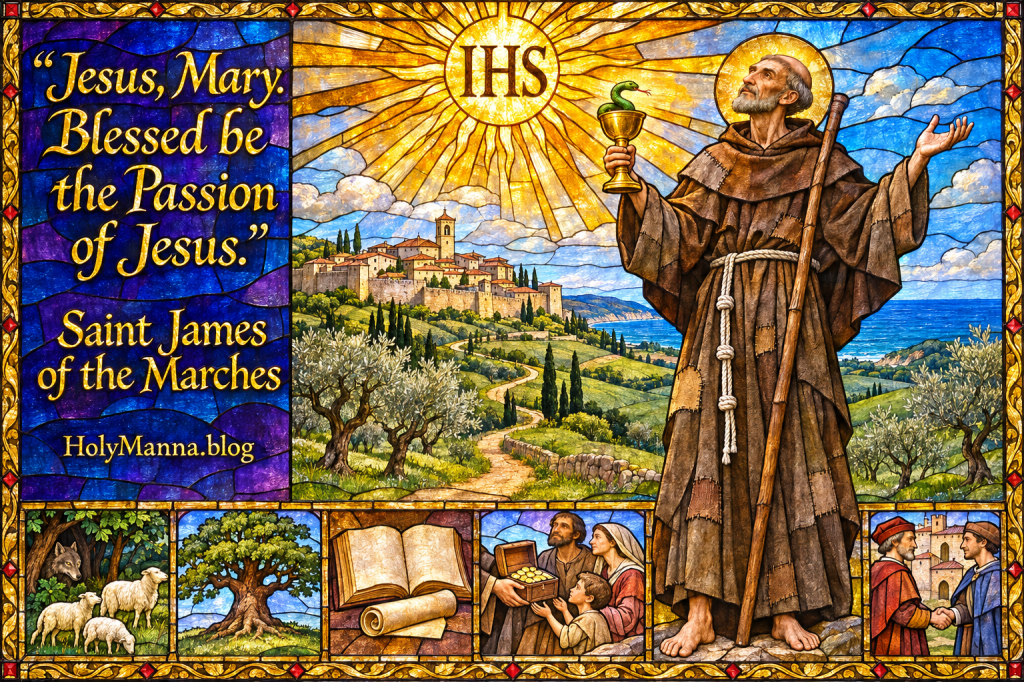
Franciscans honor him as one of the 4 pillars of the Observant reform, alongside Saint Bernardine of Siena, Saint John of Capistrano, and Blessed Albert of Sarteano. Popes used him as a diplomat, feuding cities as a peacemaker, and the poor as their defender against the moneylenders. Artists usually paint him holding a chalice with a small serpent slipping out of it, a detail explained later in this story.
The Roman Martyrology remembers him on November 28th, the day he died in Naples in 1476, as a priest “celebrated for the austerity of his life, his apostolic manner of preaching,” and for the many missions he carried out for the good of Christendom. Naples venerates him as one of its patron saints, his hometown of Monteprandone claims him as its own patron, and the friars who guard his shrine invoke him as a special protector of children.
When the Church canonizes a man like this, The Catechism explains what she is doing. In that act “the Church recognizes the power of the Spirit of holiness within her” and proposes the saints to believers “as models and intercessors” (CCC 828). James of the Marches is both a model and an intercessor.
From a Hillside Flock to the Chapel of Saint Francis
The future saint was born in Monteprandone, a small walled hill town near the Adriatic coast, in the region then called the March of Ancona. The sources do not agree on the year. The old Catholic Encyclopedia gives 1391, the Vatican’s saint of the day profile and his own shrine give September of 1393, and other Catholic sources give 1394. He was baptized Domenico, the 18th child of Antonio Gangale, known as Antonio the Red, and his wife Antonia. His father died while the boy was still small.
At about 6 or 7, Domenico was sent out to mind the family animals. Years later, in his sermons, he remembered being a keeper of sheep and pigs, and he observed that such work kept a child from Sunday Mass and from hearing the word of God. It also terrified him. A wolf kept prowling near the flock, his older brothers laughed at his fear, and one day the boy simply ran. He covered about 9 miles to the town of Offida, where a priest who was a relative, probably an uncle, took him in and taught him to read and write. Looking back, James reportedly called that animal an “angel of God and not a wolf as it seemed.” The Lord who says in The Gospel of John, “I am the good shepherd. The good shepherd lays down his life for the sheep” (Jn 10:11), had used a frightened child’s flight to begin an education.
Local tradition adds more color. One story says that a bright light filled the little house at the moment of his birth. Another says the young shepherd buried an acorn in play and found an oak, and soon a whole grove, standing on the spot the next morning. These are cherished stories in Monteprandone, but they cannot be verified.
What is documented is the schooling. From Offida he went to Ascoli, where he studied Latin, grammar, rhetoric, and poetry, and then to the University of Perugia, where he earned a doctorate in law. By about 21 he was working as a notary in Florence, and he then served as a judicial official in the Tuscan town of Bibbiena. The shepherd boy had become Ser Domenico, a man with a title and a future.
Then came a Good Friday in Bibbiena, in 1415 or 1416, when he resolved to leave the world and serve God. His first instinct was the silence of the Carthusians, so he knocked at the charterhouse outside Florence. The prior told him to think it over for a few days. He never went back. Traveling home through Assisi instead, he stopped to pray at Saint Mary of the Angels, the Portiuncula, and asked for the Franciscan habit. His shrine records that he received it on July 25th, 1416, the feast of Saint James the Apostle, and took the Apostle’s name, although the Catholic Encyclopedia gives the date as July 26th.
After a novitiate at the hermitage of the Carceri above Assisi, he studied theology in Florence, close to Fiesole, where Saint Bernardine of Siena was superior. Bernardine became his master and his friend, and James later recalled that Bernardine taught him how to preach and even how to project his voice. He was ordained a priest on June 13th, 1420, the feast of Saint Anthony of Padua. The Catechism says that Christ’s call to penance aims above all at “the conversion of the heart, interior conversion” (CCC 1430). The lawyer had been converted from the inside out, and now he had something to say.
Preacher, Peacemaker, and Enemy of the Moneylenders
For the next 47 years James preached almost every day, living Saint Paul’s charge to “preach the word, be urgent in season and out of season” (2 Tim 4:2). He began in Tuscany, Umbria, and his native Marches, speaking in the everyday language of the people about superstition, luxury, gambling, blasphemy, and above all usury. In Fermo, crowds of 3,000 to 4,000 pushed him out of the church and into the public square. In Milan, on July 22nd, 1460, a single sermon on the feast of Saint Mary Magdalene moved 36 prostitutes to change their lives.
He lived what he preached. His usual meal on the road was a bowl of soaked beans with bread and an onion or some garlic, eaten once a day. He slept only a few hours a night, and his penances were so severe that Saint Bernardine told him to moderate them. The Catechism is blunt about why saints live this way: “There is no holiness without renunciation and spiritual battle” (CCC 2015).
At the center of his preaching stood the Holy Name of Jesus. Like Bernardine, he carried the monogram IHS wherever he went, urging people to trade their charms and amulets for trust in the Savior. Saint Paul had written “that at the name of Jesus every knee should bow, in heaven and on earth and under the earth” (Phil 2:10), and The Catechism teaches that “The name ‘Jesus’ contains all” (CCC 2666). James wrote the Holy Name on slips of parchment that were touched to the sick, and many healings were attributed to that simple act of faith. The accounts of these cures come from devotional tradition, and the individual cases cannot be verified.
From 1427 onward the popes kept him moving. He was sent on missions to Germany, Austria, Bohemia, Poland, Hungary, and Bosnia. He reformed Franciscan houses in Bosnia in 1432, preached in Hungary and Bohemia at the summons of Emperor Sigismund in 1436, worked to reconcile the moderate Hussites with the Church, supported reunion with the Greeks at the Council of Ferrara and Florence, and preached the defense of Europe against the Ottoman advance. When Saint John of Capistrano died in 1456, James was sent to Hungary to take his place. One estimate credits him with 250,000 conversions, a figure that cannot be verified.
Back home he became a builder of peace. He brokered agreements between the rival cities of Fermo and Ascoli in 1446 and again in 1463. In 1451 he settled a border quarrel involving his own hometown by having 16 men, 8 from each side, swear an oath of peace before an altar of the Blessed Virgin. He also drafted or reformed civic statutes for 11 cities. “Blessed are the peacemakers, for they shall be called sons of God” (Mt 5:9) was not a slogan for him. It was a job description. The Catechism calls earthly peace “the image and fruit of the peace of Christ” (CCC 2305).
His most lasting social work was the monte di pietà, the mount of piety. Moneylenders were charging the poor ruinous interest, so James and his fellow Observant friars promoted charitable lending houses that offered small loans on pawned goods at little or no cost. In L’Aquila in 1466 he helped draft the rules for one himself. The Catechism warns that those whose “usurious and avaricious dealings” lead to the hunger and death of others bear grave guilt (CCC 2269), and it quotes Saint John Chrysostom: “Not to enable the poor to share in our goods is to steal from them and deprive them of life” (CCC 2446).
Then there are the miracles. The Catholic Encyclopedia calls his half century of ministry remarkable for them, and Butler’s Lives of the Saints reports that he worked several at Venice and raised the Duke of Calabria and the King of Naples from dangerous illnesses. Another account says that when he went to L’Aquila to pray at the tomb of Bernardine, about 60 healings took place in the public square as he prayed in the name of Jesus. His companion and biographer, Brother Venanzio of Fabriano, spoke of miracles by the tens of thousands. These reports come from early biographers and devotional tradition, and they cannot be verified in their details.
One story is especially loved at his shrine. Around 1468, James was in Rome speaking with his friend Cardinal Francesco della Rovere, the future Pope Sixtus IV, about the Incarnation, insisting that the body of Christ was formed from the very flesh and blood of Mary. It is the truth behind the statement in The Catechism that God, “to prepare a body for him,” willed the free cooperation of a creature (CCC 488). As James spoke, a small terracotta image of the Virgin and Child on the wall is said to have bowed its head. The cardinal gave the image to James, who brought it home to Monteprandone, where it is venerated as the Madonna delle Grazie. The bowing of the image is handed down by the saint’s early biographer, and it cannot be verified.
The Catechism teaches that the signs Christ worked “invite belief in him” (CCC 548). Whatever a reader makes of each account, the pattern is consistent. James never pointed to himself. He pointed to a Name, and that is exactly why he is worth remembering and imitating.
Poison, Prison, and a Body Worn Out for the Gospel
James was not a martyr, though that was not for lack of people trying. During his years in Hungary and Bohemia, historians count 16 attacks on him or his companions, and hired hecklers shouted him down in the middle of sermons. In Italy the Fraticelli, a sect that had broken from the Church, are reported to have hired assassins to kill both him and John of Capistrano, and on 2 occasions the would-be killers lost their nerve when they stood face to face with him.
The most famous episode explains the chalice in his portraits. According to tradition, enemies of his preaching in the hill country of the Marches slipped poison into the chalice he was about to drink from. James traced the sign of the cross over the cup, and a serpent slid out of it, exposing the plot. The Catholic Encyclopedia notes that the emblem alludes to attempts by heretics to poison him. The detail of the serpent is told as a tradition, and it cannot be verified.
A better documented scare came at Fabriano in 1442. The mercenary captain Niccolò Piccinino wanted the city, and when its senate shut the gates he blamed the friar’s advice. He seized James and locked him in a cell, sneering that he would teach the preacher how to preach. The townspeople rang the church bells and marched on the camp, and Piccinino fled.
His work as an inquisitor belongs in this honest accounting as well. Pope Martin V and later Pope Eugene IV charged him with opposing the heresies of the day. The Catechism defines heresy as “the obstinate post-baptismal denial of some truth which must be believed with divine and catholic faith” (CCC 2089). The same Catechism acknowledges that the tribunals of past centuries used harsh methods that are regrettable, while insisting that “the Church always taught the duty of clemency and mercy” (CCC 2298). What the sources say of James personally is that he was beaten and imprisoned by his opponents and that he forgave them, obeying the command of Christ: “Love your enemies and pray for those who persecute you” (Mt 5:44).
Some of his heaviest crosses came from inside the Church. The Observant reform was growing quickly and stirring envy, and a letter James wrote to John of Capistrano in December of 1455, still preserved in Monteprandone, shows how much he suffered over it. Then, on Easter Monday of 1462, preaching in Brescia, he repeated an opinion held by some theologians about the Precious Blood shed during the Passion, namely that it was not united to the divinity of Christ during the 3 days in the tomb. The friar who had served as an inquisitor was now summoned before one. James appealed to the Holy See, the question was debated before Pope Pius II and the cardinals at Christmas of 1462, and no decision was ever handed down. The Catechism teaches that the divine person of the Son remained united to both his soul and his body in death (CCC 626). The narrower question was left unresolved, and James went back to work.
His body was its own battlefield. He suffered from gout, colic, kidney stones, and a hemorrhage that lasted more than 20 years, and he lost all his teeth. He received the Anointing of the Sick 6 times. Tradition also says that for 30 years he was tormented by temptations against purity and that relief came through Our Lady of Loreto. One account places the moment on his return from Bosnia, when the Blessed Virgin is said to have appeared and told him, “Take heart, my son.” This apparition is handed down as a tradition, and it cannot be verified.
Honors frightened him more than assassins did. When the clergy and people of Milan wanted him as their archbishop, an offer dated to 1460 or 1461 depending on the source, he slipped out of the city by night. Franciscan tradition records his answer, that he had no other desire on earth than “to do penance and to preach penance as a poor Franciscan.”
By May 20th, 1467, at about 75, he had to give up regular preaching. In 1472 King Ferdinand of Naples asked Pope Sixtus IV to send him south. Too weak to ride, James made the journey in the spring of 1473 slung in a basket on one side of a mule, with Brother Venanzio in a basket on the other. He preached around Naples for 3 more years, grumbling that life near the court was a waste of precious time.
The end came on Thursday, November 28th, 1476, at about 3 in the afternoon. Racked by colic, he confessed, received Holy Communion, and begged the friars to forgive any bad example he had given. He took Venanzio’s hands and said, “O my son, I feel the pains of death. Pray to God for me.” His last words are reported as “Jesus, Mary. Blessed be the Passion of Jesus.” The Catechism says that through the Anointing a sick person receives “the gift of uniting himself more closely to Christ’s Passion” (CCC 1521). James died blessing the Passion he had preached for half a century. Venanzio added that the saint’s hands went on holding his own for some time after death, a detail that rests on his testimony alone and cannot be verified.
The Friar Who Came Home After Five Centuries
So many people came to see the body that James could not be buried for about 2 weeks. Venanzio noted that the face kept such a healthy color that people suspected the friars of painting it. He was laid in the earth at the Franciscan church of Santa Maria la Nova in Naples, as he had wished. About a year later, because of the many miracles reported at the grave, Pope Sixtus IV, the same friend who had given him the image of Our Lady, ordered the body raised and placed in a tomb above ground. The sources consulted for this post speak of numerous healings at the tomb without preserving the individual accounts, and those early reports cannot be verified case by case.
What can be traced is the careful process of the Church. Pope Urban VIII beatified James on August 12th, 1624, and Pope Benedict XIII canonized him on December 10th, 1726. During the canonization inquiry of 1700, 39 witnesses testified about the condition of his body. Those who had handled it while changing the habit described the hands, legs, and head as still flexible, and the examining experts found no sign of embalming. Later examinations followed in 1888, 1968, and 2008. The inspection of 1968 found the body well preserved but no longer flexible, and a Franciscan source today describes the remains as relatively incorrupt.
For more than 5 centuries the saint rested in Naples, which counts him among its patrons, in a great side chapel that bears his name. Then, in 2001, at the request of the Franciscans of the Marches, his body was brought home to Monteprandone and placed in the sanctuary of Santa Maria delle Grazie, the friary he had founded in 1449. A few sources give 2004 for the definitive return. Pilgrims now pray before a bronze urn beneath the altar of his chapel, a few steps from the Madonna delle Grazie he carried home from Rome.
Monteprandone is full of him. James was a scholar who wrote 18 volumes and could recite Dante’s Divine Comedy from memory, and the civic museum preserves 61 codices from the library he gathered for his friars, including 4 volumes in his own handwriting and his letter to John of Capistrano. Beside the sanctuary stand 2 young oaks that sprouted in 1980 from the root of the ancient Oak of Saint James, which fell in 1973. Every year a novena from November 19th to November 27th prepares the town for his feast. Paintings near his tomb recall the conviction of local families that he protected their sons during the Second World War, a grace received in faith that cannot be verified.
The Church keeps bodies, books, and birthplaces for a reason. The Catechism lists the veneration of relics, visits to sanctuaries, and pilgrimages among the forms of piety that surround her sacramental life (CCC 1674), and it explains what the saints are doing now: “they do not cease to intercede with the Father for us” (CCC 956).
Lessons From a Saint Who Never Stopped Walking
James of the Marches lived 6 centuries ago, but his problems sound familiar: childhood fear, career ambition, chronic illness, criticism from inside the Church, and a world where the poor were crushed by debt. His answer was always the same. He kept walking, and he kept saying the Name of Jesus.
Start with the wolf. The fear that drove a small boy off a hillside turned out to be the door to everything else. What fear or setback in your own story might God already be using to move you somewhere better?
Then look at how you listen. In one of his sermons James cited a teaching handed down under the name of Saint Augustine: the person who hears the word of God carelessly is “no less guilty” than the one who lets the Body of Christ fall to the ground through negligence. The Catechism says the same thing from the other side: “the Church has always venerated the Scriptures as she venerates the Lord’s Body” (CCC 103). A practical step is simple. Read the Sunday Gospel before Mass, put the phone away during the homily, and carry one sentence home.
Notice, too, that James never threw away his law degree. He used it to write fairer statutes, settle feuds, and design lending houses for the poor. Your training, your trade, and your talents can be handed over to God in the same way. Where could your professional skills serve someone who cannot pay for them? Is there a quarrel in your family, parish, or workplace where you could be the one who makes peace?
Look at your money as well. James judged an economy by what it did to the poor. Does your budget show that the poor have a real claim on what you own?
Finally, look at how he suffered. He was anointed 6 times and kept going. The Catechism defines fortitude as the virtue that “ensures firmness in difficulties and constancy in the pursuit of the good” (CCC 1808). You may never be asked to cross Bosnia on foot. You will be asked to get up tomorrow and be faithful again. When the day is heavy, try his prayer. Say the Holy Name slowly, and bless the Passion that saved you.
Engage With Us!
Share your thoughts and reflections in the comments below. Which part of this friar’s long road speaks most to your own life right now?
- Saint James called the wolf of his childhood an angel of God. What frightening or painful moment in your life later proved to be a turning point toward God?
- He left a promising legal career on a Good Friday. What might Jesus be asking you to leave behind, or to use differently, for His sake?
- James preached the Holy Name of Jesus above everything else. How could you bring the Name of Jesus into your ordinary day with more reverence and trust?
- He fought usury and built lending houses for the poor. What is one concrete way you can defend or assist someone who is struggling financially this week?
- He made peace between cities and forgave those who attacked him. Who is one person you need to forgive or be reconciled with as Advent approaches?
Saint James of the Marches spent all his strength so that ordinary people could hear the Gospel and live it. May his example move you to live a life of faith, to hear the word of God with a ready heart, and to do everything with the love and mercy that Jesus taught.
Saint James of the Marches, pray for us!
Follow us on YouTube, TikTok, Instagram and Facebook for more insights and reflections on living a faith-filled life.


Leave a Reply