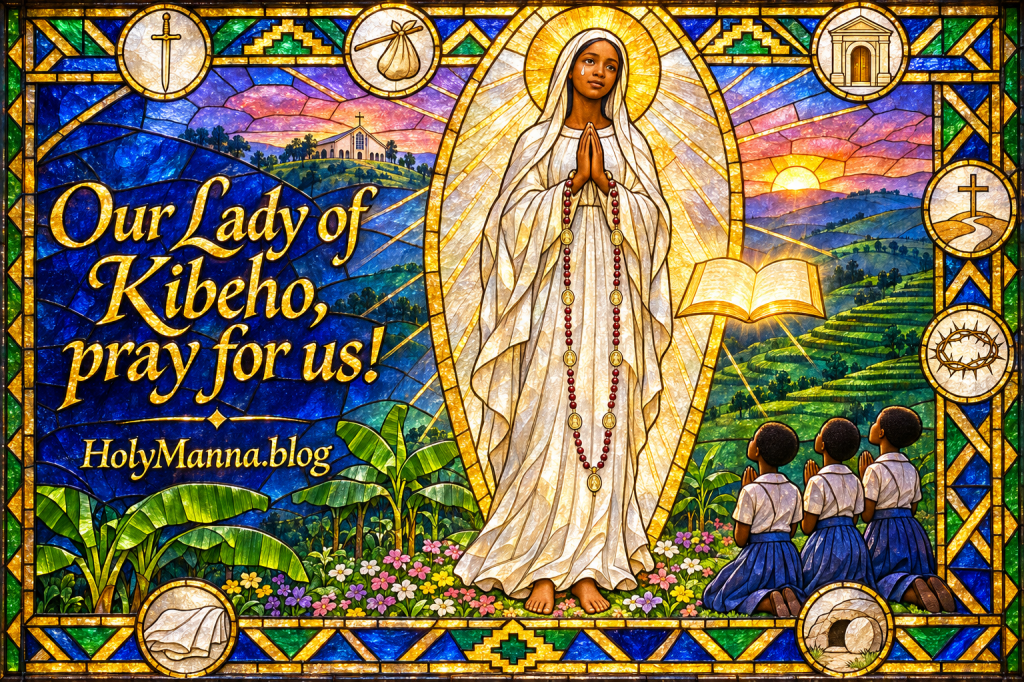
The Mother Who Wept on the Hills of Rwanda
Every year on November 28th, pilgrims climb a green hill in southern Rwanda to honor the Blessed Virgin Mary under a title that many Catholics in the West are only beginning to discover. Our Lady of Kibeho is the name given to Mary as she appeared, beginning on November 28th, 1981, to 3 students at a Catholic boarding school in the village of Kibeho. She introduced herself in Kinyarwanda, the language of the country, as Nyina wa Jambo, which means Mother of the Word. After 20 years of patient study, the local bishop judged the apparitions to those 3 young women authentic on June 29th, 2001, and the Holy See made his declaration public a few days later. Kibeho remains the only Marian apparition on the African continent to receive this formal recognition from the Catholic Church.
A quick word about the calendar keeps everything honest. Our Lady of Kibeho is not inscribed on the General Roman Calendar, so November 28th carries no universal liturgical rank. The celebration is a local feast, established by the bishop’s declaration and kept in Rwanda, above all at the shrine in Kibeho. In 2026, the rest of the Church observes Saturday of the 34th Week in Ordinary Time on this date, the last day of the liturgical year before Advent begins. People speak warmly of her feast day, and rightly so, as long as the local character of the celebration stays clear.
A local feast in Rwanda matters to Catholics everywhere for a simple reason. The message of Kibeho is the Gospel spoken in a mother’s voice, and it comes down to a few plain words: repent, pray from the heart, and stay close to the Cross. An approved apparition is a private revelation. It adds nothing to the faith handed down from the Apostles, and no Catholic is bound to believe it. Its role is not to improve the definitive Revelation of Christ but, in the words of the Catechism, “to help live more fully by it in a certain period of history” (CCC 67). Kibeho did exactly that for a nation standing at the edge of catastrophe.
A Dining Hall, a Doubting School, and a Wounded Nation
Kibeho sits among the hills of southern Rwanda, a short distance from the border with Burundi. In 1981 it was a poor, rural place with a parish and a secondary school for girls, Kibeho College, run by the Benebikira Sisters, a congregation of Rwandan women. The village belonged at that time to the Diocese of Butare under Bishop Jean-Baptiste Gahamanyi. The Diocese of Gikongoro, which includes Kibeho today, was erected later, on March 30th, 1992.
On Saturday, November 28th, 1981, the eve of the First Sunday of Advent, a student named Alphonsine Mumureke was serving her classmates in the school dining hall. According to her account, she heard a gentle voice calling her, and she then saw a lady of incomparable beauty who identified herself as Nyina wa Jambo, the Mother of the Word. Catholic sources do not agree on her age that day. Some give it as 16 and others as 17.
The reaction at school was not applause. Bishop Augustin Misago’s later declaration records that many people assumed Alphonsine was mentally unwell, troubled by evil spirits, or simply hungry for attention. The loudest critic was an older student named Marie Claire Mukangango, who was well known for her strong opposition to the whole affair. On January 12th, 1982, a second student, Nathalie Mukamazimpaka, began to experience apparitions as well. On March 2nd, 1982, the same thing happened to Marie Claire herself. Witnesses later told investigators that her change of heart was the reason they finally took the events seriously.
News traveled fast, and crowds began to gather in the schoolyard. Bishop Gahamanyi answered the way the Church asks a bishop to answer, with patience and careful investigation. He installed a medical commission on March 20th, 1982, and a theological commission on May 14th, 1982. Their work went on for years.
All of this unfolded in a country carrying deep wounds. Rwanda in the early 1980s was marked by long-standing tension between Hutu and Tutsi, and that tension was growing. In April of 1994 the hatred exploded into genocide, and hundreds of thousands of people were murdered in roughly 100 days. Kibeho was not spared. A massacre took place there in April of 1994, and a second mass killing followed in April of 1995 at a camp for displaced people. The hill where Mary had pleaded for conversion became a place of terrible grief.
The 3 visionaries shared fully in the suffering of their people. Marie Claire, who had become a teacher and married, was killed together with her husband during the genocide. Alphonsine and Nathalie fled for their lives. Alphonsine later entered religious life with the Poor Clares outside Rwanda, and Nathalie returned to Kibeho in December of 1996, where she has lived a quiet life of prayer near the shrine.
What the Mother of the Word Came to Say
The Church’s judgment deserves to come first, because it frames everything else. On June 29th, 2001, the Solemnity of Saints Peter and Paul, Bishop Augustin Misago of Gikongoro read his definitive judgment during Mass in his cathedral. The English text published in L’Osservatore Romano states that “the Virgin Mary appeared at Kibeho” on November 28th, 1981, and in the months that followed. The bishop added that the reasons to believe in the apparitions outweighed the reasons to deny them. The Holy See Press Office released his declaration on July 2nd, 2001. The approval status is therefore precise: the apparitions were approved by the competent local bishop, and his judgment was published by the Holy See.
That approval has clear limits, and the bishop drew them himself. Only the public apparitions to Alphonsine, Nathalie, and Marie Claire were recognized, with 1982 and 1983 treated as the decisive period. Other people at Kibeho later claimed visions, including alleged visions of Jesus reported from July of 1982. The bishop declined to recognize any of them, and he pointed to the disquieting personal situations of those later claimants. Those alleged apparitions remain not approved. Even the approved apparitions remain private revelation, and the bishop stated plainly that the Church obliges no one to believe in them (CCC 67).
The 3 recognized series of apparitions each had a distinct span. Alphonsine’s lasted exactly 8 years, from November 28th, 1981, to November 28th, 1989. Nathalie’s ran from January 12th, 1982, to December 3rd, 1983. Marie Claire’s were the shortest, from March 2nd to September 15th, 1982, and they ended on the day the Church honors Our Lady of Sorrows.
The content of the message is the heart of the matter. The bishop’s declaration gathers it into a handful of themes, and none of them is new. The first is an urgent call to conversion, summed up in the cry “Repent, repent, repent!” The visionaries reported that Mary grieved over a world in rebellion against God and rushing toward ruin. She asked for prayer that is constant and sincere, for the daily Rosary, for fasting and penance, and for prayer on behalf of the Church in troubled times ahead. She taught that suffering accepted in faith has a part in salvation. She also asked that a chapel be built at Kibeho.
Then came August 15th, 1982, the Solemnity of the Assumption. On a day when pilgrims might have expected only joy, the visionaries reported seeing Mary in tears, and the bishop’s declaration speaks of frightening visions that day. Catholic accounts drawn from the testimony describe a river of blood, people killing one another, and bodies left without burial. Some popular retellings place these visions on August 19th, while the declaration itself names August 15th. After 1994, many Catholics, Bishop Misago among them, came to see that day as a prophetic warning that went unheeded.
Other elements belong to the visionaries’ testimony as well. Alphonsine, on March 20th, 1982, and Nathalie, on October 30th, 1982, each reported a long mystical journey with Mary through places they described in symbolic language, places that call to mind heaven, purgatory, and hell (CCC 1023-1037). To Marie Claire, Mary entrusted the Rosary of the Seven Sorrows, a devotion that had nearly disappeared in Rwanda.
Through all of it, Mary acted as a mother who warns because she loves. She appeared as an intercessor who weeps over sin without giving up on sinners, and as a model of faith that stays put when everything grows dark. She brought no new doctrine to Kibeho. The bishop described her message as a reminder of ordinary Church teaching that people had forgotten.
The Word Made Flesh and the Sword in a Mother’s Heart
The title Mary gave herself at Kibeho is a small catechism all on its own. The Gospel of John opens with the line “In the beginning was the Word: and the Word was with God: and the Word was God” (John 1:1), and a few verses later it announces that “the Word was made flesh and dwelt among us” (John 1:14). The Church calls this mystery the Incarnation (CCC 461). Because the child Mary bore is the eternal Son of God in person, the Council of Ephesus in 431 confessed her as truly the Mother of God (CCC 466, CCC 495). Elizabeth had already said as much when she greeted Mary as “the mother of my Lord” (Luke 1:43). The bishop’s declaration notes that Mother of the Word is simply another way of saying Mother of God. Everything else the Church believes about Mary, including her Immaculate Conception (CCC 491), her perpetual virginity (CCC 499), and her Assumption (CCC 966), flows from the truth about her Son (CCC 487).
Kibeho is also bound to Our Lady of Sorrows, the title carried by the shrine. Simeon warned the young mother in the Temple, “And thy own soul a sword shall pierce” (Luke 2:35), and the Catechism reads that sword as a sign pointing to the Cross (CCC 529). The prophecy came true on Calvary: “Now there stood by the cross of Jesus, his mother” (John 19:25). The Second Vatican Council teaches in Lumen Gentium that Mary “faithfully persevered in her union with her Son unto the cross” (Lumen Gentium 58), a line the Catechism repeats when it describes her union with Christ in his Passion (CCC 964). Saint John Paul II went further in Redemptoris Mater, writing of her faith at the foot of the Cross, “This is perhaps the deepest ‘kenosis’ of faith in human history” (Redemptoris Mater 18). Kenosis is a Greek word for self-emptying. Her faith never wavered, even in that night (CCC 149, CCC 165).
The Doctors of the Church saw the same thing centuries earlier. Saint Bernard of Clairvaux, in a sermon the Church still reads in the Office of Readings every September 15th, calls Mary “more than martyr” because compassion pierced her soul more deeply than any blade could pierce a body. Saint Paul VI, in Marialis Cultus, described the Memorial of Our Lady of Sorrows as “a fitting occasion for reliving a decisive moment in the history of salvation” (Marialis Cultus 7).
From the Cross, Jesus gave his mother to the beloved disciple with the words “Behold thy mother” (John 19:27). The Church hears in that gift Mary’s motherhood toward every believer. She is Mother of the Church (CCC 963) and a mother in the order of grace (CCC 968), and she has never stopped interceding for her children from heaven (CCC 969). None of this competes with Christ. Her motherly care depends entirely on him, the one Mediator, and it puts his saving power on display instead of rivaling it (CCC 970).
The content of her message stands on equally firm ground. Jesus began his preaching with the words “Repent and believe the gospel” (Mark 1:15), and the Catechism explains that this call aims first at conversion of the heart (CCC 1430, CCC 1431). Fasting, prayer, and almsgiving are the classic forms that conversion takes (CCC 1434). Prayer is meant to rise from the heart (CCC 2562), and the Rosary is a privileged school of that kind of prayer (CCC 971, CCC 2708). Mary’s teaching on suffering echoes Saint Paul, who wrote that he rejoiced to “fill up those things that are wanting of the sufferings of Christ, in my flesh, for his body, which is the church” (Colossians 1:24). Christ invites his disciples to share in his sacrifice, and no one shared in it more closely than his mother (CCC 618, CCC 1505).
The popes have treated Kibeho with real respect. During the pontificate of Saint John Paul II, the Holy See published the bishop’s judgment, and the Prefect of the Congregation for the Evangelization of Peoples consecrated the shrine church in 2003. On April 3rd, 2014, days before the 20th anniversary of the genocide, Pope Francis told the bishops of Rwanda that the Mother of Jesus had wished to appear to children of their country, reminding them of “the efficacy of fasting and of prayer, especially the recitation of the Rosary.” He also urged the Church to turn with confidence to Our Lady of Sorrows for the gift of reconciliation and peace.
Seven Sorrows and a Hillside of Pilgrims
The devotion most closely tied to Kibeho is the Rosary of the Seven Sorrows, also called the Chaplet of the Seven Sorrows. It did not begin in Rwanda. It grew up in the Order of Friar Servants of Mary, the Servites, founded in 1233 by the Seven Holy Founders, who gave themselves to honoring the sorrowful Mother. Pope Pius VII extended the feast of the Seven Sorrows to the whole Latin Church in 1814, and Pope Saint Pius X fixed it on September 15th, the day after the Exaltation of the Holy Cross.
According to the bishop’s declaration, this rosary was known in Rwanda before the 1960s mainly within the circle of the Benebikira Sisters, and it had since faded from memory. Marie Claire reported that Mary taught it to her and gave her the mission of spreading it. The investigating commissions found no evidence that she had known the devotion beforehand. The prayer consists of 7 groups of 7 Hail Marys, each group introduced by an Our Father, with a meditation on a sorrow of Mary: the prophecy of Simeon, the flight into Egypt, the loss of the Child Jesus in the Temple, the meeting with Jesus on the way to Calvary, the Crucifixion, the receiving of his body from the Cross, and his burial. Nathalie, in an interview with the Marian Fathers, said that Mary asked for this rosary on Tuesdays and Fridays. The bishop added a wise clarification: the Rosary of the Seven Sorrows does not replace the Holy Rosary.
Bishop Gahamanyi approved public devotion at the site on August 15th, 1988, while carefully noting that this did not yet settle the question of authenticity. The first stone of the sanctuary was laid on November 28th, 1992, and the place received the name Shrine of Our Lady of Sorrows. Cardinal Crescenzio Sepe, then Prefect of the Congregation for the Evangelization of Peoples, consecrated the church on May 31st, 2003. The Pallottine Fathers have cared for the shrine since August 31st, 2003, and the Marian Fathers run a center of evangelization nearby.
Pilgrim life at Kibeho is rich and thoroughly Catholic. The bishop’s norms encourage the Eucharist and the sacraments, Eucharistic adoration, the Rosary, processions, the Stations of the Cross, and blessing with water. He also warned pilgrims against a magical mentality and asked that the visionaries never be treated as though they were already canonized. The great days are November 28th, the Solemnity of the Assumption on August 15th, and the Memorial of Our Lady of Sorrows on September 15th. In 2025 the anniversary program included a vigil Mass on November 27th, the Chaplet of the Seven Sorrows, catechesis, and a solemn Mass at which the Gospel was the opening of The Gospel of John. Reported attendance varies widely by source and by year, from tens of thousands to more than 100,000 on the largest days.
Pilgrimage has deep roots in Catholic life. The Catechism counts visits to sanctuaries, processions, and the Rosary among the forms of popular piety that enrich Christian living (CCC 1674), and it sees in every pilgrimage an image of the Christian’s journey toward heaven (CCC 2691).
From a Rwandan Hill to the Ends of the Earth
In Rwanda, Our Lady of Kibeho is inseparable from the long work of healing after 1994. When the diocese kept a Jubilee Year for the 25th anniversary of the apparitions, beginning on November 28th, 2006, Bishop Misago asked the faithful to mark it with concrete acts. His list included confession, more frequent Communion, reconciliation with enemies, a request for forgiveness from those they had wronged, truth and justice in the community courts that judged genocide cases, and works of mercy. Cardinal Ivan Dias closed that Jubilee on November 28th, 2007, at an open-air Mass with all the bishops of Rwanda. Devotion at Kibeho has been a school of forgiveness.
The shrine has also become a gathering place for the Church across Africa. On November 28th, 2024, the bishops of the Symposium of Episcopal Conferences of Africa and Madagascar joined the bishops of Rwanda in Kibeho for the 43rd anniversary, and Cardinal Fridolin Ambongo used the occasion to plead for peace and dialogue among African leaders. Pilgrims arrive from Burundi, Congo, Uganda, and Tanzania, and from much farther away. Readings at the anniversary vigil have been proclaimed in French, English, and Kinyarwanda.
Beyond Africa, the message has spread largely through witnesses. The best known is Immaculée Ilibagiza, a survivor of the genocide whose books and talks have introduced Kibeho and the Rosary of the Seven Sorrows to countless Catholics. In the United States, a shrine to Our Lady of Kibeho was dedicated on August 17th, 2025, at the Basilica Shrine of Our Lady of the Miraculous Medal in Philadelphia, and it has been described as the first such shrine in the country. Her feast also falls within November, which Catholics in the United States keep as Black Catholic History Month.
The old hymn of Our Lady of Sorrows, the Stabat Mater, captures the spirit of the place better than any statistic. It pictures the Mother standing at the Cross and asks for a share in her love. Kibeho gave that ancient prayer an African home, and through Kibeho the whole Church has been reminded that Mary’s tears are always an invitation.
Bringing Kibeho Home
This celebration lands in 2026 on the very last day of the liturgical year, with Advent beginning the next morning, just as it did in 1981. That timing is a gift. Advent is the season in which the Church renews her longing for the coming of the Lord (CCC 524), and nothing prepares a heart for his coming like the message Mary carried to a school dining hall in Rwanda. You do not need a plane ticket to answer it.
Start where she started, with conversion. Kibeho is a reminder that there is such a thing as too late, and that today is not too late. Make a good examination of conscience this week and bring what you find to confession. Interior conversion is a turning of your whole life back toward God (CCC 1431), and it usually begins with a single honest step.
Next, pray from the heart. Mary asked for the Rosary every day, prayed with attention and without pretending. If the daily Rosary is new for you, begin with a single decade and mean every word. Consider praying the Rosary of the Seven Sorrows on a Tuesday or a Friday, and let each sorrow teach you how Mary stayed faithful when nothing made sense. Scripture says it briefly: “Pray without ceasing” (1 Thessalonians 5:17).
Then comes the hardest lesson, which is forgiveness. Rwanda shows what hatred can do when it is fed, and what grace can do when people choose mercy. Jesus commands, “Love your enemies: do good to them that hate you” (Matthew 5:44). The Catechism is realistic about how hard this is. Nobody can simply switch off the memory of a wound, but a heart surrendered to the Holy Spirit can let that wound become compassion and even prayer for the offender (CCC 2843). Is there a name that tightens your chest when it comes to mind? Pray for that person by name today, even if the prayer comes through clenched teeth.
Finally, bring your suffering to the Cross and do not waste it. Mary taught at Kibeho that suffering accepted in faith is fruitful, and the Church teaches that growth in holiness always leads through the Cross (CCC 2015). Offer your illness, your grief, or your daily frustrations for someone who is far from God. Stand where Mary stood. Her advice at Cana still covers every situation you will ever face: “Whatsoever he shall say to you, do ye” (John 2:5).
Engage With Us!
Share your thoughts and reflections in the comments below. Your story of conversion, forgiveness, or prayer may be exactly what another reader needs to hear today.
- Mary introduced herself at Kibeho as the Mother of the Word. How does that title deepen your understanding of who Jesus is and who Mary is?
- The first people to hear about the apparitions responded with ridicule. When have you dismissed a call to conversion because of the person who delivered it?
- Which of the Seven Sorrows of Mary speaks most directly to a suffering you are carrying right now, and why?
- Mary asked for prayer that comes from the heart. What is a concrete change that would make your daily prayer more sincere?
- Who is the person you most need to forgive, and what first step toward reconciliation could you take this week?
- As Advent begins, what does the cry to repent while there is still time ask of you personally?
Keep walking, even when the road climbs. The same Mother who stood at the Cross and wept on a Rwandan hillside stays close to every child who turns back to her Son. Live your faith with courage, pray with your whole heart, forgive without counting the cost, and keep growing together in faith under the guidance of the Blessed Mother.
Our Lady of Kibeho, Mother of the Word, pray for us!
Follow us on YouTube, TikTok, Instagram and Facebook for more insights and reflections on living a faith-filled life.


Leave a Reply