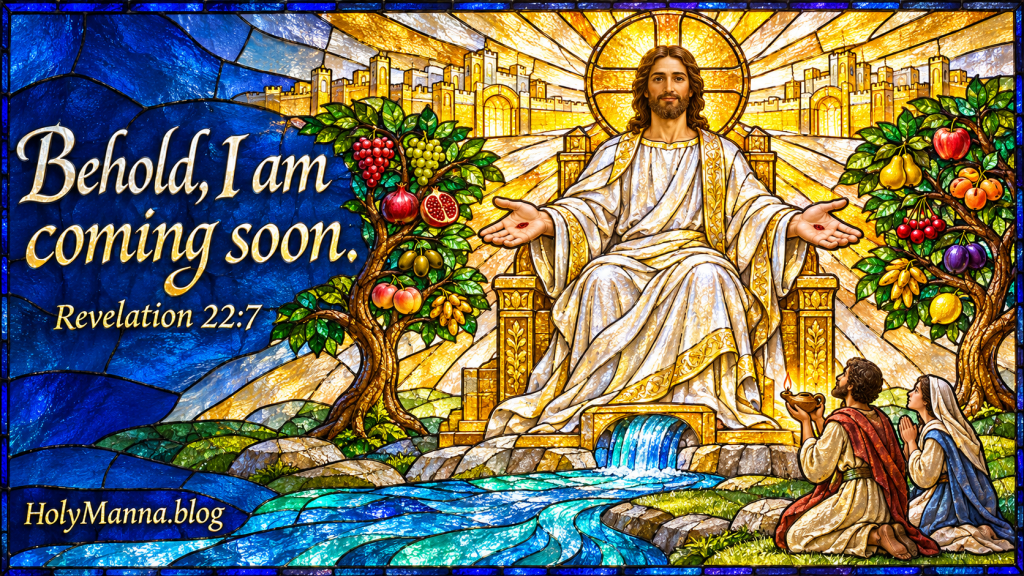
Saturday of the Thirty-fourth Week in Ordinary Time – Lectionary: 508
The Last Page of the Year
Every good story saves its best scene for the final page, and the Church does exactly that today. Saturday, November 28th, 2026, is the last day of the liturgical year. By evening the first candle of Advent will be waiting, but this morning the whole year exhales in a single prayer: “Marana tha! Come, Lord Jesus!”
The 3 readings fit together like the last 3 moves of a long journey. In Revelation 22:1-7, Saint John is shown the destination, a city where a crystal river runs from the throne of God, where the tree of life is back within reach, and where the servants of God finally “look upon his face.” In Psalm 95, the Church practices for that city by doing now what the saints do forever, which is singing, kneeling, and adoring the God who made the sea and the mountains. In Luke 21:34-36, Jesus gives the travel advice for the road between here and there. Hearts get drowsy along the way, and parties, drink, and plain old worry can weigh a soul down until the great day arrives like a trap.
The background matters too. John wrote to small, pressured churches in Roman Asia Minor, and an early tradition recorded by Saint Irenaeus places his vision near the end of the reign of the emperor Domitian, when the question was whether Caesar or the Lamb held the real throne. Jesus spoke his warning in the Temple during the last week before his Passion. Both moments were heavy, and both answers were full of hope.
That is the central theme uniting the day: a heart kept awake by prayer and worship is a heart ready to see the face of God. The year ends with eyes wide open.
First Reading — Revelation 22:1-7
Eden Reopened: The River, the Tree, and the Face of God
The Book of Revelation is the last book of the Bible, and this passage is nearly its last page. John, exiled on the island of Patmos, wrote down his visions for 7 churches in Asia Minor that were tempted to compromise with the Roman empire and its cult of the emperor. After chapters of beasts, plagues, and battles, the smoke clears and an angel walks John through the new Jerusalem. What he sees is deliberately familiar. The Bible opened in Genesis with a garden, a river, and a tree of life, and then sin locked the gate. Now the Bible closes with the river flowing again and the tree bearing fruit every month. The prophet Ezekiel had glimpsed something like it centuries earlier in Ezekiel 47, where water streams from the Temple and trees grow with leaves that heal. This reading fits the day’s theme because it shows what the watchful heart is watching for. Christian vigilance is not anxiety about the end, since it is really homesickness for this city.
Revelation 22:1-7
John said:
An angel showed me the river of life-giving water,
sparkling like crystal, flowing from the throne of God
and of the Lamb down the middle of the street,
On either side of the river grew the tree of life
that produces fruit twelve times a year, once each month;
the leaves of the trees serve as medicine for the nations.
Nothing accursed will be found anymore.
The throne of God and of the Lamb will be in it,
and his servants will worship him.
They will look upon his face, and his name will be on their foreheads.
Night will be no more, nor will they need light from lamp or sun,
for the Lord God shall give them light,
and they shall reign forever and ever.And he said to me,
“These words are trustworthy and true,
and the Lord, the God of prophetic spirits,
sent his angel to show his servants what must happen soon.”
“Behold, I am coming soon.”
Blessed is the one who keeps the prophetic message of this book.
Detailed Exegesis
Verse 1: “An angel showed me the river of life-giving water, sparkling like crystal, flowing from the throne of God and of the Lamb”
The river recalls the one that watered Eden in Genesis 2:10, but its source is new. It flows from a single throne shared by God and the Lamb, a quiet confession of the divinity of Christ. Jesus had promised living water in John 7:37-39, and the evangelist explains that he was speaking of the Holy Spirit. CCC 1137 accordingly counts this river among the “most beautiful symbols of the Holy Spirit.” Saint Bede, the 8th-century Doctor of the Church, read the river as the fruit of Baptism finally revealed in glory.
Verse 2: “down the middle of the street. On either side of the river grew the tree of life that produces fruit twelve times a year, once each month; the leaves of the trees serve as medicine for the nations.”
After the fall, cherubim and a fiery sword guarded the way to the tree of life in Genesis 3:24. Here the tree stands in the open on a public street and fruits every month. The number 12 echoes the tribes of Israel and the apostles, the whole People of God. The leaves are medicine for the nations, meaning that the healing won by Christ is meant for every people on earth. Christian tradition has long seen in this tree a figure of Christ and of his Cross, the wood from which life now hangs within reach of all.
Verse 3: “Nothing accursed will be found anymore. The throne of God and of the Lamb will be in it, and his servants will worship him.”
The sentence spoken over Adam in Genesis 3:17, “Cursed is the ground because of you!”, is lifted for good. Worship stands in its place. Heaven is not idleness, and its central activity is liturgy.
Verse 4: “They will look upon his face, and his name will be on their foreheads.”
Moses was told in Exodus 33:20, “But you cannot see my face, for no one can see me and live.” What was impossible for Moses becomes the daily life of the saints. The name on the forehead recalls the high priest of Israel, who wore on his brow a gold plate engraved with words consecrating him to the LORD, as described in Exodus 28:36-38. Every citizen of the city is now a priest who belongs entirely to God.
Verse 5: “Night will be no more, nor will they need light from lamp or sun, for the Lord God shall give them light, and they shall reign forever and ever.”
The priestly blessing of Numbers 6:25 prayed, “The LORD let his face shine upon you.” Here that blessing is answered without end. The servants of verse 3 turn out to be kings in verse 5, because to serve this God is to reign.
Verse 6: “And he said to me, ‘These words are trustworthy and true, and the Lord, the God of prophetic spirits, sent his angel to show his servants what must happen soon.’”
The angel signs the vision with a guarantee. The word “soon” does not hand anyone a calendar. CCC 673 teaches that since the Ascension the coming of Christ in glory has been imminent, even though the times and seasons belong to the Father alone.
Verse 7: “‘Behold, I am coming soon.’ Blessed is the one who keeps the prophetic message of this book.”
Suddenly Christ himself speaks. This is the 6th of the 7 beatitudes scattered through Revelation, and it blesses the one who keeps the message, which means holding it, guarding it, and living by it.
Teachings
The Church has a name for what verse 4 describes. CCC 1028 explains that God is so far beyond his creatures that he can be seen as he is only when he opens his own mystery to them and gives them the capacity for it, and the Church calls this gift “the beatific vision.” CCC 1023 promises that those who die in the grace and friendship of God, perfectly purified, “live for ever with Christ.”
Saint Irenaeus of Lyons, writing in the 2nd century in Against Heresies (Book 4, Chapter 20), put it in one unforgettable line: “For the glory of God is a living man; and the life of man consists in beholding God.” Saint Augustine ends The City of God (Book 22, Chapter 30) on the same note as he describes the eternal Sabbath of the saints: “There we shall rest and see, see and love, love and praise. This is what shall be in the end without end.”
This vision is also why the Mass matters so much. CCC 1090, quoting the Second Vatican Council, teaches that “in the earthly liturgy we share in a foretaste of that heavenly liturgy.” Every Mass is a sip from that river.
Reflection
Heaven can feel abstract, but this reading makes it concrete with water, fruit, healing, light, and a face. It invites you to let that picture reorder ordinary days. One practical step is to arrive at Mass a few minutes early this weekend and remember that the liturgy is a real share in the worship John saw. Another is to trace the Sign of the Cross slowly on your forehead tonight, recalling that you were claimed for Christ with that sign at Baptism. A third is to bring one wound, whether in your family, your past, or your country, to the Lord whose tree has leaves for healing.
What do you picture when you think about heaven, and does that picture make you want to go there? Where in your life do you most need the healing that flows from the throne of the Lamb? What would change this week if seeing the face of God were truly your deepest goal?
Responsorial Psalm — Psalm 95:1-7ab
The Song That Wakes the Church Up
Psalm 95 reads like the song of pilgrims approaching the Temple in Jerusalem, shouting for joy on the way in and then dropping to their knees before the Lord. For many centuries the Church has prayed it at the very start of her daily prayer. Saint Benedict prescribed it for the night office in Chapter 9 of his Rule in the 6th century, where it is numbered Psalm 94 in the Latin tradition, and it still opens the Liturgy of the Hours as the Invitatory. It is the psalm that wakes the Church up, which makes it a fitting partner for a Gospel about staying awake. Today it carries an unusual refrain. Instead of a line from the psalm itself, the Church answers with one of the oldest prayers Christians possess, an Aramaic cry preserved in 1 Corinthians 16:22 and echoed in Revelation 22:20: “Marana tha! Come, Lord Jesus!” The psalm teaches how to adore, and the refrain teaches what to long for.
Psalm 95:1-7ab
R. (1 Cor 16: 22b, see Rev. 22: 20c) Marana tha! Come, Lord Jesus!
Come, let us sing joyfully to the LORD;
let us acclaim the Rock of our salvation.
Let us come into his presence with thanksgiving;
let us joyfully sing psalms to him.
R. Marana tha! Come, Lord Jesus!
For the LORD is a great God,
and a great king above all gods;
In his hands are the depths of the earth,
and the tops of the mountains are his.
His is the sea, for he has made it,
and the dry land, which his hands have formed.
R. Marana tha! Come, Lord Jesus!
Come, let us bow down in worship;
let us kneel before the LORD who made us.
For he is our God,
and we are the people he shepherds, the flock he guides.
R. Marana tha! Come, Lord Jesus!
Detailed Exegesis
Verse 1: “Come, let us sing joyfully to the LORD; let us acclaim the Rock of our salvation.”
Worship begins with an invitation, and the invitation is plural. Nobody is asked to praise alone. The title “Rock” stirred a specific memory for Israel, the rock in the desert that gave water when Moses struck it in Exodus 17. Saint Paul reveals who that rock was in 1 Corinthians 10:4: “the rock was the Christ.” Saint Augustine, preaching on this verse, said that God “calls us to a great banquet of joy, not one of this world, but in the Lord.”
Verse 2: “Let us come into his presence with thanksgiving; let us joyfully sing psalms to him.”
The Hebrew behind this line speaks of coming before his face, so the psalm is already leaning toward Revelation 22:4. Thanksgiving is the way in, and Catholics can hear the word Eucharist, which means thanksgiving, humming underneath.
Verse 3: “For the LORD is a great God, and a great king above all gods;”
Israel lived surrounded by nations with crowded pantheons, and the psalm does not flatter them. Whatever powers people bow to, whether ancient idols or modern ones like money and status, the LORD outranks them all.
Verse 4: “In his hands are the depths of the earth, and the tops of the mountains are his.”
From the lowest place to the highest, nothing falls outside his grip. Ancient peoples feared the underworld and built shrines on high places, and the psalm calmly places both in the hands of one God.
Verse 5: “His is the sea, for he has made it, and the dry land, which his hands have formed.”
In the ancient world the sea stood for chaos and threat, yet the psalm treats it as a piece of craftsmanship. Augustine read the sea as this stormy world and took comfort that God made it and set its limits.
Verse 6: “Come, let us bow down in worship; let us kneel before the LORD who made us.”
A second invitation moves from the voice to the knees, because the body prays too. Bowing, kneeling, and genuflecting are not decorations. They tell the truth about who is the Creator and who is the creature. Augustine added a consoling line here for anyone burdened by guilt: “He who made you restores you.”
Verse 7ab: “For he is our God, and we are the people he shepherds, the flock he guides.”
The great King of verse 3 turns out to be a shepherd, so power and tenderness meet. Christians cannot hear this verse without thinking of Jesus, who said in John 10:11, “I am the good shepherd.” The Lectionary stops here, but the very next line of the psalm is the hinge to the Gospel: “Oh, that today you would hear his voice: Do not harden your hearts.” The Letter to the Hebrews spends chapters 3 and 4 insisting that this “today” is still open.
Teachings
CCC 2628 cites this very psalm when it describes adoration as “the first attitude of man acknowledging that he is a creature before his Creator.” Adoration, the Catechism continues, exalts the greatness of the Lord who made his people and the power of the Savior who sets them free from evil.
The refrain has its own rich history. Marana tha is Aramaic, the language Jesus spoke, and the first Christians kept it untranslated even when they wrote in Greek, much as the Church still says Amen and Alleluia. The Didache, a Christian manual from around the end of the 1st century, places the cry at the close of its thanksgiving prayers, right after this petition: “Let grace come, and let this world pass away.” CCC 2817 connects the cry to the Lord’s Prayer, teaching that the petition for the Kingdom to come is Marana tha, “the cry of the Spirit and the Bride.” CCC 1130 adds that since the age of the apostles the liturgy has been drawn toward its goal by this groaning of the Spirit in the Church. Every Mass still voices it after the consecration, when the faithful proclaim the death and Resurrection of the Lord until he comes again.
Reflection
This psalm is a morning workout for the soul, and it asks for a voice, a pair of knees, and a listening heart. A simple way to live it is to pray its opening lines as the first words of your day before reaching for a phone. Another is to make your next genuflection slow and deliberate, letting your knee say what your heart believes. A third is to adopt the refrain as a breath prayer during the last hours of this liturgical year and all through Advent, repeating “Come, Lord Jesus” in traffic, in line, and in moments of worry.
Which rival gods, such as comfort, success, or approval, compete for the place of the great King in your life? When did you last pray with your whole body and not only with your thoughts? Do you actually want the Lord to come soon, and what does your honest answer reveal?
Holy Gospel — Luke 21:34-36
Stay Awake: The Lord’s Last Word in the Temple
These 3 verses close the long discourse Jesus gave in the Temple during the final week of his earthly life. He had just foretold the destruction of Jerusalem, which Roman legions carried out in A.D. 70, and he had lifted the eyes of his disciples to his own return in glory. Luke notes right afterward that Jesus taught in the Temple by day and spent his nights on the Mount of Olives. Within days the same disciples would be in a garden on that mount, asleep while their Master prayed. That detail gives the warning its edge. Jesus is not scolding strangers, because he is preparing friends he knows are tired. The Church places these words on the last day of her year, and she proclaims them again on the First Sunday of Advent when the Sunday cycle follows Luke, because they sum up how a Christian lives between the first coming of Christ and the second. The first reading showed the destination, and this Gospel shows how to arrive.
Luke 21:34-36
Jesus said to his disciples:
“Beware that your hearts do not become drowsy
from carousing and drunkenness
and the anxieties of daily life,
and that day catch you by surprise like a trap.
For that day will assault everyone
who lives on the face of the earth.
Be vigilant at all times
and pray that you have the strength
to escape the tribulations that are imminent
and to stand before the Son of Man.”
Detailed Exegesis
Verse 34: “Beware that your hearts do not become drowsy from carousing and drunkenness and the anxieties of daily life, and that day catch you by surprise”
The Greek behind “drowsy” means weighed down, like a boat riding too low in the water. Jesus names 3 weights. The first 2 are obvious, since carousing and drunkenness numb a person on purpose. The third is the sneaky one. The anxieties of daily life sound responsible, yet Jesus puts the worrier and the partier in the same sentence, because both have hearts too crowded to notice God. He had said the same in the parable of the sower in Luke 8:14, where the thorns that choke the word are anxieties, riches, and pleasures. Saint Basil the Great, in a comment preserved by Saint Thomas Aquinas in the Catena Aurea, explained the opening command this way: “Take heed, that is, Look around you on all sides, keeping an ever watchful eye to the guardianship of your soul.”
Verse 35: “like a trap. For that day will assault everyone who lives on the face of the earth.”
A trap works because it goes unnoticed, and no one will be exempt from the day of the Lord. The surprise is not meant to terrify the faithful. It is meant to end procrastination, since a day that could come at any time is a reason to be ready every time.
Verse 36: “Be vigilant at all times and pray that you have the strength to escape the tribulations that are imminent and to stand before the Son of Man.”
Here is the remedy, and it has 2 parts that cannot be separated. Vigilance without prayer becomes nervous self-reliance, and prayer without vigilance becomes sleepy routine. Jesus also tells the disciples to pray for strength, which means that perseverance is a gift to be asked for and not a personal achievement. The goal is to “stand before the Son of Man,” the glorious figure of Daniel 7:13. In Scripture the guilty fall or flee, while the servant who is at home with his master stands. That standing is the same reality the first reading described as looking upon his face.
Teachings
The Catechism treats vigilance as a matter of prayer more than of nerves. CCC 2612 teaches that Jesus calls his hearers to conversion, to faith, and also to watchfulness, and then it states, “In prayer the disciple keeps watch.” The disciple watches for the One who is and who comes, remembering his first coming in the flesh and hoping for his second coming in glory. CCC 2730 names the positive side of the battle of prayer as “vigilance, sobriety of heart,” and notes that whenever Jesus insists on vigilance he ties it to himself, to his coming on the last day and every day.
Saint Paul gives the same counsel in 1 Thessalonians 5:6: “Therefore, let us not sleep as the rest do, but let us stay alert and sober.” Titus of Bostra, a 4th-century bishop whose comments on Luke are also preserved in the Catena Aurea, compressed the whole passage into a single warning: “Beware lest the eyes of your mind wax heavy.”
Recent popes have returned to this passage at the doorway of Advent. Pope Benedict XVI, in his Angelus of December 2nd, 2012, drew from these verses a simple program of sober living and prayer. Pope Francis, in his Angelus of November 28th, 2021, urged vigilance so that daily life does not harden into routine, and he offered this image: “Prayer is what keeps the lamp of the heart lit.”
Reflection
Few people reading this are in danger of sleeping through life in a tavern. Many are in danger of scrolling, snacking, overworking, and worrying their way into a heart that feels nothing. The Gospel invites you to an honest inventory. A first step is to name the one habit that most reliably numbs you and to fast from it for a single week. A second step is to hand over your anxieties by name each night, which is different from pretending they do not exist. A third step is to anchor each day with a fixed time of prayer, even 10 minutes, since Jesus linked staying awake to praying. A brief examination of conscience before sleep keeps short accounts with God and lets you stand before him tomorrow without fear.
Which weighs your heart down more right now, pleasure that distracts or worry that consumes? If the Lord returned tonight, what would you wish you had set right first? What concrete change would make your prayer more faithful during the coming Advent?
Lamps Lit at the Edge of Advent
The liturgical year ends the way a faithful life should end, facing forward. John has shown the destination, and it is better than anyone dared to hope. The garden lost at the beginning of the Bible returns as a city at its end, with a river no drought can touch, a tree with leaves for every wound, and a light that never needs replacing because it is the face of God himself. The psalmist has taught the language of that city, which is joyful song, bent knees, and trust in a King who shepherds his flock. Jesus has given the honest warning that the road there runs through distraction and worry, and that only a heart kept awake by prayer arrives ready to stand before the Son of Man.
None of this is meant to frighten. The One who says “Behold, I am coming soon” is the same Lord who made the sea and the dry land, who died and rose for his people, and who feeds them with his own Body and Blood. His coming is good news for everyone who loves him.
This evening, with the vigil of the First Sunday of Advent, the Church will light the first candle and begin again. Today is the day to clear the heart, to put down what numbs it, to kneel before the Lord who made all things, and to pray the oldest prayer the Church knows with real desire: “Marana tha! Come, Lord Jesus!” The Lord who is coming soon is already near, and he is worth staying awake for.
Engage With Us!
Share your reflections in the comments below. The end of a liturgical year is a natural moment to look back with gratitude and to look ahead with hope, and the insight of one reader often becomes the encouragement another reader needs.
- In Revelation 22:1-7, John sees the river of life, the tree of healing, and the servants who look upon the face of God. Which image of heaven in this reading stirs the deepest longing in your heart, and why?
- In Psalm 95:1-7ab, the psalmist calls the people of God to sing, to bow down, and to kneel before the Lord who made them. How can you bring both your voice and your body more fully into your worship this week?
- In Luke 21:34-36, Jesus warns that carousing, drunkenness, and the anxieties of daily life can make the heart drowsy. What is weighing down your heart right now, and what step will you take to stay vigilant in prayer?
- Taken together, the readings teach that a heart kept awake by worship and prayer is ready to see the face of God. How will you make “Come, Lord Jesus” a real prayer in your life as Advent begins?
Go into this new season with a heart that is awake and unafraid. Live a life of faith that sings, kneels, watches, and hopes, and do everything with the love and mercy that Jesus taught. He is coming soon, and every act of love done in his name is a lamp lit for his arrival.
Sacred Heart of Jesus, we trust in You!
Immaculate Heart of Mary, pray for us!
Saint Michael the Archangel, defend us in battle!
Follow us on YouTube, TikTok, Instagram and Facebook for more insights and reflections on living a faith-filled life.


Leave a Reply