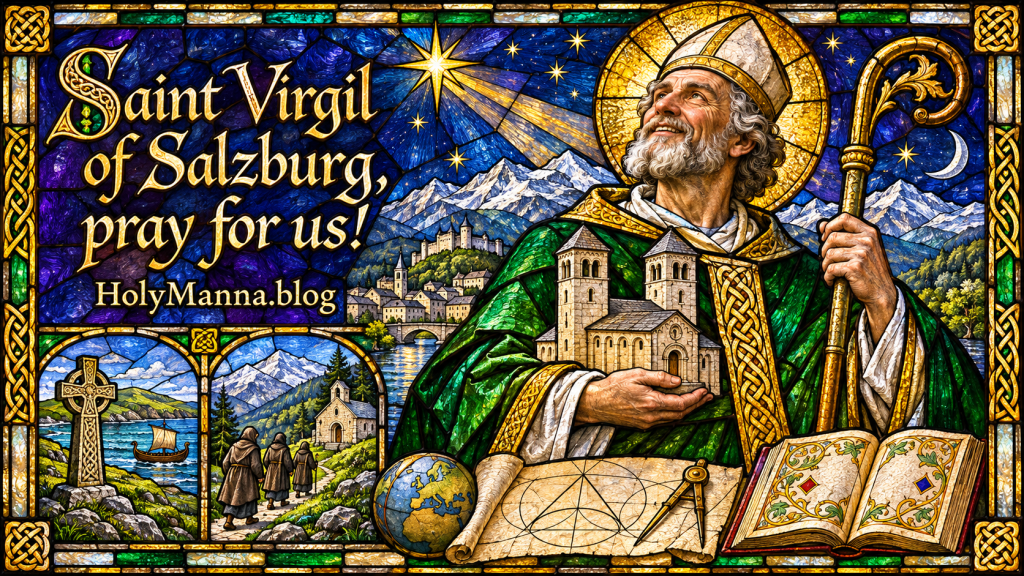
An Irish Scholar on an Alpine Throne
Every year on November 27th, the Church remembers Saint Virgil of Salzburg, an Irish monk who never planned to become a bishop in the Alps. His Irish name was Fergal, sometimes written Feirgil or Feargal. The Latin-speaking world turned it into Virgilius or Vergilius, and English shortens it to Virgil. He was an abbot, a missionary bishop, a builder of churches, and one of the most learned men of the 8th century. Later generations called him the Apostle of Carinthia, because the missionaries he sent carried the Gospel to the Slavic people of the eastern Alps. Irish tradition remembers him as the Geometer, a nickname earned by his love of mathematics, geography, and the study of the heavens.
Saint Virgil is also the saint who got into trouble over his science. He taught something about the shape of the world and about people who might live on its far side, and Saint Boniface, the great Apostle of Germany, reported him to the Pope. The story is often told badly, as though the Church once tried to silence a scientist for saying that the earth is round. The real story is more interesting and far more Catholic. It involves 2 holy men who disagreed, a Pope who asked a careful question, and a faith that has never needed to fear the truth. The Catechism teaches that “there can never be any real discrepancy between faith and reason” (CCC 159). Saint Virgil lived that sentence more than 1,200 years before it was printed.
He is honored as a patron of Salzburg, and the Archdiocese of Salzburg venerates him alongside Saint Rupert as its patron. His relics rest in Salzburg Cathedral, on the ground where he dedicated the city’s first great cathedral in 774. Pope Gregory IX canonized him in 1233, after his forgotten tomb was rediscovered and the sick began to report healings beside it. His name does not appear on the General Roman Calendar, so most parishes will celebrate the ordinary weekday Mass on November 27th. The Roman Martyrology commemorates him on that day, and his memory is kept with special love in Ireland and in Austria.
From the Green Island to the Court of Pepin
Honesty requires a plain admission at the start. Very little about the early life of Saint Virgil can be documented. He was born in Ireland, probably between 700 and 710, and his Irish birth is confirmed by writers of his own century. A later tradition says that he came from a noble family and descended from Niall of the Nine Hostages, the famous High King of Ireland. That tradition cannot be verified.
Irish sources connect him with the monastery of Aghaboe, in what is now County Laois. The Annals of the Four Masters record the death of a Ferghil the Geometer, Abbot of Aghaboe, and add that he “died in Germany, in the thirtieth year of his bishopric”. Most Catholic writers have accepted that this entry describes the bishop of Salzburg. The identification is probable rather than certain, because the Irish annals place the death in 789, while the Salzburg records give 784. What can be said with confidence is that he was formed in the Irish monastic schools, which were among the most respected centers of learning in Europe at that time.
Irish monks of that era practiced a form of sacrifice that they called pilgrimage for Christ. They left home, family, and language behind, and they went wherever God seemed to lead. The Letter to the Hebrews says of Abraham, “He went out, not knowing where he went” (Hebrews 11:8), and the Catechism holds up that obedience as a model of faith (CCC 145). Virgil walked the same road. Tradition says that he set out intending to reach the Holy Land. That intention cannot be verified, but the journey itself is certain.
Around 743 he arrived at the court of Pepin the Short, who was then mayor of the palace and would later be king of the Franks. A Salzburg account written about a century later, the Conversio Bagoariorum et Carantanorum, describes the newcomer as “a certain wise and well-taught man of God named Virgil”. Pepin was impressed enough to keep the Irishman near him for almost 2 years at Quierzy. Then, around 745, Pepin sent him to Bavaria, to his brother-in-law Duke Odilo, whom the Franks had recently defeated in battle. When Bishop John of Salzburg died a short time later, the Irish pilgrim was entrusted with both the Abbey of Saint Peter and the care of the whole diocese.
Some popular accounts say that he worked side by side with Saint Rupert, the founder of the Church in Salzburg. That cannot be correct, because Saint Rupert had died roughly a generation earlier. Virgil was his successor and the great promoter of his memory.
He governed Salzburg at first in the Irish manner. In Ireland, a great abbot often ruled the local church while a bishop living in the monastery performed ordinations and confirmations. Virgil did the same, leading the diocese as abbot while his countryman, Bishop Dobdagrecus, carried out the episcopal functions. The Conversio says that he kept his own ordination hidden for almost 2 years, and later tradition saw in this an act of humility. The date of his consecration as bishop is disputed. The Conversio gives June 15th, 767, while many modern historians, followed by official Salzburg sources, argue for 749. Either way, the pilgrim who meant only to pass through had become the shepherd of a people.
A Cathedral, a Mission, and a Book of Names
Saint Virgil led the Church of Salzburg for nearly 40 years, and 3 achievements show why he deserves to be remembered and imitated.
The first is a house for God. On September 24th, 774, he dedicated a new cathedral in Salzburg and solemnly carried the relics of Saint Rupert into it. It was a three-aisled basilica and one of the notable churches of its age. Verses attributed to Alcuin of York, the leading scholar at the court of Charlemagne, praise the builder as “an outstanding bishop, gracious in merit and character”, and they add that mother Ireland first brought him into the light. Archaeologists uncovered remains of this cathedral in the 20th century, beneath the present Baroque building. The Catechism explains why such labor matters. A church is a house of prayer where the Eucharist is celebrated and reserved, and it ought to be beautiful and worthy of what happens there (CCC 1181). Virgil the Geometer placed his gift for measure and proportion at the service of worship.
The second achievement is the mission that earned him his title. To the southeast of Salzburg lay Carantania, the land of an Alpine Slavic people who are counted among the ancestors of the Slovenes of today, and whose territory included modern Carinthia. Their duke, Boruth, had asked the Bavarians for help against the Avars, and as part of that alliance his son Cacatius and his nephew Cheitmar were raised as Christians in Bavaria. When Cheitmar became duke, he asked Virgil to come and teach his people. The Conversio records that the bishop was unable to go, and that he sent in his place a missionary bishop named Modestus, with the priests Watto, Reginbert, Cozharius, and Latinus, and a deacon named Ekihard. They consecrated a church of Saint Mary, which is traditionally identified with Maria Saal, as well as churches at Liburnia and at a place called Undrimas. Saint Modestus stayed among the Carantanians until his death.
The work was never easy. After Modestus died, uprisings broke out more than once, and at one point the priests had to leave. After the death of Duke Cheitmar, Carantania had no priest at all for several years. Each time, Virgil began again. When a new duke named Waltunc asked for help, the bishop sent one group of clergy after another, and the Conversio lists 6 successive missions. The Lord had commanded, “Go and make disciples of all nations” (Matthew 28:19), and the Catechism teaches that the Church exists to carry out this mandate (CCC 849). It also warns that missionary work requires patience and will know times of defeat (CCC 854). Saint Paul described the same experience when he wrote, “I planted. Apollos watered. But God gave the increase” (1 Corinthians 3:6). Virgil planted through the hands of other men, and God gave the increase. The Carantanians became one of the first Slavic peoples to embrace the Catholic faith.
Later writers, including Father Alban Butler in his Lives of the Saints, add that Virgil personally baptized 2 dukes of Carinthia at Salzburg. They also relate that, near the end of his life, he made a long pastoral visitation through Carinthia, as far as the place where the Drava meets the Danube. The earliest Salzburg account says only that he was unable to go and sent others in his place. These stories of personal baptisms and journeys therefore cannot be verified.
The third achievement is quieter. In the last year of his life, Virgil began the confraternity book of Saint Peter’s Abbey, known as the Liber Confraternitatum. It is a book of names, living and dead, written down so that they would be remembered at the altar, and the original still survives in Salzburg. The Catechism teaches that the Church has honored the memory of the dead from the beginning and offers prayers for them, and that this prayer can help them (CCC 958).
A reader may fairly ask about miracles. The earliest sources for his life do not record any miracle worked by Saint Virgil while he lived. They record something slower and just as real, which is 40 years of steady, intelligent, prayerful work for souls. The miracles would come later, at his tomb.
When Two Saints Disagreed
Saint Virgil was not a martyr. His hardships were those of an exile governing strangers in a duchy that had just lost a war, under the eye of a famous archbishop who doubted him. That archbishop was Saint Boniface, the English missionary who had organized the Bavarian dioceses in 739 and who was understandably protective of his work. The 2 men collided twice, and both collisions are documented in letters of Pope Saint Zachary.
The first dispute concerned Baptism. A priest in Bavaria knew so little Latin that he baptized with a mangled formula. In the papal letter of July 1st, 746, the words are reported as “Baptizo te in nomine patria et filia et spiritus sancti”, which turns the names of the Father and the Son into the feminine gender. Boniface ordered that the people be baptized again. Virgil and his companion Sidonius, the future bishop of Passau, brought the matter to Rome. Pope Zachary answered that the priest had introduced no error or heresy and had only stumbled through ignorance of the language, so the baptisms stood. He told Boniface, “you must no longer issue instructions to this effect”. The ruling fits what the Church still teaches. Baptism is conferred in the name of the Father, and of the Son, and of the Holy Spirit (CCC 1240), by a minister who intends to do what the Church does (CCC 1256). The sacraments act by the power of Christ and not by the personal polish of the minister (CCC 1128), and Baptism imprints a spiritual mark that can never be repeated (CCC 1272).
The second dispute is the famous one. In a letter of May 1st, 748, Pope Zachary answered a list of complaints from Boniface. According to that letter, Virgil was accused of stirring up trouble between Boniface and Duke Odilo, and also of teaching a strange doctrine. The Pope instructed that if it were clearly shown that Virgil held that there is “another world and other men beneath the earth”, a council should be called and he should be removed from the priesthood. The Pope also wished to have him examined in Rome.
Several facts need to be stated carefully here. The ruling was conditional. No record exists of any council, any condemnation, or any recantation. Virgil went on to serve as bishop of Salzburg until his death, and the Church later raised him to the altars. His own treatise is lost, so nobody knows exactly what he taught. The common claim that he was condemned for teaching that the earth is round is not supported by the documents. Educated churchmen of his century, such as Saint Bede in England, already described the earth as a sphere. The real worry, as the old Catholic Encyclopedia explains, was theological. If there were another race of men on the far side of the world who did not descend from Adam, then they would seem to stand outside original sin and outside the redemption won by Christ.
On that point the Church cannot bend, and nothing suggests that Saint Virgil ever asked her to. Saint Paul preached in Athens that God “made from one blood every nation of men to dwell on all the surface of the earth” (Acts 17:26). The Catechism quotes that verse when it teaches that the whole human race forms a unity because of its common origin (CCC 360). All people share in the wound of Adam (CCC 402), and Christ died for all people without exception (CCC 605). It seems that Virgil was able to show that his teaching denied none of this.
His curiosity was itself an act of faith. The psalmist sings, “The heavens declare the glory of God. The expanse shows his handiwork” (Psalm 19:1). The Catechism teaches that the order and beauty of the world lead the mind toward its Creator (CCC 32), and that scientific discoveries about the cosmos invite even greater admiration for His greatness (CCC 283).
It is worth pausing over the fact that both men in this quarrel are canonized saints. Saint Boniface would die a martyr in 754, struck down while preparing to confirm new Christians. He was not a villain, and Virgil was not a rebel. They were 2 zealous pastors with different training, different customs, and incomplete information about each other. The Catechism asks every Christian to avoid rash judgment and to interpret the thoughts, words, and deeds of a neighbor in a favorable way as far as possible (CCC 2478). Saint Paul gives the same counsel when he writes, “If it is possible, as much as it is up to you, be at peace with all men” (Romans 12:18). Virgil took his case to the successor of Peter and kept working.
His last trial was his final illness. The account given by Butler relates that a slow fever seized him after he returned from his long visitation, and that he, “after a fervent preparation, cheerfully departed to our Lord”. The date of his death, November 27th, 784, is well attested in Salzburg. The details of the fever and the journey come from later tradition and cannot be verified. The Church encourages every believer to prepare for the hour of death (CCC 1014), and tradition remembers this bishop as a man who met that hour with joy.
A Tomb in the Wall and a City at Prayer
Saint Virgil was buried in the cathedral he had built. Over the centuries, Salzburg lost track of his grave. The cathedral burned in 1167, and during the long rebuilding something unexpected happened. On February 16th, 1181, stones fell out of an old wall and exposed a hollow space decorated with ancient painting. The cathedral canons widened the opening and found a tomb, together with a painted image of a bishop and a line of Latin verse, “Virgilius templum construxit scemate pulchro”, which means “Virgil built this temple in beautiful form”. The founder of the cathedral had been resting inside its wall for almost 400 years.
News of the discovery spread quickly. People suffering in body and in mind came to the tomb in crowds, and many reported that they were healed. A collection of his miracles compiled in Salzburg at that time contains more than 80 reports, most of them cures of the sick, and the annals of the period note signs and wonders in the cathedral in that same year. These accounts come from that medieval collection, and the individual cures cannot be verified today. What is certain is that the reports were taken seriously. A papal inquiry into his life and miracles was opened under Pope Innocent III in 1200, and Pope Gregory IX canonized him on June 18th, 1233. Some popular listings give June 10th, or the year 1232, but the Salzburg records support June 18th, 1233. An altar was dedicated in his honor in the rebuilt cathedral in 1288.
By canonizing some of the faithful, the Church solemnly declares that they practiced heroic virtue and lived in fidelity to the grace of God, and she proposes them as models and intercessors (CCC 828). The saints in heaven never stop interceding for those still on earth (CCC 956). The miracles of the saints are signs that support faith (CCC 156), and the veneration of relics, pilgrimages, and processions belong to the healthy popular piety of the Christian people (CCC 1674).
That piety is still alive. The relics of Saint Virgil are kept in Salzburg Cathedral, which is the 17th-century successor of his own church and the place where Mozart was baptized. His statue stands at the cathedral entrance near that of Saint Rupert. Sacred art shows him as a bishop holding a model of a church, often with 2 towers. Salzburg celebrates its patrons each year on September 24th, the anniversary of the day in 774 when Virgil dedicated his cathedral and enshrined the relics of Rupert. In certain years the relics of both saints are carried in procession from Saint Peter’s Abbey to the cathedral. A local devotion in Salzburg also invokes him for mothers in childbirth and for children. In Carinthia, the pilgrimage church of Maria Saal preserves the memory of Saint Modestus and of the mission that Virgil sent.
His homeland has not forgotten him either. His feast is kept in Ireland, and Irish emigrants carried his name across the world. The bishop who wondered about people on the far side of the globe is honored today in the southern hemisphere, where a Catholic college in Hobart, Tasmania, bears his name.
Faith That Thinks, Builds, and Begins Again
His example offers 4 lessons, and each one can be practiced this week.
The first lesson is that you never have to choose between your faith and your mind. Virgil studied the stars and measured the earth, and none of it pulled him away from Christ. The Catechism calls science and technology precious resources when they are placed at the service of the human person (CCC 2293). If you work in a laboratory, a classroom, a hospital, or an engineering office, your work can be an offering to God. Step outside on the next clear night, look up, and pray Psalm 19 slowly. When was the last time that something you learned made you want to praise God?
The second lesson is that disagreement inside the Church does not have to become division. Virgil and Boniface saw things differently, and both of them became saints. The Irish abbot brought his case to Rome instead of nursing a grudge. You can bring a real concern to the person who has the authority to resolve it, and refuse to gossip about it in the meantime. Give other Catholics the favorable reading that the Catechism asks for (CCC 2478). Is there someone in your parish, your family, or your online life whom you have judged too quickly?
The third lesson is the courage to begin again. The mission to Carantania collapsed more than once, and Virgil simply sent the next group of priests. The Catechism reminds lay people that they also evangelize, by the witness of their lives and by their words (CCC 905). Your Carantania may be a grown child who has stopped practicing the faith or a friend who has drifted. Keep praying, keep inviting, and keep showing up with kindness. Where have you stopped planting because the first harvest failed?
The fourth lesson is trust in Providence when plans change. Virgil left Ireland as a pilgrim, and God stopped him in Salzburg and asked him to stay for 40 years. The Catechism teaches that divine Providence is concrete and immediate, and that God cares for everything from the least things to the great events of history (CCC 303). What plan of yours has God interrupted, and what might He be building there instead?
There is one more practice worth borrowing from this saint. Virgil ended his life writing down names so that they would be remembered at the altar. You can keep your own small book of names. Write down the living and the dead whom God has placed in your life, bring the list to Mass, and offer it silently at the Offertory. Prayer of this kind begins in humility, which the Catechism calls the foundation of prayer (CCC 2559). A faith that thinks clearly, builds patiently, forgives quickly, and remembers others before God is the faith that Saint Virgil handed on.
Engage With Us!
Share your thoughts and reflections in the comments below. Your story may strengthen another reader.
- Saint Virgil loved both the faith and the study of the natural world. How has learning about creation deepened your own relationship with God?
- Virgil and Boniface disagreed sharply, and both of them still became saints. How do you handle disagreement with other Catholics, and what would it look like to assume the best about them?
- The mission to Carantania failed several times before it bore fruit. Where is God asking you to begin again with patience?
- Virgil set out for the Holy Land and ended up serving in Salzburg for 40 years. How have changed plans in your life revealed the Providence of God?
- Whose names would you write in your own book of remembrance, and how can you pray for them this week?
Saint Virgil of Salzburg shows that a curious mind and a faithful heart belong together. Ask for his intercession, study hard, build what is beautiful, and never tire of sharing the Gospel. Live a life of faith, and do everything with the love and mercy that Jesus taught.
Saint Virgil of Salzburg, pray for us!
Follow us on YouTube, TikTok, Instagram and Facebook for more insights and reflections on living a faith-filled life.


Leave a Reply