Cut to Pieces & Made Whole
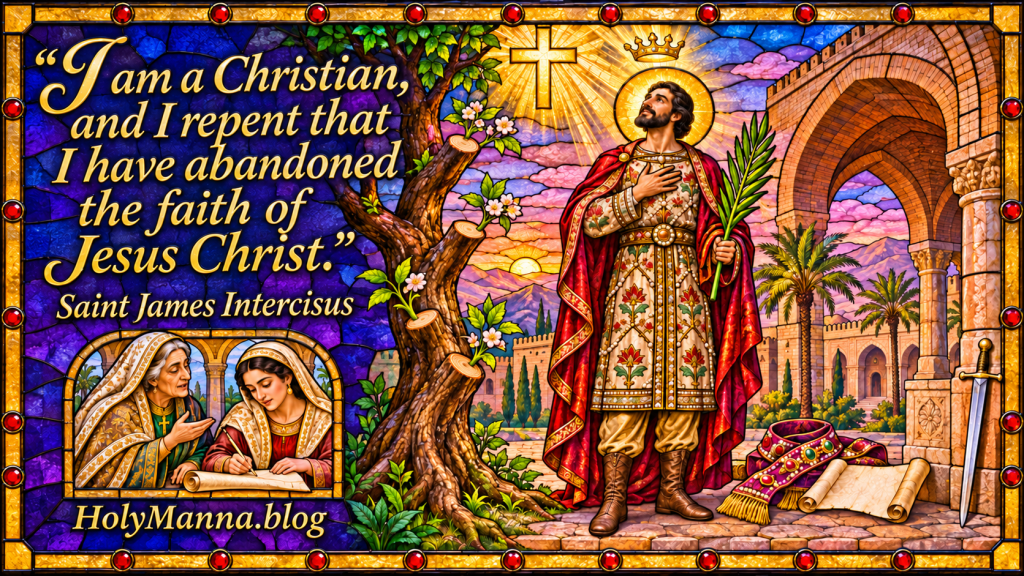
On November 27th, the Church remembers a martyr from ancient Persia whose story is almost too intense to believe and far too human to forget. His name is Saint James Intercisus. The surname is Latin, and it means cut to pieces, because that is exactly how he died around the year 421. The traditional Roman Martyrology introduces him with a single line: “In Persia, St. James Intercisus, a distinguished martyr.” The current edition of the Martyrology adds the outline of his story. He denied Christ in order to stay in the good graces of a king, he was sharply rebuked by his mother and his wife, he repented, and he fearlessly confessed the faith before the next king, who ordered him to be dismembered and beheaded.
That outline is what makes James so compelling. Many martyrs seem to have been made of steel from the very beginning, and James was not one of them. He was a nobleman and a royal favorite, remembered in later Catholic tradition as a military officer and courtier, and when the pressure came, he folded. Then 2 women who loved him told him the truth, and he came home to Christ with a courage that still stuns anyone who reads the account.
Catholic tradition invokes him as the patron of lost vocations and of victims of torture. He is honored by Latin Catholics, Maronites, Melkites, and Christians all across the East. The Catechism teaches that “Martyrdom is the supreme witness given to the truth of the faith” (CCC 2473). James gave that witness only after he had given the opposite one, which is why his life speaks so directly to anyone who has ever drifted, compromised, or kept the faith quiet in order to fit in.
A Royal Favorite From Beth Lapat
History says very little about the childhood of James. The earliest accounts of his martyrdom were written in Syriac, the Aramaic language of the Persian Christians, and they were later translated into Greek and Latin. Father Alban Butler, the 18th century English priest whose Lives of the Saints drew on those ancient Acts, reports that James was born at Beth Lapat, a royal city of Persia in the region of Beth Huzaye, in what is now southwestern Iran. Butler describes him as a nobleman of the first rank. The accounts agree that he was born to Christian parents and that he married a Christian wife.
The Church in Persia had already been through fire by the time James came of age. A long and bloody persecution under King Shapur II had filled the 4th century with martyrs. Then a season of relief arrived. Saint Alphonsus Liguori, a Doctor of the Church, tells the story of James in Victories of the Martyrs, and he notes that the Christians of Persia enjoyed about 20 years of peace under King Yazdegerd I, whom the older sources call Isdegerdes. During those quiet years James rose high, holding honors at court and enjoying the personal friendship of the king.
Then the years of peace came to an end. As Saint Alphonsus tells it, a bishop named Abdas set fire to a Persian temple, and the fury of the king fell on the whole Church. Churches were ordered destroyed, and the subjects of the king were commanded to follow the religion of Persia. James now had to choose between his King in heaven and his king on earth. Saint Alphonsus writes that James, afraid of losing his property and his honors at court, obeyed the royal decree. Butler says that he could not bear to lose the favor of the king. Either way, James renounced Jesus Christ.
The Catechism has a precise name for this sin. It is apostasy, the complete rejection of the Christian faith by someone who once held it (CCC 2089). The Lord Himself spoke about it with frightening clarity: “Every one therefore that shall confess me before men, I will also confess him before my Father who is in heaven. But he that shall deny me before men, I will also deny him before my Father who is in heaven” (Matthew 10:32 to 33).
This is where the real heroes of the first half of the story step in. The mother and the wife of James had stayed faithful, and they were away from him when he fell. When the news reached them, they did not make excuses for him. After King Yazdegerd died, they sent James a letter, and Butler preserves its sting. They told him that in chasing the favor of a king “you have forsaken the love of the immortal God.” They pointed to the dead monarch and wrote, “Think where that king now lies, on whose favour you set so high a value.” Then they drew the line: “As for our parts, we will have no more commerce with you.” In the version given by Saint Alphonsus, they warned that unless he returned to the right path, “we shall treat thee as a stranger, and separate from thee.”
It was tough love in the purest sense. The Catechism lists fraternal correction among the everyday ways that conversion takes root in a Christian life (CCC 1435). Scripture says the same thing more bluntly: “Better are the wounds of a friend, than the deceitful kisses of an enemy” (Proverbs 27:6).
The letter did its work on his heart. Butler writes that James was deeply shaken, and that he began to think about what his apostasy would deserve on the last day from the great Judge. The medieval account of his life, compiled in the 13th century by Blessed Jacobus de Voragine, places these words on his lips: “If my mother that bare me, and my wife, be made so strange to me, then how much more shall I be estranged from God.” James wept over what he had done. He kept away from the court, he turned his back on the honors that had cost him his soul, and he began to say openly what Saint Alphonsus records: “I am a Christian, and I repent that I have abandoned the faith of Jesus Christ.”
The Miracle of a Changed Heart
Anyone looking for spectacular miracles in the lifetime of James will not find them. The trustworthy accounts record no healings, no visions, and no wonders worked by his hands. What they record is something quieter and, in its own way, greater, which is a man who had publicly denied Christ and who publicly came back.
The Catechism teaches that conversion is first of all a work of the grace of God, who turns hearts back to Himself (CCC 1432), and that genuine repentance is an interior change that reorients the whole of a person’s life toward God (CCC 1431). That is precisely what happened in Beth Lapat. The same grace that reached Saint Peter reached James. The Gospel of Luke describes the moment after Peter denied the Lord 3 times: “And the Lord turning looked on Peter. And Peter remembered the word of the Lord, as he had said: Before the cock crow, thou shalt deny me thrice. And Peter going out, wept bitterly” (Luke 22:61 to 62). The Catechism points to the tears of Peter as a model of the second conversion to which every baptized person is called (CCC 1428 to 1429).
This is why James matters, and why he deserves to be remembered and imitated. He proves that failure is not final. The Catechism is emphatic that no sin is too grave for the Church to absolve when the sinner truly repents (CCC 982), and that Christ instituted the Sacrament of Penance above all for those who have fallen into grave sin after Baptism (CCC 1446). The Fathers of the Church described this sacrament as a second plank thrown to a sailor after shipwreck, and James grabbed that plank with both hands.
He also refused to return in secret. His sin had been public, and so his repentance was public. The Catechism teaches that keeping the faith privately is not enough, since every disciple is also bound to profess it openly and to bear witness to it (CCC 1816). James went back into the very world where he had denied his Lord, and he told everyone the truth about himself.
There are 3 things worth imitating here. The first is his honesty, because he never blamed the king, the times, or the pressure. The second is his speed, because once the letter opened his eyes he did not wait for a safer season. The third is his humility, because he let himself be corrected by the people who knew him best. His mother and his wife deserve imitation as well, since they loved James enough to risk losing him. It is no surprise that James is invoked as the patron of lost vocations. He knows from the inside what it is to walk away from a calling and what it costs to walk back.
28 Pieces and One Offering
Word of the change in James reached the palace quickly. By this time the throne belonged to Bahram V, called Vararanes in the old sources, the son and successor of Yazdegerd. The accounts differ on this point. Saint Alphonsus places the trial under Yazdegerd himself and dates the martyrdom to the year 420, while Butler and the Roman Martyrology place it under Bahram, and Butler gives the year as 421. The second version is the one most commonly accepted.
The king summoned James and reproached him for his ingratitude after all the favors the late king had shown him. Butler records the calm reply of James, who simply asked about the dead monarch: “Where is he at present?” When the king threatened him with a slow and terrible death, James answered with words that echo the oracle of Balaam in The Book of Numbers: “Any kind of death is no more than a sleep. May my soul die the death of the just.”
The king took counsel and passed a sentence designed to terrify every Christian in the empire. Unless James renounced Christ, he would be hung up and his limbs would be cut off one after another, joint by joint. A great crowd gathered to watch, and many of the onlookers wept. Butler reports that James told them that this death, dreadful as it looked, was “very little for the purchase of eternal life.” Then he turned to the executioners and asked, “Why stand ye idle looking on?”
They began with his right thumb. As it fell, James prayed aloud, and Butler preserves the prayer: “O Saviour of Christians, receive a branch of the tree. It will putrify, but will bud again, and, as I am assured, will be clothed with glory.” Few acts of faith in the resurrection of the body are more beautiful. The Catechism teaches that on the last day Christ will raise the dead in their own bodies, transformed to share in the glory of His risen body (CCC 999), and Saint Paul describes that hope in language James clearly knew by heart: “It is sown in corruption, it shall rise in incorruption. It is sown in dishonour, it shall rise in glory. It is sown in weakness, it shall rise in power” (1 Corinthians 15:42 to 43).
When the next finger was cut away, James prayed, “My heart hath rejoiced in the Lord; and my soul hath exulted in his salvation.” The executioners worked through all 10 fingers. In the medieval telling, friends then pleaded with him to give in while skilled physicians could still heal him, and James refused with the words, “God forbid that in me should be any false dissimulation.” His 10 toes followed, and James gave thanks at every loss. When the last toe was gone, he said, “Now the boughs are gone, cut down the trunk.” Then came his feet, his hands, his arms, and his legs. Saint Alphonsus writes that he endured each cut “without a moan.” The medieval account says that the executioners labored from the first hour of the day to the ninth, and that near the end the martyr prayed, “O good Lord, hear me half alive.” At last his head was struck off. Butler dates his death to November 27th in the year 421, the second year of King Bahram. The faithful later counted 28 severed pieces besides the trunk, which matches the order of the torture: 20 fingers and toes, 2 feet, 2 hands, 2 arms, and 2 legs.
A word of honesty belongs here. The oldest Acts present themselves as the work of an eyewitness, and the short prayers preserved by Butler come from that tradition. Later medieval versions expanded the words of James into a long series of meditations, one for each finger and toe, and those are best read as devout elaboration and not as a transcript. Some modern Catholic writers have also wondered whether the account, as it has come down, blends the memories of more than one Persian martyr of those years. That question cannot be settled with certainty. The Church, for her part, continues to honor James in the Roman Martyrology on November 27th.
There was no miraculous escape for James, and no angel came to stop the blade. The divine protection he received was interior. It was the grace of final perseverance and the gift of fortitude, the virtue that gives a person the strength to master fear, including the fear of dying, and to stand firm under persecution (CCC 1808). The Catechism also teaches that the martyr testifies to the dead and risen Christ, bound to Him by love (CCC 2473), and that the Church treasures the Acts of the Martyrs as a record of truth sealed in blood (CCC 2474). The Letter to the Hebrews could have been describing him when it says of the heroes of faith, “they were cut asunder” (Hebrews 11:37).
James turned an execution into an offering, piece by piece. It is also fitting that a man who was tortured to death is invoked as the patron of torture victims. The Catechism condemns torture as a violation of the dignity of the human person (CCC 2297).
Relics, Fire, and a Name That Crossed the World
The story of James did not end with the sword. Butler relates that the Christians offered a large sum of money for the body and were refused. They waited for their chance, carried the remains away in secret, and gathered the 28 pieces together with the trunk into a chest, along with the blood they were able to collect. They buried everything in a place unknown to the pagans. The eyewitness who wrote the Acts then adds a line that may be the earliest recorded prayer to this martyr: “We all, suppliant, implored the aid of the blessed James.” That instinct is thoroughly Catholic. The Catechism teaches that the saints in heaven never stop praying to the Father for the Church on earth (CCC 956), and it counts the veneration of relics among the genuine expressions of the piety of the faithful (CCC 1674).
One version of the ancient Syriac Acts tells a striking story about that burial. As the Christians prayed over the remains, fire came down from heaven upon the body of the martyr and upon the ground that was stained with his blood. The Greek versions of the Acts leave this episode out entirely. This story cannot be verified.
A second story concerns the travels of his relics. A Coptic account from the 6th century says that the remains of James were carried from Persia to Jerusalem and then on to the city of Oxyrhynchus in Egypt. The Syriac and Greek versions know nothing of this journey. This story cannot be verified.
Churches in the West have also claimed relics of James over the centuries. One report says that a bishop gave relics of the martyr, including his head, to the abbey of Cormery in France in the year 1103. A 12th century silver head reliquary kept in Zadar, in Croatia, has been catalogued under his name, and the cathedral of Braga in Portugal is often named as a shrine of his relics. More than one place has claimed the same relic, and none of these claims can be verified. No specific healing miracles attributed to his intercession are documented in the reliable Catholic sources either.
What can be verified is the remarkable reach of his memory. Butler wrote that his martyrdom was “most renowned in the churches of the Persians, Syrians, Coptes, Greeks, and Latins.” The Byzantine tradition honors him as the Great Martyr James the Persian, and the Maronite Catholic Church keeps his feast on November 27th. In Qara, Syria, the Monastery of Mar Yakub is dedicated to Saint James the Mutilated and traces its origins to the 6th century. It was once a famous destination for pilgrims, and since the year 2000 it has been home to a Melkite Greek Catholic monastic community. A church in the Armenian Quarter of Jerusalem bore his name in the age of the Crusades, and another is dedicated to him in Tesqopa, in northern Iraq.
James was never canonized through the modern process, because his veneration began many centuries before that process existed. His place in the Roman Martyrology is the recognition of his witness by the Church, which holds up the saints to the faithful as models and as intercessors (CCC 828). Butler notes that the persecution in which he died ended only after the armies of the Emperor Theodosius the Younger defeated King Bahram.
The Road Back Is Still Open
The life of James reads like an ancient drama, but its lessons land squarely in an ordinary week. Start with the way he fell. James never planned to deny Christ. He simply wanted to keep his career, his comfort, and the approval of powerful friends, and he let those good things outrank the best thing. The question of the Lord cuts through every age: “For what shall it profit a man, if he gain the whole world, and suffer the loss of his soul?” (Mark 8:36). Few readers will ever be asked to renounce the faith before a king, but almost everyone is asked to stay quiet about it at work, to laugh along with a crowd, or to tuck it out of sight in order to keep the peace. Where are you tempted to trade your faith for approval, comfort, or advancement?
Next, look at the letter. James was saved because 2 women loved him enough to tell him the truth. Who in your life has the courage to tell you what you need to hear, and do you listen when they do? Is there someone you love who has drifted from the faith, and have you been praying and speaking with the same honest love that the mother and the wife of James showed? Their letter was severe, but it was written to win him back, and it did.
Then consider how quickly James returned. He did not wait until he felt worthy. He simply went back to Christ. The prodigal son in the parable speaks for him: “I will arise, and will go to my father, and say to him: Father, I have sinned against heaven, and before thee” (Luke 15:18). For a Catholic today, that road leads to the confessional. The feast of James falls on the doorstep of Advent, which makes it a perfect prompt to make a good Confession. The Catechism teaches that Christ gave this sacrament to the Church so that those who have fallen after Baptism may recover the grace they lost (CCC 1446). If it has been months, or years, or decades, James is the right saint to ask for courage. What is keeping you from the confessional, and what would it take to go this week?
James also teaches a practical way to suffer. He could not control what was taken from him, but he could decide what to do with each loss, and he made each one a gift. You can do the same on a much smaller scale. A headache, a hard conversation, a long commute, a diagnosis, or a disappointment can each be handed over with a short prayer, and the prayer of James is a fine one to borrow: “O Saviour of Christians, receive a branch of the tree.” The Catechism teaches that the trials of daily life, when they are carried with patience, become a spiritual offering pleasing to the Father through Christ (CCC 901). What piece of your day could you offer to God instead of merely enduring it?
Finally, James invites a compassion that reaches beyond the self. Christians are still imprisoned and tortured for the faith in many parts of the world, and others have walked away from a vocation or from the practice of the faith altogether. James is a patron for all of them. You can pray for the persecuted, and you can entrust a fallen-away family member or friend to his intercession. You can also hold on to the promise that sustained him: “Be thou faithful until death: and I will give thee the crown of life” (Revelation 2:10). James was faithless for a season, and Christ was faithful the whole time.
Engage With Us!
Readers are warmly invited to share their thoughts and reflections in the comments below. The story of Saint James Intercisus tends to stir something personal, and your insight may be exactly what another reader needs today.
- Have you ever hidden or downplayed your faith in order to keep the approval of other people, and what did that experience teach you?
- Who has played the role of the mother and the wife of James in your life by telling you a hard truth out of love?
- Is there someone you know who has drifted from the Church, and how might you reach out to that person with both honesty and tenderness?
- What small suffering in your daily routine could you begin offering to God, piece by piece, as James did?
- How does the confidence of James in the resurrection of the body change the way you think about suffering, aging, and death?
May the example of Saint James Intercisus give you the courage to come back every time you fall and the strength to stand firm when the faith is costly. Live a life of faith, stay close to the sacraments, and do everything with the love and mercy that Jesus taught.
Saint James Intercisus, pray for us!
Follow us on YouTube, TikTok, Instagram and Facebook for more insights and reflections on living a faith-filled life.


Leave a Reply