A Small Medal With a Very Big Story
Chances are good that a Miraculous Medal is sitting somewhere close by right now. It may hang from a grandmother’s rosary, hide in a wallet, or swing from a rearview mirror. Few Catholic objects are more familiar, and few are less understood. Every November 27th, the Vincentian Family and millions of the faithful remember where that little oval came from. It came from a convent chapel at 140 Rue du Bac in Paris, where a 24-year-old novice named Catherine Labouré reported in 1830 that the Blessed Virgin Mary appeared to her and asked that a medal be struck.
Our Lady of the Miraculous Medal is not inscribed on the General Roman Calendar, so most parishes will celebrate the ordinary weekday Mass on November 27th, which in 2026 is the Friday of the 34th Week in Ordinary Time. The celebration belongs to the proper calendar of the Congregation of the Mission and the Daughters of Charity, who received it as a feast from Pope Leo XIII in 1894. The Archdiocese of Paris keeps it as an optional memorial. Calling it a feast day is accurate within the Vincentian Family and affectionate everywhere else.
A celebration absent from the universal calendar still matters, because the medal works like a pocket catechism. Its front proclaims the Immaculate Conception 24 years before the dogma was defined. Its back shows the Cross, the letter M, and 2 hearts. Its prayer is short enough for a child to memorize: “O Mary, conceived without sin, pray for us who have recourse to thee.” The Catechism of the Catholic Church teaches that honoring Mary is part of Christian worship and is a different thing altogether from the adoration owed to God alone (CCC 971).
This is the story of how a farm girl, a skeptical priest, a careful archbishop, and a cholera epidemic gave the Church a sacramental that has never gone out of circulation.
A Farm Girl and a Restless City
Catherine Labouré was born on May 2nd, 1806, in the Burgundian village of Fain-lès-Moutiers, into a large farming family, and she was baptized Zoé. Her mother died in 1815, when Catherine was 9. Her biographers pass on a story from those days. The grieving child is said to have embraced a statue of the Blessed Virgin and asked Mary to be her mother from then on. A second story tells of a dream in which an elderly priest beckoned to her, a priest she later recognized in a portrait of Saint Vincent de Paul. Both are best received as cherished stories and not as documented events.
Her father resisted her vocation and sent her to Paris to work for her brother, yet she persevered. In January 1830 she began her postulancy with the Daughters of Charity at Châtillon-sur-Seine, and that April she arrived at the motherhouse on Rue du Bac.
The France she entered was restless. The wounds of the Revolution of 1789 had never fully closed, and in July 1830 Paris erupted again when revolutionaries overthrew King Charles X. Living through that anxious moment were 2 religious families founded in the 17th century by Saint Vincent de Paul: the Congregation of the Mission, whose priests are known as Vincentians, and the Daughters of Charity, founded with Saint Louise de Marillac to serve the sick and the poor.
During a novena in April 1830, Catherine reported visions of the heart of Saint Vincent on 3 consecutive days, and afterward visions of Christ present in the Blessed Sacrament. These experiences belong to her private spiritual life, and the Church has issued no separate judgment on them. Her confessor, Father Jean-Marie Aladel, was a Vincentian priest who was not inclined to take a novice’s visions at face value. His skepticism turns out to be an important part of the story, because nothing about the medal was rushed.
A Chair, a Globe, and a Design From Heaven
Catherine’s own accounts, given to her confessor and later written down, describe 3 apparitions of the Blessed Virgin in the convent chapel.
The first came during the night of July 18th to 19th, 1830, the eve of the feast of Saint Vincent de Paul. At about 11:30 a child woke her, called her by name, and led her to the chapel. There the Blessed Virgin sat in the director’s chair in the sanctuary, and Catherine knelt beside her and rested her hands on Mary’s lap. The conversation lasted roughly 2 hours. Mary told her that God wished to entrust her with a mission, warned of sorrows about to fall on France, and directed her to the altar. An early account published by the Association of the Miraculous Medal records the promise: “There graces will be showered on you and on all those who shall ask for them, rich or poor.”
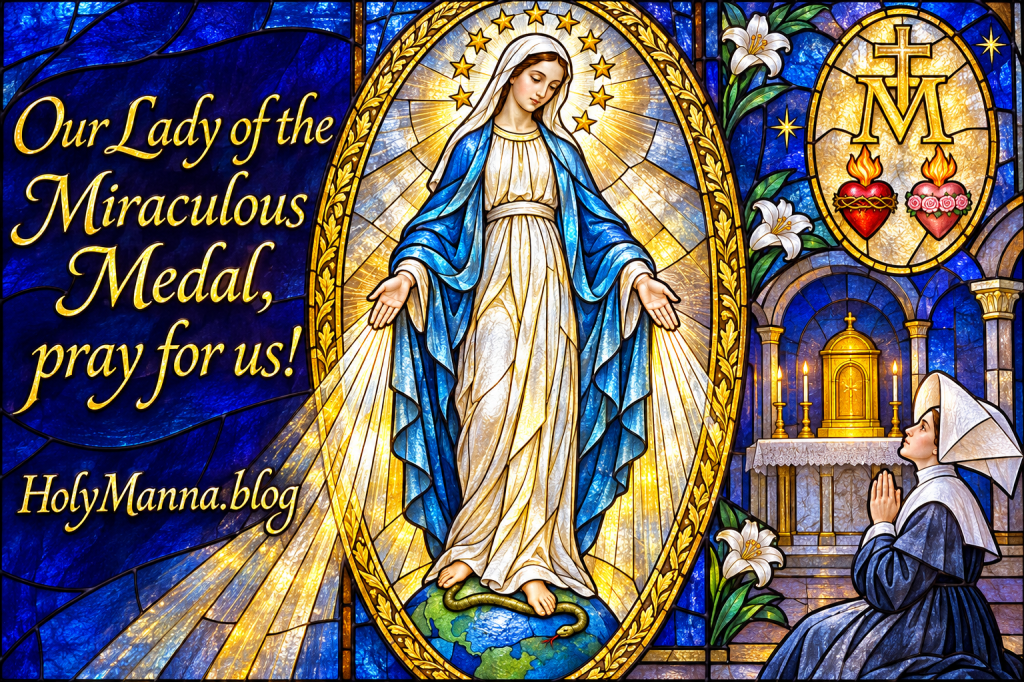
The second apparition is the one remembered on November 27th. It took place on a Saturday, the eve of the First Sunday of Advent, at about 5:30 in the evening during the community’s meditation. Catherine saw Mary dressed in white and standing on a globe, with her feet crushing a serpent. In her hands she held a golden ball topped by a small cross, which Catherine understood to represent the whole world, France, and each person. Rings set with gems covered Mary’s fingers, and rays of light streamed from them. Catherine was given to understand that the rays signified the graces Mary obtains for those who ask, and that the gems giving no light stood for graces nobody thinks to request. An oval frame then formed around the figure, with the invocation written in letters of gold. Next came the commission: “Have a medal struck from this model; persons who wear it indulgenced will receive great graces.” The old-fashioned term in that sentence refers to a medal that has received the Church’s blessing, and the promise went on to say that graces would abound for those who wear it with confidence. The image seemed to turn, and Catherine saw the reverse. It showed the letter M surmounted by a cross resting on a bar, and beneath it 2 hearts, the first encircled with thorns and the second pierced by a sword. The medal as struck also carries 12 stars.
A third apparition followed in December 1830, when Mary repeated her request. Catherine recorded no day for it.
The Church’s judgment deserves to be stated plainly. Father Aladel doubted for months. Early in 1832, according to the standard biography by Father Joseph Dirvin, he brought the matter to Archbishop Hyacinthe-Louis de Quélen of Paris, who found nothing contrary to the faith and permitted the medal to be made. In 1836 the archbishop ordered a canonical inquiry under his vicar general. Catherine, determined to remain unknown, did not testify. The findings were favorable, crediting her account and judging the medal to be of supernatural origin. In 1894 the Holy See granted the liturgical feast, and in 1947 Pope Pius XII canonized the visionary. Rue du Bac is therefore counted among the approved apparitions, on the authority of the Archbishop of Paris and with Rome’s confirmation in practice.
Honesty requires 2 clarifications. No pope has issued a decree defining the apparitions themselves, and some Vincentian scholars note that what Rome formally approved was the medal and its feast. Rue du Bac also remains private revelation. The Catechism explains that such revelations add nothing to the deposit of faith, and that their purpose is to help believers live the Gospel more deeply at a given moment in history (CCC 67). No Catholic is bound to believe it, and every Catholic is free to.
The most famous grace connected with the medal has its own formal approval. Alphonse Ratisbonne, a Jewish banker from Strasbourg with a strong dislike of the Catholic Church, accepted a medal from a friend in Rome almost as a dare. On January 20th, 1842, he stepped into the church of Sant’Andrea delle Fratte and reported seeing the Blessed Virgin as she appears on the medal. He was baptized on January 31st. A Roman inquiry sat for 25 sessions, and its decree of June 3rd, 1842, recognized the conversion as a true miracle obtained through Mary’s intercession. Ratisbonne became a priest and served for more than 30 years in the Holy Land.
Taken together, these events show Mary acting exactly as the Gospel portrays her. She notices need, she sends people to the altar where her Son is present, and she asks them to ask. She also lets a novice lean on her lap like a child, which says a great deal about the kind of mother she is.
The Gospel Pressed Into Metal
The Catechism gives the key for reading the medal correctly when it teaches that everything the Church holds about Mary flows from her faith in Christ (CCC 487). Every symbol passes that test.
The front begins with the Immaculate Conception. In 1830 the doctrine was widely held and not yet defined, and the Catechism notes that the Church grew in her awareness of it over the centuries (CCC 491). On December 8th, 1854, Blessed Pius IX defined in Ineffabilis Deus that Mary, “in the first instance of her conception, by a singular privilege and grace granted by God, in view of the merits of Jesus Christ, the Saviour of the human race, was preserved exempt from all stain of original sin,” in the wording given by the Catholic Encyclopedia. The phrase about the merits of Jesus Christ carries the whole weight. Mary did not save herself, since she was redeemed by her Son in a singular and higher way (CCC 492). As the Catechism puts it, “Mary benefited first of all and uniquely from Christ’s victory over sin” (CCC 411). Gabriel had already said as much in Nazareth: “Hail, full of grace, the Lord is with you!” (Luke 1:28; see CCC 490). Because her Son is God, the Church also confesses her as truly Mother of God (CCC 495).
The serpent under her feet reaches back to the first promise in Scripture: “I will put enmity between you and the woman, and between your seed and her seed; he shall bruise your head, and you shall bruise his heel” (Genesis 3:15). The Catechism calls this passage the Protoevangelium and recalls that a long line of Fathers and Doctors recognized Mary, the new Eve, in the woman of that prophecy (CCC 411). Saint Irenaeus of Lyons made the comparison in the 2nd century: “And thus also it was that the knot of Eve’s disobedience was loosed by the obedience of Mary. For what the virgin Eve had bound fast through unbelief, this did the virgin Mary set free through faith” (Against Heresies, Book III, chapter 22).
The stars point to the last book of the Bible: “And a great portent appeared in heaven, a woman clothed with the sun, with the moon under her feet, and on her head a crown of twelve stars” (Revelation 12:1).
The rays are the part most easily misread. Mary is not a second source of grace. The Second Vatican Council teaches that from heaven she keeps interceding so that her children receive what they need for salvation, and that the Church therefore invokes her as “Advocate, Auxiliatrix, Adjutrix, and Mediatrix,” always in such a way that Christ remains the only Mediator, with nothing subtracted from him and nothing added (Lumen Gentium 62; CCC 968-970). In November 2025 the Dicastery for the Doctrine of the Faith, with the approval of Pope Leo XIV, published the doctrinal note Mater Populi Fidelis, which reaffirmed Mary’s unique maternal intercession while cautioning against language that pictures her as a reservoir of grace apart from God. Grace comes from God, and Mary asks. The medal’s own prayer says exactly that, because its verb is pray. Saint John Paul II found the pattern at Cana, where Mary comes to people “in the reality of their wants, needs and sufferings” and places those needs before her Son (Redemptoris Mater 21). Her words there are few: “They have no wine” and “Do whatever he tells you” (John 2:3, 5).
On the back, the Cross and the M show Mary’s union with her Son in the work of redemption, a union the Catechism describes as most clearly seen at the Cross (CCC 964). The 2 hearts place the love of Christ, crowned with thorns, beside the heart of his mother, pierced as Simeon foretold in Luke 2:35. The Church honors her as Mother of Christ and Mother of the Church (CCC 963).
A final point protects all the others. The medal is a sacramental, a sacred sign established by the Church (CCC 1667). A sacramental does not work the way a sacrament does. It draws its power from the prayer of the Church, and it readies a person to welcome grace and respond to it (CCC 1670). The Catechism even names medals among the forms of popular piety that deserve both encouragement and discernment (CCC 1674, 1676). A Miraculous Medal is therefore never a lucky charm. The Council insists that real devotion is not a matter of fleeting feelings or gullibility, and that it grows out of faith and shows itself in a life that resembles Mary’s (Lumen Gentium 67). Saint Paul VI asked in Marialis Cultus in 1974 that Marian devotion be rooted in Scripture, in harmony with the liturgy, and centered on Christ.
A Medal Around the Neck and a Road to the Altar
The first medals arrived in the middle of a catastrophe. Father Aladel ordered 20,000 from the Parisian engraver Vachette in May 1832, after a delay caused by a cholera epidemic that killed more than 20,000 people in Paris. The first batch was delivered on June 30th, 1832. Accounts number it at 1,500 or 2,000 medals. The Daughters of Charity carried them to the sick. Reports of healings and conversions multiplied so quickly that ordinary Parisians renamed the Medal of the Immaculate Conception and simply called it miraculous. Most of those reports were never judged individually by the Church and stand as the testimony of grateful people. Catherine’s own reaction on receiving her medals was brief and practical: “Now it must be propagated.” By December 1836 several million had been sold, and a commonly cited estimate holds that more than 1 billion had been struck by the time she died.
Catherine herself vanished into ordinary life. She spent 46 years at the Hospice d’Enghien in the Reuilly district of Paris, working in the kitchen and the laundry, caring for elderly men, and looking after the farmyard. The day after her canonization, Pope Pius XII summed up her whole life with a maxim from The Imitation of Christ: “Ama nesciri,” which means love to be unknown. Only in 1876, the last year of her life, did she confide in her superior, Sister Dufès, because a statue of the Virgin holding the globe still needed to be made. She died on December 31st, 1876. When her tomb was opened in 1933, 57 years later, her body was found remarkably preserved, and today it rests in a glass reliquary in the chapel on Rue du Bac. She was beatified on May 28th, 1933, and canonized on July 27th, 1947, and the Vincentian Family keeps her feast on November 28th.
The medal is blessed by a priest and worn with trust, traditionally around the neck. Pope Saint Pius X recognized the Associations of the Miraculous Medal in 1905 and approved their statutes in 1909, and Vincentian priests still enroll new members with a rite of imposition of the medal. A novena runs from November 18th to November 26th, and a weekly Perpetual Novena has been prayed every Monday in Philadelphia since December 8th, 1930.
The chapel on Rue du Bac sits behind a courtyard beside the Bon Marché department store, and it welcomes about 2 million people a year. They come to pray before the altar Mary pointed to, near the bodies of Saint Catherine and Saint Louise de Marillac. On May 31st, 1980, Saint John Paul II knelt there and prayed, “I come as a pilgrim, after all those who have come to this chapel.” In Rome, the faithful visit the altar of the Madonna of the Miracle at Sant’Andrea delle Fratte, where Ratisbonne was converted. In the United States, the Basilica Shrine of Our Lady of the Miraculous Medal in Philadelphia grew out of the Central Association founded by Father Joseph Skelly in 1915, and it became a minor basilica by a Vatican decree announced in January 2023. The National Shrine of Our Lady of the Miraculous Medal in Perryville, Missouri, was built in 1929.
All of these practices work the same way. They move a person from a medal to a prayer, from a prayer to a confessional, and from a confessional to the altar, which is exactly where Mary sent Catherine.
From Paris to Philadelphia to Manila
The title has traveled wherever the Vincentian Family has gone. On November 27th, Vincentian communities celebrate a solemn Mass, often after a triduum of prayer, and many gather for a solemn supplication late in the afternoon, near the hour of the apparition. The proper Mass takes its first reading from Revelation 12 and its Gospel from the wedding at Cana, and its Alleluia verse, drawn from the Song of Songs, sings that Mary is all beautiful and untouched by original sin.
In the Spanish-speaking world she is simply La Milagrosa. Madrid has a Basilica of La Milagrosa, completed in 1904 and given the title of basilica by Pope Pius XI in 1923. Spanish associations also keep a custom in which small chapels bearing her image travel from home to home, so that families can host the Virgin for a time of prayer. In the Philippines, the celebration centers on the National Shrine of Our Lady of the Miraculous Medal in Muntinlupa, where the apostolic nuncio presided at the Mass of November 27th in 2022.
The saints took the medal with them too. Saint Maximilian Kolbe founded the Militia of the Immaculata on October 16th, 1917, and asked its members to wear the Miraculous Medal as the sign of their consecration. He celebrated his first Mass on April 29th, 1918, at the altar in Sant’Andrea delle Fratte where Ratisbonne was converted, and he prayed at Rue du Bac in 1930 before leaving for Japan. Saint Teresa of Calcutta wore the medal and handed it out freely, as the Archdiocese of Paris has recalled. Pope Francis blessed a pilgrim statue of Our Lady of the Miraculous Medal on November 11th, 2020, for the 190th anniversary of the apparitions, and the statue then visited communities across Italy for nearly a year, from Lazio to Sardinia.
The promise itself explains much of this reach, because it was addressed to rich and poor alike. A medal costs almost nothing, fits in any pocket, and asks for no education. It began among cholera patients and has kept company with the sick, the worried, and the poor ever since, which is the company Saint Vincent de Paul always preferred.
Asking for the Graces Still Waiting
The detail from November 27th that tends to stay with people is the gems that gave no light. Catherine understood them as graces that go unrequested, and the first lesson is simply to ask. What grace have you stopped asking for because you assumed the answer was no? At Cana, Mary saw a need, named it to Jesus, and trusted him with the outcome. You can do the same today, in a single sentence, for the situation that weighs on you most.
The second lesson is direction. Mary did not tell Catherine to stay with her in the chair. She pointed to the altar. If you wear the medal, let it walk you toward the Eucharist and the sacrament of Reconciliation, since a sacramental exists to prepare you for the sacraments (CCC 1667). A visit to the tabernacle on November 27th, even for 5 minutes, honors the request made in that chapel better than any amount of reading about it.
The third lesson belongs to Catherine. She carried the most famous secret in 19th-century Catholic life and spent 46 years in a kitchen, a laundry, and a ward for old men. She did not need to be known in order to be faithful. That kind of resilience speaks directly to a culture that measures worth by visibility. Where is God asking you to be faithful without being noticed? Your quiet work for a spouse, a child, a parent, or a difficult coworker may be the most Marian thing about your week.
The fourth lesson is compassion. The medal first went to the sick, carried by sisters who also brought their care and their time. Devotion that never reaches a person in need has stalled halfway. You might have a medal blessed and give it to someone who is suffering, and then bring that person real help along with it.
A few practices make all of this concrete. Ask a priest to bless your medal and wear it as a sign of belonging to Christ through his mother. Pray the invocation each morning, slowly enough to mean the words. Name a specific grace and keep asking for 9 days. Read John 2:1-11 and notice how little Mary says and how much she trusts.
Engage With Us!
Share your thoughts and reflections in the comments below. Stories of how the Miraculous Medal entered your family, or of a grace received through Mary’s intercession, are especially welcome.
- Is there a grace you have stopped asking for, and what would it look like to ask for it again with confidence this week?
- Mary directed Catherine to the altar. How could wearing or carrying the medal draw you closer to the Eucharist and to Confession?
- Saint Catherine Labouré stayed hidden for 46 years. Where is God inviting you to serve faithfully without recognition?
- The first medals were carried to cholera patients. Who in your life needs both your prayer and your practical help right now?
- Which symbol on the medal speaks to you most, and what does it teach you about Jesus?
Keep living the faith with courage and with joy. A small medal and a short prayer changed the life of Paris in 1832, and the same trust can change an ordinary home today. Stay close to the sacraments, ask boldly, serve quietly, and keep growing together in faith under the guidance of the Blessed Mother, who always leads her children to her Son.
Our Lady of the Miraculous Medal, pray for us!
Follow us on YouTube, TikTok, Instagram and Facebook for more insights and reflections on living a faith-filled life.


Leave a Reply