Friday of the Thirty-fourth Week in Ordinary Time – Lectionary: 507
The Last Friday Before the Story Begins Again
Every good story saves its biggest reveal for the final pages, and the Church does the same thing with her calendar. Friday, November 27th, 2026, falls in the 34th and final week of Ordinary Time, which means the liturgical year has only 1 day left before Advent begins on Sunday, November 29th. For 2 weeks the weekday Lectionary has walked through The Book of Revelation, while The Gospel of Luke has followed Jesus through His last public teaching in the Temple. Today those 2 roads arrive at the same destination.
The central theme is simple enough to carry all day. Everything in this world passes away, but God’s word stands, and God is preparing a home where He will live with His people forever. Saint John sees the devil chained, the dead judged, death itself destroyed, and a radiant city coming down from heaven like a bride. The psalmist, a Temple pilgrim singing a song of the Korahites, aches for that same dwelling and envies the little birds that nest near the altar. Then Jesus points to a budding fig tree and teaches His disciples to read history the way a farmer reads spring.
A little background helps. Christian tradition, recorded by Saint Irenaeus in the 2nd century, places John’s visions near the end of the reign of the emperor Domitian, when confessing Jesus could cost a believer everything. Jesus spoke His words in Jerusalem about 40 years before Roman armies leveled the Temple in the year 70. Both audiences needed to know how the story ends, and so does every reader scrolling through anxious headlines today. The Church places these readings here on purpose, because the end she proclaims is not a threat. It is a homecoming.
First Reading — Revelation 20:1-4, 11—21:2
The Dragon Loses, the Books Open, and the Bride Arrives
The Book of Revelation was written for Christians in the Roman province of Asia who were tempted to believe that Caesar held the last word. John, exiled on the island of Patmos, answers with visions in the style that Jewish readers knew from The Book of Daniel and The Book of Ezekiel, where numbers and images carry meaning rather than measurements. Today’s passage is the grand finale, and it unfolds in 3 scenes: the binding of Satan, the judgment of all the dead, and the unveiling of a new creation. Together they show why everything else passes away while God’s dwelling with His people remains.
Revelation 20:1-4, 11—21:2
I, John, saw an angel come down from heaven,
holding in his hand the key to the abyss and a heavy chain.
He seized the dragon, the ancient serpent,
which is the Devil or Satan,
and tied it up for a thousand years and threw it into the abyss,
which he locked over it and sealed,
so that it could no longer lead the nations astray
until the thousand years are completed.
After this, it is to be released for a short time.Then I saw thrones; those who sat on them were entrusted with judgment.
I also saw the souls of those who had been beheaded
for their witness to Jesus and for the word of God,
and who had not worshiped the beast or its image
nor had accepted its mark on their foreheads or hands.
They came to life and they reigned with Christ for a thousand years.Next I saw a large white throne and the one who was sitting on it.
The earth and the sky fled from his presence
and there was no place for them.
I saw the dead, the great and the lowly, standing before the throne,
and scrolls were opened.
Then another scroll was opened, the book of life.
The dead were judged according to their deeds,
by what was written in the scrolls.
The sea gave up its dead;
then Death and Hades gave up their dead.
All the dead were judged according to their deeds.
Then Death and Hades were thrown into the pool of fire.
(This pool of fire is the second death.)
Anyone whose name was not found written in the book of life
was thrown into the pool of fire.Then I saw a new heaven and a new earth.
The former heaven and the former earth had passed away,
and the sea was no more.
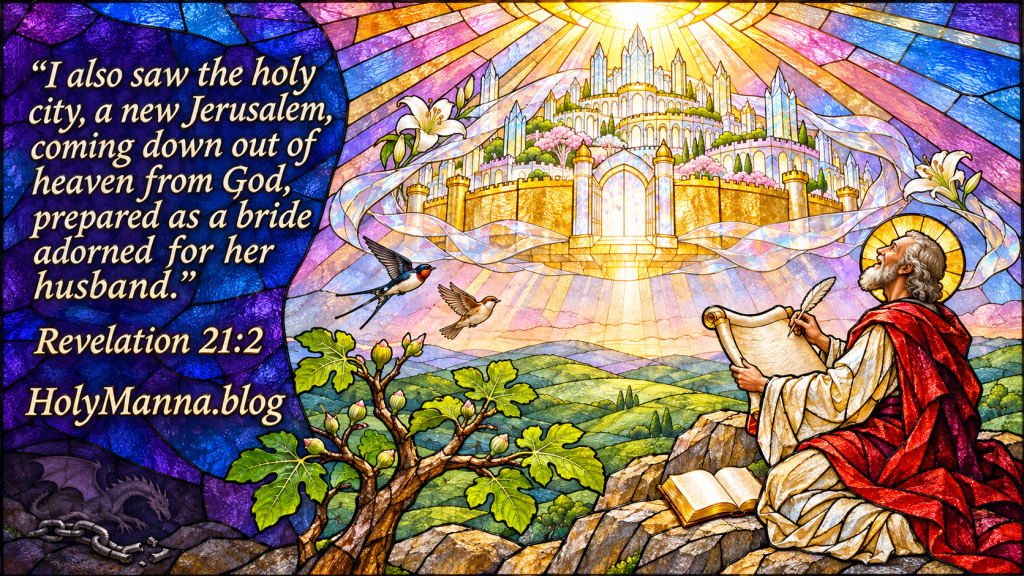
I also saw the holy city, a new Jerusalem,
coming down out of heaven from God,
prepared as a bride adorned for her husband.
Detailed Exegesis
Verse 1: “I, John, saw an angel come down from heaven, holding in his hand the key to the abyss and a heavy chain.”
The action begins in heaven, not on earth. A single unnamed angel carries the key, which shows that evil is never an equal rival to God. Earlier in the book the risen Jesus declared, “I hold the keys to death and the netherworld” (Revelation 1:18).
Verse 2: “He seized the dragon, the ancient serpent, which is the Devil or Satan, and tied it up for a thousand years”
John stacks up 4 names so that no one misses the enemy from Genesis 3. Saint Augustine read the binding through Jesus’ saying about tying up the strong man, “meaning by the strong man the devil, because he had power to take captive the human race” (The City of God, Book 20, Chapter 7). On his reading, the chain was fastened by Christ’s first coming.
Verse 3: “and threw it into the abyss, which he locked over it and sealed, so that it could no longer lead the nations astray until the thousand years are completed. After this, it is to be released for a short time.”
The devil is restrained, not erased. He can no longer keep the nations from the Gospel, yet he still tempts. Augustine explained that John “used the thousand years as an equivalent for the whole duration of this world, employing the number of perfection to mark the fullness of time” (The City of God, Book 20, Chapter 7). The brief release points to the final trial described in CCC 675.
Verse 4: “Then I saw thrones; those who sat on them were entrusted with judgment. I also saw the souls of those who had been beheaded for their witness to Jesus and for the word of God, and who had not worshiped the beast or its image nor had accepted its mark on their foreheads or hands. They came to life and they reigned with Christ for a thousand years.”
Rome’s victims turn out to be heaven’s royalty. The martyrs who refused emperor worship already live and reign with Christ. Augustine concluded, “The Church, then, begins its reign with Christ now in the living and in the dead” (The City of God, Book 20, Chapter 9).
Verse 11: “Next I saw a large white throne and the one who was sitting on it. The earth and the sky fled from his presence and there was no place for them.”
White signals holiness and victory. Creation itself offers no hiding place before its Maker, an image that echoes the throne scene of Daniel 7:9.
Verse 12: “I saw the dead, the great and the lowly, standing before the throne, and scrolls were opened. Then another scroll was opened, the book of life. The dead were judged according to their deeds, by what was written in the scrolls.”
Emperors and slaves stand on the same floor. The scrolls record deeds, while the book of life records those who belong to the Lamb. Grace and freely chosen deeds both count.
Verse 13: “The sea gave up its dead; then Death and Hades gave up their dead. All the dead were judged according to their deeds.”
No one is lost to God, not even those who perished at sea without a grave.
Verse 14: “Then Death and Hades were thrown into the pool of fire. (This pool of fire is the second death.)”
Here death itself finally dies. Saint Paul promised the same ending: “The last enemy to be destroyed is death” (1 Corinthians 15:26).
Verse 15: “Anyone whose name was not found written in the book of life was thrown into the pool of fire.”
The second death is hell, the freely chosen and final separation from God described in CCC 1033. God writes names gladly, yet He forces no one into His city.
Chapter 21, Verse 1: “Then I saw a new heaven and a new earth. The former heaven and the former earth had passed away, and the sea was no more.”
The promise of Isaiah 65:17 comes true. In Scripture the sea often stands for chaos, and the beast rose from it in Revelation 13. Its absence means that nothing remains to threaten God’s people.
Chapter 21, Verse 2: “I also saw the holy city, a new Jerusalem, coming down out of heaven from God, prepared as a bride adorned for her husband.”
The city comes down from above. Humanity does not build its way up to paradise. It receives paradise as a gift, and the gift is a wedding.
Teachings
Some early Christians expected a literal 1,000-year earthly kingdom before the end, and Saint Augustine admitted, “for I myself, too, once held this opinion” (The City of God, Book 20, Chapter 7). His mature reading became the common Catholic one: “Therefore the Church even now is the kingdom of Christ, and the kingdom of heaven” (The City of God, Book 20, Chapter 9). The Catechism guards this point firmly, teaching that the Church has rejected “this falsification of the kingdom to come” under the name of millenarianism (CCC 676). No political program will ever deliver heaven on earth.
The Catechism also explains the 2 judgments in view. Each soul meets Christ at death in the particular judgment (CCC 1021-1022), and the Last Judgment will publicly reveal the full truth of every life and the triumph of God’s justice (CCC 1038-1040). Afterward the universe itself will be renewed, and the redeemed will form the holy city of God (CCC 1042-1045). The Bride is the Church, the spotless spouse of the Lamb (CCC 757).
Reflection
This reading is strong medicine for anxious days. The enemy is real, yet he is on a chain, and the final chapter is already written. You can make a brief examination of conscience each night, since the scrolls are being written today in ordinary choices. You can go to Confession before Advent begins and let mercy edit the record. You can also ask the martyrs for courage when faith costs something.
What fear would loosen its grip if you truly believed that Satan is already bound? If the scroll of your deeds were opened tonight, what page would you want Christ’s mercy to rewrite? How does it change your view of the Church to see her as a bride being prepared?
Responsorial Psalm — Psalm 84:3-6a, 8a
Homesick for God
Psalm 84 is a pilgrim’s love song. Its heading credits the Korahites, a guild of Levites who served as singers and gatekeepers in the Jerusalem Temple, and it gives voice to an Israelite traveling up to the holy city for one of the great feasts. For that pilgrim the Temple was the one place on earth where the living God had chosen to dwell among His people. The liturgy pairs these verses with a refrain taken from Revelation 21:3, “Here God lives among his people,” so that the congregation answers John’s vision with its own longing. In a world where everything passes away, the psalm names the home that will not.
Psalm 84:3-6a, 8a
R. (Revelation 21:3b) Here God lives among his people.
My soul yearns and pines
for the courts of the LORD.
My heart and my flesh
cry out for the living God.
R. Here God lives among his people.
Even the sparrow finds a home,
and the swallow a nest
in which she puts her young–
Your altars, O LORD of hosts,
my king and my God!
R. Here God lives among his people.
Blessed they who dwell in your house!
continually they praise you.
Blessed the men whose strength you are!
They go from strength to strength.
R. Here God lives among his people.
Detailed Exegesis
Verse 3: “My soul yearns and pines for the courts of the LORD. My heart and my flesh cry out for the living God.”
The pilgrim’s desire is total. Soul, heart, and flesh all lean toward God, which means that faith is never a hobby for one corner of life. The title of living God contrasts the Lord with the lifeless idols of the nations. Saint Augustine heard in this verse the difference between earth and heaven: “Here it is longed for, there it is received: here are sighs, there joy: here prayers, there praises” (Expositions on the Psalms, Psalm 84).
Verse 4: “Even the sparrow finds a home, and the swallow a nest in which she puts her young, Your altars, O LORD of hosts, my king and my God!”
Small birds nested in the Temple precincts, and the pilgrim envies them because they never have to leave. Augustine, whose Latin Psalter named a dove where modern translations name a swallow, saw the whole person in the 2 birds: “with the heart we think upon God, as if the sparrow flew to her home: with the flesh we do good works” (Expositions on the Psalms, Psalm 84). The nest is the altar, the place of sacrifice, and Christians naturally think of the altar of the Eucharist.
Verse 5: “Blessed they who dwell in your house! continually they praise you.”
The Temple ministers lived where the pilgrim could only visit. Augustine applied the verse to heaven, where no one ever has to go home because everyone is home: “This shall be our whole duty, an unceasing Hallelujah” (Expositions on the Psalms, Psalm 84).
Verse 6a: “Blessed the men whose strength you are!”
A second beatitude covers those who are still on the road. Pilgrims are blessed because their strength comes from God and not from their own stamina.
Verse 8a: “They go from strength to strength.”
Ordinary travelers tire as the miles add up, yet these pilgrims gain energy as Zion draws near. Augustine’s Psalter read “from virtue to virtue,” and he taught that the many virtues needed for this life lead finally to Christ Himself.
Teachings
The Catechism begins its first chapter with this truth: the desire for God is written in the human heart, because every person is created by God and for God (CCC 27). Augustine gave that teaching its most famous sentence when he prayed, “Thou madest us for Thyself, and our heart is restless, until it repose in Thee” (Confessions, Book 1, Chapter 1). The pilgrim of Psalm 84 is simply a person honest enough to feel that restlessness and wise enough to aim it at the right place.
The Church teaches that every parish church carries this meaning. The visible building is a sign of the Father’s house toward which the People of God are journeying (CCC 1186), and the earthly liturgy is a foretaste of the liturgy celebrated in the heavenly Jerusalem (CCC 1090). Today’s refrain reaches its fulfillment in the promise that in the new universe “God will have his dwelling among men” (CCC 1044). Until then, the tabernacle is the nearest thing to home on earth, because the Lord who will fill the holy city already waits there.
Reflection
Most people know what homesickness feels like, and this psalm suggests that some of it is really holy longing. The restlessness that follows every promotion, purchase, or vacation is a signal and not a malfunction. A few simple practices can train that longing. You could arrive at Mass 10 minutes early this weekend and pray these verses slowly before the tabernacle. You could stop into an open church during the week, even for 5 minutes, and simply be at home there. You could also notice the next moment of dissatisfaction and turn it into a short prayer of desire for God.
Where does your heart go looking for home when life feels unsettled? Does your parish church feel like a place of obligation or a place of belonging, and what would help it become the second? How might God be leading you from strength to strength on a road that currently feels long?
Holy Gospel — Luke 21:29-33
The Farmer’s Guide to the End of the World
These 5 verses close Jesus’ great discourse about the future in The Gospel of Luke. He is teaching in the Temple during the last week of His earthly life, and He has just foretold the destruction of that magnificent building, the suffering of His followers, and the coming of the Son of Man in glory. His listeners must have felt the ground shift under their feet. Jesus responds with a parable so ordinary that a child could follow it. Fig trees grew everywhere in the Holy Land, and because they stand bare all winter, their new leaves were a dependable sign of the changing season. The lesson serves today’s theme directly, since the world passes and His word does not.
Luke 21:29-33
Jesus told his disciples a parable.
“Consider the fig tree and all the other trees.
When their buds burst open,
you see for yourselves and know that summer is now near;
in the same way, when you see these things happening,
know that the Kingdom of God is near.
Amen, I say to you, this generation will not pass away
until all these things have taken place.
Heaven and earth will pass away,
but my words will not pass away.”
Detailed Exegesis
Verse 29: “Jesus told his disciples a parable. ‘Consider the fig tree and all the other trees.’”
Only Luke mentions the other trees. Saint Ambrose noticed the detail: “Matthew speaks of the fig-tree only, Luke of all the trees” (quoted in the Catena Aurea on Luke 21). Writing for readers across the Roman world, Luke makes sure that everyone can find the lesson in the nearest orchard.
Verse 30: “‘When their buds burst open, you see for yourselves and know that summer is now near;’”
Jesus trusts ordinary observation. No secret code or clever calculation is needed, only attention. Summer in the Holy Land meant fruit and harvest, so the image is hopeful rather than dreadful.
Verse 31: “‘in the same way, when you see these things happening, know that the Kingdom of God is near.’”
The upheavals He has described are buds and not obituaries. Pope Saint Gregory the Great preached on this passage and put it memorably: “as from the fruit of the tree the summer is perceived to be near, so from the fall of the world the kingdom of God is known to be at hand” (quoted in the Catena Aurea on Luke 21). He added that the Kingdom is rightly compared to summer, “for then the clouds of our sorrow flee away, and the days of life brighten up under the clear light of the Eternal Sun.”
Verse 32: “‘Amen, I say to you, this generation will not pass away until all these things have taken place.’”
The solemn Amen marks a promise. On one level, the generation that heard Jesus lived to see Jerusalem and its Temple fall in the year 70, a judgment that foreshadows the end of history. The Fathers also read the word more broadly. Saint Bede wrote that “by generation he means either the whole human race, or especially the Jews,” while Eusebius understood it as “the new generation of His holy Church” (both quoted in the Catena Aurea on Luke 21). Either way, God’s people will endure to see His promises kept.
Verse 33: “‘Heaven and earth will pass away, but my words will not pass away.’”
No prophet ever spoke this way. The prophets said that God’s word stands forever, as in Isaiah 40:8, but Jesus says it of His own words, which is a quiet claim to divinity. Gregory restated the Lord’s meaning: “All that with us seems lasting, does not abide to eternity without change, and all that with Me seems to pass away is held fixed and immovable” (quoted in the Catena Aurea on Luke 21).
Teachings
The Church has always held 2 truths together here. Since the Ascension, Christ’s coming in glory has been imminent, and it could be accomplished at any moment (CCC 673). At the same time, no one can schedule it, for “Only the Father knows the day and the hour” (CCC 1040). The fig tree parable therefore forbids both date-setting and sleepy indifference. The Catechism adds that the message of the Last Judgment is a call to conversion while God still gives the acceptable time (CCC 1041), and that the hope of a new earth should strengthen, not weaken, the believer’s care for this one (CCC 1049).
History supplies a striking witness. Gregory the Great preached on this Gospel around the year 590, when Rome was reeling from plague, flooding, and the threat of invading armies, and many assumed that the world was ending. He did not tell his people to panic. He told them to lift up their heads, because a Christian reads a collapsing world the way a farmer reads spring. That confidence rests on the durability of Christ’s word, which the Church venerates as she venerates the Lord’s Body (CCC 103).
Reflection
Anxiety about the future can feel like a generational trait for adults under 45, who have lived through recessions, a pandemic, and a news cycle that never sleeps. Jesus does not ask His friends to ignore the signs. He asks them to interpret the signs with hope. A few habits can help. You might choose 1 sentence of Jesus from today’s Gospel, memorize it, and repeat it whenever the headlines tighten your chest. You might limit the daily intake of news and give the first minutes of the morning to the Gospel instead. You might also plant something lasting this week through an act of mercy, since love done in Christ is never lost.
Which do you check more often, the news feed or the word that will never pass away? When the world seems to shake, is your first instinct fear or expectation? What would change in your daily schedule if you believed that the Kingdom of God is near?
The Story Ends in a Wedding
Picture the 3 scenes side by side. On Patmos, an aging apostle watches the ancient serpent dragged off in chains, the books of every life opened, and a city descending like a bride on her wedding day. In Jerusalem, centuries earlier, a dusty pilgrim stands in the Temple courts, watching sparrows dart toward their nests near the altar and wishing that the visit never had to end. In that same city, days before the Cross, Jesus nods toward a fig tree and tells His friends that the hard days ahead are buds and not ruins.
All 3 voices say one thing. Empires fall, seasons turn, and even heaven and earth will pass away, but the word of Christ holds, and it promises a home where God lives among His people. Evil has an expiration date. Death has an expiration date. Love does not have one.
The liturgical year ends this weekend so that it can begin again with Advent, the season of holy waiting. That makes today a good day to travel light. Confession lets the Lord write mercy across the record. Time before the tabernacle lets the heart admit how homesick it is. The Gospels offer words that will outlast the stars to anyone willing to build a life on them. The fig tree is already budding, and summer is nearer than it looks.
Engage With Us!
Share your reflections in the comments below. The conversation grows richer whenever readers tell how the Lord is speaking to them through His word.
- In the First Reading, Revelation 20:1-4, 11-15 and 21:1-2, Satan is bound, the dead are judged, and the new Jerusalem descends. Which of these 3 images gives you the most hope right now, and why?
- In the Responsorial Psalm, Psalm 84:3-6 and 8, the pilgrim’s whole being cries out for the living God. Where do you notice a longing for God in your own life?
- In the Holy Gospel, Luke 21:29-33, Jesus promises that His words will never pass away. Which word of Jesus do you need to stand on this week?
- Taken together, today’s readings teach that everything passes away except God, His word, and the home He is preparing. What is 1 thing you could release so that you can hold more tightly to what lasts?
Keep walking toward the holy city with confidence. Live each day as a pilgrim who knows the way home, and do everything with the love and mercy that Jesus taught.
Sacred Heart of Jesus, we trust in You!
Immaculate Heart of Mary, pray for us!
Saint Michael the Archangel, defend us in battle!
Follow us on YouTube, TikTok, Instagram and Facebook for more insights and reflections on living a faith-filled life.


Leave a Reply