The Abbot Who Saw His Own Future in a Tomb
Every year on November 26th, the Church remembers Saint Sylvester Gozzolini, an Italian cathedral canon who walked away from a comfortable career at about 50 years old, moved into a cave, and ended up founding a monastic family that is still praying today. His surname also appears as Guzzolini, which is the spelling his own monks prefer, and he is often called simply Saint Sylvester the Abbot. He should not be confused with Pope Saint Sylvester I, whose feast falls on December 31st.
Sylvester lived from about 1177 to 1267, which makes him a contemporary of Saint Francis of Assisi and Saint Dominic. While the new mendicant orders were pouring into the cities of Italy, Sylvester headed in the opposite direction. He climbed into the mountains of the Marche, embraced silence and poverty, and gave the ancient Rule of Saint Benedict a fresh and austere expression. The monks who gathered around him came to be known as the Sylvestrines, and Pope Saint John Paul II once told them that their founder had “grafted a new congregation onto the fruitful tree of the Benedictine Order” at Montefano in 1231.
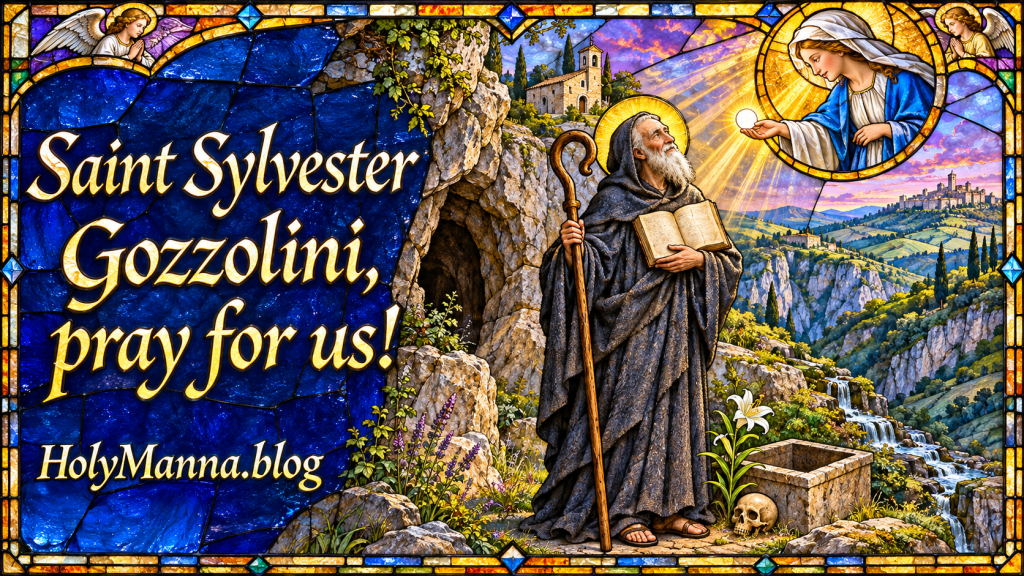
He is most famous for a single moment. Standing beside an open grave at a funeral, he looked at the body of a man he had known and saw his own future staring back at him. The current Roman Martyrology sums up his whole life from that scene. It remembers him as the abbot who grasped the emptiness of worldly things before the open tomb of a friend, withdrew into solitude, and finally founded the Sylvestrine Congregation under the Rule of Saint Benedict in a lonely place near Montefano.
The Church holds up men like Sylvester for a reason. The Catechism teaches that by canonizing some of the faithful, the Church recognizes the power of the Holy Spirit within her and proposes the saints as models and intercessors (CCC 828). Sylvester is a model for anyone who suspects that life is passing by too quickly and that something has to change. His story begins at a funeral, yet it is one of the most hopeful stories a restless heart can hear.
A Lawyer’s Son Who Chose a Higher Law
Sylvester was born in Osimo, a hill town in the March of Ancona on the eastern side of Italy. The traditional birth year of 1177 is an estimate. It comes from his first biographer, who wrote that Sylvester was almost 90 years old when he died in 1267. His family, the Gozzolini, belonged to the local nobility. His father, Gislerio, was a jurist, and later sources give his mother’s name as Bianca.
Gislerio had a plan for his son, and it was a sensible one. He sent the young man to study law at Bologna, the great legal school of the age, and some accounts add a period at Padua. A law degree meant status, income, and influence. Sylvester, however, found himself drawn away from the law books and toward theology and Sacred Scripture. He came home with a very different future in mind than the one his father had paid for.
The reaction at home was painful. According to the Catholic Encyclopedia and the lessons of the old Roman Breviary, his father was so angry at the change of course that he refused to speak to his son for 10 years. A Sylvestrine retelling of the story goes further and says that Gislerio disinherited him. Sylvester accepted the cost. The Catechism is clear that family ties are important but not absolute, and that parents must respect and encourage a child’s calling, because the first vocation of every Christian is to follow Jesus (CCC 2232, 2233). The Lord had already promised as much in The Gospel of Matthew: “And every one that hath left house, or brethren, or sisters, or father, or mother, or wife, or children, or lands for my name’s sake, shall receive an hundredfold, and shall possess life everlasting” (Matthew 19:29).
Sylvester became a canon of the cathedral of Osimo. Later tradition holds that he was ordained a priest, although the historians of his own congregation note that no surviving document confirms the ordination. What the sources agree on is that he preached, prayed, and cared for souls with real zeal.
Then came the funeral. The canons had gathered to bury a nobleman, and when the grave was opened Sylvester saw inside it the body of a relative who had been admired in life for his good looks. The sources differ slightly on the details. Some describe a decaying corpse, the Sylvestrine account speaks of remains lying in a common tomb, and the Roman Martyrology calls the dead man a friend. All of them agree on what happened in Sylvester’s heart. His first biographer, followed by the Roman Breviary, records his thought in one unforgettable line: “I am what this man was, and what he is I shall be.”
He went home and opened the Gospel, and the words of Christ met him there: “If any man will come after me, let him deny himself, and take up his cross, and follow me” (Matthew 16:24). The Catechism explains why a moment like this can be a gift and not a curse. Remembering mortality gives urgency to life, because it helps a person realize that there is only a limited time in which to bring that life to fulfillment (CCC 1007). Sylvester did not become morbid. He became free.
Raw Herbs, Wet Caves, and a Mountain Called Fano
Around 1227, when he was about 50 years old, Sylvester slipped away from Osimo. Alban Butler’s older account places the departure at age 40, so the exact year remains uncertain. A friend named Andrea accompanied him toward the mountains, and then Sylvester went on alone into the wild limestone gorge known as the Gola della Rossa, near Serra San Quirico and the Frasassi caves. He lived in a series of caves. The Catholic Encyclopedia relates that the nobleman who owned the land, a man named Conrad, recognized him and offered him a better site, and that dampness later forced him to move again to the cave called Grottafucile. His penances were severe. He lived on raw herbs and water, and he slept on the bare ground.
In 1228, two Dominican friars named Riccardo and Bonaparte visited him and urged him not to remain alone. Disciples began to arrive, and the first was Philip of Recanati. Sylvester now had to decide how this little family would live. A tradition recorded in the Roman Breviary says that Saint Benedict appeared to him in a vision and showed him the rule and the habit his monks should adopt, and an older version of the story adds that several holy founders appeared, each one offering his own rule. This vision cannot be verified. What is documented is the choice itself. Sylvester adopted the Rule of Saint Benedict and received the monastic habit from a monk named Peter Magone.
In 1231, six citizens of Fabriano donated land on Montefano, a wooded mountain just outside their town, and Sylvester founded a hermitage there beside a spring called Vembrici. The Catholic Encyclopedia notes that he first had to clear away the remains of a pagan temple. The buildings were finished by 1234, and the church was dedicated to Saint Benedict. The life was Benedictine, but it was poorer and plainer than what many large abbeys of the time had become, with rough clothing, simple food, prayer through the night, and long hours with the Scriptures. The Catechism describes consecrated life as a gift that the Church receives from her Lord, a way of following Christ more closely and of signifying the glory of the world to come (CCC 916, 926).
The new family grew. A house was opened inside Fabriano in 1244, and on June 27th, 1248, Pope Innocent IV approved the community as the Order of Saint Benedict of Montefano with the bull Religiosam vitam, sent from Lyon. The Catholic Encyclopedia gives the year as 1247, while the congregation’s own records give 1248. Other foundations followed, including houses at Osimo, Jesi, Perugia, and Rome.
His first biographer, Andrew of James of Fabriano, wrote the Life of Sylvester between about 1274 and 1282 and drew on eyewitnesses. He calls Sylvester the “Man of God” 52 times, and he preserves a number of miracle stories. He tells of a blind man who received his sight, of a man named Philip of Varano in Osimo whose crippled knees were healed by the sign of the cross, of the son of a woman from Gualdo who was cured of a disfiguring disease of the face, and of a man lame from birth at Serra San Quirico who dragged himself to Sylvester during a sermon and then walked home on his own feet. He tells of a woman delivered from an evil spirit at Cagli, of a dangerous fire in Fabriano that Sylvester put out, and of a jug of water that became good wine when Sylvester blessed it at table. These accounts come from a biographer writing within about 15 years of the saint’s death, yet none of them can be independently verified today.
One story has a touch of dark humor. In Fabriano, Sylvester saw a man digging a grave for a certain Diotisalvi, who was so sick that the doctors had given up on him. Sylvester remarked that a dead man was preparing a grave for a living one. Diotisalvi recovered, and the gravedigger died and was buried in the grave he had dug. This story cannot be verified.
The most treasured tradition of all concerns the Blessed Virgin Mary. The Life relates that one night, while Sylvester prayed alone, he was caught up in spirit and found himself in a church before an altar, where the Queen of Mercy appeared in great light and asked whether he wished to receive the Body of her Son. He humbly consented, and she gave him Holy Communion with her own hands. From that night, the biographer says, no page of Scripture seemed obscure to him. This vision cannot be verified, and the Church does not require anyone to believe it. The Catechism teaches that private revelations do not belong to the deposit of faith, and that their role is to help the faithful live more fully by Christ’s definitive revelation in a particular period of history (CCC 67). What the story certainly reflects is true doctrine. In the Eucharist, Christ is truly, really, and substantially present (CCC 1374), and authentic devotion to Mary always leads to her Son (CCC 971).
Sylvester matters because he shows that conversion is not reserved for the young, and that the second half of a life can be more fruitful than the first. He is worth imitating because he did not merely feel moved at a graveside. He acted on what he saw. The Catechism teaches that the miracles of Christ and of the saints are signs that support faith and show that it is not a blind impulse of the mind (CCC 156).
A Father’s Silence, a Bishop’s Anger, and a Knock at the Gate
Sylvester was not a martyr. He died peacefully as a very old man. His road was nonetheless marked by real suffering, and most of it came from the people and places closest to him.
The first wound was his father’s rejection. A decade of silence from a parent is a heavy cross for any son, and Sylvester carried it without abandoning his calling and without any recorded word of resentment.
The second wound came from his own bishop. As a canon, Sylvester watched his bishop live in a way that caused scandal among the faithful. The Life does not name the man, though historians identify him as Sinibaldo, who governed the Church in Osimo from 1218 to 1239. Sylvester respectfully rebuked him. The bishop turned hostile and threatened to strip Sylvester of his canonry and his income. The Catechism teaches that charity itself demands fraternal correction (CCC 1829), and that the virtue of fortitude gives firmness in difficulties and constancy in the pursuit of the good (CCC 1808). Sylvester showed both. He told the truth to a superior with respect, and then he went away to pray.
The third hardship was the solitude itself, with its hunger, its cold, and its damp stone.
The fourth hardship was spiritual combat, and here the sources pass from documented history into tradition. The Life tells that the devil, furious at his failure to make the monks stumble, came one night and pounded on the gate of the hermitage until the whole community woke. Sylvester went out, rebuked him, and commanded him to depart, and the evil spirit fled down the cliffs with such a crash that the mountain seemed to shake. This story cannot be verified. Another story says that the brothers could not lift a boulder intended for the altar of the oratory because the devil was sitting on it, and that the stone became light when Sylvester made the sign of the cross over it. This story cannot be verified.
The most dramatic account concerns a fall. One stormy night, as Sylvester went down the stairs to the oratory for the night office, the devil caused him to trip, and he fell headfirst and lay bleeding and close to death. Wind and rain drowned out his cries. He begged the Queen of Mercy not to let him die so suddenly, and the tradition says that she appeared, healed his wounds, and brought him safely back to his cell. The Roman Breviary preserves this episode and adds that he kept a special devotion to the Virgin for the rest of his life. This story cannot be verified.
The Catechism speaks soberly about such things. The power of Satan is not infinite, because he is only a creature (CCC 395), and the whole of human life is a dramatic struggle between good and evil (CCC 409). Scripture gives the strategy that Sylvester followed: “Be subject therefore to God, but resist the devil, and he will fly from you” (James 4:7). The Catechism also gives the summary of his entire path: “The way of perfection passes by way of the Cross” (CCC 2015).
Sylvester endured every trial in the same way, by putting prayer first and by trusting that God could draw good out of each loss.
A Fragrant Death and a Family That Crossed Oceans
In late November of 1267, Sylvester fell ill with a high fever at Montefano. He urged his monks to persevere in holy living and in faithful observance of the monastic life, received the last sacraments, and died on November 26th, 1267. The psalmist had already described a death like his: “Precious in the sight of the Lord is the death of his saints” (Psalm 116:15). The Catechism teaches that because of Christ, Christian death has a positive meaning (CCC 1010).
The Life surrounds that night with wonders. A hermit called John the Solitary saw the abbot’s soul carried to heaven by angels. A monk named James heard his own name called three times and saw the mountain shining with light. A monk named Bonaparte, asleep in the monastery at Jesi, dreamed of a ladder rising from Montefano to heaven. A fourth monk, Paulinus, saw the founder’s soul in flight while he was praying at Sambuco. When the surgeon, Master Andrea, opened the body to prepare it for burial, a sweet fragrance filled the house. These accounts were gathered by his first biographer and cannot be verified.
At his death, Sylvester left 12 monasteries and about 120 monks, and the general chapter of 1267 counted 119. Alban Butler’s account speaks of 25 monasteries, but the congregation’s own archives support the smaller number.
His body was laid in a cypress coffin in the church at Montefano, and the people came. The sources speak of healings and of deliverances from evil spirits at the tomb, and Butler writes that “God was pleased to work several miracles at his tomb.” No individual miracle at the tomb can be verified today. The relics were placed above the main altar in 1532, moved to a niche in the apse in 1629, enclosed in a marble urn in 1660, and laid in the present sarcophagus of brass and crystal beneath the main altar in 1968. The examination of the relics on July 11th, 1968 found that the great abbot had been a slightly built man, about 1.60 meters tall. The Catechism counts the veneration of relics and pilgrimages among the forms of piety that extend the liturgical life of the Church (CCC 1674, 1675).
Veneration began almost at once. A legal deed from 1272, only 5 years after his death, already speaks of the Order of Saint Sylvester, and the Fontana Maggiore in Perugia, carved in 1277 and 1278, shows him receiving the Rule from Saint Benedict. He never had a canonization ceremony of the modern kind. The Catholic Encyclopedia reports that Pope Clement IV first recognized the title of blessed that the people had given him. Pope Clement VIII had his name inscribed in the Roman Martyrology in 1598, Pope Paul V called him a saint in the bull Sanctorum virorum in 1617, and Pope Leo XIII extended his Mass and Office to the universal Church in 1890. Catholic sources therefore date his equivalent canonization differently, some to 1598 and others to 1890. His feast left the General Roman Calendar in the reform of 1969, but he remains in the Roman Martyrology on November 26th, and his monks keep the day with great joy.
Montefano is still a living monastery and a place of pilgrimage. The spring beside which Sylvester built his first hut still flows, and the cloister holds 24 frescoed lunettes of his life painted by Antonio Ungarini of Fabriano in 1771. Several of his first disciples are honored as blesseds, including Blessed John of the Staff, whose relics rest in the church of San Benedetto in Fabriano, and Blessed Hugh degli Atti.
His family eventually crossed oceans. The Sylvestrines, once nicknamed the Blue Benedictines for the color of their habit, opened a mission in Ceylon, now Sri Lanka, in 1845, and Sylvestrine monks later served as bishops in Colombo and Kandy. Monks arrived in the United States in 1910, and foundations followed in Australia, India, the Philippines, and the Democratic Republic of the Congo. A man who tried to hide in a cave became the father of a worldwide family.
Keeping Death in View Without Losing Joy
Sylvester’s life turns on a truth that modern life works very hard to hide. Everyone dies, and nobody knows when. The world treats that fact as a reason for anxiety or distraction. The saints treat it as a compass. Saint Benedict lists it among the tools of the spiritual craft: “To keep death daily before one’s eyes” (Rule of Saint Benedict 4:47). Scripture says the same thing with a promise attached: “In all thy works remember thy last end, and thou shalt never sin” (Sirach 7:36). The Catechism adds that the Church encourages every believer to prepare for the hour of death (CCC 1014).
You do not need a cave to live this. You can start tonight with 5 honest minutes before bed, looking back over the day and asking how it would look from the edge of eternity. You can visit a cemetery this November, the month the Church devotes to praying for the faithful departed, and offer a prayer for the souls buried there (CCC 1032).
Sylvester also proves that it is never too late. He was about 50 when he left Osimo, and his greatest work was done between that age and almost 90. If you feel that you wasted your 20s or your 30s, his life says that God is not finished with you. What would you do differently this week if you truly believed that God could still begin something new in you?
His courage with his bishop and his patience with his father speak to the relationships that hurt the most. He told the truth respectfully, he accepted the consequences without bitterness, and he kept praying. Is there a hard truth you owe someone in charity, or an old family wound that you need to bring to Christ instead of carrying it alone?
Finally, look at where his strength came from. It came from silence, from Scripture, from the Eucharist, and from a childlike trust in the Mother of God. The Catechism calls the Eucharist the source and summit of the Christian life (CCC 1324), and Saint Benedict tells his monks to “prefer nothing whatever to Christ” (Rule of Saint Benedict 72:11). You can imitate Sylvester by guarding 10 minutes of real silence each day, by reading a few verses of the Gospel before you touch your phone, by receiving Holy Communion with attention and gratitude, and by praying the Rosary. What is the one thing you are currently preferring to Christ? Saint Paul gives the answer that Sylvester found at the graveside: “For to me, to live is Christ; and to die is gain” (Philippians 1:21).
Engage With Us!
Saint Sylvester’s story invites conversation, so please share your thoughts and reflections in the comments below. Your experience may be exactly what another reader needs to hear today.
- Sylvester’s life changed at a funeral. Has an encounter with death or loss ever changed the way you live your faith?
- His father refused to speak to him for 10 years. How do you stay faithful to God’s call when the people closest to you do not understand it?
- He began his greatest work at about 50 years old. What is God inviting you to begin, or to begin again, at this stage of your life?
- Sylvester found God in silence and solitude. Where can you make room for real silence in your daily routine?
- The tradition of his Communion from the hands of Mary highlights a deep love for the Eucharist. How can you prepare your heart more intentionally for Mass this week?
May the example of Saint Sylvester Gozzolini give you the courage to look honestly at what passes away and to hold tightly to what lasts forever. Live a life of faith, stay close to the sacraments, and do everything with the love and mercy that Jesus taught.
Saint Sylvester, pray for all of us who seek God with a sincere heart!
Follow us on YouTube, TikTok, Instagram and Facebook for more insights and reflections on living a faith-filled life.


Leave a Reply