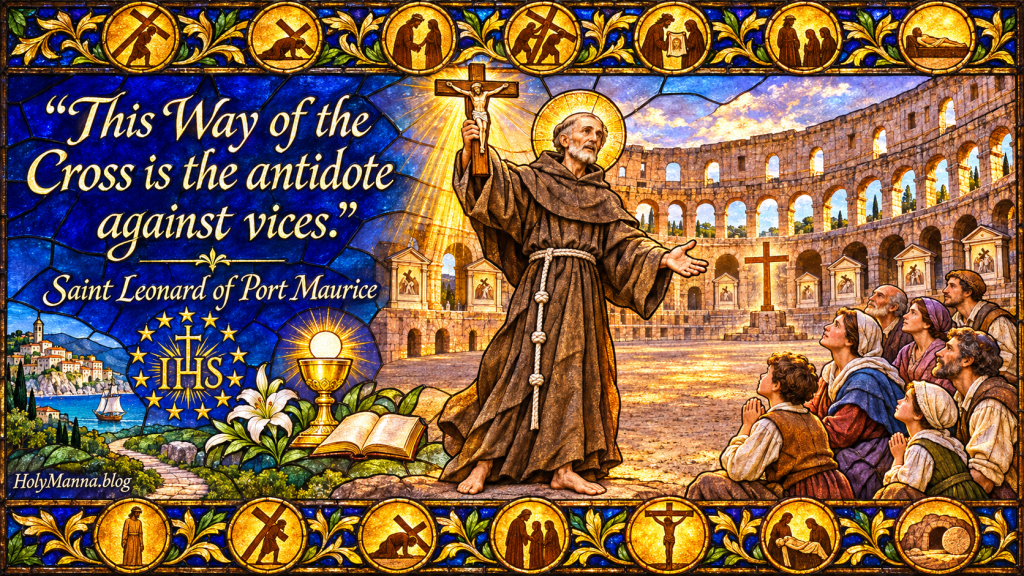
The Friar Who Brought Calvary to Every Village
Every Lent, Catholics all over the world walk slowly around the walls of their parish church, stopping 14 times to remember the road Jesus walked from Pilate’s court to the tomb. Most of them have no idea that they owe that habit, in large part, to a barefoot Franciscan from the Italian Riviera named Leonard of Port Maurice. The Church remembers him on November 26th, the anniversary of his death in Rome in 1751.
Saint Leonard spent more than 4 decades on the roads of Italy preaching what were called popular missions, which were long, intense parish revivals aimed at ordinary people. Historians count 343 of them. He set up the Stations of the Cross in hundreds of towns, including the most famous set in the world, the one inside the Roman Colosseum. He wrote a little book on the Mass, The Hidden Treasure, that is still in print almost 300 years later. He urged the Church of his day to define the Immaculate Conception as a dogma, more than a century before it happened. Saint Alphonsus Liguori, a Doctor of the Church who knew a thing or two about preaching, called him “the great missionary of the eighteenth century.”
The Church has given him a job in heaven that matches the one he had on earth. On March 17th, 1923, Pope Pius XI declared him the heavenly patron of priests who preach popular missions in Catholic lands, which is why he is honored today as the patron of parish missions and of those who preach them. He is also the patron of Imperia, the Ligurian city that now includes his hometown. The Roman Martyrology sums up his whole life in a single phrase, describing him as a priest “full of love for souls.”
The Catechism teaches that when the Church canonizes someone, she is solemnly proclaiming that this person practiced heroic virtue and lived in fidelity to God’s grace, and she is offering that person to the faithful as a model and an intercessor (CCC 828). Leonard is a model worth getting to know, because his entire message can be put in one sentence that fits every century. Look at the Cross, and then go to confession.
A Sea Captain’s Son Finds His Road
Leonard was born Paolo Girolamo Casanova on December 20th, 1676, in Porto Maurizio, a harbor town on the Ligurian coast that then belonged to the Republic of Genoa. His father, Domenico Casanova, was a ship captain. His mother was Anna Maria Benza, and some accounts report that she died when the boy was only 2 years old, leaving Domenico to give his children their first lessons in the faith.
At about 12 or 13 years old, Paolo was sent to Rome to live with a paternal uncle and to study at the Collegio Romano, the great Jesuit school of the city. He was a gifted student, and in his free time he gravitated toward the oratories of Rome, including the one that Saint Philip Neri had founded at the Chiesa Nuova. Several popular biographies add that his uncle hoped he would become a physician and disowned him when he chose otherwise, though the older reference works do not mention this.
In Rome there was a small, strict community of Franciscans known as the Riformella, living on the Palatine Hill at the friary of San Bonaventura, almost in the shadow of the Colosseum. One account tells how Paolo noticed 2 of these friars in the street, was struck by their poverty and recollection, and followed them home. When he stepped into their church, the community was chanting Compline, and the words he heard were “Convert us, O God, our Savior,” taken from Psalm 85. He received them as words addressed to himself. This story comes from the devotional biographies and cannot be verified in every detail.
On October 2nd, 1697, at 20 years old, he received the Franciscan habit at the novitiate of Ponticelli in the Sabine hills and took the name Leonard. He made his vows a year later, studied theology back at San Bonaventura, and was ordained a priest. Sources disagree about the date of his ordination, with some giving September 23rd, 1702, and others giving 1703.
Father Leonard had a plan. He wanted to go to China as a missionary, and, if God allowed it, to give his life there for the faith. He brought the request to Cardinal Colloredo, and the answer he received has been repeated ever since: “Your China will be Italy.” Then his health collapsed. The sources describe his illness differently, some as severe stomach hemorrhages and others as tuberculosis, but all agree it was serious enough that in 1704 his superiors sent him home to Porto Maurizio in the hope that his native air would save him. He was ill for about 4 years.
Leonard always said that he owed his recovery to the Blessed Virgin Mary. He had asked her for his health and promised, if he received it, to spend every bit of it winning souls for her Son. The cure was never the subject of a formal Church investigation, so it rests on his own testimony and that of his first biographers. What followed is not in doubt. In 1708 he preached his first mission in a village near his hometown, and he kept preaching for the rest of his life.
Italy Becomes His China
In 1709 Leonard was sent to Florence, to the friary of San Francesco al Monte, which Grand Duke Cosimo III de’ Medici had entrusted to the Riformella. From that hilltop he fanned out across Tuscany, and the crowds started coming. Later, at the summons of Pope Clement XII and then Pope Benedict XIV, he worked out of Rome and carried his missions through the Papal States, the Republic of Genoa, the Kingdom of Naples, and beyond. Churches were often too small for the crowds, so he preached in piazzas and open fields.
A mission with Father Leonard was not a weekend retreat. It lasted at least 15 days in the countryside and 18 days in a city, and he usually stayed another week afterward just to hear confessions. He studied each place in advance and avoided the busiest farming seasons so that laborers could attend. In the opening days, local peacemakers were appointed to seek out people locked in public feuds and invite them personally. His preaching was vivid and direct. He spoke about death, judgment, and the seriousness of sin, and then he spoke about the mercy of God, honest work, fair wages, Sunday rest, and the duty of parents to teach their children the faith.
All of it was aimed at one place, the confessional. “Confession is the greatest good of the mission,” he insisted, and he considered everything else a mere appearance of good without it. The Catechism teaches that the whole power of the sacrament of Penance lies in restoring the sinner to God’s grace and joining him to God in intimate friendship (CCC 1468). Leonard understood that a stirring sermon which never ends in absolution has not finished its job.
To keep a parish converted after he left, he gave people simple things to do. He taught them to love the Holy Name of Jesus and urged families to place it over the doors of their homes. The Catechism says of that name, “The name ‘Jesus’ contains all,” and it calls the invocation of the Holy Name the simplest way of praying always (CCC 2666, CCC 2668). He taught the short prayer “My Jesus, mercy!” and promised that those who used it often would find strength against sin. He promoted perpetual adoration of the Blessed Sacrament and devotion to the Sacred Heart. He spread the practice of the Three Hail Marys, a devotion traditionally traced to a private revelation given to Saint Mechtilde. The Catechism is careful to note that private revelations do not belong to the deposit of faith, though they can help the faithful live it more fully in a particular age (CCC 67).
Above everything else, he gave them the Way of the Cross. Before Leonard, the Stations were largely confined to Franciscan churches. After years of asking, he obtained from Clement XII in 1731 the permission to erect them in other churches as well, and he took full advantage of it. The traditional count is that he personally set up 571 or 572 sets of Stations across Italy, and he wrote meditations to go with them. His reasoning was simple. People fall into sin because they do not stop to think, and nothing makes a person think like standing in front of what sin cost. “This Way of the Cross is the antidote against vices,” he wrote. The Catechism lists the Stations among the forms of popular piety that extend the liturgical life of the Church without replacing it (CCC 1674, CCC 1675), and it says, “Christian prayer loves to follow the way of the cross in the Savior’s steps” (CCC 2669).
Leonard also had a tender love for the Mass. In 1737 he published The Hidden Treasure, a short guide meant to help ordinary people understand what happens on the altar and how to pray through it. In its pages he states his conviction that the world would have sunk long ago under the weight of its sins if the Holy Sacrifice were not being offered every day. The Catechism speaks with the same seriousness when it calls the Eucharist the “source and summit of the Christian life” (CCC 1324) and teaches that the sacrifice of Christ and the sacrifice of the Eucharist are one single sacrifice (CCC 1367).
His contemporaries were certain that God worked wonders through his preaching. The witnesses who testified in his cause, Saint Alphonsus Liguori and Saint John Baptist de Rossi among them, described a preacher who was fiery in the pulpit and gentle with each soul in private, and the records of his missions speak of hardened sinners converted, enemies embracing in public, and whole towns changed in a fortnight. The devotional biographies also tell of healings. One story still told in his hometown says that while preaching outdoors in Porto Maurizio in 1743, he announced that a great basilica would one day rise on that very spot, and the Basilica of San Maurizio was in fact completed there about a century later. These stories come from devotional biographies and local tradition, and they cannot be independently verified.
There was one more cause close to his heart. Leonard longed to see the Immaculate Conception of Mary defined as a dogma, and he had a practical idea for how to do it. Instead of gathering the bishops of the world in a costly council, the pope could simply write to them and ask what they and their people believed. He called it a “council in writing.” Leonard died without seeing it happen. A century later, a priest who had loved to pray at Leonard’s tomb became Pope Pius IX. In 1849 he wrote to the bishops of the world asking exactly that question, and on December 8th, 1854, he defined the dogma (CCC 491).
The Cross He Carried Himself
Saint Leonard was not a martyr. No one put him to death for the faith. His hardships were of a slower kind, and he chose most of them.
The first was disappointment. The man who dreamed of China never left Italy and its islands. He accepted that as God’s will and poured his missionary heart into villages most of the world would never hear of. The second was the way he spent his body. He traveled on foot and without shoes, fasted strictly, and practiced severe penances. Between missions he withdrew to a hermitage he had founded on a peak outside Florence, Santa Maria dell’Incontro, where he and his companions lived in silence and prayer before going out again. He kept a set of private resolutions, the Proponimenti, which mapped out his pursuit of holiness in exacting detail. The Catechism explains why saints live this way: “The way of perfection passes by way of the Cross” (CCC 2015).
The third hardship was responsibility he did not want. He served as superior of the friary in Florence and later of San Bonaventura in Rome, and he asked to be spared higher office so that he could keep preaching. The fourth was Corsica.
In 1744 Pope Benedict XIV sent him to that island, which was ruled by Genoa and was tearing itself apart in rebellion and family feuds. Leonard was 67 years old and already worn down. He preached there from May to November, moving from village to village among men who came to the sermons carrying their guns. The best known story from that mission tells how, after he preached on the Passion of Christ, the men fired their weapons into the air, threw their arms around one another, and shouted, “Long live Brother Leonard, long live peace!” The story is treasured in the biographies, though its details cannot be verified today. What the historical record does show is more sobering. Many Corsicans suspected the friar from Genoese territory of being an agent of their rulers, politics limited what he could accomplish, and the peace he encouraged did not last. He returned to the mainland exhausted. The Catechism places the forgiveness of enemies at the very summit of Christian prayer (CCC 2844), and Leonard learned in Corsica how steep that summit is.
Benedict XIV, who called him the “great hunter of heaven,” then asked him for one last great effort. Leonard prepared Rome for the Holy Year of 1750 with missions so crowded that he preached in Piazza Navona, and the pope and the cardinals came to listen. During that Jubilee he obtained permission to erect 14 chapels of the Way of the Cross and a large cross inside the Colosseum, in honor of the Passion of Christ and of the Christians who, according to long-standing tradition, shed their blood there. In a sermon on the spot, he said he hoped to see the old amphitheater become “one of Rome’s greatest sanctuaries.” The Colosseum had been used for generations as a stone quarry, and this consecration helped to save what was left of it.
He could have rested after that. Instead, in 1751, at 74 years old, he went north to preach in Lucca and around Bologna. The pope, worried about him, ordered him to travel by carriage and to be back in Rome by November. Leonard erected his last Stations in the village of Pianoro and then turned toward home, already failing. He fell ill on the road after Tolentino and crossed the mountains in wintry weather. At Foligno, exhausted, he still insisted on celebrating Mass, saying that “a Mass is worth more than all the treasures in the world.”
He reached San Bonaventura on the evening of November 26th, 1751, so weak that his pulse could barely be felt, and the early accounts say he arrived praying the Te Deum. He made his confession, received the last sacraments, and thanked God for the grace of dying among his brothers. He was dead before midnight. Some sources place his death late on the evening of November 25th instead, and that discrepancy remains unresolved. The Catechism reminds the faithful that the Church encourages everyone to prepare for the hour of death (CCC 1014). Leonard had been preparing other people for that hour for more than 40 years, and he met his own in peace.
A Voice That Kept Preaching
Rome already regarded him as a saint, and Benedict XIV ordered that he be buried in the friary where he died. The cause for his canonization gathered testimony from people who had known him, including men who would themselves be raised to the altars. Pope Pius VI, who had known Leonard personally, beatified him in 1796. Reference works disagree on whether the beatification took place on March 19th or June 19th of that year. Blessed Pius IX canonized him on June 29th, 1867, the Solemnity of Saints Peter and Paul.
Italian accounts of his cause report that miracles attributed to his intercession were examined and approved for both his beatification and his canonization. One account handed down in Italian devotional writing concerns a 14-year-old girl named Laura, gravely ill, whom a religious sister encouraged to pray to Blessed Leonard, and who is said to have recovered her strength at once. The details of this story could not be verified against the official acts of the cause. The teaching of the Church on such favors is calm and clear. The saints in heaven do not cease to intercede with the Father for those still on earth (CCC 956), and the Catechism counts the miracles of Christ and of the saints among the signs that make the faith credible (CCC 156).
His body rested for more than 2 centuries beneath the high altar of San Bonaventura al Palatino, and the Catholic Encyclopedia of 1910 described it as partly incorrupt. His cell in the friary became a chapel, where objects he used are kept alongside votive offerings left in thanks for favors received. In 1996 his remains were brought home to Liguria, and they are now venerated in the Basilica of San Maurizio in Imperia, while a relic remains at the Palatine. Readers should know that some reference works still list the body as resting in Rome. The Catechism counts the veneration of relics and visits to sanctuaries among the genuine expressions of the piety of the faithful (CCC 1674).
His greater monument is everywhere. The chapels he built in the Colosseum were removed during excavations in the 1870s, but the devotion came back. Since 1964, when Pope Saint Paul VI revived the custom, the popes have led the Way of the Cross at the Colosseum on Good Friday night, watched by millions around the world. Every parish church with 14 Stations on its walls is, in a sense, one more of Leonard’s foundations. Italian immigrants carried his name across the ocean, and Saint Leonard’s Church in the North End of Boston, founded in 1873, is honored as the first Catholic church in New England built by Italian immigrants. In Rome, a parish church dedicated to him in the Acilia district has served as a cardinal’s titular church since 2016.
Walking the Way in an Ordinary Week
Saint Leonard’s world can feel far away. There are no barefoot friars preaching 18-day missions in the town square anymore. His message travels well, though, because it was never really his own. Saint Paul put it this way in the First Letter to the Corinthians: “But we are preaching Christ crucified. Certainly, to the Jews, this is a scandal, and to the Gentiles, this is foolishness” (1 Cor 1:23). The New Testament passages in this post are quoted from the Catholic Public Domain Version.
The first lesson is to look at the Cross on purpose. Leonard believed that most spiritual trouble begins with not thinking, with rushing through life without ever stopping in front of what God has done. The Stations are his remedy. They take about 20 minutes, they can be prayed in a church or at home, and they are not only for Lent. When was the last time you stood still before the Passion of Jesus and let it speak to you? Saint Paul’s own answer was fierce: “But far be it from me to glory, except in the cross of our Lord Jesus Christ, through whom the world is crucified to me, and I to the world” (Gal 6:14).
The second lesson is that a moved heart needs somewhere to go. Leonard sent every listener to the confessional, because sorrow that never becomes a sacrament tends to evaporate by Monday morning. If it has been a while, his feast day is a good reason to go back. What is keeping you from going to confession this month?
The third lesson is to treasure the Mass. A dying man of 74 would not miss it, because he knew what it was. Do you arrive at Sunday Mass expecting to receive a treasure, or hoping it will be over quickly? Arriving 5 minutes early and asking for the grace to pay attention is a small resolution in the spirit of Saint Leonard, and it changes a great deal.
The fourth lesson is to let God redirect a dream. Leonard wanted China and was given Italy. He wanted martyrdom and was given 4 years in a sickbed, followed by 4 decades of sore feet. He became a saint in the place where he was actually put. Is there a closed door in your life that might be God’s way of pointing you to the mission field right in front of you, at your kitchen table, in your office, or in your own parish?
The last lesson is to keep small prayers close. Leonard armed farmers and fishermen with a prayer of 3 words, “My Jesus, mercy!”, and trusted it to carry them through temptation. It still fits into a commute, a hard meeting, or a sleepless night. Jesus set the terms for every disciple in The Gospel of Luke: “If anyone is willing to come after me: let him deny himself, and take up his cross every day, and follow me” (Lk 9:23). Leonard took the words “every day” seriously, and those are the words that make saints.
Engage With Us!
Readers are warmly invited to share their thoughts and reflections in the comments below.
- Which Station of the Cross speaks most powerfully to you, and why does that moment of the Passion stay with you?
- Saint Leonard believed that people fall into sin mainly because they stop thinking about eternal things. What habits help you slow down and remember what matters?
- Has God ever closed a door on one of your plans, the way He closed China to Leonard, and later shown you why?
- What would help you to appreciate the Mass more deeply as the treasure Saint Leonard knew it to be?
- Who in your life needs peace right now, and what is 1 concrete step you could take this week toward forgiving or being forgiven?
Saint Leonard of Port Maurice never crossed an ocean, and he still changed the way the whole Church prays. Take up whatever cross this day holds, keep your eyes on the One who carried His first, and do everything, great and small, with the love and mercy that Jesus taught.
Saint Leonard of Port Maurice, pray for us!
Follow us on YouTube, TikTok, Instagram and Facebook for more insights and reflections on living a faith-filled life.


Leave a Reply