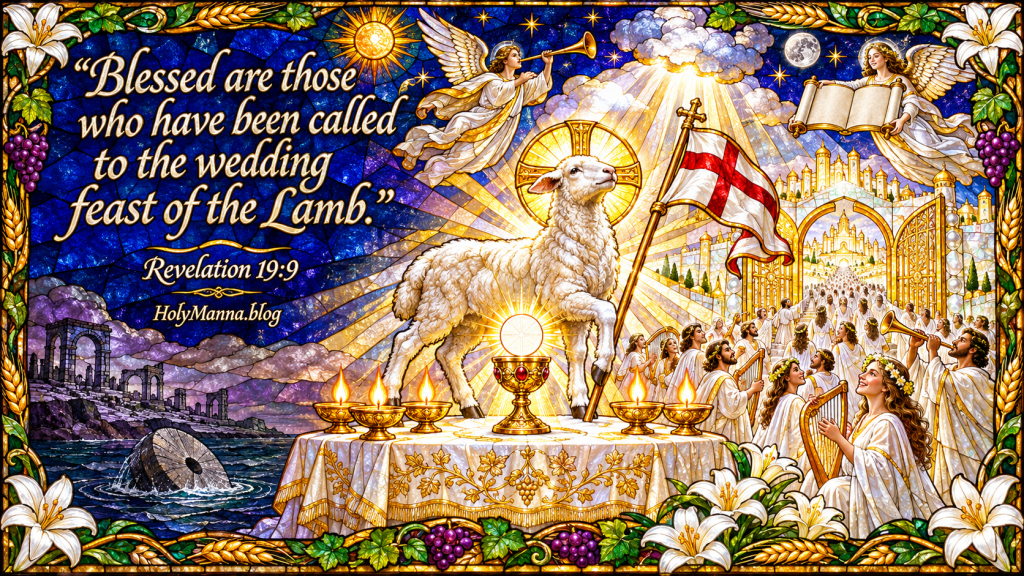
Thursday of the Thirty-fourth Week in Ordinary Time – Lectionary: 506
Two Cities and One Invitation
Every story worth telling has an ending, and the Church spends the last week of her year making sure nobody forgets how this one ends. Thursday, November 26th, 2026 falls in the 34th and final week of Ordinary Time, 4 days after the Solemnity of Christ the King and 3 days before Advent begins. The readings sound like sirens at first. Babylon collapses in The Book of Revelation, and Jerusalem is surrounded by armies in The Gospel of Luke. Yet between them sits Psalm 100, the great thanksgiving song of the Bible, and the refrain repeated all day long is an invitation to a wedding.
That contrast is the central theme. Every city built on pride eventually falls, but the people who belong to the Lamb are invited to a feast, so for the faithful the end is not ruin but redemption. Saint Augustine summed up all of history this way in The City of God: “two cities have been formed by two loves: the earthly by the love of self, even to the contempt of God; the heavenly by the love of God, even to the contempt of self.” These readings show both cities arriving at their destinations.
The historical background sharpens the point. Saint John wrote to Christians pressured by the Roman Empire, which he code-named Babylon after the empire that destroyed Jerusalem in 587 BC. Jesus spoke about 40 years before Roman legions destroyed Jerusalem again in AD 70. In the United States, this Thursday is also Thanksgiving Day, which makes a psalm about entering the gates of God with thanksgiving feel providential. How does a Christian look at a shaking world and still lift up the head?
First Reading — Revelation 18:1-2, 21-23; 19:1-3, 9a
The Night the Music Stopped and the Morning It Began Again
Saint John wrote The Book of Revelation from exile on the island of Patmos, near the end of the 1st century, to 7 churches in Asia Minor. Those Christians lived inside the most powerful empire on earth, and that empire wanted their worship. John calls it Babylon, the same nickname Saint Peter uses for Rome when he writes, “The chosen one at Babylon sends you greeting” (1 Peter 5:13). Saint Bede the Venerable, a Doctor of the Church, read Babylon more broadly as the society of all who live as though God did not matter. The Lectionary gathers verses from 2 chapters to show a single dramatic turn, in which a great city goes silent, heaven breaks into song, and a wedding invitation goes out.
Revelation 18:1-2, 21-23; 19:1-3, 9a
I, John, saw another angel coming down from heaven,
having great authority,
and the earth became illumined by his splendor.
He cried out in a mighty voice:
“Fallen, fallen is Babylon the great.
She has become a haunt for demons.
She is a cage for every unclean spirit,
a cage for every unclean bird,
a cage for every unclean and disgusting beast.”A mighty angel picked up a stone like a huge millstone
and threw it into the sea and said:“With such force will Babylon the great city be thrown down,
and will never be found again.
No melodies of harpists and musicians,
flutists and trumpeters,
will ever be heard in you again.
No craftsmen in any trade
will ever be found in you again.
No sound of the millstone
will ever be heard in you again.
No light from a lamp
will ever be seen in you again.
No voices of bride and groom
will ever be heard in you again.
Because your merchants were the great ones of the world,
all nations were led astray by your magic potion.”After this I heard what sounded like
the loud voice of a great multitude in heaven, saying:“Alleluia!
Salvation, glory, and might belong to our God,
for true and just are his judgments.
He has condemned the great harlot
who corrupted the earth with her harlotry.
He has avenged on her the blood of his servants.”They said a second time:
“Alleluia! Smoke will rise from her forever and ever.”
Then the angel said to me,
“Write this:
Blessed are those who have been called
to the wedding feast of the Lamb.”
Detailed Exegesis
Revelation 18:1: “I, John, saw another angel coming down from heaven, having great authority, and the earth became illumined by his splendor.”
The messenger carries borrowed light. Bede notes that this angel can be understood as the incarnate Lord Himself or as the teachers of His Church. Judgment begins with light, because truth must be seen before it is accepted.
Revelation 18:2: “He cried out in a mighty voice: ‘Fallen, fallen is Babylon the great. She has become a haunt for demons. She is a cage for every unclean spirit, a cage for every unclean bird, a cage for every unclean and disgusting beast.’”
The cry repeats Isaiah 21:9, and it is spoken in the past tense while Rome still stood, because the verdict of God is that certain. Bede explains: “For it is no other than the city of the devil which receives every unclean spirit, in which all the uncleanness throughout the world abides.” A culture that evicts God does not stay empty for long.
Revelation 18:21: “A mighty angel picked up a stone like a huge millstone and threw it into the sea and said: ‘With such force will Babylon the great city be thrown down, and will never be found again.’”
The gesture copies Jeremiah 51:63-64, where a scroll tied to a stone is sunk in the Euphrates as a sign against old Babylon. Bede comments, “The city of the age, because of the weight and transgression of sins, is compared with an unstable mass.” Sin is heavy, and whatever is built on it sinks.
Revelation 18:22: “No melodies of harpists and musicians, flutists and trumpeters, will ever be heard in you again. No craftsmen in any trade will ever be found in you again. No sound of the millstone will ever be heard in you again.”
Music, skilled work, and daily bread are good things, and the list echoes Jeremiah 25:10. The tragedy is that Babylon enjoyed real gifts and cut them off from the Giver. Every good thing withheld from God eventually goes quiet.
Revelation 18:23: “No light from a lamp will ever be seen in you again. No voices of bride and groom will ever be heard in you again. Because your merchants were the great ones of the world, all nations were led astray by your magic potion.”
Commerce had become a god, and the nations had been seduced by sorcery. The Catechism teaches that idolatry means treating as divine what is not God, including power, pleasure, and money (CCC 2113), and it rejects all magic and sorcery (CCC 2117). The last sound silenced is the voice of bride and groom, and that detail is about to matter.
Revelation 19:1: “After this I heard what sounded like the loud voice of a great multitude in heaven, saying: ‘Alleluia! Salvation, glory, and might belong to our God,’”
The scene shifts from earth to heaven. Alleluia is a Hebrew word that means praise the Lord, and Saint John Paul II observed in his General Audience of September 15th, 2004 that this chapter is the only place the word appears in the New Testament. The first response of heaven to the defeat of evil is worship.
Revelation 19:2: “‘for true and just are his judgments. He has condemned the great harlot who corrupted the earth with her harlotry. He has avenged on her the blood of his servants.’”
This is the relief of the oppressed, not gloating. The martyrs who cried out in Revelation 6:10 have been heard. The Catechism notes that this book is carried along by the songs of the heavenly liturgy and by the intercession of the martyrs (CCC 2642).
Revelation 19:3: “They said a second time: ‘Alleluia! Smoke will rise from her forever and ever.’”
The image comes from Isaiah 34:10 and means that the defeat of evil is permanent. Bede writes, “The Church extols the Lord for His judgments with unceasing love.”
Revelation 19:9a: “Then the angel said to me, ‘Write this: Blessed are those who have been called to the wedding feast of the Lamb.’”
The wedding voices silenced in Babylon are now heard forever in the city of God. At every Mass the priest lifts the Host and says, “Blessed are those called to the supper of the Lamb.” One reason the Mass is called the Lord’s Supper is that it looks ahead to this very feast in the heavenly Jerusalem (CCC 1329).
Teachings
Saint Augustine wrote The City of God after Rome was sacked in the year 410, when the empire that seemed eternal proved breakable. He could say that “Rome herself is like a second Babylon,” yet his point was larger than any map, since Babylon is wherever self-love pushes God out. Bede offers the faithful this courage: “O Jerusalem, he says, fear thou not the power of the earthly city, which falls spiritually by the very thing in which it prevails over thee, through the hostility of unholy citizens.”
The Catechism observes that Scripture opens with the creation of man and woman and closes with a vision of the wedding feast of the Lamb (CCC 1602), and that the liturgy on earth already shares in the worship John saw in heaven (CCC 1137-1139). Pope Benedict XVI wrote in Spe Salvi that the Last Judgment is “not primarily an image of terror, but an image of hope” (Spe Salvi 44), because it means that injustice does not get the final say.
Reflection
Babylon is not only ancient Rome. It is any arrangement of life in which money, comfort, status, or a screen quietly takes the place of God. The verse the Lectionary skips gives the marching orders: “Depart from her, my people, so as not to take part in her sins and receive a share in her plagues” (Revelation 18:4). You can start small by naming one thing that has too much of your heart and fasting from it for a week. Listen for the words about the supper of the Lamb at your next Mass, and treat every Sunday as the wedding invitation it is.
What in your life would go silent if God asked for it back? Where have you been living as a citizen of Babylon while carrying an invitation to the feast?
Responsorial Psalm — Psalm 100:1-5
Gratitude Is the Password at the Gate
Psalm 100 carries the heading “A psalm of thanksgiving.” Pilgrims most likely sang it while walking through the gates of the Temple in Jerusalem to offer a sacrifice of thanks. The Church still uses it as one of the psalms that can open the Liturgy of the Hours each morning. In this Mass it answers the fall of Babylon with the sound of the other city, and the refrain from Revelation 19:9 tells the reader where those gates finally lead. Saint Augustine preached a whole sermon on these 5 verses, and his insights are worth hearing line by line.
Psalm 100:1-5
R. (Rev. 19: 9a) Blessed are they who are called to the wedding feast of the Lamb.
Sing joyfully to the LORD, all you lands;
serve the LORD with gladness;
come before him with joyful song.
R. Blessed are they who are called to the wedding feast of the Lamb.
Know that the LORD is God;
he made us, his we are;
his people, the flock he tends.
R. Blessed are they who are called to the wedding feast of the Lamb.
Enter his gates with thanksgiving,
his courts with praise;
Give thanks to him; bless his name.
R. Blessed are they who are called to the wedding feast of the Lamb.
For he is good:
the LORD, whose kindness endures forever,
and his faithfulness, to all generations.
R. Blessed are they who are called to the wedding feast of the Lamb.
Detailed Exegesis
Psalm 100:1: “Sing joyfully to the LORD, all you lands;”
The invitation goes out to the whole earth, not only to Israel. Augustine’s Latin Bible said “jubilate,” and he explained it as a joy too large for words, like the wordless singing of harvesters in a field. He asks and answers, “When then are we jubilant? When we praise that which cannot be uttered.” The great multitude of Revelation 19 is this verse fulfilled.
Psalm 100:2: “serve the LORD with gladness; come before him with joyful song.”
Babylon demanded service too, but it was the grim kind. Augustine reassures the nervous: “Fear not the servitude of that Lord: there will be no groaning there, no discontent, no indignation.” Then he adds one of his finest lines: “At the same time you are slave, and free; slave, because you are created such; free, because you are loved by God, by whom you were created: yea, free indeed, because you love Him by whom you were made.”
Psalm 100:3: “Know that the LORD is God; he made us, his we are; his people, the flock he tends.”
The cure for the pride of Babylon is one sentence of realism, because no human being is self-made. Augustine’s text reads, “It is He that has made us, and not we ourselves.” The flock points straight to Christ, who says, “I am the good shepherd. A good shepherd lays down his life for the sheep” (John 10:11). The Shepherd of this psalm is also the Lamb of the wedding feast.
Psalm 100:4: “Enter his gates with thanksgiving, his courts with praise; Give thanks to him; bless his name.”
Gratitude is the way in. Augustine, whose Bible used the word confession for both admitting sin and praising God, says, “Let the gate, that is, the commencement for you, be confession.” The word Eucharist itself means thanksgiving (CCC 1328), so every Mass is a walk through these gates.
Psalm 100:5: “For he is good: the LORD, whose kindness endures forever, and his faithfulness, to all generations.”
Here is the reason for everything. The smoke of Babylon rises forever, and the kindness of God endures forever, and only one of those is worth living in. Augustine comments, “For He will not cease to be merciful, after He has freed you: it belongs to His mercy to protect you even unto eternal life.”
Teachings
The Catechism gives a definition that fits this psalm exactly: “Praise is the form of prayer which recognizes most immediately that God is God” (CCC 2639). It also teaches that thanksgiving marks the prayer of the Church, and that every event and every need can become an offering of thanks (CCC 2637-2638). Saint Paul says the same thing without qualification: “In all circumstances give thanks, for this is the will of God for you in Christ Jesus” (1 Thessalonians 5:18). The Mass is the highest form of this prayer, a sacrifice of thanksgiving offered to the Father (CCC 1360). On a day when many American families gather around a table to give thanks, the Church is quietly pointing to a greater table.
Reflection
Gratitude is a decision before it is a feeling, and this psalm is a 30-second training plan. You can pray it first thing in the morning before reaching for a phone. You can name 3 specific gifts before asking God for anything. You can arrive at Mass 5 minutes early and thank Him for the invitation. If you are sitting at a Thanksgiving table, you can say grace slowly enough to mean it.
What are you serving right now, and does it leave you glad? When did you last thank God for simply being God? Who needs to hear your gratitude out loud this week?
Holy Gospel — Luke 21:20-28
Heads Up, Because Redemption Is Coming
Jesus speaks these words in the Temple during the final days before His Passion. Some bystanders had been admiring the costly stones of the building (Luke 21:5), and He answered with a long discourse that holds 2 horizons together: the destruction of Jerusalem within a generation, and the end of history itself. Only days earlier He had wept over the city (Luke 19:41-44), so these are the words of a grieving prophet. The Catechism teaches that Jesus announced the ruin of the Temple as a sign of the last days, which were to begin with His own Passover (CCC 585). An earthly city falls here as well, and once more the disciples are given hope.
Luke 21:20-28
Jesus said to his disciples:
“When you see Jerusalem surrounded by armies,
know that its desolation is at hand.
Then those in Judea must flee to the mountains.
Let those within the city escape from it,
and let those in the countryside not enter the city,
for these days are the time of punishment
when all the Scriptures are fulfilled.
Woe to pregnant women and nursing mothers in those days,
for a terrible calamity will come upon the earth
and a wrathful judgment upon this people.
They will fall by the edge of the sword
and be taken as captives to all the Gentiles;
and Jerusalem will be trampled underfoot by the Gentiles
until the times of the Gentiles are fulfilled.“There will be signs in the sun, the moon, and the stars,
and on earth nations will be in dismay,
perplexed by the roaring of the sea and the waves.
People will die of fright
in anticipation of what is coming upon the world,
for the powers of the heavens will be shaken.
And then they will see the Son of Man
coming in a cloud with power and great glory.
But when these signs begin to happen,
stand erect and raise your heads
because your redemption is at hand.”
Detailed Exegesis
Luke 21:20: “When you see Jerusalem surrounded by armies, know that its desolation is at hand.”
Where The Gospel of Matthew and The Gospel of Mark speak of a mysterious desolating abomination, Saint Luke describes plain military history for his Gentile readers. Roman forces encircled the city in AD 66 and returned under Titus to destroy it in AD 70.
Luke 21:21: “Then those in Judea must flee to the mountains. Let those within the city escape from it, and let those in the countryside not enter the city,”
In the ancient world people ran into walled cities during war, so this advice sounded backwards. The Christians remembered it anyway. Eusebius records in his Church History that “the people of the church in Jerusalem had been commanded by a revelation, vouchsafed to approved men there before the war, to leave the city and to dwell in a certain town of Perea called Pella.”
Luke 21:22: “for these days are the time of punishment when all the Scriptures are fulfilled.”
The language comes from the prophets, especially Hosea 9:7 and the covenant warnings of Deuteronomy 28. Jesus is describing consequences foretold for centuries. The Church is careful here and teaches that the Jewish people bear no collective guilt for the death of Christ (CCC 597).
Luke 21:23: “Woe to pregnant women and nursing mothers in those days, for a terrible calamity will come upon the earth and a wrathful judgment upon this people.”
This woe is a cry of sorrow, not a curse. The heart of Jesus goes first to the most vulnerable. Eusebius quotes this prophecy when he recounts the siege and its famine.
Luke 21:24: “They will fall by the edge of the sword and be taken as captives to all the Gentiles; and Jerusalem will be trampled underfoot by the Gentiles until the times of the Gentiles are fulfilled.”
Eusebius, relaying the Jewish historian Josephus, reports about 1,100,000 dead and tens of thousands of the young sold into slavery. The phrase about the times of the Gentiles opens a window of mercy. Saint Paul explains in Romans 11:25-26 that the nations are being gathered in and that Israel remains in the plan of God, a hope the Catechism affirms (CCC 674).
Luke 21:25: “There will be signs in the sun, the moon, and the stars, and on earth nations will be in dismay, perplexed by the roaring of the sea and the waves.”
The horizon now widens from one city to the whole cosmos. This is the vocabulary of the Day of the Lord in Isaiah 13:10 and Joel 3:3-4, and the sea in Scripture stands for chaos. Creation itself will announce the return of its Creator.
Luke 21:26: “People will die of fright in anticipation of what is coming upon the world, for the powers of the heavens will be shaken.”
Terror is the natural reaction of anyone whose whole treasure is in this world. Saint Gregory the Great reads the shaken powers as the angelic hosts: “For whom does He call the powers of heaven, but the angels, dominions, principalities, and powers?”
Luke 21:27: “And then they will see the Son of Man coming in a cloud with power and great glory.”
Jesus claims the vision of Daniel 7:13-14, where one like a son of man receives everlasting dominion. The cloud is the biblical sign of the presence of God. The Catechism teaches that the reign of Christ, already present in His Church, will be fulfilled when the King returns in glory (CCC 671), and that the cloud of the Ascension will reveal Him on that day (CCC 697).
Luke 21:28: “But when these signs begin to happen, stand erect and raise your heads because your redemption is at hand.”
Here is the hinge of the whole day. While others collapse in fear, disciples take the posture of free people. Gregory the Great preaches it unforgettably: “When the buffetings of the world multiply, lift up your heads, that is, rejoice your hearts, for when the world closes whose friends you are not, the redemption is near which you seek.”
Teachings
Saint Gregory the Great, a Doctor of the Church who led Rome through plague, flood, and invasion, explained what raising the head means: “To lift up our heads then, is to raise up our minds to the joys of the heavenly country.” The Catechism teaches that the coming of Christ in glory has been imminent ever since the Ascension, even though no one knows the hour (CCC 673). It adds that the Last Judgment will show that the justice of God triumphs over every injustice and that His love is stronger than death, which is why it calls people to conversion while time remains (CCC 1040-1041). The flight to Pella shows what happens when believers take Jesus at His word. They listened, they moved, and they lived.
Reflection
You do not need to decode headlines to live this Gospel. You need to be ready. When the news makes your chest tighten, you can answer with one of the oldest Christian prayers, “Come, Lord Jesus!” (Revelation 22:20). You can go to Confession before Advent begins on Sunday, because a clean conscience is what makes it possible to look up. You can trade 10 minutes of scrolling for 10 minutes with Luke 21. You can do one concrete work of mercy this week, since love is how a disciple stays awake.
When the world feels unstable, where do your eyes go first? What would you want to set right if the Lord returned tonight? Do you think of the Second Coming as a threat or as a rescue, and why?
The Last Word Is a Wedding
Picture two cities at the end of a long day. In the first, the music has stopped, the lamps are out, and the markets that once ruled the world are quiet. In the second, a crowd too large to count is singing a word that needs no translation, and the gates stand wide open. A Lamb is waiting at a table.
That is the story these readings tell. The Book of Revelation shows that every Babylon falls, however permanent it looks. Psalm 100 hands over the password for the better city, which is thanksgiving. The Gospel of Luke shows Jesus looking directly at the worst that history can do and then telling His friends to stand up straight, because the end of the old world is the arrival of their redemption.
The Christian is not asked to be naive about the darkness. The Christian is asked to remember the ending. The invitation has already been delivered at Baptism, and it is renewed at every Mass when the priest holds up the Lamb of God and calls the guests blessed. All that remains is to live like someone who intends to show up.
So this last Thursday of the Church year can become a turning point for anyone willing to take it. The path is simple enough to remember: leave whatever belongs to Babylon, walk through the gates with a grateful heart, and look up, because the One who is coming on the clouds is the same One who laid down His life for the flock. Who would want to miss a wedding like that?
Engage With Us!
Share your reflections in the comments below. Your insight on these readings may be exactly what another reader needs as the Church year comes to a close.
- In Revelation 18:1-2, 21-23 and Revelation 19:1-3, 9a, Babylon falls silent while heaven sings Alleluia. What attachment in your life looks more like Babylon than like the wedding feast of the Lamb, and what is one step you can take to leave it behind?
- Psalm 100:1-5 invites all lands to enter the gates of the Lord with thanksgiving. What 3 gifts can you thank God for today, and how could gratitude change the way you pray this week?
- In Luke 21:20-28, Jesus tells His disciples to stand erect and raise their heads. What fear about the future do you need to hand over to Christ so that you can look up with hope?
- All of these readings point to one message: the cities of this world fall, but the faithful are invited to a feast. How will you live this week as someone who has already received the invitation?
Keep walking in faith, even when the world feels unsteady. Stay close to the sacraments, stay grateful, and keep your head lifted toward the Lord who is coming. Do everything with the love and mercy that Jesus taught, and let that love be the sign that you belong to the city of God.
Sacred Heart of Jesus, we trust in You!
Immaculate Heart of Mary, pray for us!
Saint Michael the Archangel, defend us in battle!
Follow us on YouTube, TikTok, Instagram and Facebook for more insights and reflections on living a faith-filled life.


Leave a Reply