The Last Blood of the Great Persecution
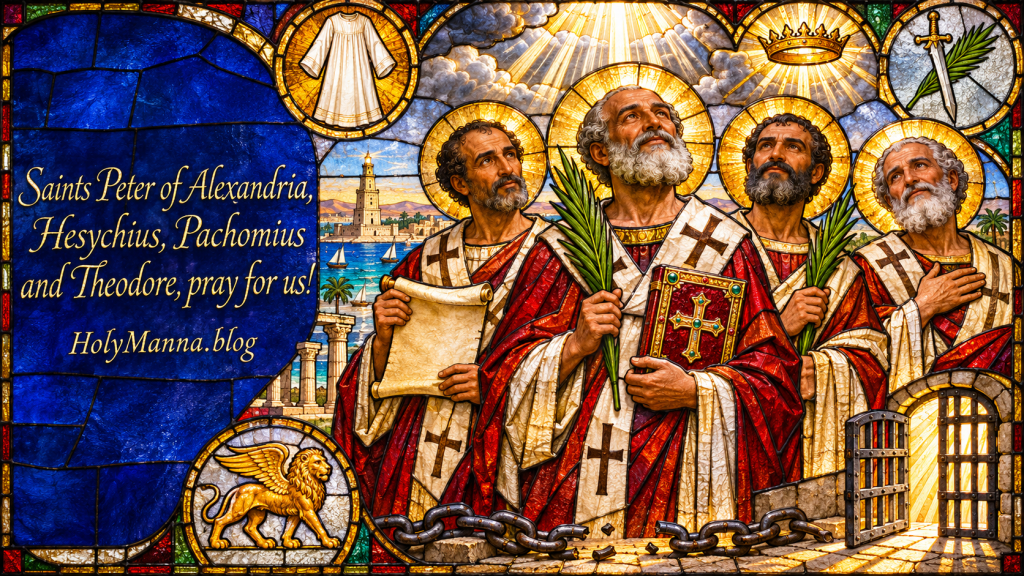
On November 25th, the Roman Martyrology remembers 4 bishops of Egypt who gave their lives for Christ during the final and fiercest persecution the Roman Empire ever launched against the Church. The first is Saint Peter, bishop of Alexandria, who was seized without warning and beheaded in the year 311. Commemorated with him are Saints Hesychius, Pachomius and Theodore, 3 bishops of Egyptian churches who suffered at Alexandria in the same persecution, along with a great many other Christians whose names only God knows.
Peter is the best known of the 4. The historian Eusebius of Caesarea, who lived through those terrible years, called him “one of the most excellent teachers of the religion of Christ” (Church History 8.13). Christians of the East have long honored him with the title Seal of the Martyrs, because his death was remembered as the closing signature on an age of blood. He was a scholar who defended the truth about Jesus, a pastor who wrote merciful rules for sinners who wanted to come home, and a father who refused to let his flock be split in two.
Hesychius, Pachomius and Theodore are quieter figures. History has kept almost nothing about them except their names, one remarkable letter written from a prison cell, and the fact that they died for Jesus Christ. That is exactly why they deserve a place beside Peter. The Catechism teaches that “Martyrdom is the supreme witness given to the truth of the faith” (CCC 2473), and these 4 shepherds gave that witness in the same city, for the same Lord, and for the same undivided Church.
Sons of the Church of Saint Mark
Alexandria at the close of the 3rd century was one of the greatest cities of the Roman Empire and one of the great capitals of Christian learning. Its church traced its beginnings to Saint Mark the Evangelist, and its famous catechetical school had trained generations of believers. This is the world that formed Peter.
Very little is known about his early years. Catholic accounts describe him as a native of Alexandria, but the date of his birth, the names of his parents, and the date of his ordination have all been lost. A 5th century historian named Philip of Side reports that Peter once served as head of the catechetical school, although Philip is the only ancient writer who says so. What is certain is that in the year 300 Peter succeeded Saint Theonas as bishop of Alexandria.
Eusebius records that Peter governed his church for 12 years, and that fewer than 3 of those years were peaceful. When the persecution broke out in 303, Peter did not grow softer or more cautious in his own spiritual life. Eusebius says that he took up an even stricter life of self-discipline and cared openly for the churches entrusted to him. Suffering did not push him away from God. His life holds no dramatic conversion story, only the steady deepening of a faith he was already living.
For Hesychius, Pachomius and Theodore, the record is thinner still. Their birthplaces, their families, and even the names of the cities where they served as bishops are unknown. Eusebius simply lists them, together with Bishop Phileas of Thmuis, among the bishops of Egyptian churches who died for Christ.
Two clarifications help here. This Pachomius is not Saint Pachomius the Great, the famous father of monastic community life, and this Theodore is not the disciple of that same abbot. Those 2 monks lived in Egypt a generation later. Some scholars have also proposed that this Hesychius is the same Hesychius whose revision of the Greek text of the Bible circulated in Egypt, a revision mentioned by Saint Jerome. That identification is an old scholarly conjecture, and it cannot be proven.
Truth, Mercy and a Letter From Prison
In February of 303 the emperor Diocletian ordered churches torn down and the Scriptures burned, and further edicts soon demanded that Christians sacrifice to the Roman gods. The Church in Egypt suffered terribly. Eusebius, who saw some of it with his own eyes, describes Christians in the region being tortured and executed in great numbers, sometimes as many as 100 in a single day, and many of them going to their deaths singing hymns.
Peter’s first gift to his people in those years was clear teaching. Fragments of his writings survive, and they show a bishop correcting some of the mistaken speculations that had grown up around the brilliant Alexandrian teacher Origen. Against the idea that souls existed before their bodies, Peter taught that God creates the human person as one being, body and soul together. The Church professes the same truth when she teaches that every soul is created immediately by God (CCC 366). Against a watered down view of the resurrection, he insisted that the body that rises is the same body that lived on earth (CCC 999). Above all, he confessed that Jesus Christ is God by nature and became man by nature. More than a century later, Saint Cyril of Alexandria quoted Peter’s book on the divinity of Christ at the Council of Ephesus in 431. The Church still proclaims that faith in the words of The Catechism: “Jesus Christ is true God and true man” (CCC 464).
His second gift was mercy with a backbone. Under torture and terror, many Christians had denied Christ or offered incense to idols, and afterward many of them wanted to come back. At Easter of 306, which Peter called the 4th Pasch of the persecution, he issued a letter of 14 canons that became one of the most important documents of the early Church on repentance. The Catechism recalls that in the first centuries the reconciliation of Christians who had committed grave sins such as idolatry was “tied to a very rigorous discipline” (CCC 1447). Peter worked inside that discipline, but he read every case with a father’s eye.
Those who had broken down only after brutal torture, and who had already done penance for 3 years, were to be received after 40 more days. Those who had fallen out of fear alone, without suffering anything, were given longer penances. Christian slaves who had been forced by their masters to sacrifice received 1 year, while the masters who had forced them received 3. Clergy who had rashly volunteered for martyrdom and then failed lost their ministry but stayed in the communion of the Church. Those who had paid money to be left alone were not to be accused, and those who had fled were not to be blamed. That judgment is in harmony with the Lord’s own counsel, given here in the words of the Douay-Rheims Bible: “And when they shall persecute you in this city, flee into another” (Mt 10:23). Peter himself spent part of the persecution in hiding so that he could keep guiding his flock by letter and through trusted priests.
A final canon, which may come from another of his writings, mentions the fasts of Wednesday and Friday and adds a beautiful line about Sunday: “the Lord’s day we celebrate as a day of joy”. The Church still keeps each Friday as a day of penance “in memory of the death of the Lord” (CCC 1438), and she still guards “the joy proper to the Lord’s Day” (CCC 2185). Every one of Peter’s canons breathes the conviction that Christ gave the sacrament of Penance “above all for those who, since Baptism, have fallen into grave sin” (CCC 1446).
Meanwhile, Hesychius, Pachomius, Theodore and Phileas were sitting in prison for the faith. While they waited for death, disturbing news reached them. Meletius, the bishop of Lycopolis in Upper Egypt, was traveling through other bishops’ territories and ordaining clergy for churches whose own shepherds were in chains or in hiding. The 4 prisoners wrote to him, and their letter still exists in an ancient Latin translation.
The bishops greet Meletius as a friend and fellow minister, and they admit that at first they refused to believe the reports. Then they remind him of the ancient rule that no bishop may ordain in another bishop’s territory, a rule that protects the careful testing of candidates, and they appeal to the warning of Saint Paul: “Impose not hands lightly upon any man” (1 Tim 5:22). They answer his excuse that the flocks were going without pastors by pointing out that visitors had already been appointed to care for them. Most movingly, they reproach him for forgetting the honor owed to the man they call “our great bishop and father, Peter, on whom we all depend”.
From a prison cell, these bishops defended the unity of the Church. The Catechism explains why this matters so much, because individual bishops are “the visible source and foundation of unity in their own particular Churches” (CCC 886). A bishop who ignores that order does not strengthen the Church, even when his reasons sound pastoral.
As for miracles, the writers closest to these events record no wonders worked by any of the 4 during their lives. A later Life of Saint Peter, handed down in Latin by Anastasius the Librarian, tells one story. It says that Peter would never sit on the bishop’s throne during the liturgy and took the footstool instead. When his clergy objected, he explained that whenever he approached the throne he saw a heavenly radiance resting upon it, and that he knew himself unworthy to sit there. This story cannot be verified.
The Tempest and the Sword
Meletius never answered the letter. According to a short ancient note preserved with it, he did not visit the imprisoned bishops, and he did not go to Peter. After the bishops, priests and deacons held at Alexandria had died as martyrs in their prison, he entered the city itself. Two ambitious men, Isidore and Arius, pointed out to him the priests whom Peter had left in charge. The Catholic Encyclopedia identifies this Arius as the future heretic. Meletius suspended Peter’s priests and ordained replacements on his own authority.
Peter’s response was firm and patient. He wrote to his people that they should “hold no communion with him” until the matter could be examined face to face. Around 306, a council of Egyptian bishops under Peter deposed Meletius. Saint Athanasius, who would later sit in Peter’s chair, wrote simply: “Peter was Bishop among us before the persecution”. Athanasius also recorded that Peter suffered martyrdom during the persecution and that Meletius was convicted of many offenses, including sacrifice to idols. The Catholic Encyclopedia advises caution about that last charge, because it may have rested on rumor. Saint Epiphanius gives a different version, in which Meletius is the stricter party in a dispute over the lapsed, but Catholic scholars regard that account as marked by historical errors.
What is not in doubt is the wound. The Catechism describes schism as a refusal of submission to the Roman Pontiff or of “communion with the members of the Church subject to him” (CCC 2089). It adds that such “ruptures that wound the unity of Christ’s Body” (CCC 817) never happen without human sin. The Meletian schism was still alive when the Council of Nicaea met in 325, and it lingered into the 5th century. Alban Butler also records that Peter ordained Arius a deacon and later had to excommunicate him for siding with the schismatics. The empire attacked Peter from outside, and division tore at him from within.
The deaths of Hesychius, Pachomius and Theodore are known only in outline. Eusebius lists them among those who died gloriously at Alexandria and throughout Egypt. The ancient note attached to their letter says that the imprisoned clergy died as martyrs in their prison. The later Life of Saint Peter speaks of more than 660 confessors confined in one dungeon with Hesychius and Theodore, and it says that Peter wrote to strengthen them and gave thanks when he learned that they had finished their course. The older editions of the Roman Martyrology say that the sword of persecution sent them to heaven. The exact year is uncertain, since their letter dates to no later than 307, yet Eusebius also says that many Egyptian bishops suffered with Peter in 311. Their companion Phileas was beheaded at Alexandria and has his own commemoration on February 4th.
Peter’s end came in 311. That spring the dying emperor Galerius had issued an edict of toleration, but in the East Maximinus Daia soon renewed the attack. Eusebius reports that Peter was “seized for no cause and quite unexpectedly” (Church History 9.6) and was beheaded at once, without explanation, as though by direct command of Maximinus. In another place he says that Peter was “adorned with the crown of martyrdom” (Church History 7.32) in the 9th year of the persecution. The priests Faustus, Dius and Ammonius are named beside him as perfect martyrs of Christ.
The later Life of Saint Peter fills that bare record with a much longer and very moving account. According to this tradition, Peter was held for a time in prison, and a great crowd of Christians surrounded the building so that the soldiers could not reach him without a massacre. Arius, already excommunicated, sent clergy to beg for pardon. Peter refused, and then he took aside 2 of his priests, Achillas and Alexander, who would be the next 2 bishops of Alexandria. He told them that during his prayer he had seen a boy of about 12, whose face shone too brightly to look at, wearing a linen tunic torn from the neck to the feet and holding the torn halves together against his chest. When Peter asked who had torn the garment, the boy, who was Christ, answered that Arius had done it and warned that Arius must not be received into communion.
The story continues that Peter, wanting to spare his people, secretly told the officers to break through the back wall of the prison at night while a storm covered the noise. He was led to the place where Saint Mark was believed to have been martyred, and he prayed at the Evangelist’s tomb. His prayer included this plea: “Speak peace, I beseech Thee, to the tempest that shakes Thy Church.” A consecrated virgin living nearby is said to have heard a voice from heaven declaring that as Peter was the first of the apostles, so this Peter was the last of the martyred bishops of Alexandria. The soldiers were so afraid to strike him that each put up 5 gold coins as a reward, until one of them took the money and beheaded him. The account gives the date as November 25th. This story cannot be verified. The Catholic Encyclopedia judges that the surviving Acts of his martyrdom were written too late to count as history, and their account of an imprisonment does not match Eusebius, who says that Peter’s arrest and death were sudden.
Even so, the image at the heart of that tradition has taught Christians for centuries. The Gospel of John says of the tunic of Jesus at the Cross: “Now the coat was without seam, woven from the top throughout” (Jn 19:23). Saint Cyprian of Carthage, in his work On the Unity of the Catholic Church, saw in that seamless garment a sign of the unity of the Church. To tear the Church by schism, or to tear the faith by denying that the Son is truly God, is to tear the garment of Christ. The Council of Nicaea would later condemn Arius and confess that the Son is of the same substance as the Father (CCC 465).
A Witness That Kept Speaking
The same later tradition tells what happened next. It says that Peter’s body remained upright, as though still at prayer, until the faithful found it. It says that the people of Alexandria nearly came to blows over where he should be buried, and that his body was finally carried by boat to a church and martyrs’ cemetery he had built on the western side of the city. There, the account says, the faithful first seated his body on the bishop’s throne that he had never been willing to occupy in life, and then they laid him to rest with palms, candles, hymns and incense. It adds that healings and deliverances from evil spirits took place at his tomb. These stories cannot be verified.
An early 20th century Catholic dictionary also states that most of Peter’s relics were later enshrined in a church at Grasse, in France. That claim cannot be verified.
What can be verified is the long reach of his witness. His canons on repentance were ratified by the Council in Trullo in 692 and became part of the canon law of the Christian East. His priests Achillas and Alexander succeeded him in turn, and Alexander’s young deacon and successor was Saint Athanasius, who carried the defense of Christ’s divinity through the whole Arian storm.
The title Seal of the Martyrs comes from the Eastern tradition. Historically, the persecution under Maximinus Daia dragged on in places until 313, so Peter was not literally the last Christian to die under pagan Rome. The title expresses how Alexandria remembered him, as the bishop whose blood closed its age of martyrs. Dom Prosper Guéranger notes that for centuries the West knew him simply as Peter the Martyr, until Saint Peter of Verona received that name in the 13th century and the bishop became known as Saint Peter of Alexandria.
His feast was long kept in the Roman calendar on November 26th, and the older Roman Martyrology named him on that day together with Phileas, Hesychius, Pachomius, Theodore and 660 others. He is no longer on the General Roman Calendar, but the current Roman Martyrology commemorates him with Hesychius, Pachomius and Theodore on November 25th. He remains especially beloved among Coptic Christians, and his vision of Christ in the torn garment became a familiar subject in the sacred art of the Eastern churches.
The 3 bishops beside him left no shrine and no recorded miracles. Their memory survives in a few lines of Eusebius, in a letter that lay hidden in a manuscript at Verona until Scipione Maffei published it in the 18th century, and in the yearly remembrance of the Church. That quiet remembrance is enough. The Catechism says that the Church has carefully collected “the records of those who persevered to the end in witnessing to their faith” (CCC 2474), and it assures the faithful that the saints in heaven “do not cease to intercede with the Father for us” (CCC 956).
Mending What Is Torn
First, they show how truth and mercy belong together. Peter never pretended that denying Christ was a small thing, and he never treated a fallen Christian as a lost cause. He named the sin, set a path of penance, and opened the door. That is exactly what happens in every confessional. If you have been away from the sacrament of Reconciliation for months or years, Peter’s canons are an invitation written 17 centuries ago with someone like you in mind. What sin or failure have you decided is too embarrassing to bring to confession, and what would it mean to trust the mercy of Christ with it this week?
Second, they show that unity is worth suffering for. Meletius had reasons that sounded pastoral, since he claimed that the flocks needed shepherds. He was still wrong, because he acted outside communion with the bishop to whom he owed respect. It is easy today to build a private version of the Church out of favorite online voices and favorite grievances. The imprisoned bishops chose a harder path. They corrected a brother honestly and gently, and they stayed loyal to their bishop from a prison cell. You can imitate them by praying for your own bishop and pastor by name, by refusing to pass along gossip about the clergy, and by bringing real concerns to the right person in charity. Is there any place in your life where you are quietly tearing at the garment of Christ through criticism, division, or contempt?
Third, they show that hidden fidelity counts. Almost nothing is known about Hesychius, Pachomius and Theodore. History records only that they stayed faithful to the end, and heaven considers that a complete biography. Most Christian lives look more like theirs than like the lives of famous saints. Would you be content to be forgotten by history if you were remembered by God?
Finally, they show what courage looks like. The Catechism teaches that “Fortitude is the moral virtue that ensures firmness in difficulties and constancy in the pursuit of the good” (CCC 1808), and it reminds every disciple that the faith must be professed and not merely kept (CCC 1816). Few readers will ever face a sword, but many will face a mocking comment or pressure to stay quiet about what they believe. Jesus promises: “Every one therefore that shall confess me before men, I will also confess him before my Father who is in heaven” (Mt 10:32). A simple way to begin is to keep Friday as a real day of penance, as Peter taught his people, and to offer that small sacrifice for Christians who are persecuted today. What is one small, concrete act of courage that Christ is asking of you right now?
Engage With Us!
Readers are warmly invited to share their thoughts and reflections in the comments below.
- Saint Peter of Alexandria held truth and mercy together when he welcomed back Christians who had fallen. How have you experienced both the honesty and the tenderness of God in the sacrament of Reconciliation?
- Hesychius, Pachomius, Theodore and Phileas defended the unity of the Church from a prison cell. What is one concrete thing you can do this week to build unity in your parish, your family, or your friendships?
- The 3 companion bishops are almost unknown to history, yet the Church remembers them every year. How does their hidden faithfulness change the way you think about your own ordinary, unseen acts of love?
- Tradition remembers Peter praying that peace would be spoken to the tempest shaking the Church. What storm in the Church or in your own life do you most need to hand over to Christ in prayer?
- Where are you being asked to confess Christ openly right now, and what fear is holding you back?
May the example of Saints Peter, Hesychius, Pachomius and Theodore give you courage to stay faithful when it costs something, humility to seek mercy when you fall, and love strong enough to protect the unity of Christ’s Church. Live your faith out loud, lean on the prayers of the martyrs, and do everything with the love and mercy that Jesus taught.
Saints Peter, Hesychius, Pachomius and Theodore, pray for us!
Follow us on YouTube, TikTok, Instagram and Facebook for more insights and reflections on living a faith-filled life.


Leave a Reply