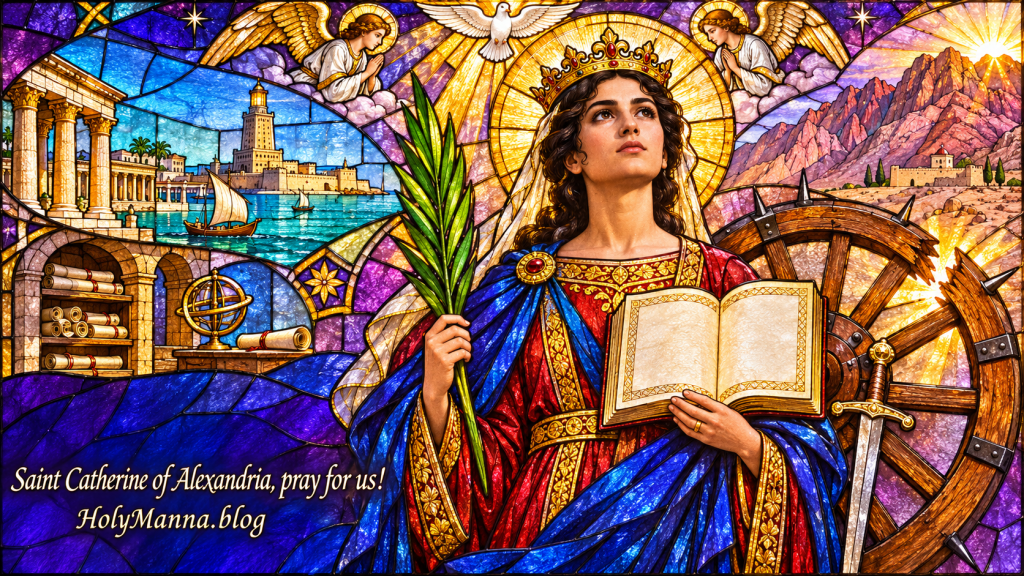
The Girl Who Out-Argued an Empire
Every year on November 25th, the Church remembers a teenage girl from Egypt whose name has been carried by queens, cathedrals, a California island, and one of the oldest monasteries on earth. Saint Catherine of Alexandria, Virgin and Martyr, is honored as the young scholar who stood before a Roman emperor, defended the Christian faith with her mind, and then sealed that defense with her blood. For close to 6 centuries of the Middle Ages, she was one of the most beloved saints in Christendom. She was counted among the Fourteen Holy Helpers, and Saint Joan of Arc named her as one of the heavenly voices that guided her mission.
Her story deserves to be told honestly. The oldest surviving written accounts of Catherine’s life date from centuries after her death, and the Church herself speaks about her with care. The current Roman Martyrology introduces her as a virgin and martyr of Alexandria according to tradition, a woman filled with keen intelligence, wisdom, and strength of soul, whose body is venerated at the monastery on Mount Sinai. Her feast was removed from the General Roman Calendar in 1969 because so little about her could be documented, and Pope Saint John Paul II restored it in 2002 as an Optional Memorial. The Collect of her Mass in The Roman Missal still calls her “a Virgin and an invincible Martyr”.
That is why this account separates what history can confirm from what loving tradition has handed down. History confirms an ancient devotion, a shrine on Sinai, and an enormous footprint on Christian culture, while tradition supplies one of the most dramatic stories in the whole calendar of saints.
Saint Catherine is the patroness of philosophers, theologians, apologists, preachers, students, teachers, and young unmarried women. Because of the spiked wheel linked to her martyrdom, she is also the patroness of wheelwrights, millers, potters, and others who work with wheels, and English lacemakers long kept her feast as their own. The Dominican Order honors her as a special protectress.
The Church holds up saints like Catherine for a reason. The Catechism teaches that the Church sustains the hope of believers “by proposing the saints to them as models and intercessors” (CCC 828). Catherine is a model for anyone who has ever wondered whether a sharp mind and a deep faith can live in the same person.
Raised Among Scrolls, Claimed by Christ
Alexandria at the close of the 3rd century was the intellectual capital of the Mediterranean world. It was also home to a Christian community that tradition traces back to Saint Mark the Evangelist, along with a famous catechetical school where the faith was taught with real intellectual rigor.
According to tradition, Catherine was born there around the year 287 into a noble family. Later accounts name her father Costus. The medieval Legenda Aurea of Blessed Jacobus de Voragine calls him a king, while other tellings make him the governor of Alexandria, and still later tradition gives her mother the name Sabinella. The same accounts say that Catherine was trained from childhood in the liberal arts and that she outshone the scholars of her city while still in her teens. None of these family details can be verified from early historical records, and they are best received as the tradition they are.
The story of her conversion is one of the most tender parts of that tradition. It is told that Catherine, brilliant and wealthy and sought after, could find no suitor who was her equal. A Christian hermit living outside the city spoke to her of a Bridegroom whose beauty and wisdom surpassed all creation, and he gave her an image of the Blessed Virgin holding the Child Jesus. That night Catherine saw the Blessed Mother and her Son in a vision, but the Child turned His face away from her because she had not yet been washed in Baptism. Catherine sought instruction and was baptized. In a second vision, the Child Jesus looked on her with love and placed a ring on her finger, taking her as His spouse. This episode, which artists such as Annibale Carracci and Filippino Lippi later painted as the mystical marriage of Saint Catherine, comes from later medieval tradition, and it cannot be verified.
Whatever the historical details, the heart of the story fits what the Church has always believed about consecrated virginity. From apostolic times, Christian women have been called to give themselves entirely to the Lord (CCC 922). The Catechism describes virginity for the sake of the Kingdom as “a powerful sign of the supremacy of the bond with Christ” (CCC 1619). The Catherine of tradition did not despise marriage or learning. She simply found the One to whom everything else pointed, and she gave Him everything.
Her conversion also did not require her to switch off her mind. The Catechism insists that “there can never be any real discrepancy between faith and reason” (CCC 159), because the same God is the source of both. Catherine brought every bit of her education with her to the baptismal font, and she would soon need all of it.
One Teenager Against 50 Philosophers
According to the traditional account, Catherine was 18 years old when an emperor came to Alexandria and ordered everyone, rich and poor alike, to offer sacrifice to the pagan gods. Christians who refused were punished. The sources do not agree on which emperor this was. The Legenda Aurea names Maxentius, while the older editions of the Roman Martyrology and The Catholic Encyclopedia name Maximinus. The Vatican City State’s own profile of the saint judges Maximinus Daia the more likely of the two, and most accounts place the events around the year 305.
Catherine did not hide. Tradition says she walked into the middle of the festivities, greeted the emperor respectfully, and then told him that he was worshiping creatures in place of the Creator. She asked him to look up at the heavens and to consider who must be greater than they are. It is a strikingly Catholic argument. The Book of Wisdom says, “For from the greatness and the beauty of created things their original author, by analogy, is seen” (Wisdom 13:5), and the Catechism teaches that God “can be known with certainty from the created world by the natural light of human reason” (CCC 36). Catherine was not asking the emperor to stop thinking. She was asking him to think all the way to the end. She also named the real problem, which the Catechism states plainly: “Idolatry consists in divinizing what is not God” (CCC 2113).
The emperor could not answer her, so he sent for help. Tradition says he summoned 50 of the finest orators and philosophers in the empire to humiliate the girl in public debate. What happened was the exact opposite. Catherine answered them point by point, and their own leader admitted that they had no reply. The story goes on to say that the 50 scholars professed faith in Christ, that the furious emperor had them burned alive in the center of the city, and that Catherine encouraged them to the end. The account adds that the flames left their bodies unharmed. This story of the debate and of the martyrdom of the philosophers cannot be verified.
Christians have always heard in that scene an echo of a promise Jesus made to His disciples about the day they would be dragged before rulers. He told them that He Himself would give them “a wisdom in speaking that all your adversaries will be powerless to resist or refute” (Luke 21:15).
The tradition does not stop there. The emperor, taken with Catherine’s beauty and intelligence, offered to make her his consort and to set up her statue in the city. She refused, answering that she already belonged to Christ. He had her scourged and thrown into a dark cell for 12 days without food. It is told that a white dove brought her heavenly nourishment each day, so that she came out of the dungeon radiant instead of starved. During those days the empress, named Faustina in some tellings, came to the prison at night with Porphyrius, the commander of the imperial troops. Both were won over by Catherine’s words and were baptized, and 200 soldiers followed them into the faith. These episodes of the dove, the empress, and the soldiers come from the later accounts of her passion, and they cannot be verified.
The reason generations of Catholics loved this saint is summed up by The Catholic Encyclopedia, which explains that theologians, apologists, preachers, and philosophers sought her intercession because she “triumphed in science by closing the mouths of sophists”. She matters because she shows that the faith can be explained, defended, and proposed with confidence. Saint Peter asked exactly this of every Christian: “Always be ready to give an explanation to anyone who asks you for a reason for your hope” (1 Peter 3:15). The Catechism is just as direct when it says that the disciple of Christ must not only keep the faith but also “confidently bear witness to it, and spread it” (CCC 1816).
The Wheel That Shattered
An emperor who could not win the argument turned to the machinery of terror. According to tradition, he ordered the construction of a device made of 4 wheels fitted with iron saws and sharp nails, designed to tear Catherine’s body apart. She was led out to it and she prayed. The story says that an angel struck the machine and shattered it, and that the flying wreckage killed many of the pagan onlookers; the Legenda Aurea puts the number at 4,000. In another version, the wheel simply broke apart at her touch. This is the origin of the wheel that appears beside her in countless paintings, statues, and stained glass windows, and of her old title, Saint Catherine of the Wheel. The miracle of the wheel cannot be verified.
The emperor’s own household then turned against him. Tradition says the empress rebuked her husband for his cruelty, refused to sacrifice, and was tortured and beheaded. Porphyrius buried her body, confessed that he was a Christian, and was beheaded along with his soldiers. Catherine was given one last choice between sacrifice and death. She chose death without hesitation. She prayed for all who would remember her passion, bent her neck to the sword, and was beheaded. The accounts add that milk flowed from her wound in place of blood. These details of the final martyrdoms cannot be verified.
A fair question follows. What can be said about her death with more confidence? The older Roman Martyrology told her passion far more simply than the popular stories. It recorded that she was imprisoned at Alexandria for confessing the Christian faith, scourged at length, and finally beheaded. There is also an intriguing witness from her own era. Eusebius of Caesarea, writing his Church History within about a generation of the persecution, tells of a Christian noblewoman of Alexandria, distinguished for her wealth, family, and education, who alone “conquered the passionate and intemperate soul of Maximinus by most heroic firmness”. Eusebius does not give her name, and he says she was punished with exile and the loss of her property, not with death. Some Catholic writers have wondered whether this courageous woman stands behind the story of Catherine. That connection is a conjecture, and it cannot be proven.
Léon Clugnet, writing in The Catholic Encyclopedia, offered a balanced judgment. He held that the long speeches and many of the marvels in her Acts were later embellishments, that the main outline could still be accepted, and that there was no reason to doubt that the saint existed. The date of her death is also uncertain. Most sources give about 305, while others suggest 307, 310, or 312.
What is never uncertain is what the Church means by martyrdom. The Catechism says, “Martyrdom is the supreme witness given to the truth of the faith” (CCC 2473). The martyr is united to Christ, who died and rose, and endures death through an act of fortitude. The Catechism explains that this virtue enables a person “to conquer fear, even fear of death” (CCC 1808). Jesus had prepared His friends for this: “And do not be afraid of those who kill the body but cannot kill the soul” (Matthew 10:28). The Catherine whom the Church venerates is a young woman who believed Him.
From Mount Sinai to the Ends of the Earth
The story does not end at the executioner’s block. Tradition holds that angels took up Catherine’s body and carried it across the desert to Sinai, a journey of more than 20 days, and laid it to rest on the heights where God once spoke to Moses. The older Roman Martyrology stated it simply: “Her body was miraculously conveyed by angels to Mount Sinai”. This beautiful tradition cannot be verified, and The Catholic Encyclopedia frankly notes that the travel accounts of the earliest pilgrims to Sinai do not mention it.
History picks up the thread at the monastery itself. The Emperor Justinian built a fortified monastery at the foot of Mount Sinai in the 6th century. At some later point the monks there came to venerate the relics of Saint Catherine, said to have been found on a nearby peak that still bears her name. Sources do not agree on when this happened; a date around the year 800 is often given, while at least one Catholic source places the discovery much later. Over time so many pilgrims came to honor her that the whole monastery became known as Saint Catherine’s. Medieval pilgrims reported that a fragrant oil flowed from her bones and brought healing to the sick, and the Legenda Aurea says that this oil strengthened the limbs of the weak. These reports of healing oil cannot be verified. Today the Greek Orthodox monks of Sinai preserve her head and her left hand in precious reliquaries, and pilgrims who venerate them are given a ring in memory of the ring Christ is said to have given her.
Devotion reached the West in force in the 11th century, when a monk named Simeon carried relics of the saint from Sinai to Rouen in Normandy. The Legenda Aurea tells the story in its own way: a monk of Rouen served at Sinai for 7 years, begged the saint for a relic, and saw a finger break away from her hand as a gift. That story of the finger cannot be verified. The same collection tells of a man who had grown careless in his devotion and then saw Catherine pass by with her face veiled, because he no longer knew her as he once had. That story also cannot be verified.
After the Crusades, love for Catherine spread across Europe. Her feast was kept as a holy day of obligation in several French dioceses until the early 17th century, and she was invoked with Saint Barbara and Saint Margaret among the Fourteen Holy Helpers. Dominican tradition holds that she appeared with the Blessed Virgin to Saint Dominic and to Blessed Reginald of Orleans, which is why the Order of Preachers took her as a protectress. That apparition cannot be verified.
Her most famous client was Saint Joan of Arc. At her trial in 1431, when Joan was asked whose voice had been guiding her, she answered, “It is the Voice of Saint Catherine and of Saint Margaret.” Joan also testified that her voices led her to a rusted sword marked with 5 crosses, buried behind the altar of the church of Sainte-Catherine-de-Fierbois. Joan’s voices belong to the category of private revelation. Such revelations do not add to the deposit of faith, and their role is to help the faithful live more fully by the Gospel in a particular moment of history (CCC 67). The Church canonized Joan in 1920.
Catherine left her mark on ordinary life too. The spinning firework called the Catherine wheel is named for her, and the great round rose windows of Gothic churches have sometimes shared the same name. In France, unmarried women who had reached the age of 25 became known as Catherinettes and were crowned with extravagant hats of yellow and green on her feast. English lacemakers baked Cattern cakes in her honor. In Quebec, families pulled Saint Catherine’s taffy, a custom said to go back to Saint Marguerite Bourgeoys and her first schoolchildren in Montreal. When the Spanish explorer Sebastián Vizcaíno reached an island off the California coast in November of 1602, at the time of her feast, he named it Santa Catalina.
The modern chapter of her story is just as striking. On February 26th, 2000, Pope Saint John Paul II went as a pilgrim to Mount Sinai and preached at the monastery, saying, “here the body of the martyr Catherine found a final resting-place”. Arriving in Egypt 2 days earlier, he had said, “The fame of Saint Catherine of Alexandria lives on in Christian devotion”. In 2002 her memorial returned to the universal calendar. The Collect now assigned to her feast asks that the faithful may give themselves completely for the unity of the Church, which is a fitting prayer for a saint loved by Catholics and Orthodox Christians alike. The Catechism teaches that communion with the Orthodox Churches is so deep that it lacks little to reach the fullness that would allow a common celebration of the Eucharist (CCC 838).
All of this devotion rests on solid doctrine. The saints in heaven “do not cease to intercede with the Father for us” (CCC 956). The veneration of relics, visits to sanctuaries, and pilgrimages are forms of piety that the Church recognizes and encourages when they lead toward the liturgy (CCC 1674, CCC 1675). The miracles of Christ and of the saints are counted by the Catechism among the signs that show faith to be reasonable (CCC 156). Even where a particular story about Catherine cannot be verified, the truth it points toward is certain. God is glorified in His saints, and they have not forgotten those who are still on the journey.
Bring the Whole Mind, Give the Whole Heart
Few readers will ever be summoned before an emperor, yet the pressures Catherine faced have modern cousins, and her example speaks directly to life in a noisy, skeptical age.
The first lesson is that faith is not afraid of questions. You may have classmates, coworkers, or family members who assume that belief is what people settle for when they stop thinking. Catherine is the Church’s answer. The Catechism teaches that “Faith seeks understanding” (CCC 158), which means that a believer naturally wants to know better the One in whom he or she has put faith. A practical way to follow her is to study what you believe. You could read a few paragraphs of the Catechism each day, or spend 10 minutes with the Sunday Gospel before Mass, or finally look up the answer to the objection that always leaves you tongue-tied. When was the last time you gave your faith the same serious attention you give your career or your favorite hobby?
The second lesson is that truth should be spoken with both courage and kindness. The tradition never shows Catherine sneering at her opponents. She reasons with them, and they end up as her brothers in Christ. Saint Peter, right after telling Christians to be ready with a reason for their hope, adds that they should do it “with gentleness and reverence” (1 Peter 3:16). The Catechism reminds every baptized person that the duty to bear witness is not optional (CCC 2472). For most people this will not look like a public debate. It will look like making the Sign of the Cross before a meal in a restaurant, or calmly declining to laugh along when the faith is mocked, or telling a friend the real reason for your peace. Where is the Lord asking you to speak up this week, and where is He asking you to speak more gently?
The third lesson is about an undivided heart. The emperor offered Catherine a crown, a palace, and a statue in the public square. She saw that offer for what it was. The Catechism warns that idolatry is not only a matter of ancient statues, because people still give the place of God to power, pleasure, money, or the state (CCC 2113). You do not have to be offered an empire to be tempted to trade away your soul in small installments. What is the crown that the world keeps offering you in exchange for a little less of Christ?
The last lesson is hope. Catherine was young, outnumbered, and by every worldly measure powerless. Saint Paul explains what God likes to do in exactly that situation: “God chose the weak of the world to shame the strong” (1 Corinthians 1:27). The Catechism says with complete realism that “The way of perfection passes by way of the Cross” (CCC 2015). You may never face a spiked wheel, but you will face your own trials, and the same Lord who stood by Catherine in her prison cell stands by you. Ask for her prayers before an exam, before a hard conversation, and before any moment when you need both clarity and courage.
Engage With Us!
Readers are warmly invited to share their thoughts and reflections in the comments below. Saint Catherine’s story has inspired Christians for more than 1,000 years, and your own experience of defending, questioning, or rediscovering the faith may be exactly what another reader needs to hear today.
- Saint Catherine used her education in the service of the Gospel. What gifts, skills, or training has God given you that could be placed more fully at His service?
- Have you ever been asked a hard question about the Catholic faith that you could not answer? How did you respond, and what did you do afterward?
- Catherine refused an emperor’s crown in order to remain faithful to Christ. What comfort, approval, or ambition is hardest for you to surrender to Him?
- Much of Catherine’s story comes down through tradition and cannot be historically verified. How does her example still strengthen your faith, and what does that teach you about the communion of saints?
- Who in your life needs to hear a reason for your hope, spoken with gentleness and reverence?
May Saint Catherine of Alexandria pray for every reader who longs to love God with the whole mind and the whole heart. Go into this week with courage, live a life of faith, and do everything with the love and mercy that Jesus taught.
Saint Catherine of Alexandria, pray for us!
Follow us on YouTube, TikTok, Instagram and Facebook for more insights and reflections on living a faith-filled life.


Leave a Reply