Wednesday of the Thirty-fourth Week in Ordinary Time – Lectionary: 505
The Song on the Far Side of the Storm
Every great story saves its victory song for the final chapter, and the Church does the same as her year draws to a close. Wednesday, November 25th, 2026, falls in the 34th and final week of Ordinary Time, only 4 days before Advent begins, and the liturgy turns its gaze toward the last things. The central theme uniting today’s readings is that faithful perseverance through trial ends in a song of victory, because the victory belongs to God.
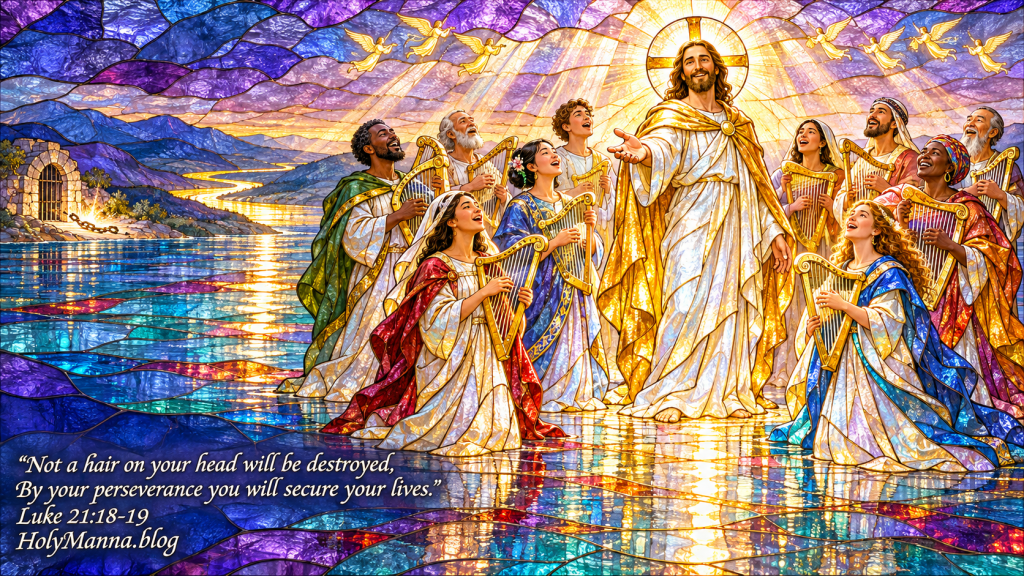
In The Book of Revelation, Saint John sees the conquerors of the beast standing beside a fiery sea with harps in their hands, singing as Israel once sang on the far shore of the Red Sea. Psalm 98 supplies the lyrics for every age, calling the nations, the seas, and the mountains to praise the Lord Whose right hand has won the victory. Then The Gospel of Luke shows the road that leads to that shore. Jesus, teaching in the Temple days before His Passion, tells His disciples plainly that they will be arrested, betrayed, and hated, and that their endurance will secure their lives.
These words were first heard by Christians who knew real danger. John wrote as an exile on Patmos to churches pressured to honor Caesar as a god, and Luke’s first readers had already watched the apostles stand before councils, governors, and kings. Fittingly, the Church also offers today the Optional Memorial of Saint Catherine of Alexandria, a virgin and martyr of the early 4th century whom tradition remembers for bearing witness to Christ before an emperor. The readings do not promise an easy road. They promise that the road has a destination, and that the destination is filled with music.
First Reading — Revelation 15:1-4
The Victory Song Beside the Fiery Sea
The Book of Revelation was written to 7 churches in Asia Minor near the end of the 1st century, and an ancient tradition reaching back to Saint Irenaeus places it late in the reign of the emperor Domitian. Christians there faced growing pressure to join the worship of the emperor and the gods of Rome. John, exiled on the island of Patmos, was shown what that struggle looks like from heaven. Chapter 15 is the shortest chapter in the book, and it works like a deep breath before the 7 bowls of judgment are poured out. Before the plagues fall, the reader is shown the ending. The faithful are already safe, already standing, and already singing. That is today’s theme in a single image, because perseverance ends in praise.
Revelation 15:1-4
I, John, saw in heaven another sign, great and awe-inspiring:
seven angels with the seven last plagues,
for through them God’s fury is accomplished.Then I saw something like a sea of glass mingled with fire.
On the sea of glass were standing those
who had won the victory over the beast
and its image and the number that signified its name.
They were holding God’s harps,
and they sang the song of Moses, the servant of God,
and the song of the Lamb:“Great and wonderful are your works,
Lord God almighty.
Just and true are your ways,
O king of the nations.
Who will not fear you, Lord,
or glorify your name?
For you alone are holy.
All the nations will come
and worship before you,
for your righteous acts have been revealed.”
Detailed Exegesis
Verse 1: “I, John, saw in heaven another sign, great and awe-inspiring: seven angels with the seven last plagues, for through them God’s fury is accomplished.”
This is the 3rd great sign in the book, following the woman clothed with the sun and the dragon in chapter 12. The 7 plagues deliberately recall the plagues of Egypt, which means that a new and final Exodus is underway. The fury of God is not a divine loss of temper. It is the settled opposition of perfect holiness to everything that destroys His children. The word “accomplished” matters as well, because it means that evil has an expiration date.
Verse 2: “Then I saw something like a sea of glass mingled with fire. On the sea of glass were standing those who had won the victory over the beast and its image and the number that signified its name. They were holding God’s harps,”
John saw this crystal sea before the throne of God in chapter 4, and now it glows with fire. The scene mirrors Israel standing safely on the far shore of the Red Sea while Pharaoh’s army lay beneath the waves. Saint Bede the Venerable, a Doctor of the Church, read the glassy sea as “the pellucid fount of Baptism, which is consecrated by the fire of the Holy Ghost,” and he added that the fire may also signify the red glow of martyrdom. The victors refused the beast, its image, and its number, which chapter 13 presents as idolatrous power demanding the worship owed to God alone. It is worth noticing that they win by remaining faithful and not by overpowering anyone. Their hands hold harps instead of swords.
Verse 3: “and they sang the song of Moses, the servant of God, and the song of the Lamb: ‘Great and wonderful are your works, Lord God almighty. Just and true are your ways, O king of the nations.’”
The song of Moses is the hymn of The Book of Exodus, chapter 15, sung after the sea closed over the chariots of Egypt. It is also the song of the Lamb, because Jesus is the true Passover Lamb Whose Blood accomplishes the Exodus from sin and death. One song belongs to both covenants, and one God stands behind both rescues. The lyrics are stitched together from the Psalms and the Prophets, and they contain no boasting at all. The martyrs do not sing about what they endured. They sing about what God has done.
Verse 4: “‘Who will not fear you, Lord, or glorify your name? For you alone are holy. All the nations will come and worship before you, for your righteous acts have been revealed.’”
The question echoes the prophet Jeremiah, and its answer is obvious to anyone who sees clearly. This fear is not terror. It is the reverent awe of a creature who has finally seen Who God is. The horizon is wide and hopeful, since all the nations will come. God’s judgments are not destruction for its own sake. They reveal His righteousness so that the world may come home and worship.
Teachings
The Church hears in this passage a window into the worship of heaven. The Catechism teaches that The Book of Revelation “is borne along by the songs of the heavenly liturgy” and by the intercession of the martyrs, and that the Church on earth sings these same songs with faith in the midst of trial (CCC 2642). It also names the martyrs among those who take part in the unending praise of heaven (CCC 1138).
The Red Sea imagery is baptismal. The Catechism explains that the crossing of the Red Sea, which freed Israel from slavery in Egypt, announces the liberation accomplished by Baptism (CCC 1221). Every baptized Catholic has therefore already passed through the water and stands by grace on the side of the victors. That is why the Church sings the song of Moses at the Easter Vigil. It is also why this very canticle from Revelation 15:3-4 is prayed in the Liturgy of the Hours at Evening Prayer on Fridays, the day of the Lord’s Passion. The song of heaven is already on the lips of the Church on earth.
Reflection
This reading invites you to learn the song before you reach the shore. The saints in John’s vision did not start praising God only after the danger had passed, because praise had been their habit all along. You can build the same habit in small and concrete ways. Begin the morning by naming one work of God that is great and wonderful before reaching for the phone. Pray the canticle of Revelation 15:3-4 on Friday evenings in union with the whole Church. Renew your baptismal promises quietly when the pressure to compromise grows strong, whether that pressure comes from a workplace, a screen, or a friendship. Identify the modern image that demands too much of your loyalty, and refuse it one decision at a time.
What trial in your life right now could become the place where you learn to praise? Which image or influence competes most with God for your trust? Do your prayers spend more time on your own struggle or on the greatness of the One Who saves?
Responsorial Psalm — Psalm 98:1-3, 7-9
A New Song for a World Made New
Psalm 98 belongs to a cluster of psalms that celebrate the Lord as King, sung in the Temple to proclaim that the God of Israel reigns over every nation. Many scholars hear in it the joy of the return from exile, since its language closely echoes the second half of The Book of Isaiah. Israel had seen the Lord act, and a fresh act of God called for a fresh song. The Church has always loved this psalm. It is sung at the Mass of Christmas Day, when the salvation it announces lies in a manger. Today the refrain is borrowed directly from the First Reading, so the congregation on earth takes up the very words of the victors in heaven. The psalm fits the day’s theme because it teaches the faithful what to sing while they persevere.
Psalm 98:1-3, 7-9
R. (Rev. 15: 3b) Great and wonderful are all your works, Lord, mighty God!
Sing to the LORD a new song,
for he has done wondrous deeds;
His right hand has won victory for him,
his holy arm.
R. Great and wonderful are all your works, Lord, mighty God!
The LORD has made his salvation known:
in the sight of the nations he has revealed his justice.
He has remembered his kindness and his faithfulness
toward the house of Israel.
R. Great and wonderful are all your works, Lord, mighty God!
Let the sea and what fills it resound,
the world and those who dwell in it;
Let the rivers clap their hands,
the mountains shout with them for joy.
R. Great and wonderful are all your works, Lord, mighty God!
Before the LORD, for he comes,
for he comes to rule the earth;
He will rule the world with justice
and the peoples with equity.
R. Great and wonderful are all your works, Lord, mighty God!
Detailed Exegesis
Verse 1: “Sing to the LORD a new song, for he has done wondrous deeds; His right hand has won victory for him, his holy arm.”
A new song answers a new act of salvation. Saint Augustine heard a deeper newness here and preached, “The new man knoweth this, the old man knoweth it not.” The old life comes from Adam, and the new life is formed in Christ. Augustine also named the holy arm directly when he told his people, “What is the Lord’s holy Arm? Our Lord Jesus Christ.” The victory is won by God alone, which is exactly why the martyrs in The Book of Revelation sing about Him and not about themselves.
Verse 2: “The LORD has made his salvation known: in the sight of the nations he has revealed his justice.”
God does not save in secret. His justice here means His faithfulness in setting things right, and it is displayed before the whole world. Christians recognize the fullest revelation of that salvation in the Cross and Resurrection of Jesus, proclaimed to every nation. The same idea returns in today’s canticle, where the righteous acts of God have been revealed.
Verse 3: “He has remembered his kindness and his faithfulness toward the house of Israel.”
When Scripture says that God remembers, it means that He acts on His promises. Kindness and faithfulness are covenant words, describing a love that binds itself and does not let go. The Blessed Virgin Mary echoes this very line in her Magnificat, praising the God Who has helped Israel in remembrance of His mercy.
Verse 7: “Let the sea and what fills it resound, the world and those who dwell in it;”
The sea was a symbol of chaos and danger to ancient Israel, yet here it is summoned into the choir. Augustine saw in the stirred sea the persecutions that rose against the preaching of the apostles, which could not drown the song of the Church. In John’s vision the sea has become as calm as glass beneath the feet of the saints.
Verse 8: “Let the rivers clap their hands, the mountains shout with them for joy.”
All creation joins the liturgy because all creation is caught up in redemption. Augustine gave the image a practical edge when he explained, “To clap hands, is to rejoice; hands, mean works.” Praise is meant to reach the hands, so that good works become a form of applause for God.
Verse 9: “Before the LORD, for he comes, for he comes to rule the earth; He will rule the world with justice and the peoples with equity.”
The reason for all this joy is that the Lord is coming to rule. For those who have suffered injustice, the arrival of a perfectly just Judge is very good news. Augustine reminded his people that the delay of that coming is itself mercy, since Christ waits so “that when He comes He may not condemn you.”
Teachings
The Catechism gives the simplest description of what this psalm is doing: “Praise is the form of prayer which recognizes most immediately that God is God” (CCC 2639). Praise does not wait for circumstances to improve, because it rests on Who God is. The Catechism also notes that the first Christians read the Psalms in a new way, singing in them the mystery of Christ (CCC 2641). That is precisely what Saint Augustine, a Doctor of the Church, does in his Exposition on Psalm 98 when he finds Jesus in the right hand and holy arm of the Lord.
The final verse of the psalm points toward the Last Judgment, which the Church professes every Sunday in the Creed. The Catechism teaches that the Last Judgment will reveal that “God’s justice triumphs over all the injustices committed by his creatures” and that His love is stronger than death (CCC 1040). Judgment is therefore part of the hope of the Gospel. It is the promise that every hidden wrong will be answered and every hidden act of fidelity will be honored.
Reflection
This psalm asks you to sing before the story is finished. Singing a new song begins with living as a new person, which means bringing old habits of resentment, cynicism, and complaint to Confession and leaving them there. It also means letting your hands join the praise. Choose one concrete work of mercy this week and offer it deliberately as applause for God. Sing at Mass, even if your voice is ordinary, because the psalm commands seas and rivers to make noise and makes no exception for the self-conscious. When the news of the day feels heavy, pray verse 9 slowly and remember Who is coming to set the world right.
What would a new song sound like in your home this week? Is there an old habit that keeps you singing the old life? Does the thought of Christ coming as Judge stir fear in you, or hope, or some mixture of both?
Holy Gospel — Luke 21:12-19
When the Courtroom Becomes a Pulpit
Jesus speaks these words in the Temple during the final days before His Passion. Some bystanders have admired the costly stones of the Temple, and He has answered that not one will be left upon another, a prophecy fulfilled when Roman legions destroyed Jerusalem in A.D. 70. In the middle of that sobering discourse, He turns from the fate of buildings to the fate of His friends. Saint Luke, who also wrote The Acts of the Apostles, would go on to record how precisely these words came true in the lives of Peter, John, Stephen, and Paul. This passage is the hinge of today’s theme. Saint John’s vision shows the victors singing, and here Jesus explains that they reached that shore by persevering.
Luke 21:12-19
Jesus said to the crowd:
“They will seize and persecute you,
they will hand you over to the synagogues and to prisons,
and they will have you led before kings and governors
because of my name.
It will lead to your giving testimony.
Remember, you are not to prepare your defense beforehand,
for I myself shall give you a wisdom in speaking
that all your adversaries will be powerless to resist or refute.
You will even be handed over by parents,
brothers, relatives, and friends,
and they will put some of you to death.
You will be hated by all because of my name,
but not a hair on your head will be destroyed.
By your perseverance you will secure your lives.”
Detailed Exegesis
Verse 12: “They will seize and persecute you, they will hand you over to the synagogues and to prisons, and they will have you led before kings and governors because of my name.”
Jesus names both religious and civil authorities, and The Acts of the Apostles shows each one in turn. The apostles are flogged by the Sanhedrin, Peter is chained in Herod’s prison, and Paul stands before the governors Felix and Festus and before King Agrippa. The cause is stated simply. They suffer because of the Name of Jesus.
Verse 13: “It will lead to your giving testimony.”
The Greek word for testimony here is martyrion, the root of the word martyr. Persecution does not interrupt the mission of the Church. It becomes the mission. Saint Cyril of Alexandria, a Doctor of the Church, preached on this passage that such trials came upon the disciples “to win for them the glory of martyrdom.”
Verse 14: “Remember, you are not to prepare your defense beforehand,”
Jesus is not forbidding study or preparation in ordinary life. He is forbidding the anxious rehearsal that trusts in cleverness more than in Him. The disciple on trial never sits alone at the defense table.
Verse 15: “for I myself shall give you a wisdom in speaking that all your adversaries will be powerless to resist or refute.”
The promise is personal, since Jesus says that He Himself will give the words. Luke shows the fulfillment in Saint Stephen, whose opponents “could not withstand the wisdom and the spirit with which he spoke” (Acts 6:10). Today’s Optional Memorial offers another picture of this verse. The tradition surrounding Saint Catherine of Alexandria, whose historical details cannot be verified, tells of a young Christian woman whose answers confounded the philosophers of the emperor.
Verse 16: “You will even be handed over by parents, brothers, relatives, and friends, and they will put some of you to death.”
This is the hardest line in the passage. Pope Saint Gregory the Great observed in his homily on this Gospel that wounds hurt more when they come from those who were trusted. Jesus does not hide the cost, and He does not promise that every disciple will escape death.
Verse 17: “You will be hated by all because of my name,”
This hatred is not earned by cruelty or arrogance, which would be no witness at all. It falls on the disciple because he bears the Name of Christ, Who was hated first.
Verse 18: “but not a hair on your head will be destroyed.”
Placed immediately after a prediction of death, this promise cannot mean physical safety. It means that nothing belonging to a faithful disciple is finally lost to God, Who will raise the body in glory. Pope Francis said of this verse in his Angelus address of November 17th, 2013, “This reminds us that we are completely in God’s hands!”
Verse 19: “By your perseverance you will secure your lives.”
The Greek word is hypomone, which means steadfast endurance under a heavy load. Saint Gregory the Great taught that the soul is possessed through patience, because “patience is the root and protector of all virtues.” The life secured here is eternal life, the life of those who stand singing beside the sea of glass.
Teachings
The Catechism speaks about the subject of this Gospel with great clarity: “Martyrdom is the supreme witness given to the truth of the faith” (CCC 2473). The martyr bears witness to Christ, Who died and rose, and endures death through an act of fortitude. The Catechism describes fortitude as the virtue that gives firmness in difficulties and enables a person to conquer fear, even fear of death, and to face trials and persecutions (CCC 1808). It also teaches that the duty of Christians to take part in the life of the Church impels them to act as witnesses of the Gospel (CCC 2472).
History confirmed the words of the Lord. Around the year 197, the African writer Tertullian told the Roman authorities in his Apology that persecution only multiplied believers, because “the blood of Christians is seed.” Saint Gregory the Great added a consoling word for those who will never face a tribunal. He taught that a believer can be a martyr without the sword by keeping true patience in the heart amid daily wrongs.
Reflection
Most readers of this Gospel will never be dragged before a governor, yet the smaller courtrooms are everywhere. You may be the only practicing Catholic at a family table, in a group chat, or in a meeting where the faith is mocked. This Gospel offers you a way to stand there. Pray to the Holy Spirit before a hard conversation instead of rehearsing arguments in anger. Speak plainly and kindly when asked about your faith, and trust Jesus with the outcome. Practice the quiet martyrdom that Saint Gregory described by absorbing a slight this week without revenge or gossip. Pray by name for someone who has hurt you because of your beliefs, and remember the Christians around the world who face prison and death for the Name today.
Where is Jesus asking you to give testimony right now? Do you trust Him enough to stop rehearsing your defense? What would it look like to persevere, patiently and without bitterness, in the trial you are carrying?
The Shore Where the Singing Never Ends
Today’s readings tell one story in 3 movements. It begins in a Temple courtyard, where Jesus looks at His friends and tells them the truth. They will be seized, betrayed by people they love, and hated for His Name, and He will be with them in every courtroom with a wisdom no adversary can refute. It continues in the song of Israel, where Psalm 98 teaches the faithful what to sing while the trial lasts, because the right hand of the Lord has already won the victory and He is coming to rule the earth with justice. It ends on the shore of a sea of glass mingled with fire, where those who persevered stand with harps in their hands and praise the God Whose ways are just and true.
The message is as honest as it is hopeful. Christ does not promise His followers an easy passage, but He promises that not a hair on their heads will be lost to Him. Perseverance is not grim survival. It is the daily decision to keep trusting, keep testifying, and keep singing until faith gives way to sight.
So carry the song into this ordinary Wednesday. Go to Mass if it is possible, and hear the hymn of heaven on the lips of the Church. Offer a patient answer where an angry one would be easier. Praise God out loud for one great and wonderful work before the day ends. The saints are already singing on the far shore, and there is room in the choir for every soul who endures to the end.
Engage With Us!
Share your reflections in the comments below. The readings for this final week of the liturgical year were given to strengthen the whole Church, and your insight may be exactly what another reader needs today.
- In Revelation 15:1-4, the victors sing about the works of God and not about their own struggles. How might your prayer change if praise came before petition this week?
- In Psalm 98:1-3, 7-9, all creation is called to sing a new song to the Lord Who comes to rule with justice. What new song is God inviting you to sing in this season of your life?
- In Luke 21:12-19, Jesus promises a wisdom in speaking and tells His disciples that perseverance will secure their lives. Where do you most need the courage to give testimony, and how can you rely on Him instead of on yourself?
- Taken together, today’s readings teach that faithful perseverance ends in a song of victory. What is one concrete way you can persevere in faith today while keeping your eyes fixed on heaven?
Keep walking in faith, even when the road is steep. Stay close to the sacraments, keep the song of the saints in your heart, and do everything with the love and mercy that Jesus taught.
Sacred Heart of Jesus, we trust in You!
Immaculate Heart of Mary, pray for us!
Saint Michael the Archangel, defend us in battle!
Follow us on YouTube, TikTok, Instagram and Facebook for more insights and reflections on living a faith-filled life.


Leave a Reply