Born of Gold, Tested by Fire
Anyone who has prayed along with the Roman Canon, the ancient Eucharistic Prayer I of the Roman Missal, has heard his name. It comes in the middle of a solemn roll call of apostles and martyrs, tucked between a famous Roman deacon and a pair of Roman brothers: “Lawrence, Chrysogonus, John and Paul, Cosmas and Damian.” Most Catholics let the name roll past without a second thought. It is hard to pronounce, it rarely appears on a parish sign, and almost nobody chooses it for Confirmation. Yet the Church of Rome has been speaking this name at the altar for more than 1,400 years. The Catechism explains why those names are there at all, teaching that the Church offers the Eucharistic sacrifice in communion with the Blessed Virgin Mary and all the saints, including those already in the glory of heaven (CCC 1370).
Saint Chrysogonus was a martyr who gave his life for Jesus Christ near the great Roman city of Aquileia, at the northern tip of the Adriatic Sea, most probably during the persecution of the emperor Diocletian at the very beginning of the 4th century. His name comes from Greek and means born of gold, and the Church has treasured his memory accordingly. The current Roman Martyrology remembers him on November 24th as a martyr of Aquileia “who is venerated at Rome in the titular church” that carries his name, on the anniversary of that church’s dedication. He is also the principal patron saint of the city of Zadar in Croatia, where his feast doubles as the official Day of the City and where his image, a knight on horseback, rides across the civic coat of arms.
The honest truth about Saint Chrysogonus is that history preserves very little about him, while tradition preserves a great deal. That gap is part of what makes him worth knowing. The Catechism teaches that “Martyrdom is the supreme witness given to the truth of the faith” (CCC 2473), and it explains that the Church sustains the hope of believers by “proposing the saints to them as models and intercessors” (CCC 828). A man can be a model and an intercessor even when most of the details of his biography have been lost, because the one detail that matters most, his fidelity unto death, was never forgotten.
What History Knows and What Tradition Remembers
Any faithful telling of this saint’s life has to begin by drawing a clear line between documented history and later tradition, because the two are easy to blur.
The documented history is brief. No reliable source records where Chrysogonus was born, who his parents were, how he was educated, or how he came to faith in Christ. What the evidence does establish is that a Christian named Chrysogonus was put to death for the faith in the territory of Aquileia, that he was buried there, and that the local Church venerated him publicly from a very early date. The ancient calendar of martyrs known as the Martyrologium Hieronymianum lists him on both May 31st and November 24th and places him at Aquileia. Even more striking is a piece of carved stone. In the village of San Canzian d’Isonzo, which scholars identify with the Roman settlement of Aquae Gradatae about 12 miles from Aquileia, a sarcophagus from the 4th century still survives with a Latin dedication that translates as “To the most blessed martyr Chrysogonus.” It is the closest thing to a birth certificate that this saint possesses.
Tradition then fills in the blank pages. The fullest account is found in the Passio of Saint Anastasia, a Latin narrative composed in Rome, probably in the 5th or 6th century, long after the events it describes. In that telling, Chrysogonus is not a native of Aquileia at all. He is a Roman, a Christian man of rank attached to the office of the vicar of the City, and above all the teacher who formed a young noblewoman named Anastasia in the faith. Anastasia was the daughter of a distinguished Roman named Praetextatus and the wife of a pagan named Publius, who bitterly opposed her Christianity.
Other strands of tradition describe Chrysogonus differently. Some present him as a soldier who became a priest. An old list of the bishops of Aquileia includes the name Chrysogonus around the turn of the 4th century, and for that reason some sources identify the martyr as a bishop of that city. Still another tradition makes him a native of Aquileia and a friend of the martyrs Cantius, Cantianus, and Cantianilla, 3 siblings who are said to have travelled from Rome to see him and to have arrived only after his execution. None of these portraits can be verified, and the sources do not agree with one another.
Catholic historians have long recognized why the Roman version of the story developed. By the year 499 a parish church in the Trastevere district of Rome was already known as the titulus Chrysogoni, the title of Chrysogonus. Monsignor Johann Peter Kirsch, writing in the Catholic Encyclopedia, explained that either the veneration of the Aquileian martyr reached Rome very early, or the church was founded by a Roman benefactor of the same name and was soon dedicated to the saint. The story that ties Chrysogonus to Rome and to Saint Anastasia seems to have grown up to explain why a martyr from northeastern Italy was so beloved on the banks of the Tiber.
As for his conversion, no account of it survives. Whether Chrysogonus was raised in a Christian home or embraced the Gospel as an adult is simply unknown. What is known is how the story of his faith ended, and the Church has always judged that to be enough.
Letters From a Prison Cell
The part of the tradition that has moved Christian hearts for centuries is set in a prison. According to the Passio, Chrysogonus was arrested in Rome when the persecution of Diocletian broke out, and he remained in custody for about 2 years. One version of the story places him under guard in the house of a nobleman named Rufinus, and it adds that Chrysogonus spoke of Christ so convincingly in captivity that Rufinus and his whole household came to believe.
During that long confinement, his former student Anastasia quietly brought food and comfort to him and to other Christians who were suffering for the faith. When her husband discovered what she was doing, he shut her up in her own home, took control of her inheritance, and left her with almost nothing to eat. Cut off from her teacher, Anastasia managed to send him letters through an elderly Christian woman.
Those letters are the emotional center of the story. Anastasia wrote that she expected to die, that her family fortune was being squandered on idols, and that she begged her teacher to remember her soul. Chrysogonus wrote back as a spiritual father. He urged her not to be shaken by the wrongs done to her, and he promised that a gentle season would follow the frost. In the famous 13th century collection of saints’ lives compiled by Blessed Jacobus de Voragine, as rendered in the old English of William Caxton, he tells her that after the darkness she will “see anon the flourished light of God.” In a second letter he compares the soul to a ship in heavy seas, which survives the waves only when it is held fast, and he points her toward the Cross as the place where every Christian victory begins.
The prison scenes, the conversion of Rufinus, and the exchange of letters all come from the later Passio and its retellings, and they cannot be verified.
No miracle worked by Saint Chrysogonus during his lifetime is recorded in any reliable source, and even the traditional accounts do not credit him with healings or wonders. What they describe instead is quieter and, in its own way, harder to imitate. Here is a man who has lost his freedom, his position, and his future, and who spends the strength he has left on steadying someone else. He does not write to complain about his chains. He writes to give courage to a frightened friend.
That is exactly the kind of charity the Church asks of every believer. The Catechism lists visiting the imprisoned among the corporal works of mercy, and it counts consoling and comforting among the spiritual ones (CCC 2447). The Letter to the Hebrews gives the same command in a single line: “Remember those who are in prison, as though in prison with them” (Heb 13:3). In the tradition about Chrysogonus and Anastasia, both of them obey that verse at the same time, each from a different kind of captivity.
This is why Saint Chrysogonus deserves to be remembered and imitated. He shows that a Christian never has to wait for better circumstances before doing good. The Catechism describes fortitude as the virtue that ensures “firmness in difficulties and constancy in the pursuit of the good” (CCC 1808), and a prisoner writing letters of hope is a living portrait of that virtue.
The Emperor’s Offer and the Sword at Aquae Gradatae
The persecution that claimed Chrysogonus was the most severe that the early Church ever faced. Beginning in the year 303, imperial edicts issued under Diocletian ordered churches to be destroyed and the Scriptures to be burned, stripped Christians of their legal protections, sent the clergy to prison, and finally demanded sacrifice to the Roman gods under pain of death.
The older edition of the Roman Martyrology summarized the martyr’s last months in a single sentence. It recalled that he “long endured bonds and imprisonment for his steadfast confession of Christ,” and that he was then taken to Aquileia by order of Diocletian, beheaded, and thrown into the sea.
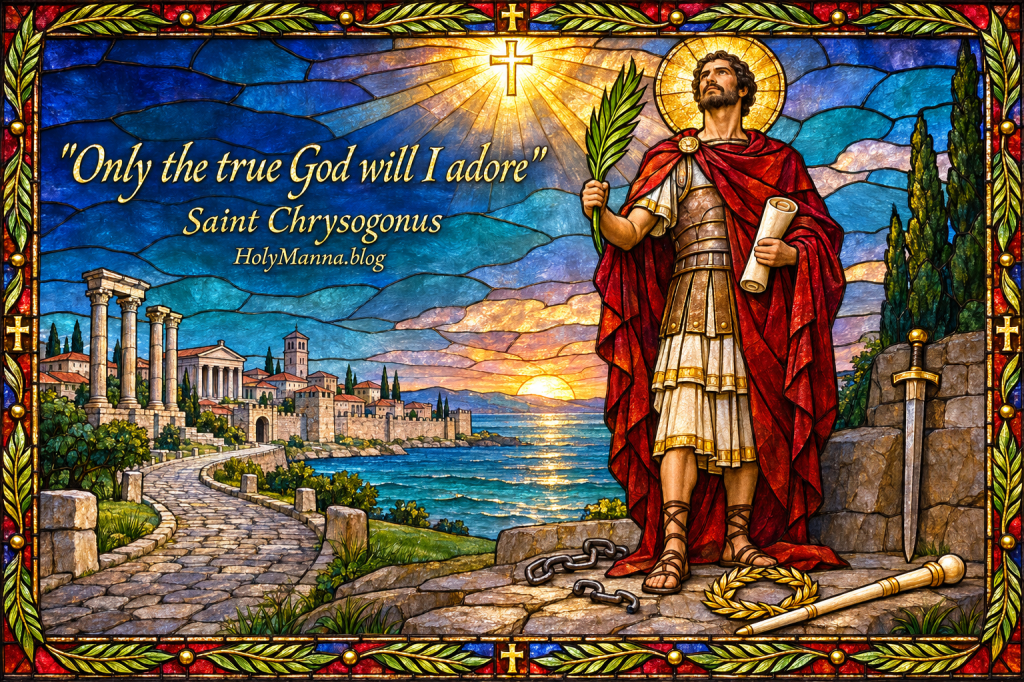
Tradition supplies the dramatic details. According to the Passio, the emperor was staying in the region of Aquileia, and he had the prisoner brought north to stand before him in person. Diocletian did not open with threats. He opened with a bribe. If Chrysogonus would only offer sacrifice to the gods, he would receive the office of prefect and the dignity of consul, which were among the highest honors a Roman could hold. The reply attributed to the martyr was short and unmistakable. He declared that he worshipped the one God of heaven alone, and that he counted the emperor’s honors as so much mud.
The sentence followed at once. Chrysogonus was led out to a place called Aquae Gradatae, on the road known as the Via Gemina, about 12 miles from the city, and there he was beheaded. His body was left to the sea. The sources place his death on November 23rd or November 24th, and they give the year as either 303 or 304.
The historical core of this account, a martyrdom by the sword near Aquileia under Diocletian, is well supported. The audience with the emperor, the offer of high office, and the words of the reply come from the later Passio and cannot be verified.
The tradition records no miraculous escape for Chrysogonus. No angel opens the prison doors, and no blade refuses to cut. The protection he received was of another kind. The Catechism teaches that the martyr bears witness to Christ, to whom he is united by charity, and that he endures death through an act of fortitude (CCC 2473). Grace did not take Chrysogonus out of the trial. Grace carried him through it.
The offer he refused also shines a light on a temptation that never goes out of style. The Catechism warns that idolatry is not only a matter of ancient pagan statues, since “It remains a constant temptation to faith” (CCC 2113). A person commits idolatry whenever a creature is honored in the place of God, whether that creature is power, pleasure, the state, or money. Diocletian put the whole exchange in the plainest possible terms, a brilliant career in return for a pinch of incense. Chrysogonus answered with the logic of the Gospel, in which the Lord teaches that there is no profit in gaining the whole world at the cost of one’s own life (Mk 8:36). The promise recorded in The Book of Revelation was kept in him: “Be faithful unto death, and I will give you the crown of life” (Rev 2:10).
The Church has never thought of such deaths as defeats. The Catechism calls the records of the martyrs “the archives of truth written in letters of blood” (CCC 2474). The entry for Chrysogonus in those archives is only a few lines long, but it is written in the same ink as all the others.
From the Adriatic Shore to the Altars of Rome and Zadar
The story of what happened after the execution begins on a beach. Tradition holds that the martyr’s body came to rest on the shore near an estate called Ad Saltus, where an elderly priest named Zoilus lived close to 3 Christian sisters named Agape, Chionia, and Irene. Zoilus is said to have gathered up the body, to have recovered the severed head as well, and to have buried both with honor beneath his own house. Some tellings add that the saint afterward appeared to Zoilus in a vision, foretold the coming martyrdom of the 3 sisters, and announced that the old priest himself would soon die in peace. A version cherished in Zadar adds that the body was found wondrously whole. None of this can be verified, and it should be noted that the Church elsewhere remembers Agape, Chionia, and Irene as martyrs of Thessalonica in Greece.
What can be verified is how quickly and how widely the Church began to honor him. The sarcophagus at San Canzian d’Isonzo shows that Christians near Aquileia were venerating his tomb in the 4th century. His portrait appears among the martyrs in the mosaics of Ravenna, both in the Archbishop’s Chapel around the year 500 and in the Basilica of Sant’Apollinare Nuovo in the 6th century. Saint Bede the Venerable recorded his feast on November 24th in far-off England in the 8th century. In Rome, the titulus Chrysogoni appears in the records of a synod in 499 and again in a synod held by Pope Saint Gregory the Great in 595, and his name was written into the Canon of the Mass, where it remains today.
The Basilica of San Crisogono still stands in Trastevere, and it is one of the oldest parish churches in Rome. The first church on the site dates from the 4th century. Pope Saint Gregory III restored it in 731 and founded a monastery beside it. It was rebuilt between 1123 and 1129 and received its present appearance in the 1620s. Blessed Pius IX entrusted the basilica to the Trinitarian Order in 1847, and the Trinitarians serve there to this day. The body of Blessed Anna Maria Taigi, the Roman wife, mother, and mystic, rests in a side chapel. In 1907 excavations beneath the floor uncovered the remains of the ancient church, including frescoes from the 8th century that depict the martyr. The basilica preserves relics honored as a hand and part of the skull of Saint Chrysogonus, which have been kept there since the 15th century.
Across the Adriatic, the city of Zadar claims him with even greater affection. Local tradition holds that his relics were brought to Zadar from the region of Aquileia in the year 649. That date cannot be verified, and the earliest firm evidence for his veneration in the city comes from the late 9th century. The Romanesque Church of Saint Chrysogonus that visitors see today, once the heart of a powerful Benedictine monastery, was consecrated in 1175.
A medieval text from Zadar, the Translatio beati Grisogoni martyris, preserves 3 stories about his relics. In the first, the martyr’s body is discovered in a cemetery outside the city and cannot be carried through the gates until the citizens endow it with property. In the second, 3 monks steal the saint’s hand and carry it to a distant land, where a plague persuades the inhabitants to send the relic home. In the third, a merchant from Aquileia survives a storm at sea and makes a generous offering in thanksgiving. These stories cannot be verified.
The people of Zadar also credited their patron with protecting them in war. After a victory over the Venetians in 1190, the citizens hailed him as “our patron, guardian, and protector of the city.” During the siege of 1345 and 1346, the defenders fought under his banner, and a chronicler recorded that a house bearing his painted image survived a fire, an event the chronicler regarded as miraculous. That event cannot be verified as a miracle.
From the 12th or 13th century onward, the artists of Zadar began to portray the martyr as a mounted knight with spear and shield, and that image eventually became the coat of arms of the city. Zadar still celebrates November 24th as both the feast of its patron and the Day of the City, with Mass in the Cathedral of Saint Anastasia. The teacher and the student of the old story are therefore honored side by side. A recent forensic study by Croatian scholars concluded that a skeleton long kept in the cathedral treasury under another saint’s name most probably belongs to Saint Chrysogonus. Other places have claimed his relics over the centuries as well, and Alban Butler reported in the 18th century that the body was at Venice. These claims cannot all be reconciled.
Like most martyrs of the first centuries, Saint Chrysogonus was never the subject of a formal canonization process, and his place among the saints rests on the constant veneration of the Church. For that reason there are no officially investigated miracles attached to his name. When the General Roman Calendar was revised in 1969, his annual commemoration was left to his titular basilica in Rome, and on November 24th the universal Church now keeps the Memorial of Saint Andrew Dung-Lac and Companions, the martyrs of Vietnam. His name nevertheless remains in the Roman Martyrology and in the Roman Canon.
All of this devotion rests on solid doctrinal ground. The Catechism teaches that when the Church keeps the memorials of the martyrs, she proclaims the Paschal mystery in those who have suffered and been glorified with Christ (CCC 1173). It teaches that the saints in heaven “do not cease to intercede with the Father for us” (CCC 956). It also recognizes the veneration of relics, visits to sanctuaries, and pilgrimages as authentic expressions of the piety of the faithful (CCC 1674).
Refusing the Promotion That Costs the Soul
Saint Chrysogonus speaks to modern believers precisely because so little about him is known. Most Christians will never be famous for their faith. Their fidelity will be lived out in kitchens, cubicles, classrooms, and hospital rooms, and the details will be forgotten within a few generations. The martyr of Aquileia is proof that God forgets nothing. The world lost his biography, yet the Church still says his name at the altar. Does the hidden, ordinary faithfulness of your daily life feel wasted, or do you trust that God sees it?
His name offers a second lesson. He was called born of gold, and The First Letter of Peter describes a tested faith as “more precious than gold which though perishable is tested by fire” (1 Pt 1:7). Trials do not prove that God has abandoned a believer. They reveal what a believer’s faith is actually made of. When your faith has been tested by loss, illness, or opposition, what did the fire reveal?
The tradition about his letters offers a third lesson, and it is a practical one. Chrysogonus did not wait to be free before he began encouraging someone else. You can imitate him this week without leaving your home. Write a real note, or send a thoughtful message, to someone who is confined by sickness, grief, loneliness, or an actual prison sentence. Consider supporting a parish prison ministry, since visiting the imprisoned remains a work of mercy for every generation (CCC 2447). Who in your life is waiting for a letter that only you can write?
The fourth lesson is the hardest. Diocletian offered Chrysogonus a promotion in exchange for his conscience, and the same bargain is still offered in quieter forms. It may look like a career that demands silence about the faith, a relationship that requires leaving the sacraments behind, or a circle of friends that rewards mockery of the Church. The Catechism reminds every disciple that the faith must not only be kept, but also professed and confidently witnessed (CCC 1816). What honor, comfort, or approval would be hardest for you to refuse if it stood between you and Christ?
Finally, you can simply start listening for him. The next time the priest prays the Roman Canon, notice the name Chrysogonus when it passes, and quietly ask him to obtain for you a share of his courage. That small habit can turn a list of ancient names into a circle of friends.
Engage With Us!
Share your thoughts and reflections in the comments below. Your experience may be exactly what another reader needs to hear.
- Had you ever noticed the name Chrysogonus in the Roman Canon before today, and how does knowing his story change the way you hear that prayer?
- History records only that Saint Chrysogonus died for Christ near Aquileia. Does it encourage you or challenge you that a person can be a great saint and still be almost unknown to the world?
- In the tradition, Chrysogonus spent his imprisonment strengthening Saint Anastasia through letters. Who has encouraged your faith during a difficult season, and whom could you encourage now?
- The emperor offered high office in exchange for one act of false worship. Where do you see that same kind of bargain offered to Christians today?
- The people of Zadar have turned to their patron for centuries. Which saint do you turn to most often, and why?
May the example of Saint Chrysogonus give you the courage to hold fast to Christ when it costs something, to lift up the people around you even when your own burdens are heavy, and to live a life of faith every single day. Do everything with the love and mercy that Jesus taught, and trust that the God who remembered a nearly forgotten martyr will never forget you.
Saint Chrysogonus, pray for us!
Follow us on YouTube, TikTok, Instagram and Facebook for more insights and reflections on living a faith-filled life.


Leave a Reply