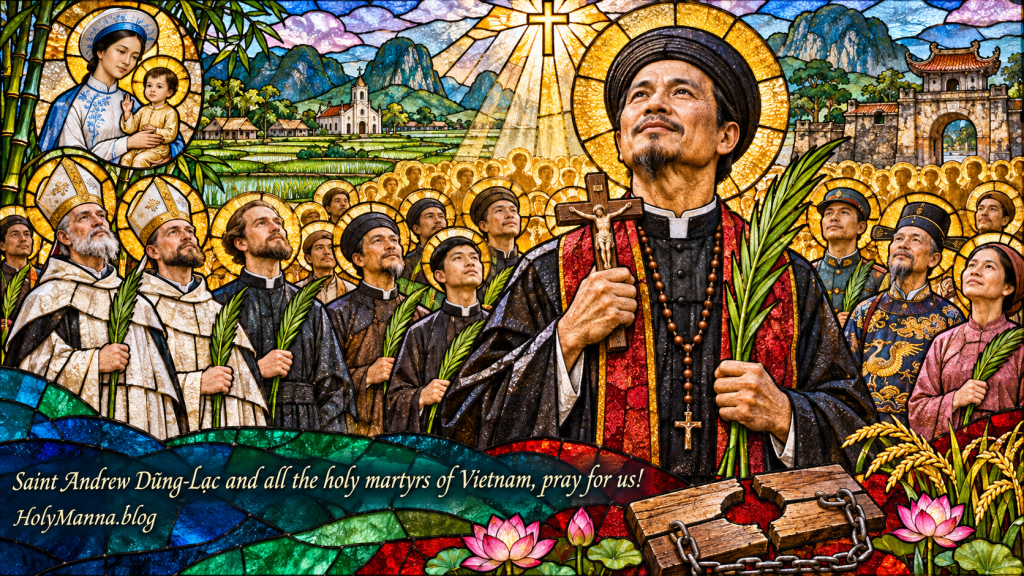
The Harvest of Vietnam
Every year on November 24th, the Church keeps the Memorial of Saint Andrew Dũng-Lạc and his 116 companions, the Martyrs of Vietnam. One priest gives his name to the day, but he stands at the front of a very long line. With him are 8 bishops, 50 priests, and 59 lay faithful, 117 saints in all, who gave their lives for Christ in Vietnam between 1745 and 1862. Among them, 96 were Vietnamese, 11 were Spanish Dominicans, and 10 were French missionaries of the Paris Foreign Missions Society. Behind those 117 stands a far greater crowd. The Vatican’s own profile of these martyrs counts 53 decrees against Christians between 1625 and 1886 and estimates about 130,000 victims, most of them buried without a name.
Pope Saint John Paul II canonized the 117 together in Rome on June 19th, 1988. In his homily that day he voiced the problem every storyteller faces with this feast: “How to remember them all?” That is why the Church lets Andrew carry the banner. He was a poor boy from Bắc Ninh who became a catechist, then a parish priest, and finally a martyr. On December 14th, 1990, in the apostolic letter Si quidem cunctis, the same Pope proclaimed these martyrs the Patrons of Vietnam.
The Church honors them for a reason the Catechism states plainly: “Martyrdom is the supreme witness given to the truth of the faith” (CCC 2473). By canonizing them, the Church recognizes the power of the Holy Spirit at work in their lives and gives them to the faithful as models and intercessors (CCC 828). The Letter to the Hebrews describes exactly what they have become for every Christian still running the race: “And therefore we also having so great a cloud of witnesses over our head, laying aside every weight and sin which surrounds us, let us run by patience to the fight proposed to us” (Hebrews 12:1).
The Catechist Who Opened His Door
The man the Church now calls Andrew Dũng-Lạc was born around 1795 in Bắc Ninh, in the northern part of Vietnam that Europeans of his day called Tonkin. His name was Trần An Dũng. His family was poor, and his parents were not Christians. They followed the traditional religion of their people, and nothing in his first years pointed toward the altar.
When Dũng was 12, the family moved to Hanoi so that his parents could find work. There an ordinary layman changed everything. A Catholic catechist took the boy under his roof, fed him, and offered him an education that a poor child could not otherwise have hoped for. His parents agreed to the arrangement. For about 3 years the boy learned the Christian faith, and then he was baptized at Vĩnh Trị and received the name Andrew.
That catechist deserves a moment of attention, because the Church in Vietnam was built on men like him. Missionaries had first brought the Gospel to the region in the 16th century, and in 1659 the Holy See organized the mission into 2 apostolic vicariates, one for the north and one for the south. Of the 117 canonized martyrs, 16 were catechists. The Catechism teaches that lay people share in the prophetic mission of Christ through evangelization, which it describes as proclaiming Christ by word and by the testimony of life (CCC 905). Andrew’s whole vocation began with one layman who did exactly that for one poor child.
The Church that Andrew entered already knew the price of faith. The earliest of the 117, the Spanish Dominicans Francisco Gil de Federich and Mateo Alonso Leciniana, had been beheaded in 1745, and 2 more of the 117 were put to death around 1798, when Andrew was a small child.
After his baptism he studied Chinese and Latin and served as a catechist for 10 years, handing on to others what had been handed to him. His superiors chose him for theological studies, and on March 15th, 1823, he was ordained a priest. The boy whom a catechist had rescued from poverty was now a father to the poor.
A Shepherd Who Preached With His Whole Life
Father Andrew served as parish priest at Kẻ Đăm and in several other communities. The accounts describe him as a tireless preacher who fasted often and lived very simply, and they add that his example drew many people to baptism.
His priesthood unfolded under a darkening sky. Emperor Minh Mạng, who came to the throne in 1820, banned foreign missionaries in the early 1830s and ordered Vietnamese Christians to renounce their faith. From then on, much of Father Andrew’s ministry had to be carried out in hiding. The faithful sheltered him, and when he was caught, they emptied their own pockets to buy his freedom. That detail says a great deal about what kind of priest he was. People who had very little did not hesitate to spend it on him.
Honesty requires a plain statement about miracles. The historical record consulted for this post contains no documented healing or wonder worked by Father Andrew during his lifetime, and none should be invented for him. The wonder of his life is of a quieter kind. Grace took a poor, unbaptized boy and made him a priest who would not abandon his flock. Grace also kept him faithful in small things long before it asked him for the great thing.
One of those small things is the most moving detail in his story. In November of 1839, Father Andrew traveled to visit another Vietnamese priest, Father Peter Trương Văn Thi, for a simple reason. He wanted to go to confession. He was arrested on that visit. Speaking to pilgrims on the day after the canonization, John Paul II singled out this fact as striking, a priest seized at the very moment he came to receive the sacrament of mercy. The Catechism strongly recommends regular confession even of venial sins, because it helps to form the conscience and to fight against evil tendencies (CCC 1458). Father Andrew believed that enough to risk the road for it.
There is one more reason to remember him. Andrew and his companions were not enemies of their country. In his canonization homily, John Paul II stressed that the martyrs remained loyal to their homeland and honored its authorities in everything that was just and honest. The Catechism teaches that love and service of one’s country flow from the duty of gratitude (CCC 2239), and it also teaches that a citizen is bound in conscience not to follow directives that contradict the moral order or the teachings of the Gospel (CCC 2242). When the command finally came to deny Christ, the martyrs gave the answer of the Apostles: “We ought to obey God, rather than men” (Acts 5:29).
The Cross on the Ground
The test was brutally simple. A crucifix was laid on the ground, and the Christian was ordered to walk on it. Whoever trampled the cross went home. Whoever refused faced prison, exile, or death. Christians who held firm could be branded on the face with the words “tà đạo,” which mean “false religion.” Husbands were separated from wives, children were taken from parents, property was confiscated, and whole Christian villages were broken up and scattered among non-Christian populations. Under Emperor Tự Đức, who reigned from 1847 to 1883, rewards of silver were offered for help in capturing missionaries, and the bodies of the executed were ordered thrown into rivers.
Father Andrew met this storm twice. In 1835 he was arrested, and his parishioners raised the money to ransom him. To throw the authorities off his trail he changed his name from Dũng to Lạc and moved to another district, which is why the Church remembers him by both names joined together. On November 10th, 1839, he was arrested again, this time with Father Peter Thi, the confessor he had gone to see. Once more the faithful paid for their release, and once more the 2 priests were seized shortly afterward. They were taken to Hanoi and tortured. The Roman Martyrology records that they refused the order to trample the cross. On December 21st, 1839, both priests were beheaded at Cầu Giấy, on the edge of the city. Father Andrew was about 44 years old, and Father Peter was 76.
No miraculous escape is recorded for Father Andrew. His rescues came through the hands of his own parishioners, and when ransom could do no more, God gave him fortitude, the virtue that enables a person to conquer fear, even fear of death, and to face trials and persecutions (CCC 1808).
His companions walked the same road in every generation. Bishop Ignacio Delgado, a Spanish Dominican in his late seventies, died of hunger and sickness in a cage that July. His coadjutor, Bishop Domingo Henares, was beheaded in June. Thomas Trần Văn Thiện, an 18-year-old seminarian, was scourged and strangled in September. On November 24th, 1838, the French missionary Pierre Dumoulin-Borie, who had been named a bishop while he was in prison, was put to death at Đồng Hới, and the Vatican notes that 3 of the 117 died on that single day. That date, November 24th, is the one the Church chose for the common memorial of all 117.
The laity suffered beside their priests. Paul Tống Viết Bường was captain of the emperor’s own bodyguard before he was stripped of his rank and beheaded in 1833. Michael Hồ Đình Hy was a high mandarin in charge of the royal silk mills who had neglected his faith for years, returned to it, became a protector of his fellow Christians, and was beheaded in 1857. Simon Phan Đắc Hòa was a physician, a village mayor, and a father of 12 who was executed in 1840 after aiding hunted clergy.
Only 1 woman is counted among the 117, and she is unforgettable. Agnes Lê Thị Thành, known as Bà Đê, was a wife and a mother of 6 who was arrested in 1841 and died in prison on July 12th of that year. A story is told among Vietnamese Catholics about a visit from her youngest daughter, who wept at the sight of her mother’s bloodstained clothing. Agnes is said to have comforted her with the words “Do not cry, these are my red roses.” The story is cherished and widely repeated, but it could not be verified against the original beatification records for this post.
Some of the martyrs left words of their own. Paul Lê Bảo Tịnh was still a seminarian when he was thrown into prison in Hanoi, and in 1843 he wrote a letter to his fellow seminarians that the Church now reads on this memorial in the Liturgy of the Hours. He describes a prison that looked to him like an image of hell, full of chains, hatred, curses, and grief. Then he says something astonishing. In the middle of it all he is “full of joy and gladness, because I am not alone,” for Christ is with him. Pope Benedict XVI quoted this letter at length in his encyclical on hope as a picture of suffering transformed from within (Spe Salvi 37). Paul was later released and ordained a priest. He was arrested again and beheaded on April 6th, 1857.
The best loved of the missionaries is Saint Théophane Vénard, a young priest of the Paris Foreign Missions who was betrayed in 1860 and kept in a cage until his execution. His bishop wrote of him, “Though in chains, he is as gay as a little bird.” From that cage he wrote to his father: “A slight sabre-cut will separate my head from my body, like the spring flower which the Master of the garden gathers for His pleasure. We are all flowers planted on this earth, which God plucks in His own good time: some a little sooner, some a little later.” He added a line no parent could read with dry eyes: “Father and son may we meet in Paradise.” The 1912 Catholic Encyclopedia reports that he chanted psalms on the way to his death and that, when the executioner asked what he would give to be killed quickly, he answered that the longer it lasted, the better it would be. He was beheaded on February 2nd, 1861, at the age of 31.
The final years were among the bloodiest. On November 1st, 1861, the Spanish Dominican bishops Jerónimo Hermosilla and Valentín de Berrio-Ochoa were beheaded together with the priest Pedro Almató. In the first half of 1862, a wave of laymen from the north were beheaded or burned alive. The last of the 117 to die was Peter Đa, who was burned to death on June 17th, 1862. The New Catholic Encyclopedia also lists in that final group a boy named Joseph Túc, whom it describes as a child of 9.
The Vatican’s summary of how the 117 died is stark. It counts 75 beheaded, 22 strangled, 6 burned alive, 5 quartered, and 9 who died in prison from their tortures. They left more than a list of sufferings, however. On the evening of the canonization, John Paul II urged Vietnamese pilgrims to forgive as the martyrs had taught them to forgive. The Catechism places that same forgiveness at the heart of Christian prayer, teaching that it shows love to be stronger than sin and that the martyrs of yesterday and today bear this witness to Jesus (CCC 2844). They had taken the Lord at His word: “Love your enemies: do good to them that hate you: and pray for them that persecute and calumniate you” (Matthew 5:44).
Seed Sown in the Soil of Vietnam
Around the year 197, the African writer Tertullian told the persecutors of his own day that their cruelty was pointless, because “the blood of Christians is seed” (Apology, chapter 50). The Catechism cites that very line when it explains that the Church’s mission follows the path of Christ, the path of the cross (CCC 852). Jesus Himself had said it first: “Amen, amen I say to you, unless the grain of wheat falling into the ground die, Itself remaineth alone. But if it die, it bringeth forth much fruit” (John 12:24-25).
Vietnam is the proof. The Church that emperors tried to erase did not disappear. On November 24th, 1960, Pope Saint John XXIII established the Catholic hierarchy in Vietnam, and by the time of the canonization the Vatican counted 25 dioceses and about 6 million Catholics, nearly 10 percent of the population. That harvest is the first and greatest sign attached to these martyrs.
The Church took her time in honoring them, as she always does. The 117 were beatified in 4 groups: 64 by Pope Leo XIII in 1900, with Father Andrew among them, then 8 in 1906 and 20 in 1909 by Pope Saint Pius X, and 25 by Pope Pius XII in 1951. On April 18th, 1986, their causes were joined into one. According to the saint of the day page of the Vatican City State, the signs and miracles attributed to their intercession were recognized on June 5th, 1986. The particular favors examined in that process are not described in the sources consulted for this post, so no individual healing can responsibly be retold here. The saints in heaven do not cease to intercede with the Father for those still on earth (CCC 956), and Vietnamese Catholics have long leaned on these martyrs with confidence.
The canonization itself became a moment of witness. The government of Vietnam did not permit a single representative from the country to attend. About 8,000 Vietnamese Catholics living in exile around the world came to Rome anyway, and they stood in for the brothers and sisters who could not come.
One tradition from the years of persecution is especially dear to Vietnamese Catholics. In 1798, Christians fleeing a wave of violence are said to have hidden in the forest of La Vang, where the Blessed Virgin Mary appeared to them holding the Child Jesus, consoled them, and promised that their prayers would be heard. The Holy See has never issued a formal judgment on the apparition, and it cannot be verified from surviving documents. Pope Saint John XXIII nonetheless raised the church at La Vang to the rank of minor basilica in 1961, and John Paul II spoke of the shrine at the Angelus on the very day of the canonization. He recalled then that devotion to Mary had been one of the supports of the martyrs’ faith and that many of them went to execution with a rosary around their necks. The Catechism reminds the faithful that private revelations do not add to the deposit of faith, but can help Christians live it more fully in a particular moment of history (CCC 67).
The martyrs touched another great saint as well. Saint Thérèse of Lisieux, the patroness of the missions, read the letters of Théophane Vénard and was deeply inspired by them. John Paul II said that she “lived, one could say, in the intimacy of Saint Théophane Vénard.”
Pilgrims still seek them out. The Basilica of the Immaculate Conception at Sở Kiện, about 70 kilometers south of Hanoi, is the birthplace of Father Peter Thi and serves as the national pilgrimage center of the Vietnamese Martyrs, where relics of the martyrs are venerated. The body of Théophane Vénard was brought to Paris in 1865 and rests with the Paris Foreign Missions Society. The Catechism counts the veneration of relics and pilgrimages among the expressions of piety that extend the liturgical life of the Church (CCC 1674). Wherever Vietnamese Catholics have settled, parishes bear the martyrs’ names, and each November the memorial of these saints proclaims again the Paschal mystery in those who suffered and have been glorified with Christ (CCC 1173).
Standing Beside the Cross Instead of Stepping on It
The Martyrs of Vietnam can feel very far away. Their test involved a crucifix on the ground and a sword at the neck, and most readers will never face anything like it. Their story still lands close to home, because the temptation they resisted comes in quieter forms. Few people today are ordered to trample the cross. Many are invited to step around it, to stay silent about the faith at work, to laugh along when the Church is mocked, or to tuck away a conviction because it has become inconvenient. Jesus spoke to exactly that moment: “Every one therefore that shall confess me before men, I will also confess him before my Father who is in heaven” (Matthew 10:32). The Catechism teaches that a disciple must not only keep the faith and live by it, but also profess it and confidently bear witness to it (CCC 1816). Where in your week are you most tempted to step around the cross instead of standing beside it?
Father Andrew’s life suggests where to begin, and none of it requires heroics. He started as a child whom a catechist welcomed, and he spent 10 years as a catechist himself. You can do the same in small ways by teaching a child a prayer, inviting a friend to Mass, or answering a coworker’s honest question with patience. He fasted and lived simply. You can choose one concrete sacrifice this week and offer it for Christians who are persecuted today. He went to confession even when the road was dangerous. If it has been a while, you can let his example be the push to go this month, on a road that is perfectly safe. Who was the catechist in your own story, and for whom could you become one?
His parishioners teach a lesson too. They ransomed their priest more than once, at real cost to families who had little. You can support your own priests with prayer, encouragement, and practical help.
Paul Lê Bảo Tịnh offers the lesson that may matter most in a hard season. He did not pretend that his prison was pleasant. He called it what it was, and then he said that he was not alone. Jesus never promised His friends a life without the cross. He said, “If any man will come after me, let him deny himself, and take up his cross daily, and follow me” (Luke 9:23). The Catechism teaches that Christ calls His disciples to take up their cross because He desires to associate them with His redeeming sacrifice (CCC 618). Whatever you are carrying right now, whether illness, grief, a strained marriage, or loneliness, you can make Paul’s words a prayer of your own. What suffering in your life most needs to hear that Christ is in it with you?
Finally, the martyrs forgave. You can pick one person who has wronged you and pray for that person by name every day this week. The promise that sustained the Martyrs of Vietnam is the same promise held out to you: “But the souls of the just are in the hand of God, and the torment of death shall not touch them” (Wisdom 3:1).
Engage With Us!
Share your thoughts and reflections in the comments below. Your insights, your questions, and your own family stories of faith will enrich everyone who reads them.
- Father Andrew was arrested while going to confession. What place does the Sacrament of Reconciliation hold in your life right now, and what would help you return to it more faithfully?
- A lay catechist changed the whole course of Andrew’s life. Who first handed the faith on to you, and how could you thank God for that person this week?
- The martyrs were asked to step on a crucifix. In what quieter ways are Christians today pressured to step around their faith, and how do you respond when it happens to you?
- Paul Lê Bảo Tịnh wrote from prison that he was full of joy because Christ was with him. When have you experienced the presence of Christ in the middle of suffering?
- The parishioners of Father Andrew sacrificed to ransom their priest. What is one concrete way you could support your parish priest or a persecuted Christian community this month?
Saint Andrew Dũng-Lạc and his 116 companions ran their race to the end, and they now stand among the great cloud of witnesses cheering you on. Ask for their prayers today. Then go and live your faith out loud, and do everything, the great things and the very small ones, with the love and mercy that Jesus taught His disciples.
Saint Andrew Dũng-Lạc and all the holy martyrs of Vietnam, pray for us!
Follow us on YouTube, TikTok, Instagram and Facebook for more insights and reflections on living a faith-filled life.


Leave a Reply