Memorial of Saint Andrew Dung-Lac, Priest, and Companions, Martyrs – Lectionary: 504
The Last Week of the Year and the Harvest of God
Every farmer knows that a field tells the truth at harvest time. Whatever was planted in the spring finally shows itself in the fall. The Church sets that same honest moment before her children on November 24th, 2026, in the final week of the liturgical year, only 2 days after the Solemnity of Christ the King. The readings turn every eye toward the end of the story, when the King returns and history is gathered in.
In The Book of Revelation, Saint John sees one like a son of man seated on a white cloud with a sickle in his hand, and the earth is harvested. In Psalm 96, all creation breaks into song because the Lord comes to rule the world with justice. In The Gospel of Luke, Jesus stands before the most magnificent building his listeners have ever seen and calmly announces that not one stone will remain upon another. The central theme uniting all 3 readings is that the just judgment of Christ is certain, and so his people can live without fear, without being deceived, and with their lives built on what will last.
The day also carries the Memorial of Saint Andrew Dung-Lac, Priest, and Companions, Martyrs. These 117 witnesses, 96 of them Vietnamese and 21 of them Spanish and French missionaries, stand for a far greater multitude who died for Christ in Vietnam, and Saint John Paul II canonized them together on June 19th, 1988. They lived what these readings describe. Their churches were torn down and their world shook, yet they refused to be terrified. Tertullian told the persecutors of his day that “the blood of Christians is seed” (Apology, 50). The martyrs of Vietnam were that seed, and the Church that flourishes there now is part of the harvest.
First Reading — Revelation 14:14-19
The Son of Man Holds the Sickle
Saint John received this vision while exiled on the island of Patmos, and he wrote it down for 7 churches in Asia Minor that were under pressure to honor the Roman emperor as a god. A tradition reaching back to Saint Irenaeus places the vision near the end of the reign of Domitian, in the 90s of the 1st century. The Book of Revelation speaks in symbols borrowed from the prophets, and this scene borrows from Joel, who cried, “Wield the sickle, for the harvest is ripe” (Joel 4:13). Chapter 13 showed the beasts that persecute the Church. Chapter 14 answers with what God will do about it, and that answer is the heart of the day’s theme. The persecutors do not get the last word, because the harvest belongs to the King.
Revelation 14:14-19
I, John, looked and there was a white cloud,
and sitting on the cloud one who looked like a son of man,
with a gold crown on his head and a sharp sickle in his hand.
Another angel came out of the temple,
crying out in a loud voice to the one sitting on the cloud,
“Use your sickle and reap the harvest,
for the time to reap has come,
because the earth’s harvest is fully ripe.”
So the one who was sitting on the cloud swung his sickle over the earth,
and the earth was harvested.Then another angel came out of the temple in heaven
who also had a sharp sickle.
Then another angel came from the altar, who was in charge of the fire,
and cried out in a loud voice
to the one who had the sharp sickle,
“Use your sharp sickle and cut the clusters from the earth’s vines,
for its grapes are ripe.”
So the angel swung his sickle over the earth and cut the earth’s vintage.
He threw it into the great wine press of God’s fury.
Detailed Exegesis
Verse 14: “I, John, looked and there was a white cloud, and sitting on the cloud one who looked like a son of man, with a gold crown on his head and a sharp sickle in his hand.”
The figure comes straight from Daniel 7:13, where one like a son of man arrives on the clouds of heaven to receive everlasting kingship. Jesus applied that title to himself throughout the Gospels. The gold crown is the wreath of a victor, and the white cloud signals the glory of God. The sickle is a farmer’s tool, which means the Judge of the world arrives looking like a man ready for a day of honest work in his own field.
Verse 15: “Another angel came out of the temple, crying out in a loud voice to the one sitting on the cloud, ‘Use your sickle and reap the harvest, for the time to reap has come, because the earth’s harvest is fully ripe.’”
The angel does not give Christ an order. The angel carries word from the temple, the dwelling of the Father, that the appointed hour has arrived. This fits the teaching in CCC 1040 that the Father alone knows the day and the hour of the Last Judgment. The harvest happens when the grain is fully ripe, neither early nor late, because God wastes nothing and rushes nothing.
Verse 16: “So the one who was sitting on the cloud swung his sickle over the earth, and the earth was harvested.”
One swing is enough. Jesus had already explained the image in his parable of the weeds and the wheat: “The harvest is the end of the age, and the harvesters are angels” (Matthew 13:39). Many Catholic interpreters see this first harvest of grain as the gathering of the faithful into the barn of God. Saint Bede, in his Explanation of the Apocalypse, holds that the grain harvest and the grape harvest are one single judgment shown in 2 pictures, and he calls the sickle “the judicial sentence of separation”. Both readings agree on the essential point, which is that Christ himself does the sorting.
Verse 17: “Then another angel came out of the temple in heaven who also had a sharp sickle.”
Angels serve as ministers of the judgment of Christ, as CCC 333 teaches when it says that the angels will accompany his return and assist at his judgment. The second sickle introduces the second picture, the vintage.
Verse 18: “Then another angel came from the altar, who was in charge of the fire, and cried out in a loud voice to the one who had the sharp sickle, ‘Use your sharp sickle and cut the clusters from the earth’s vines, for its grapes are ripe.’”
The altar matters here. Earlier in the book, the souls of the martyrs cry out from beneath the altar asking how long until justice comes (Revelation 6:9-10), and the prayers of the saints rise from it like incense (Revelation 8:3-5). The command to gather the vintage comes from that same altar. The judgment of God is therefore his answer to the prayers of those who suffered for him.
Verse 19: “So the angel swung his sickle over the earth and cut the earth’s vintage. He threw it into the great wine press of God’s fury.”
The wine press echoes Isaiah 63:1-6 and the same verse of Joel. The fury of God is not a bad temper. It is the settled opposition of perfect love to everything that destroys the people he loves. Saint Bede notes that if the vintage includes the good as well as the wicked, then the press works the way a threshing floor works, separating what has lasting value from what has none.
Teachings
The Church teaches plainly that this harvest is real. CCC 1039 explains that when each person stands before Christ, nothing about that person’s life with God will stay hidden, neither the good that was done nor the good that was neglected. CCC 1040 adds the consoling line that the Last Judgment will reveal that “God’s justice triumphs over all the injustices committed by his creatures”. CCC 1041 then draws the practical conclusion that this message calls everyone to conversion while there is still time.
The martyrs honored on this memorial show what ripe wheat looks like. Andrew Dung-Lac was born around 1795 to a poor family in northern Vietnam, was baptized after a catechist took him in, and was ordained a priest in 1823. He was arrested more than once, ransomed by his own parishioners, and finally beheaded in Hanoi on December 21st, 1839. CCC 2473 calls martyrdom “the supreme witness given to the truth of the faith”. The verse that comes immediately before this reading says, “Blessed are the dead who die in the Lord” (Revelation 14:13). One of the companions, Saint Paul Le-Bao-Tinh, wrote from prison in 1843 that he was “full of joy and gladness” amid his torments because Christ was with him. That letter is read by the Church in the Office of Readings for this memorial.
Reflection
A harvest only frightens a farmer who planted nothing. This reading invites you to look honestly at what is growing in the field of your own life right now. A brief examination of conscience each night is a simple way to walk the rows before the Lord does. Regular Confession lets the mercy of Christ pull the weeds while there is still a growing season. Remembering persecuted Christians in your daily prayers joins your voice to the voices beneath the altar.
What is ripening in your life right now, and would you be glad for Christ to gather it? Where have you been waiting for God to set something right, and can you entrust that wound to his justice instead of to your own anger? What small sacrifice could you offer this week in union with the martyrs of Vietnam?
Responsorial Psalm — Psalm 96:10-13
Why the Forest Sings When the Judge Arrives
Psalm 96 belongs to a family of psalms that celebrate the kingship of the Lord, and a version of it appears in 1 Chronicles 16, where David brings the Ark of the Covenant into Jerusalem with music and dancing. That setting explains the mood. In ancient Israel a judge was the one who set things right, who defended the widow and the poor against those who cheated them. News that the true Judge was on his way was therefore good news for anyone who had ever been wronged. After the sickle and the wine press of the first reading, the psalm teaches the right response of a faithful heart, which is joy.
Psalm 96:10-13
R. (13b) The Lord comes to judge the earth.
Say among the nations: The LORD is king.
He has made the world firm, not to be moved;
he governs the peoples with equity.
R. The Lord comes to judge the earth.
Let the heavens be glad and the earth rejoice;
let the sea and what fills it resound;
let the plains be joyful and all that is in them!
Then shall all the trees of the forest exult.
R. The Lord comes to judge the earth.
Before the LORD, for he comes;
for he comes to rule the earth.
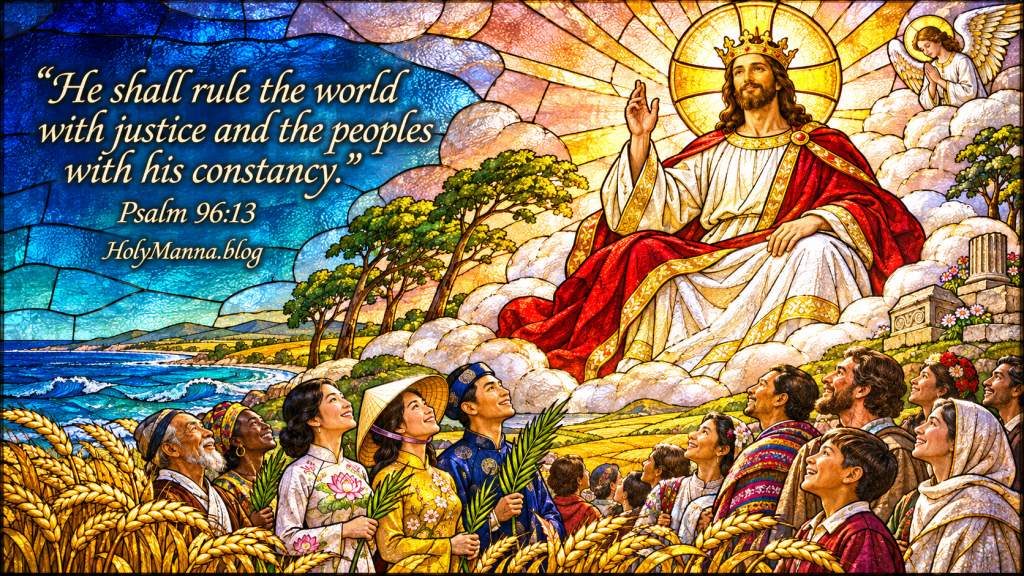
He shall rule the world with justice
and the peoples with his constancy.
R. The Lord comes to judge the earth.
Detailed Exegesis
Verse 10: “Say among the nations: The LORD is king. He has made the world firm, not to be moved; he governs the peoples with equity.”
The verse begins with a mission. Israel is told to announce the kingship of God to every nation, which is exactly what the missionaries and catechists of Vietnam did at the cost of their lives. The firmness of the world comes from the firmness of its King. Saint Augustine and other early writers knew an ancient form of this verse with an added phrase, so that it said the Lord reigned from the wood. Those added words are not found in the Hebrew text or in the NABRE, and they should be treated as an early Christian tradition and not as Scripture. The tradition still shows how the first Christians heard this psalm, because they saw the King reigning from the Cross.
Verse 11: “Let the heavens be glad and the earth rejoice; let the sea and what fills it resound;”
Sky, land, and sea cover the whole of creation as the ancient world pictured it. Saint Augustine, in his Exposition on Psalm 96, reads the heavens as the preachers of the Gospel and the earth as those who listen to them. The literal sense matters as well. Saint Paul teaches in Romans 8:19-21 that creation itself waits with eager longing to be set free.
Verse 12: “let the plains be joyful and all that is in them! Then shall all the trees of the forest exult.”
Saint Augustine sees the level plains as the meek and gentle among the people of God. He sees the trees of the forest as the nations that once grew wild and were then grafted into the good olive tree of Israel. Every baptized Gentile is one of those trees, and the psalm expects such a tree to sing.
Verse 13: “Before the LORD, for he comes; for he comes to rule the earth. He shall rule the world with justice and the peoples with his constancy.”
The psalm says twice that he comes. Saint Augustine hears in that repetition the 2 comings of Christ, the first received in faith through the preaching of the Gospel and the second in judgment, and he urges his listeners not to resist the first coming, “that we may not tremble at His second.” The final word of the psalm is constancy, which means faithfulness. The Judge who is coming is the same Lord who has kept every promise he ever made.
Teachings
The Catechism holds judgment and joy together in the same way the psalm does. CCC 1041 teaches that the thought of the Last Judgment should stir both reverent fear and real hope, because the One who is coming is the Lord whom the Church longs to see. CCC 2817 explains that the petition “Thy kingdom come” in the Lord’s Prayer is the ancient cry of the Church for the return of Christ. CCC 1047 teaches that the material world will not be thrown away but renewed, so the rejoicing of sea and forest in this psalm is more than poetry.
The martyrs of Vietnam prayed this way. In the same prison letter of 1843, Saint Paul Le-Bao-Tinh asks the seminarians of Ke-Vinh for their prayers, and he also invites them to give thanks and to bless the Lord along with him. A man in chains who sings is a living commentary on Psalm 96. He has already accepted the first coming of Christ, and so the thought of the second holds no terror for him.
Reflection
Many people hear the word judgment and feel only dread. This psalm invites you to ask whether you truly want Jesus to return. The season of Advent begins on November 29th, 2026, and it exists to train that desire. A simple practice is to pray “Come, Lord Jesus!” (Revelation 22:20) each morning this week. A second practice is to spend a few minutes outdoors and let the created world lead you into praise. A third practice is to hand over to God one injustice that you cannot fix, trusting that he governs the peoples with equity.
When you imagine Christ returning as Judge, do you feel more fear or more joy, and what does that reveal? Who in your life needs to hear from you, in words or in actions, that the Lord is king? What would change in your week if you believed that every wrong will one day be set right?
Holy Gospel — Luke 21:5-11
When the Beautiful Things Fall
Jesus speaks these words in Jerusalem during the final days before his Passion. He has just praised a poor widow for dropping 2 small coins into the treasury (Luke 21:1-4), and the people around him have turned their attention to the building itself. Herod the Great had begun rebuilding the temple around 20 B.C., and the work was still unfinished some 46 years later, as John 2:20 records. The Jewish historian Josephus describes enormous white stones and gold plating that flashed in the sun. In A.D. 70, roughly 40 years after Jesus spoke, Roman legions under Titus burned the temple and tore it down. The Gospel fits the day’s theme with precision. Everything built by human hands will face its harvest, and only what is built on Christ remains standing.
Luke 21:5-11
While some people were speaking about
how the temple was adorned with costly stones and votive offerings,
Jesus said, “All that you see here–
the days will come when there will not be left
a stone upon another stone that will not be thrown down.”Then they asked him,
“Teacher, when will this happen?
And what sign will there be when all these things are about to happen?”
He answered,
“See that you not be deceived,
for many will come in my name, saying,
‘I am he,’ and ‘The time has come.’
Do not follow them!
When you hear of wars and insurrections,
do not be terrified; for such things must happen first,
but it will not immediately be the end.”
Then he said to them,
“Nation will rise against nation, and kingdom against kingdom.
There will be powerful earthquakes, famines, and plagues
from place to place;
and awesome sights and mighty signs will come from the sky.”
Detailed Exegesis
Verse 5: “While some people were speaking about how the temple was adorned with costly stones and votive offerings, Jesus said,”
The admiration was reasonable. The temple was the holiest place on earth for Israel, and Jesus loved it as the house of his Father, as CCC 583-584 teaches. Votive offerings were gifts donated by the wealthy and the powerful. The contrast with the widow and her 2 coins is deliberate.
Verse 6: “All that you see here, the days will come when there will not be left a stone upon another stone that will not be thrown down.”
CCC 585 teaches that in foretelling the ruin of the temple, Jesus “announced a sign of the last days”, days that would begin with his own Passover. The fall of Jerusalem was a real event in history, and it was also a preview of the end of the present age. The true temple had already been named: “Destroy this temple and in three days I will raise it up” (John 2:19).
Verse 7: “Then they asked him, ‘Teacher, when will this happen? And what sign will there be when all these things are about to happen?’”
The question is the one everybody asks. Saint Ambrose observes that Jesus answers by giving signs and declines to give a date. Saint Cyril of Alexandria adds that the disciples misunderstood him and assumed that he was speaking only about the end of the world.
Verse 8: “He answered, ‘See that you not be deceived, for many will come in my name, saying, “I am he,” and “The time has come.” Do not follow them!’”
The first danger Jesus names is deception, and he names it before he mentions any disaster. Saint Bede points to the false messiahs who appeared in the years just before Jerusalem fell. The warning reaches further than the 1st century. CCC 675 teaches that before the second coming the Church must pass through “a final trial that will shake the faith of many believers”, and that this trial will take the form of a religious deception.
Verse 9: “When you hear of wars and insurrections, do not be terrified; for such things must happen first, but it will not immediately be the end.”
Saint Gregory the Great preached on this passage in Rome on November 11th, 591, to a people worn down by plague and war. He explained that wars come from foreign enemies while insurrections arise among fellow citizens, so that trouble presses from outside and from inside at once. He also taught that the Lord foretells these blows because a blow that is expected wounds less deeply. The word “must” is important. History is not out of control, even when it looks that way.
Verse 10: “Then he said to them, ‘Nation will rise against nation, and kingdom against kingdom.’”
Jesus uses the language of the prophets, especially Isaiah 19:2. Conflict between peoples is a constant feature of a fallen world, and its presence in the news is not proof that the end has arrived.
Verse 11: “There will be powerful earthquakes, famines, and plagues from place to place; and awesome sights and mighty signs will come from the sky.”
Saint Gregory notes that these afflictions come from every direction, from other people, from the earth, from the human body, and from the sky. Every generation since the Ascension has seen them. They are not a countdown clock. They are a standing reminder that this world is passing and that the King is coming.
Teachings
CCC 586 teaches that Jesus went so far as to identify himself with the temple, since in him God has come to live among his people for good, and CCC 593 adds that the temple was a foreshadowing of Christ himself. The building could fall because the reality it pointed to had arrived in person. CCC 676 finds the seed of that deception in every promise that a purely earthly project can deliver the final salvation that only God will give at the end of time. That teaching is a sober guard against every preacher, movement, or ideology that promises heaven on earth or claims to know the date.
Saint Ambrose carries the image inward. In a comment preserved by Saint Thomas Aquinas in the Catena Aurea, he says there is “a temple in every one, which falls when faith is lacking”. The martyrs of Vietnam prove the reverse. The emperor Minh Mang banned foreign missionaries in 1832, churches were destroyed, and believers were ordered to step on a crucifix as proof that they had abandoned Christ, and many of them refused. Their buildings fell, and the temple within them stood.
Reflection
Everyone has a temple that seems too impressive to fail. For some it is a career, for others a retirement account, a reputation, or a country. This Gospel asks you to hold those good things with an open hand. When alarming headlines arrive, you can answer them with a Rosary before you answer them with worry. When a confident voice online claims secret knowledge about the end of the world, you can test it against the Catechism. You can also strengthen the inner temple through the Eucharist, Confession, and a few minutes with Scripture each day.
What in your life seems too solid to fall, and is your peace resting on it more than on Christ? Which voices are shaping your view of the future, and do they leave you terrified or faithful? If everything outward were taken from you, what would remain standing within you?
The Stones Fall, the Song Rises, and the King Comes
Picture the 3 scenes of this day side by side. On a hill in Jerusalem, admirers point at white stone and gold, and Jesus quietly tells them that all of it will come down. On the island of Patmos, an aged apostle watches the Son of Man lift a sickle over a ripe world. Between those 2 scenes, a choir of forests and oceans is singing because the Judge is finally on his way. The scenes belong together. The Gospel says that everything built by human hands is temporary. The reading from The Book of Revelation says that Christ himself will gather what is good and bring an end to what is evil. The psalm says that this is the best news creation has ever heard.
Now picture a 4th scene. In Hanoi in 1839, a priest named Andrew waits for the executioner, and 4 years later a prisoner named Paul writes a letter full of thanksgiving from his cell. Their churches had been leveled and their faith had been outlawed. Yet neither man was deceived and neither man was terrified, because each had already settled the only question that matters at harvest time. Each of them belonged to the King.
The invitation of this day is to settle that same question now. A good Confession before Advent begins, a daily prayer for the return of the Lord, and a looser grip on the temples of this world are simple places to start. The stones will fall in their time. The song of creation will rise. The King will come on the clouds exactly when the Father wills. Those who have welcomed his first coming with faith will discover that the Judge holding the sickle is the same Savior who laid down his life for them.
Engage With Us!
Share your reflections in the comments below. Every reader who describes how the Word of God is at work in daily life helps someone else take the next step, so take a moment to answer one or more of these questions.
- In Revelation 14:14-19, the Son of Man harvests the earth when it is fully ripe. What is growing in your life right now that you would be glad for Christ to gather?
- In Psalm 96:10-13, all creation rejoices because the Lord comes to rule the world with justice. Does the thought of the return of Christ bring you joy, and what would help that joy grow?
- In Luke 21:5-11, Jesus tells his disciples not to be deceived and not to be terrified. Which fear or false promise do you most need to surrender to him this week?
- Taken together, these readings and the witness of Saint Andrew Dung-Lac and his companions proclaim that only what is built on Christ will last. What is one concrete change you can make today to build your life on him?
Walk through this final week of the liturgical year with courage. Stay close to the sacraments, live your faith openly, and do everything with the love and mercy that Jesus taught.
Sacred Heart of Jesus, we trust in You!
Immaculate Heart of Mary, pray for us!
Saint Michael the Archangel, defend us in battle!
Follow us on YouTube, TikTok, Instagram and Facebook for more insights and reflections on living a faith-filled life.


Leave a Reply