The Dove Who Roared
On November 23rd, the Church celebrates Saint Columban, also known by the Latin form of his name, Columbanus. He was an Irish monk, a missionary priest, and an abbot who left his homeland in the late 500s and never saw it again. His name means dove, and he liked the wordplay enough to call himself a poor dove when he wrote to popes. This particular dove, however, had the nerve of an Old Testament prophet. He corrected kings to their faces, argued with bishops, wrote blunt letters to Rome, and planted monasteries in the forests and mountains of what are now France, Austria, and Italy.
He should not be confused with Saint Columba of Iona, whose feast falls on June 9th. Columban’s road ran deep into a continental Europe that had been shaken by war, migration, and the collapse of Roman order. There he founded the abbeys of Annegray, Luxeuil, and Fontaines in Gaul and the abbey of Bobbio in northern Italy. He wrote a monastic rule, sermons, and letters that still survive, and his monks carried the Irish habit of frequent, private confession across the continent. Pope Benedict XVI devoted his General Audience of June 11th, 2008 to him and said that Columban “truly became one of the Fathers of Europe.”
Saint Columban is the patron of the city of Bobbio and co-patron of the Diocese of Piacenza-Bobbio, where his body rests. Motorcyclists also widely invoke him as their patron, a nod to the thousands of miles he covered on foot and by riverboat. The Church holds up saints like him as models and intercessors, as The Catechism teaches in CCC 828 and CCC 956. His life shows what happens when one person decides to belong entirely to Christ and then refuses to turn around.
A Mother at the Door and a Call That Would Not Wait
Most of what is known about Columban comes from two places. The first is his own writing. The second is the Life of Saint Columban by Jonas of Bobbio, a monk who entered Bobbio about 3 years after the saint died and who gathered his material from men who had lived and traveled with the abbot. Jonas loved the miraculous, and a fair reader keeps that in mind.
Columban was born in the Irish province of Leinster. The traditional date is 543, although some sources say about 540 and a number of modern historians prefer a date closer to 550. Jonas tells a story that before the birth his mother had a dream in which “she saw the sun rise from her bosom,” and wise neighbors took it as a sign that her child would give light to many. The dream comes down through Jonas alone and cannot be verified.
The boy received a strong education in grammar, rhetoric, and the Scriptures. He also grew into a handsome young man, and Jonas says frankly that the attention of young women became a real temptation for him. Troubled, he sought out a holy woman who had lived as a hermit for many years. Jonas records her words: “Away, O youth, away! flee from corruption, into which, as you know, many have fallen.” She added, “Forsake the path which leads to the gates of hell.”
Columban took her seriously. He went home, announced that he was leaving to give his life to God, and met a wall of maternal grief. His mother begged, wept, and finally lay down across the doorway to block his way. Jonas says that he asked her not to give way to her sorrow and then went out, “leaping over both threshold and mother.” He answered her tears with the words of Jesus: “Hast thou not heard, ‘He that loveth father or mother more than me is not worthy of me?’” The verse comes from The Gospel of Matthew, at Matthew 10:37. The scene is hard to read, and it must have been harder to live. The Catechism honors the bonds of family and also teaches, in CCC 2232 and CCC 2233, that these bonds are not absolute and that the first vocation of every Christian is to follow Jesus.
He studied first under a teacher named Sinell at Cleenish, on an island in Lough Erne. Then he entered the great monastery of Bangor, on the coast of what is now County Down, under its founder, Saint Comgall. Bangor was famous for hard discipline, constant prayer, and serious study. Columban became a monk there, was ordained a priest, and spent many years in that school of holiness.
Then a new desire took hold of him. Irish monks called it pilgrimage for Christ, a voluntary exile in which a man left everything familiar and went wherever the Gospel was needed. Jonas says that Columban remembered the command God gave to Abraham in The Book of Genesis: “Go forth out of thy country, and from thy kindred, and out of thy father’s house, and come into the land which I shall shew thee” (Genesis 12:1). Comgall at first refused and then gave his blessing and 12 companions, among them the future Saint Gall. The sources disagree on the timing. The Catholic Encyclopedia has him reaching Gaul around 585 at about 40 years old, while Pope Benedict XVI places the departure at about age 50 and the landing in Brittany around 590. Either way, he was a seasoned monk starting over in middle age.
Bread in the Wilderness and Wolves on the Path
What the Irishmen found in Gaul was a land that was Christian in name and wounded in practice. Wars between rival Frankish kings had left the faith neglected, and Jonas says that penance and self-denial were scarcely to be found. A Frankish king welcomed the strangers and offered them land. Jonas names him as Sigibert, who had died in 575, so historians propose Guntram of Burgundy or Childebert II instead.
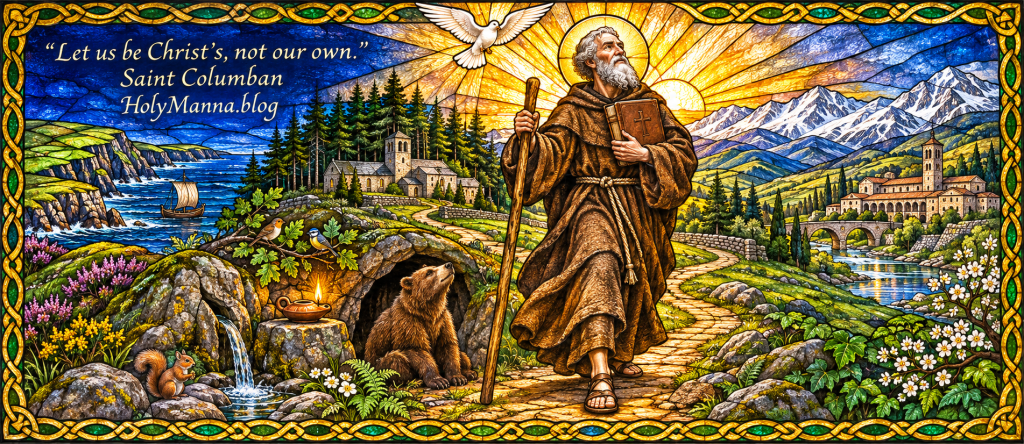
Columban chose the hard place. He settled his monks in a ruined Roman fort at Annegray in the Vosges mountains, where they often lived on herbs, berries, and the bark of trees. When vocations multiplied, he founded a second house in the old Roman spa town of Luxeuil and then a third at Fontaines. He governed all three and lived at Luxeuil for almost 20 years. For his monks he wrote the Regula monachorum, a short and demanding rule in 10 chapters. It was severe, and its severity had a purpose. As he told his monks in a sermon, in words translated from his Latin, “Let us be Christ’s, not our own” (Instructio X).
He also wrote a penitential, a handbook that matched particular sins with particular penances, and with it he brought to the continent the Irish custom of confessing privately and often to a priest. This is one of his greatest gifts to the whole Church. The Catechism records the development directly, noting in CCC 1447 that Irish missionaries in the 7th century “took to continental Europe the ‘private’ practice of penance,” a practice that did not demand long public penance before reconciliation and that has shaped the celebration of the sacrament ever since. Every Catholic who has slipped quietly into a confessional on a Saturday afternoon owes something to Columban and his brothers. The penances served the conversion of heart that The Catechism describes in CCC 1430 and CCC 1431.
Jonas fills these years with wonders, and he says he learned them from the monks who were there. Walking alone in the woods with a book of Scripture on his shoulder, Columban was surrounded by 12 wolves that seized his clothing. Jonas writes, “As he stood firm they left him unterrified.” Soon afterward he found a cave that he wanted as a place of solitary prayer, and a bear was already living in it. Jonas says simply, “He ordered the beast to depart and not to return to that place again.” The bear obeyed him and left the cave.
Other stories are homelier. On a day when the storeroom held only 2 loaves and a little beer, the abbot prayed, the whole community ate, and “All were satisfied and each one drank as much as he wished.” A disciple named Chagnoald testified that wild creatures came to the abbot when he called, and Jonas adds, “The beasts and birds joyfully played, frisking about him.” Jonas gathered these accounts from the saint’s own companions, and they cannot be independently verified today.
The Church does not ask anyone to treat such stories as articles of faith. She does teach that God can work signs through his saints, as CCC 156 and CCC 2003 explain, and the gentleness toward animals fits the pattern of holy men and women recalled in CCC 2416. What matters most is the kind of man the stories describe, a monk so given over to prayer that fear, hunger, and wild creatures seemed to lose their hold on him. He is worth remembering and imitating because he shows that holiness is not softness and that a disciplined life can be a joyful one.
Kings, Councils, and a Ship That Would Not Sail
Trouble came first from fellow churchmen. The Irish calculated the date of Easter by an older table than the one used in Gaul, so Columban’s monks sometimes kept the feast on a different Sunday from their neighbors. The Frankish bishops objected. The Catechism notes in CCC 1170 how much the Church has always cared about a common celebration of Easter. Around the year 600, Columban wrote to Pope Saint Gregory the Great to defend the Irish custom. In that letter he uses the expression “of all Europe” (Epistula I), which, as Benedict XVI pointed out, appears there for the first time with reference to the Church’s presence on the continent.
When the bishops summoned him to a synod at Chalon-sur-Saône, dated to 602 or 603 depending on the source, he sent a letter instead and asked only to be left in peace in the forests, near the graves of the 17 brothers he had already buried there.
The fiercer storm came from the palace. Luxeuil lay in the realm of the young King Theuderic II, who admired Columban and visited him. Theuderic also kept concubines and had fathered children by them, and his grandmother, the formidable Queen Brunhilda, encouraged the arrangement because a lawful queen would threaten her own power. Columban rebuked the king repeatedly. The Catechism is plain that adultery and concubinage offend the dignity of marriage, in CCC 2380 and CCC 2390, and the abbot would not pretend otherwise. When Brunhilda presented the king’s illegitimate sons for a blessing, he refused. According to Jonas he said, “Know that these boys will never bear the royal sceptre, for they were begotten in sin.” When Theuderic himself pushed into the monastery to challenge its enclosure, Columban warned him, “If you dare to violate the monastic rule in any particular, I will not accept any gift or aid from you in the future.”
In 610 the king and his grandmother had him arrested and ordered him back to Ireland. He replied, “I do not think it would be pleasing to my Creator if I should go back to the home which I left because of my love for Christ.” He would leave, he said, only if he were dragged out by force. In the end the soldiers pleaded that their own lives depended on obeying the king, and he went with them out of mercy. Only his Irish monks were allowed to accompany him.
The guards took the old abbot down the Loire toward the sea. At Nantes, waiting for the ship, Columban wrote a letter to the monks he had left behind. In words translated from his Latin, he tells them, “Even as I write, a messenger has come to tell me that a ship is being made ready, on which I shall be carried against my will to my own country” (Epistula IV). He urges them not to fear the trial, and he gives his reason: “If you take away the enemy, you take away the battle; if you take away the battle, you take away the crown.” Then he adds, “if you take away freedom, you take away dignity.” The Catechism speaks in the same key when it teaches that there is no holiness without renunciation and spiritual battle, in CCC 2015, and that freedom belongs to the dignity of the human person made in God’s image, in CCC 1705 and CCC 1730.
The ship never carried him home. Jonas writes that as it made for open water, “a huge wave came and drove the vessel on shore,” and the captain put the monks off before sailing away without them. Pope Benedict XVI likewise records that the ship ran aground, although the details rest on Jonas and cannot be independently verified.
He was nearly 70 years old, homeless, and free. With the support of King Theudebert he traveled up the Rhine to preach to the pagan Alemanni around Lake Zurich and Lake Constance. At Bregenz they restored a ruined chapel of Saint Aurelia, Gall preached in the local tongue, and the idols were thrown down. Jonas tells a story from this mission in which Columban came upon men gathered around a great cask of beer that they meant to offer to their god Woden. He breathed on it, and the cask burst apart. The story comes from Jonas alone and cannot be verified. The Catechism treats the sin of idolatry in CCC 2112 and CCC 2113.
After about a year, hostility returned, war redrew the map, and Columban chose the road south. Gall, sick with fever, stayed behind, and the two friends parted with pain on both sides.
So Columban crossed the Alps and arrived at Milan around 612, at the court of the Lombard King Agilulf and his Catholic queen, Theodelinda. Many Lombards were Arians, who denied the true divinity of the Son that the Church confesses in CCC 465. At the king’s request he also wrote to Pope Boniface IV about a schism that divided northern Italy from Rome. The letter is startlingly direct. “Watch, therefore, I beg you, Pope, watch,” he writes in Epistula V. Yet the same letter is full of loyalty, and he declares, “we are bound to the Chair of Saint Peter.” Here was a man who could speak boldly to the pope precisely because he believed what CCC 882 teaches, that the successor of Peter is the visible source and foundation of the Church’s unity.
Agilulf gave him land at Bobbio, in the Trebbia valley of the Apennines, with a ruined church dedicated to Saint Peter. The old man set to work rebuilding it. He spent his last months in prayer, often in a cave above the river. Jonas writes, “After a single year in his monastery of Bobbio, Columban the man of God, ended his devout life.” The Church keeps November 23rd, 615 as the day of his death, while the Catholic Encyclopedia and the older Roman Martyrology give November 21st. He was not a martyr. His witness was the long, bloodless kind, made of exile, hunger, opposition, and perseverance to the end.
A Staff Carried North and a Cup Carried to Pavia
Jonas says only that Columban’s remains were buried at Bobbio, “where they have proved their virtues, by the aid of Christ.” That restrained sentence is the earliest witness to favors received at his tomb.
A tender tradition concerns Saint Gall. According to the Life of Saint Gall written by Walafrid Strabo in the 800s, Columban had doubted that his friend was truly too ill to cross the Alps and had forbidden him to celebrate Mass for as long as Columban lived. On the day the abbot died at Bobbio, Gall is said to have learned of it in a vision. A messenger sent to Italy confirmed the death and brought back the abbot’s staff, which Columban had left to Gall as a sign of forgiveness. This tradition was written down some 2 centuries after the events and cannot be verified. The hermitage of Gall grew into the great Abbey of Saint Gall in Switzerland.
The most detailed collection of miracles after his death comes from Bobbio itself. Around the middle of the 900s, a monk of the abbey wrote the Miracula Sancti Columbani, the account of an extraordinary journey. Powerful nobles had seized the monastery’s lands. On July 17th, 929, Abbot Gerlan and his monks lifted the saint’s body from its tomb and carried it in procession to Pavia, to the court of King Hugh of Italy. The account says that the king’s young son Lothar, sick with fever, slept beside the relics, drank from the saint’s cup, and recovered. It also says that nobles who had mocked the relics were brought to swear that they would return what they had taken, and that the saint was carried home in triumph. The journey of the relics in 929 is a historical event. The miracles reported along the way rest on this single monastic account, written a generation later in the heat of a property dispute, and they cannot be verified.
The body of Saint Columban still rests at Bobbio, in the crypt of the basilica that bears his name. In 1482 the relics were placed in a marble tomb near the tombs of his successors Saint Attala and Saint Bertulf. The Church’s regard for relics and pilgrimage as expressions of popular piety is described in CCC 1674.
His larger impact is beyond dispute. His disciples are credited with founding more than 100 monasteries across France, Germany, Switzerland, and Italy. Bobbio grew into one of the great libraries of the early Middle Ages, a center of learning that Benedict XVI compared with Monte Cassino. His rule spread so widely that for a time it was better known in Europe than the Rule of Saint Benedict, before the Benedictine rule gradually took its place.
In the 20th century, Irish priests bound for China named their new missionary society after him, and the Missionary Society of Saint Columban still serves around the world. That choice fits a saint who embodied the missionary mandate described in CCC 849 through CCC 851. In July 1950, statesmen and churchmen gathered at Luxeuil to mark the 1,400th anniversary of his birth, among them Robert Schuman and the future Pope Saint John XXIII. Today a pilgrim route called the Columban Way traces his journey from Ireland through 8 countries to his tomb.
Wounded by Love and Still Walking
The first lesson of Columban’s life is his own motto: “Let us be Christ’s, not our own.” Everything else follows from it. He could leave home, bury his brothers in a foreign forest, face down a king, and start again at nearly 70 because he had already settled the question of whom he belonged to. Have you settled that question, or are you still negotiating terms? You may never be asked to step over a threshold the way he did, but you are asked daily to put Christ ahead of comfort, approval, and control.
The second lesson is courage joined to loyalty. Columban told a king the truth about his sin, and he told a pope the truth about a crisis, yet he never stopped loving the Church or honoring Peter’s chair. It is easy to be bold and bitter, and it is easy to be loyal and silent. The Catechism calls every Christian to bear witness to the truth, in CCC 2471 and CCC 2472, and it names fortitude as the virtue that keeps a person firm in difficulty, in CCC 1808. Where in your life are you staying quiet because the truth might cost you something?
The third lesson is confession. The private, repeatable confession you know today spread through Europe on the feet of Columban’s monks. The Catechism strongly recommends regular confession even of everyday faults, in CCC 1458, because it forms the conscience and lets Christ heal what is hidden. A practical way to honor this saint is to put confession on your calendar this week and to keep it there every month.
The fourth lesson is thirst. For all his severity, Columban’s sermons burn with longing for Jesus. He preached on the Lord’s own invitation, “If any man thirst, let him come to me, and drink” (John 7:37), and he told his monks, “If you thirst, drink the Fountain of life; if you hunger, eat the Bread of life” (Instructio XIII). He counted it a grace to be pierced by that love, saying, “Blessed is the soul that is thus wounded by love.” The Eucharist, which CCC 1324 calls the source and summit of the Christian life, is where that thirst is met. What is one comfort you could set aside this week so that you feel your hunger for God more clearly? You might fast from one meal on Friday, pray one psalm slowly each morning, or walk to a nearby church and offer the walk for someone who has left the faith.
Finally, Columban teaches resilience. He lost his monasteries, his friend, and his plans, and he kept walking. When your plans collapse, do you assume that God has abandoned you, or do you ask where the road turns next? His life suggests that the detour is often the mission.
Engage With Us!
Share your thoughts and reflections in the comments below. Your story may be exactly what another reader needs to hear today.
- Columban stepped over his mother’s grief to follow Christ. What attachment, even a good one, most competes with God for first place in your heart?
- He rebuked a king and still showed mercy to the soldiers sent to arrest him. How can you speak a hard truth this week with both courage and charity?
- When was your last confession, and what is keeping you from making it a regular part of your life?
- Columban wrote that taking away the battle takes away the crown. Which struggle in your life might God be using to make you holy?
- He started over in a new country when he was nearly 70 years old. What new beginning is God inviting you to accept right now?
Saint Columban walked across a broken continent with the Scriptures on his shoulder and Christ in his heart, and whole nations were changed. You do not need to cross the Alps to follow him. Begin where you are, belong to Christ completely, and do everything with the love and mercy that Jesus taught.
Saint Columban, pray for us!
Follow us on YouTube, TikTok, Instagram and Facebook for more insights and reflections on living a faith-filled life.


Leave a Reply