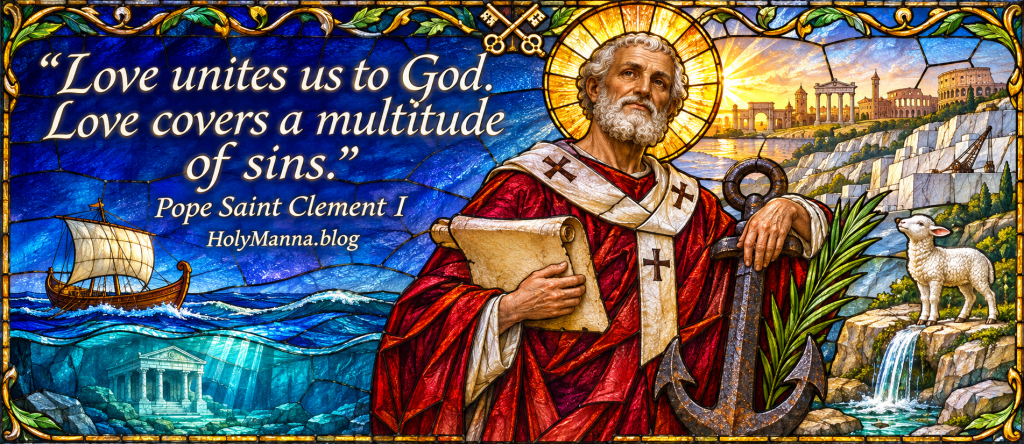
A Voice Still Ringing With the Apostles
Every November 23rd, the Church remembers Pope Saint Clement I, a man who stood so close to the beginning of Christianity that he could still hear it. He was Bishop of Rome in the last years of the 1st century, the 3rd successor of Saint Peter and therefore the 4th pope, and he is honored as the first of the Apostolic Fathers, the generation of writers who learned the faith from the Apostles themselves. He is named in the Roman Canon, the First Eucharistic Prayer of the Mass, right after Linus and Cletus in a list of early martyrs.
Clement is remembered above all for a single letter. Around the year 96, the Christian community in Corinth turned on its own leaders, and the Church of Rome answered with a long, patient, and remarkably firm appeal for peace. That letter survives to this day. It is one of the oldest Christian writings outside the New Testament, and Pope Benedict XVI, in his general audience of March 7th, 2007, described it as a first exercise of the Roman primacy after the death of Saint Peter. In its pages a reader finds apostolic succession, the dignity of the laity, salvation by grace, and a stunning prayer for the very rulers who had been persecuting Christians.
Honesty matters when telling his story. Very little about Clement’s biography is certain, and the most dramatic episodes attached to his name, including an exile to Crimea, a miraculous spring, and an anchor tied around his neck, come from accounts written roughly 300 years after he died. Those traditions are beautiful and worth knowing, and they are told here as traditions. Because of them, Clement has long been invoked as the patron of mariners and sailors, of stonecutters and marble workers, and in England of blacksmiths and metalworkers. The Catechism explains that a patron saint offers a model of charity and the assurance of intercession, CCC 2156.
A Roman Hidden in the Shadows of History
Nobody knows for certain where Clement was born, who his parents were, or how he first met Christ. The Liber Pontificalis, a collection of papal biographies compiled in Rome in the 6th century, says that he was a Roman from the district of the Caelian Hill and the son of a man named Faustinus. That book was assembled more than 400 years after Clement lived, so these details cannot be verified.
Scholars have offered educated guesses. Clement moves through the Old Testament with such ease that some have wondered whether he came from a Jewish family. Others think he may have been a freedman, or the son of a freedman, attached to the imperial household, perhaps even to the household of the consul Titus Flavius Clemens, a relative of the emperor Domitian who was put to death by that emperor. An older theory claimed that the pope and the consul were the same man, but no ancient writer ever suggests it, and the Catholic Encyclopedia sets it aside.
A much-loved tradition connects him to Saint Paul. Writing to the Philippians, the Apostle sends greetings to those who labored beside him in the Gospel, “with Clement and the rest of my fellow labourers, whose names are in the book of life,” Philippians 4:3. Origen, Eusebius, and Saint Jerome all believed this was the future pope, and the Roman liturgy long read this passage on his feast. The identification cannot be verified, and many scholars think that Paul’s Clement was simply a Christian of Philippi.
There is also an ancient religious novel, written in the 3rd century and known as the Clementine Recognitions, that gives Clement a whole adventure. In this story he is a thoughtful young Roman nobleman, restless with questions about the soul, whose mother, father, and twin brothers have been scattered by shipwreck and misfortune. He travels east, meets Saint Barnabas, becomes the disciple and traveling companion of Saint Peter, and is finally reunited with every member of his lost family. This tale cannot be verified, and historians treat it as pious fiction.
What history can say is simpler and more striking. Around the year 180, Saint Irenaeus of Lyons listed the bishops of Rome and wrote that Clement had seen the blessed Apostles and had spoken with them, so that he might be said to have “the preaching of the apostles still echoing” in his ears. Around 199, Tertullian reported the Roman Church’s own claim that Clement had been ordained by Saint Peter. Whatever the details of his conversion, Clement’s faith was formed at the source. The Catechism teaches that the Apostles left bishops as their successors and handed on to them their own teaching role, so that the Gospel would be kept whole and alive in the Church, CCC 77. Clement is one of the first faces of that handing on.
Even his dates require care. Irenaeus places him 3rd after Peter, following Linus and Anacletus, and this is the order the Church follows. Other ancient lists differ, and Saint Jerome noted that many Latin Christians of his day thought Clement came immediately after Peter. His pontificate is given as roughly 88 to 97 in some sources, 90 to 99 in others, and 92 to 101 in the reckoning of Eusebius. The safest statement is that he led the Church of Rome during the final decade of the 1st century.
The Letter That Quieted a Storm
The crisis that made Clement famous began far from Rome. In Corinth, the same lively and quarrelsome church that had given Saint Paul so much grief, a group of headstrong members rose up and removed presbyters who had served blamelessly. The Church of Rome was slow to respond because it had been battered by what the letter calls sudden and repeated calamities, which most scholars connect with the persecution under Domitian. When the storm passed, Rome wrote.
The letter opens with a greeting from “the church of God which sojourns at Rome, to the church of God sojourning at Corinth.” Clement never names himself. The attribution comes from early witnesses such as Bishop Dionysius of Corinth, writing around 170, and Saint Irenaeus, and the Church has received the letter as his ever since. Three trusted men, Claudius Ephebus, Valerius Bito, and Fortunatus, carried it across the sea.
Clement goes straight to the root of the problem, which is jealousy. He walks the Corinthians through Scripture, from Cain and Abel onward, to show that envy always destroys, and then he turns to recent memory: “Let us set before our eyes the illustrious apostles.” What follows is one of the earliest testimonies outside the New Testament to the sufferings and deaths of Saints Peter and Paul. Then comes the pointed question: “Why are there strifes, and tumults, and divisions, and schisms, and wars among you?” The Catechism names envy as a capital sin and says that the baptized must fight it through good will and humility, CCC 2539 to 2540. Clement prescribes exactly that medicine: “Let us therefore, brethren, be of humble mind, laying aside all haughtiness, and pride.” To the ringleaders he is blunt: “Learn to be subject, laying aside the proud and arrogant self-confidence of your tongue.”
The letter is far more than a scolding. Clement reminds his readers that Christians “are not justified by ourselves, nor by our own wisdom,” but by faith, which echoes what the Church teaches when she says that justification comes from the grace of God as a free and undeserved gift, CCC 1996. Grace is never an excuse for laziness, however, and Clement immediately urges his readers to hurry toward every good work. Above all he sings of charity: “Love unites us to God. Love covers a multitude of sins.” He continues: “Love admits of no schisms: love gives rise to no seditions: love does all things in harmony.” The Catechism makes the same point when it teaches that charity animates all the virtues and binds them together, CCC 1827.
Then Clement explains why the deposed presbyters could not simply be pushed out. Their office did not come from the congregation. “Christ therefore was sent forth by God, and the apostles by Christ.” The Apostles in turn appointed bishops and deacons, and, knowing that there would be strife over the office, they arranged for other approved men to succeed them. This is apostolic succession, described by a man who knew the Apostles, and The Catechism cites these very chapters of Clement when it teaches the doctrine, CCC 861. In the same part of the letter Clement becomes the first Christian writer to use the Greek word laikos, meaning a layman, for the faithful who hold their own proper place in the worshiping People of God, a dignity described in CCC 897. Pope Benedict XVI drew the lesson that the structure of the Church is sacramental and not political.
The tone of the letter is what catches the attention of historians. Rome does not apologize for getting involved. The letter warns that anyone who disobeys what God has spoken through it places himself in serious danger, and it asks for the joy of hearing that peace has returned. Corinth did not take offense. About 70 years later, Bishop Dionysius of Corinth told Pope Soter that his church still read the letter aloud at its Sunday worship. Saint Irenaeus called it “a most powerful letter.” Eusebius reports that it was read publicly in many churches, and it was even copied into the great 5th-century Bible manuscript called the Codex Alexandrinus. All of this fits what the Church believes about the Bishop of Rome, who as the successor of Peter is the lasting and visible source and foundation of unity, CCC 882.
Near its end the letter rises into a long prayer, and within it Clement prays for the emperor and his governors: “to them, Lord, give health, peace, concord, stability, that they may exercise the authority given to them without offense.” These words were written by a community that had just been persecuted by those same authorities. Pope Benedict XVI called it the oldest prayer for political rulers after the New Testament, and he summed up its other edge in a single short sentence: “Caesar is not everything.” The Catechism quotes this prayer of Clement in CCC 1900.
As for miracles during his lifetime, the historically reliable sources record none. A later account of his life, the Acts of his martyrdom, written no earlier than the 4th century, tells a vivid one. In this story a Roman lady named Theodora became a Christian through Clement’s preaching. Her suspicious husband, Sisinnius, a courtier of the emperor Nerva, followed her to church and was struck blind and deaf when he entered. Clement came to the house and healed him by prayer, but Sisinnius, convinced that sorcery was involved, ordered his servants to tie the bishop up. The servants, their senses confused, wrestled with stone columns and bound those instead. That night Saint Peter appeared to Theodora and promised that her husband would come to the faith through her, and Sisinnius was soon baptized, followed by 423 other persons of rank. An 11th-century fresco of the scene can still be seen in Clement’s basilica in Rome. This story cannot be verified.
The wonder that history can vouch for is quieter. A bishop who had every reason to be absorbed in the suffering of his own city turned his attention to the wound of another church, and he wrote with enough truth and tenderness that the letter was treasured for centuries. That is why Clement is worth remembering and imitating.
Marble Quarries and an Iron Anchor
Clement’s documented hardships are the ordinary, crushing ones of a shepherd in dangerous times. He led the Church of Rome after the Apostles were gone, through the reign of Domitian, when his own flock was struck by the calamities his letter mentions.
Whether he died by violence is a question the oldest sources leave open. Irenaeus, Eusebius, and Jerome say nothing of a martyrdom. The first writer to call him a martyr is Rufinus, around the year 400. In 417 Pope Zosimus wrote that Clement had learned the faith from Peter and had given his life for it, and the Roman Canon lists him among the martyrs. Pope Benedict XVI noted that the title of martyr rests on testimonies from the 4th to the 6th centuries. The Church venerates him as a martyr and celebrates his memorial in red vestments.
The traditional account of how he died comes from the same Acts that tell of Sisinnius. In this tradition, Clement’s success among the Roman nobility provoked accusations against him, and the emperor Trajan banished him across the Black Sea to Chersonesus in Crimea, to hard labor in the marble quarries. There he found 2,000 Christians already condemned, and they were suffering terribly from thirst because the nearest water was 6 miles away. Clement gathered them to pray. He then saw a lamb standing on a hill and marking a spot with its foot. He struck the ground there, and a spring of fresh water burst out. The people of the region flocked to him, and the tradition claims that 75 churches were built.
When word reached Trajan, an official named Aufidianus was sent to end the matter. Clement was rowed 3 miles out to sea, an iron anchor was fastened to his neck, and he was thrown overboard so that the Christians could not recover and honor his body. The tradition places his death around the year 100 or 101. This account was written centuries after the events and cannot be verified. The Liber Pontificalis complicates matters further by stating that he died a martyr in the 3rd year of Trajan and was buried in Greece.
Whatever the exact circumstances, the instinct of the Church about Clement is sound. The Catechism calls martyrdom “the supreme witness given to the truth of the faith,” CCC 2473. A man who wrote so movingly about the endurance of Peter and Paul would have understood what was being asked of him. The Liber Pontificalis preserves one more tradition that suits him well: Clement is said to have divided Rome into 7 districts and assigned each to a notary charged with carefully recording the acts of the martyrs. This detail cannot be verified, yet it reflects something the Church has always done, since she has carefully gathered the accounts of those who stayed faithful unto death, CCC 2474.
A Chapel Beneath the Waves and Bones Carried Home
The tradition does not end with the splash of the anchor. In the Acts, Clement’s disciples Cornelius and Phoebus asked the grieving Christians to pray, and the sea drew back 3 miles from the shore. The people walked out on dry ground and found a small marble shrine, not built by human hands, with the body of the martyr resting inside a stone coffin and the anchor lying beside it. They were told to leave the body where it was. Each year afterward, on the anniversary of his death, the sea is said to have withdrawn for 7 days so that pilgrims could walk out to pray. Saint Bede repeated the account in his 8th-century martyrology. This story cannot be verified.
Saint Gregory of Tours, writing in Gaul in the 6th century, added a tender sequel. In his telling, a mother brought her little boy to the shrine on the feast. The child fell asleep, the tide rushed back, and he was left behind. The mother grieved for an entire year. When the sea opened again on the next feast, she found her son asleep in the shrine, unharmed and unaware that a year had passed. A medieval fresco in the lower church of San Clemente in Rome shows the scene. This story cannot be verified.
With the relics, firmer ground returns. Around the year 861, Saint Cyril, the future Apostle of the Slavs, was in Crimea on a mission to the Khazars. Convinced that Clement had died there, he searched for the grave and recovered bones and an anchor, which the Catholic Encyclopedia notes were dug from a mound on land and not from a tomb under the sea. Cyril and his brother Saint Methodius carried these relics to Rome in 867 or 868, where Pope Adrian II received them with great solemnity and enshrined them in the Basilica of San Clemente. Historians regard this transfer as a real event. Whether the bones are truly those of Clement rests on Cyril’s conviction and on the anchor found with them, and it cannot be proven. Cyril died in Rome on February 14th, 869, and at his brother’s request he was buried in San Clemente, near the pope whose relics he had brought home.
The basilica is one of the most fascinating churches in Rome. The present church dates from the early 12th century, when Pope Paschal II rebuilt it after the Norman sack of the city. Beneath it lies a 4th-century basilica, rediscovered in the 1850s by Father Joseph Mullooly, the Irish Dominican prior, and beneath that lie 1st-century Roman buildings and a shrine of the pagan god Mithras. A tradition holds that the church stands over Clement’s own house, which cannot be verified. Irish Dominicans have cared for the basilica since 1677. The relics rest beneath the high altar together with those of Saint Ignatius of Antioch, and every November 23rd they are exposed for veneration and carried in procession through the neighboring streets.
Clement’s memory traveled widely. According to the chronicles of Kyivan Rus, Prince Vladimir brought relics of Clement from Chersonesus to Kyiv around 988 and placed them in the Church of the Tithes, which helps explain the deep honor Clement has received among the Eastern Slavs. The details of this tradition cannot be verified. In England, the guild of mariners at Deptford that became Trinity House was dedicated to the Holy Trinity and Saint Clement, and the anchor-shaped cross is still called Saint Clement’s Cross. English blacksmiths kept his feast as Old Clem’s Night and opened it by firing their anvils, while children went door to door asking for apples and pears, a custom called clementing.
The Catechism places such things in their proper frame. The veneration of relics, pilgrimages, and processions are expressions of popular piety that prolong the liturgical life of the Church without taking its place, CCC 1674 to 1675. The saints in heaven keep praying for those who are still on the journey, CCC 956. By canonizing saints, the Church proposes them to the faithful as models and intercessors, CCC 828.
An Anchor for a Restless Age
Clement wrote to people who were sure they were right. That is what makes his letter feel so current. The troublemakers in Corinth were probably talented, energetic, and convinced that the old guard was holding the church back. Clement did not question their gifts. He questioned their hearts, and he found envy there. The Catechism teaches that the ruptures which wound the unity of the Church do not happen without human sin, CCC 817, and Clement shows that the wound usually starts small, with a comparison, a resentment, or a clever remark at the expense of someone else.
Where has envy quietly shaped the way you speak about people in your parish, your workplace, or your own family?
His remedy is humility, and he is practical about it. He asks: “Who then among you is noble-minded? Who compassionate? Who full of love?” He then suggests that the truly noble person is the one who is willing to step back for the sake of peace. You can practice this today. You can let someone else have the last word. You can refuse to pass along the cutting comment. You can go to Confession and name envy for what it is, because Clement urges every believer: “Let us look steadfastly to the blood of Christ, and see how precious that blood is to God.” The Catechism quotes this very line of Clement when it teaches about conversion of heart, CCC 1432.
Clement also models a way of relating to authority that is neither servile nor rebellious. He honors bishops and priests as a gift handed down from the Apostles, CCC 861 to 862, and he prays for civil rulers who have treated Christians badly, a prayer the Church still asks of the faithful, CCC 2240. You might choose one concrete act this week: pray by name for your pastor, your bishop, the Holy Father, and the public officials you find hardest to like.
When you disagree with a leader in the Church or in public life, is your first move to pray or to complain?
Finally, there is the anchor. Whatever its history, Christians have always seen in it a sign of hope, and the Letter to the Hebrews describes hope as a sure and firm anchor of the soul, Hebrews 6:19, an image The Catechism takes up in CCC 1820. Clement stayed steady while emperors raged and churches quarreled because he was fastened to something that does not move. You do not need a quarry in Crimea to imitate him. You need a habit of prayer, a love for the Church as Christ actually built her, and the courage to be a peacemaker in the next tense conversation.
What would change in your home this week if you chose harmony over winning?
Engage With Us!
Share your thoughts and reflections in the comments below. Clement’s letter has been read in Christian communities for more than 1,900 years, and the conversation it started is still worth having.
- Clement traced the trouble in Corinth to jealousy and envy. Where do you see envy doing damage in Christian communities today, and how can you resist it in yourself?
- Clement taught that the Apostles appointed successors to carry on their mission. How does knowing that your bishop stands in a line reaching back to the Apostles change the way you see the Church?
- Clement prayed for the rulers who had persecuted his people. Which leader do you find hardest to pray for, and what would it take to begin?
- Very little is known about Clement’s life, yet his one letter has shaped the Church for centuries. What does that suggest about how God uses hidden and ordinary faithfulness?
- The anchor has become the symbol of Saint Clement. What keeps your faith anchored when life feels stormy?
May Pope Saint Clement I pray for you and for the whole Church. Hold fast to the faith handed down from the Apostles, be quick to make peace, and do everything with the love and mercy that Jesus taught.
Pope Saint Clement I, servant of the Lord, pray for us!
Follow us on YouTube, TikTok, Instagram and Facebook for more insights and reflections on living a faith-filled life.


Leave a Reply