Monday of the Thirty-fourth Week in Ordinary Time – Lectionary: 503
When Heaven Counts Differently
Some people give God whatever happens to be left over, and some people hand Him everything in their pockets. Monday of the 34th Week in Ordinary Time is about the second kind. This is the final week of the Church’s year. The Solemnity of Christ the King was celebrated only yesterday, and Advent begins in 6 days, so the liturgy turns its eyes toward the end of all things and asks a very direct question. Who actually belongs to God?
Each reading answers from a different angle. In The Book of Revelation, Saint John sees the Lamb standing on Mount Zion with 144,000 companions who carry His name on their foreheads and follow Him wherever He goes. Psalm 24, an old pilgrim chant from the gates of the Jerusalem temple, asks who may climb the mountain of the Lord and answers that the climb belongs to people with clean hands and an undivided heart. Then The Gospel of Luke brings everything down to street level. Jesus sits in the temple during the last week before His Passion and watches a poor widow drop 2 tiny coins into the treasury, which is everything she has.
The thread running through all 3 readings is total belonging. God’s people are those who hold nothing back from Him, whether that means a whole life, a whole heart, or a whole livelihood. First-century Jerusalem measured generosity the way the modern world still does, by the size of the gift. Heaven measures by how much of the giver comes with it. The readings also promise where that kind of giving leads, and the psalm response says it best: “Lord, this is the people that longs to see your face.”
First Reading — Revelation 14:1-3, 4b-5
The Lamb’s People and the Song Only They Can Sing
The Book of Revelation was written for Christians under pressure. Saint Irenaeus, writing in the 2nd century in Against Heresies, places Saint John’s visions near the end of the reign of the emperor Domitian, and John himself says he received them in exile on the island of Patmos (Rev 1:9). The chapter just before this reading is one of the darkest in the Bible. A beast rises from the sea, and its followers are branded on the hand or forehead so that no one can buy or sell without the mark (Rev 13:16-17). Then the scene changes. The Lamb has a people too, and they belong to God so completely that it is written on their faces.
Revelation 14:1-3, 4b-5
I, John, looked and there was the Lamb standing on Mount Zion,
and with him a hundred and forty-four thousand
who had his name and his Father’s name written on their foreheads.
I heard a sound from heaven
like the sound of rushing water or a loud peal of thunder.
The sound I heard was like that of harpists playing their harps.
They were singing what seemed to be a new hymn before the throne,
before the four living creatures and the elders.
No one could learn this hymn except the hundred and forty-four thousand
who had been ransomed from the earth.
These are the ones who follow the Lamb wherever he goes.
They have been ransomed as the first fruits
of the human race for God and the Lamb.
On their lips no deceit has been found; they are unblemished.
Detailed Exegesis
Verse 1
“I, John, looked and there was the Lamb standing on Mount Zion, and with him a hundred and forty-four thousand who had his name and his Father’s name written on their foreheads.”
The Lamb is Jesus, crucified and risen, and He is standing. The dragon took its position on the sand of the sea (Rev 12:18), while the Lamb stands on Mount Zion, the hill of God’s temple. The number 144,000, first seen in Rev 7:4, is 12 times 12 times 1,000, a figure of completeness, and Saint Bede writes in his Commentary on Revelation, “This finite number should be understood as representing an infinite number.” The Catechism places them within the heavenly liturgy as “the new People of God (the one hundred and forty-four thousand)” (CCC 1138). The name on the forehead deliberately answers the mark of the beast, as Bede also points out. The Catechism connects this very verse to the Christian name received at Baptism, teaching, “The name one receives is a name for eternity.” (CCC 2159).
Verse 2
“I heard a sound from heaven like the sound of rushing water or a loud peal of thunder. The sound I heard was like that of harpists playing their harps.”
Heaven’s worship is overwhelming and beautiful at the same time. Rushing water and thunder are how Scripture describes the voice of God Himself (Ez 43:2; Rev 1:15), and yet the same sound resolves into music. The Church teaches that the liturgy on earth is a real share in this heavenly liturgy (CCC 1090; CCC 1139), which means the reading describes something every Catholic touches at Sunday Mass.
Verse 3
“They were singing what seemed to be a new hymn before the throne, before the four living creatures and the elders. No one could learn this hymn except the hundred and forty-four thousand who had been ransomed from the earth.”
The Psalms repeatedly call for a new song whenever God saves His people (Ps 96:1; Ps 98:1), and heaven has already sung one to the Lamb who was slain (Rev 5:9). Only the ransomed can learn this hymn because it is a song of experience. Anyone can read about a rescue, but only the rescued can sing about it from the inside. They did not earn their place on the mountain. They were purchased, and the price was the Blood of the Lamb.
Verse 4b
“These are the ones who follow the Lamb wherever he goes. They have been ransomed as the first fruits of the human race for God and the Lamb.”
Here is the heart of the reading. Jesus once warned a would-be disciple who promised to follow Him anywhere that the Son of Man has nowhere to rest His head (Lk 9:57-58). Following Him wherever He goes means following to Calvary before following to glory. First fruits were the first and best portion of the harvest, which Israel handed over to God as a sign that the whole harvest was His (Dt 26:1-11). The 144,000 are that kind of offering. They are set apart entirely for God, and they are a pledge that a great harvest is still coming.
Verse 5
“On their lips no deceit has been found; they are unblemished.”
The word “unblemished” is sacrificial language. An animal offered in the temple had to be without defect (Lv 22:21), and Saint Peter describes Christ as a spotless, unblemished lamb (1 Pt 1:19). His people have become like Him, living offerings with nothing false in them. Bede preserves a comment from the early writer Tyconius, who noticed that the verse says deceit was not found in them, which is not the same as saying it was never there. Sin that has been washed away is sin that God no longer finds.
Teachings
The Lectionary skips the first half of verse 4, which describes the 144,000 as virgins, but the Church’s tradition has never forgotten it. Saint Augustine, in Of Holy Virginity, addresses consecrated men and women directly with this passage and urges them, “follow the Lamb, because the Flesh of the Lamb also is assuredly virgin.” The Catechism echoes him, teaching that from the very beginning of the Church some men and women have renounced the great good of marriage in order to follow the Lamb wherever He goes (CCC 1618). Consecrated virginity is the most literal form of the undivided heart.
Augustine is no elitist, though. A little later in the same work he reassures the rest of the faithful that the Lamb will not desert those who cannot follow Him in that particular way, and he adds, “Almighty is the Lamb, of Whom we speak.” Every baptized person is called to holiness (CCC 2013), and so every baptized person is called to follow, in whatever state of life God has given.
The Church’s calendar offers a striking example on this very date. Blessed Miguel Agustín Pro, a Jesuit priest who ministered in secret during the persecution in Mexico, was executed by firing squad in Mexico City on November 23rd, 1927. He stretched out his arms in the form of a cross and died proclaiming, “Viva Cristo Rey!”, which means long live Christ the King. That is what following the Lamb wherever He goes looks like in the 20th century.
Reflection
The mark in Revelation is about allegiance, and it raises an uncomfortable question about what a stranger would say you belong to. For many people the honest answer would be a career, a phone, or a political tribe. A good first step is to make the Sign of the Cross slowly tomorrow morning and remember that a cross was traced on your forehead at Baptism. A second step is to get to Confession before Advent, so that whatever deceit has been on your lips is no longer found there. A third is to sing at Mass this Sunday, even badly, as someone who has actually been rescued.
Where has following Jesus quietly turned into following Him only where it is comfortable?
What would change if you believed His name was already written on you?
Responsorial Psalm — Psalm 24:1-6
The Question at the Temple Gate
Picture pilgrims climbing the last steep road to Jerusalem, singing as they come. Saint John Paul II, in his General Audience of June 20th, 2001, described Psalm 24 as a procession chant that rang out at the temple, built in 3 scenes. The psalm’s title attributes it to David, and it has often been linked with the day he brought the ark of the covenant up to Zion (2 Sm 6), although the psalm itself does not say so. At the gate the pilgrims call out a question, and the answer comes back listing the conditions for entry. The first reading showed a people already standing on Mount Zion with the Lamb. The psalm asks how anyone gets up there. The Church sings this same psalm with this same response on All Saints’ Day, which says a great deal about who she thinks it describes.
Psalm 24:1-6
R. (see 6) Lord, this is the people that longs to see your face.
The LORD’s are the earth and its fullness;
the world and those who dwell in it.
For he founded it upon the seas
and established it upon the rivers.R. Lord, this is the people that longs to see your face.
Who can ascend the mountain of the LORD?
or who may stand in his holy place?
He whose hands are sinless, whose heart is clean,
who desires not what is vain.R. Lord, this is the people that longs to see your face.
He shall receive a blessing from the LORD,
a reward from God his savior.
Such is the race that seeks for him,
that seeks the face of the God of Jacob.R. Lord, this is the people that longs to see your face.
Detailed Exegesis
Verse 1
“The LORD’s are the earth and its fullness; the world and those who dwell in it.”
The psalm begins with ownership. Everything belongs to God, including the people. John Paul II called these opening lines “a profession of faith in the Lord of the cosmos and of history.” The Catechism teaches that the goods of creation were entrusted to the whole human race as stewards (CCC 2402). This matters for the Gospel that follows. The widow’s coins were God’s before they were hers. Nobody gives God anything He does not already own. A person can only hand it back.
Verse 2
“For he founded it upon the seas and established it upon the rivers.”
In the ancient imagination the sea meant chaos, and creation meant God setting solid ground above the waters (Gn 1:9-10). Saint Augustine, in his Exposition on Psalm 24, reads the seas and rivers spiritually as the surging desires of this world, above which the Church is established. A believer’s life rests on what God has founded, not on whatever is churning underneath.
Verse 3
“Who can ascend the mountain of the LORD? or who may stand in his holy place?”
Now comes the question. The mountain is Zion and the holy place is the temple. There are 2 verbs, and both matter. Getting to God’s presence is one thing, and being able to remain standing there is another. John Paul II compares what follows to an examination of conscience before worship, which is exactly what the Penitential Act does at the beginning of every Mass.
Verse 4
“He whose hands are sinless, whose heart is clean, who desires not what is vain.”
The answer gives 3 conditions that move from the outside in. Hands stand for actions, the heart for intentions, and desire for what a person ultimately wants. Augustine sums up the worthy pilgrim as “the guiltless in deed, and pure in thought.” John Paul II stresses that these requirements are moral and not merely ritual, and that the rejection of what is false reaches all the way down to the rejection of idolatry. A vain thing, in the Bible, is anything that promises fullness and delivers emptiness. Jesus gathered all of it into one Beatitude: “Blessed are the clean of heart, for they will see God” (Mt 5:8).
Verse 5
“He shall receive a blessing from the LORD, a reward from God his savior.”
Notice the last word. Even the pilgrim with clean hands receives rather than achieves, and the God who rewards him is called his savior. The purity that opens the gate is itself a gift, which is why the Church looks for clean hearts in Baptism and the ongoing struggle sustained by grace, not in willpower alone (CCC 2520).
Verse 6
“Such is the race that seeks for him, that seeks the face of the God of Jacob.”
The psalm ends with seekers. A whole people is defined by what it longs for. Jacob wrestled through the night and marveled that he had seen God face to face (Gn 32:31), and his descendants came to the temple seeking the same presence. The last page of the Bible ties this psalm to the first reading in a single line about the saints in glory: “They will look upon his face, and his name will be on their foreheads” (Rev 22:4).
Teachings
The Catechism explains that the pure in heart are those who have attuned their minds and wills to the demands of God’s holiness, chiefly in charity, chastity, and love of the truth (CCC 2518). It then draws the same connection the psalm draws between the heart and the face of God: “Purity of heart is the precondition of the vision of God.” (CCC 2519). That vision is the whole point of the climb. Those who die in God’s grace and are perfectly purified see Him face to face (CCC 1023), and the Church calls this contemplation of God in His glory the beatific vision (CCC 1028).
Augustine adds a deeper layer. The title of the psalm in his Bible assigned it to the first day of the week, so he reads the whole psalm as a song about the Lord’s Resurrection and glorification. Read this way, the question at the gate has one perfect answer. Only Jesus climbs the mountain by His own right, and everyone else ascends by belonging to Him. That is why the response speaks of a people and not of a solitary hero.
Reflection
This psalm makes a simple examination of conscience for the end of the day. Ask what your hands did today, what was going on in your heart while they did it, and what you wanted most from the moment you woke up. It also suggests arriving at Mass 5 minutes early, so that the Penitential Act becomes a real answer to the question at the gate instead of words recited on autopilot. It is worth naming the vain thing as well, whether that is endless scrolling, the approval of others, or the number in a savings account.
If your hands could testify about this past week, what would they say?
What empty thing has been receiving the desire that belongs to God?
When did you last ask simply to see His face, with no other request attached?
Holy Gospel — Luke 21:1-4
Two Coins and a Whole Life
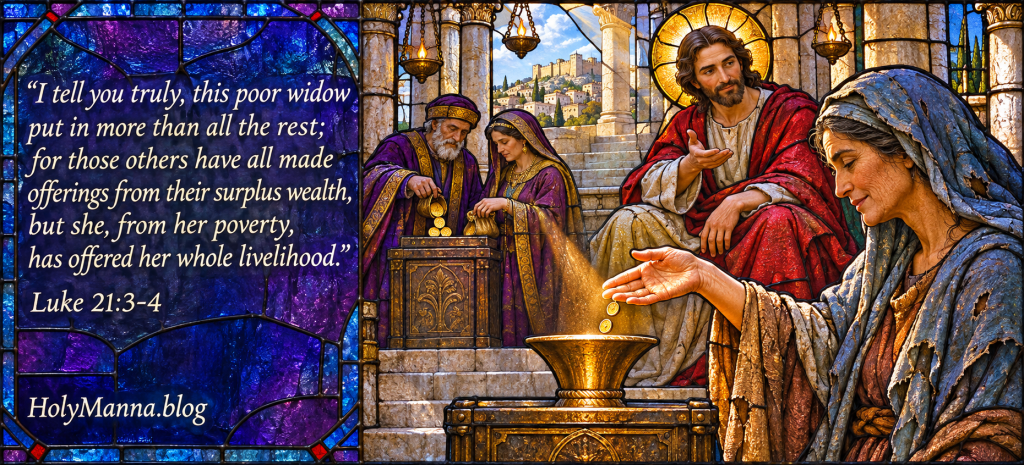
It is the last week of Jesus’ earthly life. He is teaching daily in the temple (Lk 19:47), and the Last Supper is only days away. The treasury stood in the Court of the Women, the area open to every Israelite, and Jewish tradition recorded in the Mishnah describes 13 trumpet-shaped chests placed there for offerings. In the verses just before this scene, Jesus warned about scribes who devour the houses of widows (Lk 20:47). A widow in the ancient world had usually lost her income along with her husband, and Scripture names widows again and again among those under God’s special protection (Dt 10:18; Ps 68:6). Right after describing men who consume widows, Jesus points to a widow who gives. She is the day’s theme in a single figure, a person who holds nothing back.
Luke 21:1-4
When Jesus looked up he saw some wealthy people
putting their offerings into the treasury
and he noticed a poor widow putting in two small coins.
He said, “I tell you truly,
this poor widow put in more than all the rest;
for those others have all made offerings from their surplus wealth,
but she, from her poverty, has offered her whole livelihood.”
Detailed Exegesis
Verse 1
“When Jesus looked up he saw some wealthy people putting their offerings into the treasury”
Saint Mark adds that Jesus had sat down opposite the treasury and was watching the crowd (Mk 12:41). The Son of God pays attention to how people give. Nothing in the text says the gifts of the wealthy were wrong. They are simply not what holds His attention. Saint Bede, commenting on this passage, observes that the Lord who sees the heart praises what He finds worthy there.
Verse 2
“and he noticed a poor widow putting in two small coins.”
The coins are lepta, the smallest coins in circulation, and Mark explains that 2 of them equaled the smallest Roman coin (Mk 12:42). The detail that matters most is the number. She had 2, which means she could have kept 1, and nobody would have blamed her. Saint Cyril of Alexandria pictures these coins as what she had earned by the sweat of her daily labor. In a courtyard full of noise and impressive donations, the eyes of Jesus went straight to her.
Verse 3
“He said, ‘I tell you truly, this poor widow put in more than all the rest;”
The phrase “I tell you truly” signals a solemn teaching. Jesus is not being sentimental. He is doing math, only with a different scale. Saint John Chrysostom, in a comment preserved in the Catena Aurea of Saint Thomas Aquinas, explains the scale: “God regarded not the scantiness of the offering, but the overflowing of the affection.” Saint Leo the Great taught the same thing in the 5th century, saying in Sermon 90 that divine justice weighs hearts and not the quantity of gifts.
Verse 4
“for those others have all made offerings from their surplus wealth, but she, from her poverty, has offered her whole livelihood.’”
Here is the measure. The question is how much is left afterward. The wealthy gave from their surplus and went home to full houses. She went home with nothing except God. The Greek word translated “livelihood” is bios, which simply means life. She put her life into the treasury. Within days, Jesus will do the same on the Cross, and Saint Paul will later describe Him as the one who was rich and became poor for the sake of others (2 Cor 8:9). Her gift is also an act of trust. She believes that the God who owns the earth and its fullness will take care of her tomorrow.
Teachings
The Catechism teaches that Jesus asks His disciples to prefer Him to everything and everyone, and it presents this widow as the example He gave them shortly before His Passion, the woman who “out of her poverty, gave all that she had to live on” (CCC 2544). The same paragraph states that detachment from riches is obligatory for entering the Kingdom of heaven. That is a requirement for every Christian and not an optional extra for monks. The Catechism adds that abandonment to the Father’s providence frees a person from anxiety about tomorrow (CCC 2547).
The Fathers loved this woman. Saint Cyprian, the 3rd-century bishop of Carthage and martyr, held her up to the comfortable Christians of his city in On Works and Alms, describing her as needy in means and rich in works, and telling the wealthy to be ashamed of their barrenness. Bede saw in her an image of the Church herself, with the 2 coins standing for love of God and love of neighbor.
Pope Benedict XVI returned to her in his Angelus of November 11th, 2012, pairing her with the widow of Zarephath who fed Elijah from her last handful of flour (1 Kgs 17:10-16). Both women, he said, show that faith means entrusting oneself completely to God, and he drew a conclusion that removes every excuse: “No one is so poor that he cannot give something.”
None of this means the Church asks every family to empty its bank account into the collection basket. Her precept is that the faithful assist with the material needs of the Church, in keeping with what each person is able to give (CCC 2043). What the widow models is the heart behind the gift, a heart that trusts God more than it trusts its reserves.
Reflection
Try the surplus test this week. Look honestly at what you give God and ask whether any of it costs you anything. Prayer squeezed into the last drowsy minutes of the night is surplus. So is a donation calculated from whatever remains after everything else has been paid. One practical change is to give first instead of last, by deciding on your offering before the month’s spending begins and giving God the first 15 minutes of the morning. Another is to do one generous thing this week that nobody will ever know about. The Gospel never says the widow heard a word of Jesus’ praise. She simply gave and went home. And if you feel that you have very little to offer, take heart, because the smallest gift in the temple that day was the only one Jesus pointed out.
Does God receive your first and best, or what is left over?
What are your 2 coins right now, the small thing that is actually everything?
How would your giving change if you remembered that Jesus watches with delight and not with suspicion?
Everything in His Hands
An old apostle in exile looks up and sees a mountain covered with people who are singing. A line of dusty pilgrims stops at a temple gate and asks who is allowed to go up. A widow crosses a crowded courtyard, opens her hand over a collection chest, and walks home with nothing. The Church sets these 3 scenes side by side in the last week of her year because they are really 1 story.
The widow is what the 144,000 look like before anyone can see the name on their foreheads. Her hands are clean, her heart is undivided, and she wants nothing empty. She follows the Lamb wherever He goes, and she does it only days before He gives His own whole life on the Cross. The psalm explains where her road leads. The people who hold nothing back are the people who will see the face of God, and they will sing a song that only the ransomed can learn.
Advent begins on Sunday, which makes this a good week to decide what handing everything over would look like in practice. For one person it will be a long-delayed Confession. For another it will be a time of prayer that costs some sleep, or a gift that is actually felt. Christ the King does not need anyone’s coins. He wants the giver, and He is watching the treasury even now with the same attentive love. Place the 2 small coins of this ordinary Monday in His hands, and trust that He counts them the way heaven counts.
Engage With Us!
Share your reflections in the comments below. Tell the community which of today’s readings spoke to you most and how you plan to live it this week. Your story may be exactly the encouragement another reader needs.
- First Reading, Revelation 14:1-3, 4b-5: The 144,000 follow the Lamb wherever He goes. Where is Jesus asking you to follow Him right now in a way that feels costly or inconvenient?
- Responsorial Psalm, Psalm 24:1-6: The psalm names sinless hands, a clean heart, and a desire that is not vain. Which of these 3 most needs the Lord’s cleansing in your life as Advent approaches?
- Holy Gospel, Luke 21:1-4: The widow gave from her poverty instead of her surplus. What could you give God this week that you would actually miss?
- All 3 readings describe people who belong entirely to God. What is one thing you are still holding back from Him, and what would help you place it in His hands?
Keep seeking His face this week, and do not be discouraged if your offering looks small. Live a life of faith in the ordinary places where God has put you, and do everything with the love and mercy Jesus taught.
Sacred Heart of Jesus, we trust in You!
Immaculate Heart of Mary, pray for us!
Saint Michael the Archangel, defend us in battle!
Follow us on YouTube, TikTok, Instagram and Facebook for more insights and reflections on living a faith-filled life.


Leave a Reply