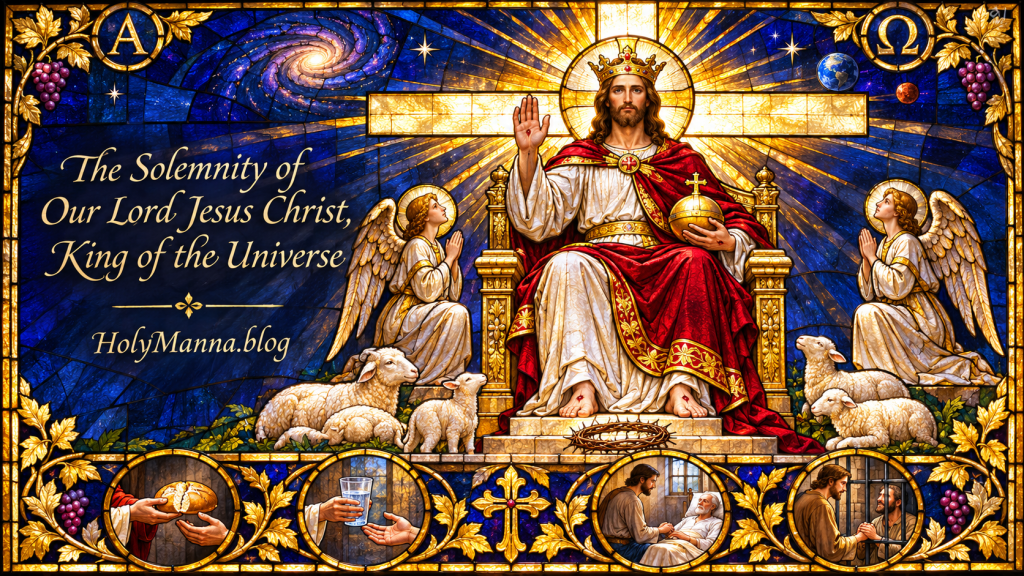
The King Who Reigns From a Cross
Every good story has a final line, and the Church has chosen hers with care. On Sunday, November 22nd, 2026, the liturgical year closes with the Solemnity of Our Lord Jesus Christ, King of the Universe, the day most Catholics simply call Christ the King. A week later, on November 29th, Advent begins and the whole cycle starts over. Before that happens, the Church pauses, looks back across everything she has celebrated since last Advent, and says plainly who it was all about.
The celebration holds the highest rank on the General Roman Calendar. As a solemnity of the Lord, it takes the place of the last Sunday in Ordinary Time, and in 2026 it also means that the Memorial of Saint Cecilia, normally kept on November 22nd, gives way for the year.
This feast day is also surprisingly young. Christmas and Easter reach back to the earliest centuries, yet Christ the King was instituted by Pope Pius XI on December 11th, 1925, which makes it just over 100 years old. It was born in a century of world wars, collapsing empires, and governments determined to push God out of public life, and it was given to the Church as an answer to all of that.
The answer is a Person. The Catechism of the Catholic Church teaches that across the liturgical year the Church walks through the entire mystery of Christ, from his Incarnation to the hope of his return in glory (CCC 1194). Christ the King is where that unfolding lands. The Child in the manger, the Teacher on the hillside, the Man on the Cross, and the risen Lord are the same King, and the Church ends her year by saying so out loud. For a generation that has watched institutions wobble, this solemnity carries a steadying truth: history is going somewhere, and Someone good is in charge of where it ends.
A Feast Born in a World That Had Lost Its Kings
To understand why a pope would create a new feast in 1925, it helps to picture Europe after the First World War. Millions of people were dead. Dynasties that had ruled for centuries had fallen within a few years of each other, and new movements were promising salvation through the state, the party, or the nation.
Achille Ratti became Pope Pius XI in February of 1922 and took as his motto Pax Christi in regno Christi, the peace of Christ in the reign of Christ. His first encyclical, Ubi Arcano Dei Consilio, issued on December 23rd, 1922, argued that the world’s troubles came from shutting Jesus Christ and his law out of homes and out of public affairs alike.
Then came the Holy Year of 1925, with its crowds of pilgrims, a great Missionary Exhibition, and 6 new saints canonized by Pius XI. The Church also marked 1,600 years since the Council of Nicaea, which in 325 had defended the full divinity of the Son. As the year drew to a close, the pope signed the encyclical Quas Primas at Saint Peter’s on December 11th, 1925, and instituted the Feast of Our Lord Jesus Christ the King.
An honest footnote belongs here. Quas Primas credits Nicaea with adding to the Creed the words about a kingdom that will have no end. Historians of the Creed generally trace that line to the fuller form associated with the First Council of Constantinople in 381, so the encyclical is best read as pointing to the Nicene faith as the Church professes it at Mass every Sunday.
The idea itself was not brand new. On May 25th, 1899, Pope Leo XIII had published Annum Sacrum, teaching that “the whole human race is most truly under the power of Jesus Christ” and calling for the consecration of all humanity to the Sacred Heart. That letter fixed the act for June 11th, 1899, ahead of the Holy Year of 1900, the year Quas Primas later associates with it.
Pius XI also explained why he chose a feast instead of another document. Feasts, he observed, teach better than official pronouncements, because they return every year and reach the heart as well as the mind, as Corpus Christi and the feast of the Sacred Heart had done when devotion grew cold. The illness of his own age, in his diagnosis, was the organized effort to exclude Christ and his Church from public life, which the English text of the encyclical names anti-clericalism and compares to a plague.
He set the feast on the last Sunday of October for 3 reasons. A Sunday allowed working people to take part. The date fell near the end of the liturgical year, so that the kingship of Christ would cap everything celebrated before it. It also came just before All Saints, honoring the Lord whose victory every saint shares. He further ordered that the consecration of the human race to the Sacred Heart, which Pope Saint Pius X had commanded to be renewed yearly, be made on the feast. For the Holy Year itself, he asked that the observance be kept on the 31st of the month. The English text does not name the month, and since the letter is dated December 11th, it is generally read as December 31st, 1925. The first celebration on the last Sunday of October followed on October 31st, 1926.
History did not wait long to test the feast. Within weeks of that October Sunday, on November 18th, 1926, Pius XI issued Iniquis Afflictisque on the persecution of the Church in Mexico, where Catholics would soon answer persecution with a cry that still echoes: “Viva Cristo Rey!”
The final chapter came in 1969, when Pope Saint Paul VI approved the reformed Roman calendar with the motu proprio Mysterii Paschalis. The celebration received its present title, Our Lord Jesus Christ, King of the Universe, the rank of solemnity, and a new home on the last Sunday of the liturgical year, where its connection to the end of time shines more clearly. Communities that worship according to the 1962 Roman Missal still keep it on the last Sunday of October, which in 2026 was October 25th.
From David’s Throne to Pilate’s Courtyard
The kingship of Christ was not invented in 1925. It runs through the whole Bible like a golden thread, and the Scripture quotations that follow are taken from the Douay-Rheims Bible.
The thread begins with a promise. God told King David that a descendant of his would sit on a throne made firm forever (2 Samuel 7:12-16). The Psalms sang of a king installed on Zion and seated at God’s right hand (Psalm 2; Psalm 110). Isaiah foresaw a child who would be called the Prince of Peace and would rule from David’s throne (Isaiah 9:6-7). Zechariah pictured a king arriving humbly on a donkey (Zechariah 9:9). Ezekiel heard God promise to shepherd his people himself (Ezekiel 34:11-16). Daniel saw one like a Son of man receive a kingdom from the Ancient of Days, with the promise that “all peoples, tribes, and tongues shall serve him” (Daniel 7:14).
The New Testament opens by picking up that thread at once. The angel Gabriel told Mary that her Son would receive the throne of David, and that “of his kingdom there shall be no end” (Luke 1:33). Wise men arrived in Jerusalem asking, “Where is he that is born king of the Jews?” (Matthew 2:2).
When Jesus began to preach, his first announcement was that “the kingdom of God is at hand” (Mark 1:15). Nathanael met him and blurted out, “Thou art the King of Israel” (John 1:49). Yet Jesus refused the crown on the world’s terms. After he fed the 5,000, the crowd wanted to take him by force and make him king, and he slipped away to the mountain alone (John 6:15). He was a king, but not the kind they were shopping for.
On Palm Sunday he finally accepted a royal welcome, and he chose the mount Zechariah had described. Matthew quotes the prophet: “Behold thy king cometh to thee, meek” (Matthew 21:5). The Catechism notes that the King of glory entered his city in humility, winning his people through meekness instead of force or trickery (CCC 559).
Days later he stood before Pontius Pilate, the representative of the most powerful empire on earth. Pilate asked whether he was a king. Jesus answered, “My kingdom is not of this world” (John 18:36), and then, “Thou sayest that I am a king” (John 18:37), adding that he had come into the world to give testimony to the truth. The soldiers answered with a crown of thorns and a purple cloak (John 19:2-3). Pilate had a sign fixed to the Cross that read “Jesus of Nazareth, the King of the Jews” (John 19:19). It was written in Hebrew, Greek, and Latin, and he refused to change a word of it (John 19:20-22).
There, of all places, someone finally recognized the King. A dying criminal turned his head and prayed, “Lord, remember me when thou shalt come into thy kingdom” (Luke 23:42). The reply was a royal pardon: “This day thou shalt be with me in paradise” (Luke 23:43). Pope Benedict XVI, preaching on the solemnity on November 21st, 2010, marveled that a condemned man could look at a battered, dying figure and recognize royalty.
Easter confirmed the thief’s instinct. The risen Jesus told his apostles, “All power is given to me in heaven and in earth” (Matthew 28:18). Saint Paul wrote that the Father has brought believers into “the kingdom of the Son of his love” (Colossians 1:13) and that “he must reign, until he hath put all his enemies under his feet” (1 Corinthians 15:25). The last book of the Bible gives him his full title: “King of kings and Lord of lords” (Revelation 19:16).
A Kingdom Not From Here, Yet Very Much Here
So what does the Church mean when she calls Jesus a king? Quas Primas gives 2 foundations. Christ is King by nature, because he is the eternal Son of God who took on human flesh, and he is King by acquired right, because he redeemed the human race at the price of his own blood. Pius XI quotes Saint Cyril of Alexandria, a Father and Doctor of the Church, who says Christ’s dominion over all creatures is “not seized by violence nor usurped, but his by essence and by nature.” The Catechism teaches the same truth when it explains that calling Jesus Lord is a confession of his divine sovereignty, and that he possesses all power in heaven and on earth (CCC 446-451, 668).
His kingdom, however, does not work like any government in the news. Pius XI insists that it is a spiritual realm, ordered to the things of the spirit. Saint Augustine, commenting on the scene before Pilate, imagines Christ reassuring every ruler on earth: “I interfere not with your government in this world.” Augustine then points out that Jesus said his kingdom is not of this world, and did not say it is not in this world. It is present here without originating here. Benedict XVI made the same point on November 25th, 2012, when he preached that “the kingdom of God is a kingdom utterly different from earthly kingdoms.”
The difference shows most clearly on Calvary. The Catechism says that what his kingship really means comes into view only when he is lifted up on the Cross (CCC 440). An ancient hymn of the Church, the Vexilla Regis, sings Regnavit a ligno Deus, God has reigned from the wood. Pope Leo XIV echoed that tradition in his homily for the solemnity on November 23rd, 2025: “His power is love, his throne the Cross.” That same day he released the apostolic letter In Unitate Fidei for the 1,700th anniversary of Nicaea, tying the feast once again to the Church’s confession of who Jesus is.
This kingdom is also already and not yet. The Lord truly reigns now through his Church, but the world has not yet been brought fully under his rule, and that rule stays contested until he returns in glory (CCC 671, 680). When Catholics pray the Our Father, the petition for the kingdom to come refers primarily to that final coming (CCC 2818). On that day he will judge the living and the dead, a right the Catechism says he acquired by his Cross (CCC 679), and nothing about a person’s standing before God will stay hidden (CCC 1039).
None of this is merely private. The Catechism teaches that worship of God is owed by communities as well as by individuals, and that through the witness of her members the Church makes Christ’s rule over creation and over society visible (CCC 2105). Leo XIII and Pius XI both insisted that this reign extends to every person and every nation. The flip side is liberating: because Jesus is Lord, no earthly power may claim a person’s freedom absolutely, and the title of Lord does not belong to Caesar (CCC 450).
Finally, the baptized share in this kingship. Christ was anointed priest, prophet, and king, and his people participate in all 3 offices (CCC 783-786). The Second Vatican Council, in Lumen Gentium 36, describes his reign as “a kingdom of truth and life, a kingdom of holiness and grace,” language the Preface of the solemnity echoes at Mass. The Catechism sums up the royal vocation of every Christian in a line that turns worldly power upside down: “to reign is to serve him” (CCC 786), above all in the poor and the suffering. Saint Ambrose of Milan, quoted by Benedict XVI in his homily for the solemnity in 2007, put the whole mystery in a single phrase: “where Christ is, there is his Kingdom.”
Consecrated Hearts and a Mountain in the Middle of Mexico
From the beginning, this solemnity has been tied to devotion to the Sacred Heart of Jesus, which the Catechism presents as the chief sign of the love with which the Redeemer loves the Father and every human being (CCC 478). Pius XI wanted the feast to include an act of consecration, and that practice lives on. The Church’s Manual of Indulgences grants a plenary indulgence to the faithful who publicly recite the Act of Dedication of the Human Race to Jesus Christ King on the solemnity, under the usual conditions of sacramental confession, Holy Communion, prayer for the pope’s intentions, and detachment from sin. Recited at other times, the prayer carries a partial indulgence. The Catechism explains indulgences as the remission of temporal punishment due to sins already forgiven, drawn from the treasury of Christ and the saints (CCC 1471, 1478-1479).
On the Cerro del Cubilete in Guanajuato, long regarded as the geographic center of Mexico, stands the national shrine of Cristo Rey. A first monument honoring the Sacred Heart was raised there in 1920, and the cornerstone of a larger monument to Christ the King was blessed on January 11th, 1923. During the persecution, government forces dynamited the site on January 30th, 1928. Work on the present shrine began in 1944, and the bronze statue that crowns it was erected in 1950 in tribute to the martyrs of that era. Sources give its height variously as 20 to 23 meters. Every winter, tens of thousands of young Mexicans make a pilgrimage up the mountain, and reports counted more than 50,000 in January of 2020.
Poland offered a memorable act of devotion on November 19th, 2016. On the eve of the solemnity, at the Shrine of Divine Mercy in Kraków-Łagiewniki, the Polish bishops proclaimed the Jubilee Act of Acceptance of Jesus Christ as King and Lord, and the act was repeated in parishes across the country the next day. The bishops described it as a deliberate confirmation of the choice of Jesus.
Viva Cristo Rey
No people have marked this feast with their blood quite like the Catholics of Mexico. During the persecution of the 1920s, “Viva Cristo Rey!” became the confession of a generation. Blessed Miguel Agustín Pro, a Jesuit priest, was executed without trial in Mexico City on November 23rd, 1927. Witnesses record that he forgave his executioners, stretched out his arms in the form of a cross, and died with those 3 words on his lips. Pope Saint John Paul II beatified him as a martyr on September 25th, 1988, and the dioceses of the United States may keep his optional memorial on November 23rd, the day after the solemnity in 2026. Saint José Sánchez del Río, only 14 years old, was killed in Sahuayo on February 10th, 1928, making the same confession. Pope Francis canonized him on October 16th, 2016. The Church honors martyrdom as the highest witness a believer can give to the truth of the faith (CCC 2473).
The solemnity has its own soundtrack as well. The medieval acclamation Christus vincit, Christus regnat, Christus imperat proclaims that Christ conquers, Christ reigns, Christ commands. In 1941, Monsignor Martin Hellriegel, a German-born pastor in Saint Louis, set an English version of that acclamation as the refrain of his hymn To Jesus Christ, Our Sovereign King. By his own account, as later reported in the Adoremus Bulletin, he wrote it as an answer to the pretensions of Hitler’s regime.
Young people now have a special claim on the day. At the end of Mass on the solemnity in 2020, Pope Francis announced that the diocesan celebration of World Youth Day would move from Palm Sunday to Christ the King beginning in 2021, and he urged the young to proclaim with their lives that Christ lives and reigns.
The feast has also traveled beyond its Roman origins. Published summaries of the Syro-Malabar calendar place Christ the King on the 4th and final Sunday of the Season of the Dedication of the Church, the Sunday that closes that Church’s liturgical year, with the Gospel of Jesus before Pilate appearing in a published cycle of its readings. Many Lutheran, Anglican, and Methodist communities keep the day too.
The Latin Church’s readings rotate over 3 years. Year B gives the dialogue with Pilate, and Year C gives the good thief. In 2026, Year A proclaims the Last Judgment. In the First Reading, God promises through Ezekiel to seek out his scattered sheep himself and to judge among the members of his own flock (Ezekiel 34:11-12, 15-17). The psalm answers, “The Lord is my shepherd; there is nothing I shall want” (Psalm 23). Saint Paul then looks ahead to the day when Christ hands the kingdom to the Father, so “that God may be all in all” (1 Corinthians 15:28). In the Gospel, the Son of man sits on his throne and separates the nations as a shepherd separates sheep from goats, and the standard is startling. Whatever was done, he says, “to one of these my least brethren, you did it to me” (Matthew 25:40). The Catechism draws the lesson directly: the way a person treats a neighbor in need shows whether grace and divine love have been welcomed or refused (CCC 678). The King, it turns out, has been hiding among the hungry, the sick, and the imprisoned the entire time.
Letting the King Actually Reign
It is easy to cheer for a king in church and then run the rest of the week as a private republic. This solemnity asks a harder and better thing of you. Pius XI closed Quas Primas by insisting that Christ must reign in the mind, in the will, in the heart, and in the body. That makes a good 4-part examination for the last week of the liturgical year.
Begin with the mind. What voices get the first and last word in your day, and does the voice of Christ in Scripture have a place among them? Even 10 minutes with the Sunday Gospel can start to change who is forming your thoughts.
Move to the will. A king is obeyed, not merely admired. Is there a teaching of Jesus you have been treating as a suggestion? The sacrament of Confession is where a divided will gets handed back to its rightful Lord, and Advent is a fitting time to return.
Then turn to the heart. Everyone serves something, whether success, approval, comfort, or control. The Catechism reminds believers that Caesar does not hold the title of Lord (CCC 450), and neither does a career, a political party, or a phone. What would change this week if Jesus, and not your anxiety, sat on the throne of your heart?
Finally, bring in the body, which means action. The Gospel for this year leaves no room for a kingship that stays in the head. The King will ask about the hungry, the stranger, the sick, and the prisoner, and the Catechism lists those very deeds among the works of mercy (CCC 2447). Choose 1 concrete work before Advent begins: a meal delivered, a visit made, a debt forgiven, or a lonely person called. Remember that in this kingdom, ruling and serving are the same thing.
When the news feels heavy, hold on to what this solemnity promises. Christ already reigns, his kingdom is still coming, and nothing done in love for him is wasted. The Mexican martyrs believed it with rifles pointed at them. You can believe it in traffic, at work, and at the kitchen table. Pray the line you already know, and mean it a little more this Sunday: “Thy kingdom come.”
Engage With Us!
Share your thoughts and reflections in the comments below, especially your own stories of how Christ the King has met you.
- Which image of Christ the King speaks most to your heart right now: the Shepherd of Ezekiel, the Judge of Matthew 25, or the King enthroned on the Cross?
- Where in your daily routine is it hardest to let Jesus reign, in your mind, your will, your heart, or your actions?
- Who are the least of Christ’s brethren God has placed in your path this week, and how can you serve the King in them?
- What false kings, such as success, approval, or comfort, compete for the throne of your heart?
- How does the witness of the martyrs who died confessing Christ the King challenge the way you live your faith in public?
Go into this last week of the Church’s year with courage. Live a life of faith, keep your eyes on the King who reigns from the Cross, and do everything with the love and mercy that Jesus taught.
Christ the King, have mercy on us!
Follow us on YouTube, TikTok, Instagram and Facebook for more insights and reflections on living a faith-filled life.


Leave a Reply