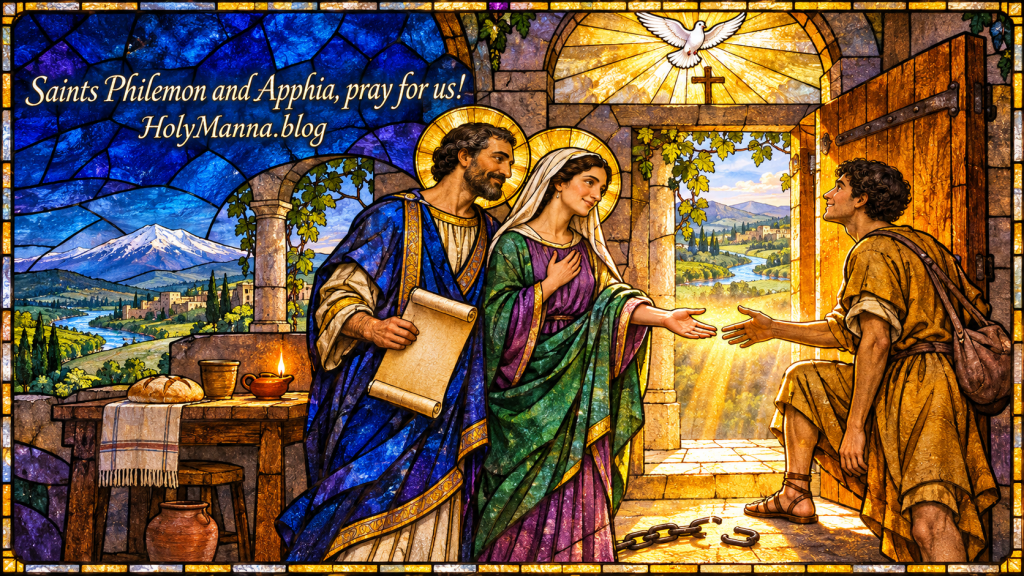
The House With an Open Door
Most saints are known through long biographies, sworn testimonies, and shelves of their own writings. Saints Philemon and Apphia are known through a single page. The Letter to Philemon is the shortest of all the letters of Saint Paul, only 25 verses long, and it was carried by hand to the front door of a married couple living in the small Phrygian city of Colossae in the middle of the 1st century. That one page has been read in Catholic churches ever since, and it has kept the names of this husband and wife alive for almost 2,000 years.
The Church honors them together on November 22nd. The current edition of The Roman Martyrology remembers Saint Philemon of Colossae as the man “whose love for Christ Jesus rejoiced Saint Paul the Apostle”, and it adds that he is venerated together with his wife, Saint Apphia. Older English texts often spell her name Appia or Apphias, and all 3 spellings refer to the same woman.
They were not monks, missionaries, or theologians. They were a lay couple with a household to run, a guest room to keep ready, and a main room that filled with Christians every time the local church gathered. Their story matters because it shows what holiness looks like inside an ordinary home. It also matters because the hardest thing they were ever asked to do is something every Christian is eventually asked to do, which is to forgive someone who truly did them wrong and then to love that person as family.
The Catechism teaches that when the Church recognizes saints, she holds them up as models and intercessors (CCC 828). Philemon and Apphia model 3 things in particular: a home that works as a little church, a mercy that costs something, and a faith strong enough to see a brother where the world saw only a slave. Honesty requires one note at the start. Nearly everything certain about this couple comes from Sacred Scripture itself, and the later accounts of how they died are presented below as traditions and are clearly marked as such.
A Comfortable Home in the Lycus Valley
Colossae sat in the valley of the Lycus River in the region of Phrygia, in what is today southwestern Türkiye, a short distance from the larger cities of Laodicea and Hierapolis. No Catholic source preserves the year of Philemon’s birth, the names of his parents, or anything about his childhood, and the same silence covers Apphia. What can be known about their background has to be read from the details of Saint Paul’s letter.
Those details say a good deal. Philemon owned a house large enough to hold the Christian assembly of his city. He had at least one slave in his household, and he was able to keep a guest room ready for travelers. The Catholic Encyclopedia describes him as a wealthy and noble citizen, and Butler’s Lives of the Saints likewise presents him as a rich man of good birth. Apphia’s name is native to Phrygia, which suggests that she was a local woman. Scripture itself calls her a sister in the faith, greeting her as “Appia, our dearest sister” (Phlm 2), and it never uses the word wife. The identification of Apphia as the wife of Philemon is an ancient reading held by Saint John Chrysostom and by Theodoret of Cyrus, and it is the reading the Church follows in The Roman Martyrology. In his first homily on the letter, Chrysostom judged that she was Philemon’s partner in life, and he noticed that Saint Paul addressed his request to the wife as well as to the husband.
A third name appears in the greeting. Paul salutes Archippus as “our fellow soldier” (Phlm 2). The Catholic Encyclopedia notes the general belief that Archippus was the son of Philemon and Apphia, although Scripture never states the relationship. He clearly held some sacred office in the region, because Paul sends him a pointed message at the end of The Letter to the Colossians: “Take heed to the ministry which thou hast received in the Lord” (Col 4:17).
Saint Paul never visited Colossae in person, a fact he mentions himself (Col 2:1). Yet he writes to Philemon as a close friend, and he drops a remark that reveals how the friendship began. Reminding Philemon of a debt far greater than money, he says, “thou owest me thy own self also” (Phlm 19). The natural meaning is that Paul himself brought Philemon to faith in Christ. The Catholic Encyclopedia judges that this most probably happened during the long ministry of the Apostle in Ephesus, the great city to the west, when the whole province of Asia heard the word of the Lord (Acts 19:10). Butler’s Lives of the Saints leaves open a second possibility, that Philemon was converted by Saint Epaphras, the disciple of Paul who first preached the Gospel in Colossae (Col 1:7). The sources do not settle the question, although the words of Paul lean strongly toward the first answer.
However it happened, the change was total. The Catechism teaches that Baptism makes the believer a new creature and an adopted child of God (CCC 1265), and the new life of this couple quickly spilled past their own threshold. Paul greets not only Philemon, Apphia, and Archippus but also “the church which is in thy house” (Phlm 2). In an age before church buildings existed, the Christians of Colossae gathered for prayer and for the breaking of the bread under this family’s roof. Saint John Chrysostom, reflecting on that greeting about 3 centuries later, concluded that “his house was altogether a lodging for the Saints”.
The Catechism observes that from the very beginning the core of the Church was often formed by those who came to believe together with their whole household, and it calls the Christian family a domestic church (CCC 1655, 1656). It adds that parents and children live out their baptismal priesthood at home in a special way, through the sacraments, prayer, and works of charity (CCC 1657). Philemon and Apphia are among the first married couples in history to whom that title can be applied quite literally. Their marriage was not a private arrangement. It was a mission base.
The Day the Letter Arrived
Paul’s opening lines show how highly he thought of this home. He calls Philemon “our beloved and fellow labourer” (Phlm 1), which means that this layman had worked actively for the Gospel. He then tells him, “I have had great joy and consolation in thy charity” (Phlm 7). The Apostle wrote those words in chains, and the generosity of one family in a small Phrygian city was a comfort to him there. The Catechism teaches that lay people share in the mission of Christ and are called to evangelize by word and by the witness of life in the ordinary circumstances of the world (CCC 904, 905). Philemon and Apphia did exactly that from their own address.
What made this couple famous, however, was not a sermon. It was a problem inside their own household. A slave named Onesimus, whose name means useful or profitable in Greek, left the house and did not come back. The letter hints that he had also wronged his master in some way, perhaps financially, since Paul writes, “if he hath wronged thee in any thing, or is in thy debt” (Phlm 18). The Catholic Encyclopedia and Butler’s Lives of the Saints both understand the situation as theft followed by flight, although the letter itself speaks conditionally.
Onesimus eventually reached Saint Paul, who was a prisoner. Catholic tradition and The Catholic Encyclopedia place this imprisonment in Rome, around the years 61 to 63, while noting that some scholars have proposed Caesarea instead. There the runaway heard the Gospel and was baptized. Paul describes him with the tenderness of a father: “my son, whom I have begotten in my bands” (Phlm 10). He even plays on the meaning of the name, saying that the man who had once been unprofitable “now is profitable both to me and thee” (Phlm 11).
Paul could have kept Onesimus at his side. He chose instead to send him home, in the company of Tychicus, carrying this letter. In The Letter to the Colossians, which traveled with the same messengers, Paul introduces Onesimus to the whole community as “a most beloved and faithful brother, who is one of you” (Col 4:9).
The scene that followed deserves a moment of imagination. The letter was not addressed to Philemon alone. It was addressed to Apphia, to Archippus, and to the whole church that met in the house, which means that it was almost certainly read aloud to the assembly. No other letter of Saint Paul names a woman in its opening address. Apphia, as the lady of the house, would likely have dealt daily with the household servants, and Paul plainly wanted her heart in this decision as much as her husband’s. Chrysostom saw a second purpose in the public greeting. In his reading, the word church reminded Philemon that servants belonged to that assembly too, because “the Church knows not the distinction of master and servant”.
The request itself is a masterpiece of Christian persuasion. Paul states that he has the authority to command, and then he declines to use it. He wants Philemon’s response to be free, “that thy good deed might not be as it were of necessity, but voluntary” (Phlm 14). This matches what The Catechism teaches about charity, which gives the Christian the freedom of a child of God, who obeys out of love and not out of fear (CCC 1828). Then comes the heart of the letter. Philemon is to receive Onesimus back “Not now as a servant, but instead of a servant, a most dear brother” (Phlm 16). Paul raises the stakes even higher with a single sentence: “If therefore thou count me a partner, receive him as myself.” (Phlm 17). Whatever is owed, he says, “put that to my account” (Phlm 18), and he signs the promise in his own handwriting. Christians have long heard in that offer an echo of the Lord Himself, who made satisfaction for sins that were not His own (CCC 615).
Paul ends with confidence, “knowing that thou wilt also do more than I say” (Phlm 21), and with a friendly request that shows how he expected to be welcomed there: “prepare me also a lodging” (Phlm 22).
No miracle worked by Philemon or Apphia during their lifetime is recorded in Scripture or in any reliable Catholic source, and none will be invented here. What the sources do record is a work of grace in a human heart, and that is exactly why this couple should be remembered and imitated. They were asked to let the Gospel rearrange the most practical corner of their lives, including their money, their household, and their social standing, and the Church has always understood that they said yes.
That yes carries enormous weight. The Catechism quotes this very letter when it teaches that the seventh commandment forbids every act that leads to the enslavement of human beings or treats them as merchandise (CCC 2414). It also teaches that every human being is made in the image of God and therefore possesses the same dignity (CCC 1934, 1935). Saint Paul put the principle in one line: “For you are all one in Christ Jesus.” (Gal 3:28). Pope Benedict XVI, writing about this letter in the encyclical Spe Salvi, explained that Baptism and a shared place in the Church made master and slave into one family, and that “even if external structures remained unaltered, this changed society from within”. The first place that change was tested was the house of Philemon and Apphia.
Scripture does not report what Philemon did next. Butler’s Lives of the Saints relates that he forgave Onesimus, gave him his freedom, and sent him back to serve Saint Paul. The fact that the letter was treasured and copied suggests that its request was honored, but the outcome itself cannot be verified. Later traditions go further. The Apostolic Constitutions, a 4th century collection, lists Onesimus as bishop of Beroea, while older editions of The Roman Martyrology make him bishop of Ephesus and a martyr at Rome. Saint Ignatius of Antioch, writing to the Ephesians in the early 2nd century, does praise their bishop Onesimus as “a man of inexpressible love”. Whether that bishop was the former slave of Philemon cannot be verified. The Church honors Saint Onesimus in his own right on February 15th.
Stones at Colossae
The documented hardship of Philemon and Apphia is the one contained in the letter, and it should not be underestimated. They were wronged inside their own home by someone they had trusted. Roman law and custom gave a master very wide power to punish a runaway, and the neighbors of this couple would have expected them to use it. Paul asked for the opposite, and he asked for it in front of the whole congregation. To welcome Onesimus as a brother meant absorbing a real loss, setting aside a legitimate grievance, and accepting whatever their pagan peers might say about it.
The Catechism is honest about how hard this is. It admits that no one can simply switch off the sting of an offense or erase the memory of it, and it teaches that a heart surrendered to the Holy Spirit is able to change the wound into compassion and into prayer for the offender (CCC 2843). It also teaches that forgiveness bears witness that “love is stronger than sin” (CCC 2844). Philemon and Apphia were asked to give that witness with the entire church of Colossae watching.
There were other pressures as well. Hosting Christian worship in a pagan city carried obvious risk. Their friend Paul was in chains, and Epaphras, the founder of their local church, is named in the letter as a fellow prisoner.
The story of their death comes from later tradition. Older editions of The Roman Martyrology place it at Colossae during the reign of the emperor Nero. According to that account, pagans celebrating a feast of the goddess Diana broke into the church while the Christians were gathered. The rest of the faithful fled, and Philemon and Apphia were seized. By order of a governor named Artocles, they were “scourged, let down into a pit up to their waist, and overwhelmed with stones”. The Greek liturgical books for November 22nd honor Philemon as a holy apostle and add that Archippus and Onesimus died with them. No miraculous escape or sign of divine protection is attached to this account.
Other traditions do not agree with one another. The Apostolic Constitutions names Philemon as bishop of Colossae, while a later list attributed to Dorotheus of Tyre makes him bishop of Gaza. Butler’s Lives of the Saints is noticeably cautious and says only that some of the Greeks hold that Philemon died a martyr. The current edition of The Roman Martyrology, revised after the Second Vatican Council, commemorates the couple without the title of martyr and without any description of their deaths. These accounts of their martyrdom and of Philemon’s episcopal office cannot be verified.
What can be said with confidence is that the Church has never doubted their fidelity. The Catechism teaches that martyrdom is the highest testimony a believer can give to the truth of the faith (CCC 2473). If the tradition is true, then the couple who opened their door to the Church closed their lives by refusing to abandon her. If it is not, they still bore the daily witness of a household that belonged entirely to Christ.
25 Verses That Outlived an Empire
No Catholic source preserves an account of a miracle worked through the intercession of Saints Philemon and Apphia after their deaths. No relics of the couple can be documented, and no shrine or established pilgrimage is dedicated to them.
One early trace of local devotion does survive. Theodoret of Cyrus, a bishop and biblical commentator of the 5th century, reported that the house of Philemon was still being pointed out at Colossae in his own day. That detail shows that the Christians of the city remembered where their church had first gathered. Whether the building shown to visitors was truly the home of Philemon and Apphia cannot be verified.
Their veneration, on the other hand, is ancient and wide. Butler’s Lives of the Saints notes that both the Latin Church and the Greek Church honor them, and November 22nd remains their day in The Roman Martyrology. Their own city has largely vanished. Colossae declined over the centuries, and its site is now a quiet mound near the town of Honaz in the Denizli province of Türkiye. For generations it was left unexcavated. A research project led by Pamukkale University began surveying the site in 2021, and excavation has followed, so the coming years may reveal more about the world in which this couple lived.
Their true monument is the letter. The Church recognizes The Letter to Philemon as inspired Scripture and lists it in the canon of the New Testament (CCC 105, 120). Saint John Chrysostom preached 3 homilies on it, and Saint Jerome wrote a commentary defending its place in the Bible against those who thought it too small and too personal to matter. The Church proclaims it at Mass on the 23rd Sunday in Ordinary Time in Year C of the Sunday cycle, and again on the Thursday of the 32nd week in Ordinary Time in Year II of the weekday cycle. Every time that happens, a congregation somewhere in the world hears a letter that was first read aloud in the home of this husband and wife.
The Catechism teaches that the saints in heaven keep praying for the Church on earth, and that their brotherly care is a real support in human weakness (CCC 956). A couple who once made room for an entire congregation can surely be asked to pray for the homes, marriages, and parishes of today.
The Welcome That Changes Everything
The lives of Saints Philemon and Apphia offer lessons that fit easily into the week ahead. The first concerns the home. Their house was a church before any church building stood in Colossae, and The Catechism still calls the family home the place where the faith is first proclaimed and where people learn to persevere, to find joy in work, to love one another, and to forgive again and again (CCC 1657, 1666). You do not need a large house to imitate them. You can pray before meals without embarrassment, keep a crucifix where guests will see it, invite a lonely parishioner to Sunday dinner, or host a rosary or a Bible study once a month. How would a visitor know that Christ is welcome in your home?
The second lesson concerns forgiveness. Philemon and Apphia had a real grievance, and Paul did not pretend otherwise. He simply asked them to let love have the last word. You can begin the same way, by naming one person who has wronged you and praying for that person by name every day this week. The Catechism promises that the Holy Spirit can turn the injury into compassion (CCC 2843). Is there someone you are still treating as a debtor instead of a brother or a sister?
The third lesson concerns the way people are seen. Paul asked this couple to look at Onesimus and see a man equal in dignity and beloved by God. The Catechism teaches that each person is to regard every neighbor, with no exceptions, as another self (CCC 1931). In practice, that means learning the name of the person who cleans the office, treating the newest employee with the same respect as the manager, and refusing to measure anyone by usefulness alone. Whom do you tend to overlook because of their job, their past, or their status?
The fourth lesson belongs to married couples in particular. Paul wrote to a husband and a wife together, and the Church venerates them together. The Catechism teaches that the grace proper to the sacrament of Matrimony strengthens spouses to grow holy together (CCC 1641). Big decisions about mercy, money, and hospitality are meant to be made side by side and on your knees. If you are married, when did you and your spouse last pray together about a hard decision?
Finally, Paul trusted that Philemon would do more than he was asked. Love does not calculate the minimum. It looks for the extra mile and walks it gladly, with resilience when the road is hard and with faith that God sees what is done in secret.
Engage With Us!
Share your thoughts and reflections in the comments below. The story of this holy couple touches marriage, family, work, and forgiveness, and your experience may be exactly what another reader needs to hear.
- Saints Philemon and Apphia turned their house into a home for the Church. What is one concrete step you could take this month to make your home more of a domestic church?
- Saint Paul asked Philemon to receive Onesimus as a beloved brother. Who in your life is hardest for you to welcome in that way, and what would a first step look like?
- Paul refused to command and chose to appeal out of love. How do you respond when God invites you to do something good without forcing you?
- Apphia is named beside her husband in the greeting of the letter. How have you seen spouses, or close friends in the faith, strengthen one another to make a difficult act of mercy?
- Paul offered to pay the debt of Onesimus out of his own pocket. When has someone taken on a cost for your sake, and how did it change you?
Saints Philemon and Apphia never preached to crowds or wrote a single line that has survived. They opened a door, they forgave a debt, and they made room at their table, and the Church is still talking about it. Go and do the same in your own home this week. Live your faith out loud, forgive generously, and do everything with the love and mercy that Jesus taught.
Saints Philemon and Apphia, pray for all of us who seek to follow Christ at home!
Follow us on YouTube, TikTok, Instagram and Facebook for more insights and reflections on living a faith-filled life.


Leave a Reply