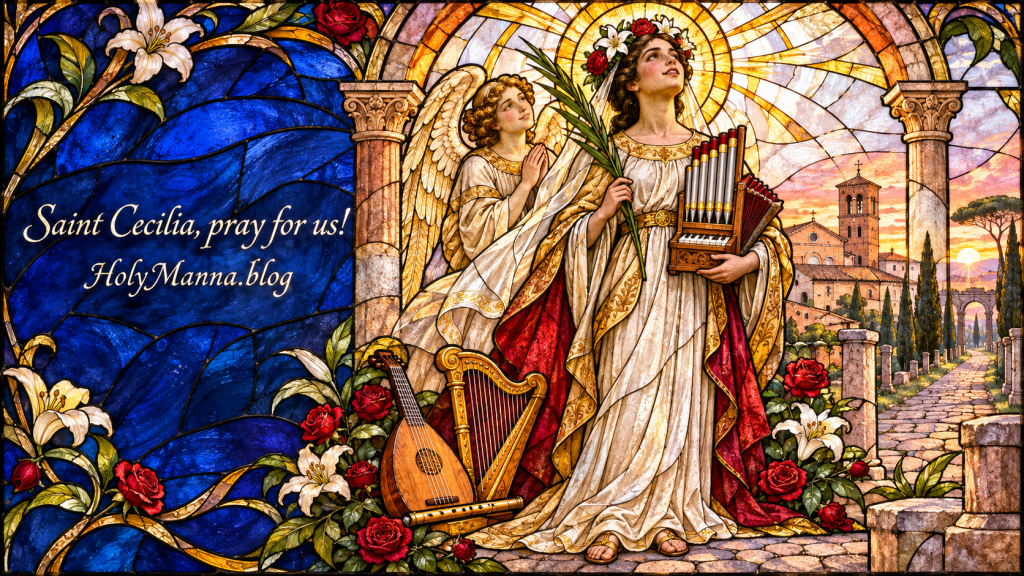
The Song No Sword Could Silence
Every time a priest prays the Roman Canon at Mass, he speaks the names of 7 women who gave their lives for Jesus Christ: Felicity, Perpetua, Agatha, Lucy, Agnes, Cecilia, and Anastasia. Saint Cecilia, Virgin and Martyr, has held her place in that prayer since the early centuries of the Church, and the faithful celebrate her memorial each year on November 22nd. She is the patroness of music, musicians, singers, and the makers of musical instruments.
Her story calls for some candor up front. The facts that history can firmly establish are few. A Christian woman named Cecilia died for the faith in Rome, and she was buried in a place of honor along the Appian Way, beside the tombs of the popes. Her feast was already being kept in the Roman Church in the 4th century, and a church bearing her name in the Trastevere district is documented in the year 499. Nearly everything else comes from the Passio Sanctae Caeciliae, an account of her martyrdom written around the middle of the 5th century, long after her death. Catholic scholars have long recognized that this text reads more like devotional literature than like a court record, so its scenes are best received as cherished tradition and not as verified history.
The Church herself models this balance. In the Collect for the memorial, she prays that “what has been devoutly handed down concerning her” may give the faithful examples to imitate. The heart of the matter is certain: she belonged entirely to Christ, and she chose death over denying Him. The Catechism calls martyrdom “the supreme witness given to the truth of the faith” (CCC 2473). The Church has always treasured the memory of such witnesses, and she calls the records of their deaths “the archives of truth written in letters of blood” (CCC 2474). Cecilia’s page in those archives has inspired Christians for well over 1,500 years.
Born to Privilege, Promised to Christ
Tradition places Cecilia’s birth in Rome, in a noble family usually identified with the Caecilii, one of the old senatorial clans of the city. Her birth year is unknown, and even the era of her life is disputed. The early writers Venantius Fortunatus and Ado of Vienne placed her death around the year 177, during the reign of Marcus Aurelius and Commodus, and the great catacomb archaeologist Giovanni Battista de Rossi considered that the most reliable view. The more familiar tradition, repeated today by Vatican News, places her martyrdom around the year 230, under Emperor Alexander Severus and during the pontificate of Pope Saint Urban I. The Catholic Encyclopedia concludes that none of these dates has been proven, and that the location of her tomb points to some time between the late 2nd century and the middle of the 3rd century.
According to the Passio, Cecilia was raised as a Christian from childhood. The tradition describes a young woman who prayed constantly, fasted often, and wore a rough garment hidden beneath the fine clothing her rank required. An ancient line of praise remembers her as “The virgin Cecilia who always carried the gospel of Christ on her breast.” Most important of all, the story says that she had privately vowed her virginity to God. The Catechism explains that from the time of the Apostles, Christian virgins have been called by the Lord “to cling only to him with greater freedom of heart, body, and spirit” (CCC 922), and it describes virginity for the sake of the Kingdom as “a powerful sign of the supremacy of the bond with Christ” (CCC 1619).
Her family had other plans. Her parents arranged her marriage to a young pagan nobleman named Valerian. Cecilia did not rebel, and she did not run away, but she did pray. The Passio gives the scene that would one day make her the patroness of music. On the wedding day, while the hired musicians filled the house with festive sound, the text says that “she sang in her heart to the Lord alone.” The words of her silent song are recorded as well: “Let my heart and my body be kept spotless, that I may not be put to shame.” That prayer echoes Psalm 119, where the psalmist prays, “May my heart be blameless in thy statutes” (Ps 119:80).
A bride stands surrounded by noise, pressure, and expectation, and her real conversation is happening where no one else can hear. These details of Cecilia’s upbringing, her vow, and her wedding day come from the Passio alone, and they cannot be verified.
An Angel, a Pair of Crowns, and a House Full of Converts
On the wedding night, the story goes, Cecilia told Valerian a secret. An angel of God was watching over her and guarding her virginity, and she asked her husband to honor the vow she had made. Valerian’s reply was remarkably reasonable for a surprised young Roman, because he simply asked to see the angel. Cecilia told him that he would see it once he believed in the one true God and was baptized. She sent him out along the Appian Way to find Pope Urban, who was living in hiding among the tombs of the martyrs.
Valerian went, he listened, he believed, and he was baptized. When he returned home, the Passio says that he found Cecilia at prayer with an angel standing beside her. The angel placed on each of their heads a crown of roses and lilies, flowers that would never wither and that only the eyes of faith could see. Valerian’s brother Tiburtius arrived soon afterward and was puzzled by the fragrance of roses and lilies filling the house out of season. Cecilia and Valerian told him everything, and Tiburtius also went to Pope Urban and received Baptism.
The story teaches truths that the Church firmly holds. The care of the angels for each person is Catholic doctrine, and The Catechism quotes Saint Basil the Great to make the point: “Beside each believer stands an angel as protector and shepherd leading him to life” (CCC 336). It is also fitting that Valerian could see the angel only after his Baptism, because The Catechism recalls that this sacrament has been called “enlightenment” since the earliest days of the Church (CCC 1216).
Both brothers refused to keep their new faith private. The tradition says that they devoted themselves to giving alms and to burying the bodies of Christians who had been executed, which was a dangerous act of love in a city where the martyrs were treated as criminals. The Catechism defines the works of mercy as “charitable actions by which we come to the aid of our neighbor” and it lists burying the dead among them (CCC 2447). Cecilia, meanwhile, turned her home into a place where the Gospel was taught. The tradition holds that Pope Urban himself came to her house to baptize those she had brought to the faith.
This is why Cecilia matters, and why she is worth imitating. She did not treat her faith as a private hobby, and she did not treat her marriage as an obstacle to holiness. She evangelized the person closest to her first, and the grace spread outward from there, to a brother-in-law, to a household, and to a neighborhood. Her story also honors both vocations at once, which is just what the Church teaches when she says that both Matrimony and virginity for the Kingdom “come from the Lord himself” (CCC 1620). The account of the angel, the crowns, and these conversions comes from the Passio, and it cannot be verified.
The Bath, the Sword, and the Final Sermon
The charity of Valerian and Tiburtius drew the attention of the prefect of the city, whom the Passio names Turcius Almachius. The brothers were arrested and ordered to offer sacrifice to Jupiter, and they refused. The tradition says that Cecilia strengthened them at dawn on the day of their execution with words that became part of the ancient Office for her feast: “Soldiers of Christ, cast away the works of darkness and put on the armor of light.” Her cry echoes Saint Paul, who wrote to the Christians of her own city, “cast off the works of darkness and put on the armor of light” (Rom 13:12).
Both brothers were beheaded. The officer assigned to lead them to their deaths, a man named Maximus, was so moved by their peace that he became a Christian himself, and the story adds that a vision at the hour of their death confirmed his faith. He professed Christ openly and was killed as well. Cecilia saw to the burial of all 3 martyrs.
Then the prefect came for her. The Passio describes a trial in which Almachius tried to reason with her and then to frighten her, and Cecilia answered him with calm courage and refused to sacrifice to idols. Cecilia’s steadiness is a portrait of the cardinal virtue of fortitude, the virtue that The Catechism says ensures “firmness in difficulties and constancy in the pursuit of the good” (CCC 1808).
The prefect sentenced her to die in her own home. He ordered her to be shut inside the bath of the house, with the furnace stoked far beyond its normal heat, so that she would suffocate in the steam. The story says that she remained there for a day and a night and came out unharmed. Almachius then sent an executioner to behead her. The man struck her neck 3 times and failed to sever her head. Roman law did not permit a 4th stroke, so he fled and left her bleeding on the floor.
According to the tradition, Cecilia lived for 3 more days. Christians crowded into the house, and she spent the time the way she had spent the rest of her life. She encouraged the people she had brought to the faith, she gave her possessions to the poor, and she entrusted her household to Pope Urban. Her final request to him, as the tradition preserves it, was a gift: “I also bequeath to you this house in which I have lived.” She wanted her home to become a church. One telling adds that when she could no longer speak, she confessed the Holy Trinity with her hands, extending 3 fingers on one hand and 1 finger on the other.
Then she died, and Pope Urban and his deacons buried her in the Catacomb of Saint Callistus, close to the crypt where the popes of the 3rd century were laid to rest. In the 19th century, de Rossi identified the Crypt of Saint Cecilia directly beside the Crypt of the Popes, with an empty niche that most likely once held her sarcophagus.
The martyrdom of Cecilia shows what the Lord meant when He said, “Be faithful unto death, and I will give you the crown of life” (Rev 2:10). She did not seek death, and she did not fear it either, because the Church teaches that “Because of Christ, Christian death has a positive meaning” (CCC 1010). The particular details of the trial, the bath, the 3 blows, and the 3 days come from the Passio, and they cannot be verified. The martyrdom itself, and the honor in which the Roman Church has held her since antiquity, have never been seriously doubted.
A Saint Found Sleeping and a World Set Singing
The Church of Rome never forgot her. Her feast appears in the Martyrologium Hieronymianum, the oldest surviving martyrology of the Western Church, and a Roman sacramentary compiled near the end of the 5th century contains 5 different Masses in her honor. The church in Trastevere that carries her name appears in the records of a Roman council in 499, and tradition holds that it stands over her family home.
The first great story after her death belongs to Pope Saint Paschal I. Around the year 821, although some sources say 822, Paschal was rebuilding her church and wished to bring her relics there. He feared that the Lombards had carried them off during their siege of Rome decades earlier. According to the Liber Pontificalis, the ancient book of papal biographies, Paschal fell asleep during a vigil at Saint Peter’s, and Cecilia appeared to him. She assured him that the invaders had never found her body, and she urged him to keep searching. He searched again, and he found her. The account says that she was clothed in a robe woven with gold, with linen cloths stained by her blood folded at her feet. The same source places the discovery in the neighboring Catacomb of Praetextatus, although tradition says she was buried in the Catacomb of Callistus, and that discrepancy has never been resolved. Paschal carried her relics into the city and placed them beneath the high altar of his new basilica, together with those of Valerian, Tiburtius, Maximus, and Popes Urban and Lucius. The apse mosaic that he commissioned still glitters above that altar today. The translation of the relics is a matter of historical record, but the vision that led to it cannot be verified.
The second story is even more famous. In 1599, Cardinal Paolo Emilio Sfondrati was restoring the basilica in preparation for the Jubilee of 1600. On October 20th, according to most accounts, although some give October 22nd, the space beneath the high altar was opened and the sarcophagi that Paschal had placed there came to light. Inside a coffin of cypress wood lay the body of a young woman on her right side, dressed in a garment threaded with gold, like someone who had fallen asleep. Pope Clement VIII sent the historian Cardinal Caesar Baronius to examine the discovery, and the archaeologist Antonio Bosio recorded it in detail. The witnesses reported that the body was intact. Out of reverence, they did not remove the thin silk veil that covered her, and Baronius wrote that the coverings, “when pressed down, showed the position and posture of the body.” For about a month, crowds filled Trastevere to pray before her, and on November 22nd, 1599, Pope Clement VIII came to the basilica for her solemn reburial.
Cardinal Sfondrati commissioned a young sculptor named Stefano Maderno to carve what had been seen. The white marble statue that Maderno finished in 1600 still lies beneath the high altar, and it ranks among the most moving works of sacred art in Rome. The inscription that accompanies it, written in the cardinal’s name, declares that the statue shows the saint “whom I myself saw lying incorrupt in the tomb.” The eyewitness testimony of 1599 is well documented. Because the veil was never lifted, and because the tomb has not been opened for examination since, the full extent of the preservation of her body cannot be verified.
The Catechism includes the veneration of relics, visits to sanctuaries, and pilgrimages among the expressions of piety that surround the sacramental life of the Church (CCC 1674). It also teaches that the saints in heaven “do not cease to intercede with the Father for us” (CCC 956).
Pilgrims can still walk through her story. Beneath the Basilica of Santa Cecilia in Trastevere lie the excavated remains of Roman houses from the imperial era, and a side chapel preserves what tradition identifies as the bath where she was condemned to die. The Benedictine nuns who care for the basilica guard a medieval masterpiece in their choir, the fresco of the Last Judgment painted by Pietro Cavallini. By long custom these nuns receive the lambs blessed on the feast of Saint Agnes, and from the wool they weave the pallia that the Pope gives to new metropolitan archbishops. Out on the Appian Way, visitors to the Catacombs of Saint Callistus can pray in the Crypt of Saint Cecilia, where a copy of Maderno’s statue rests in the place her body once lay. Far from Rome, the great brick cathedral of Albi in southern France is dedicated to her.
Then there is the music. Nothing in the earliest sources connects Cecilia with musical skill. The link grew from that single line about her wedding day, which the Church sang for centuries as an antiphon on her feast. Over time, the words about the instruments playing seem to have been heard as though Cecilia herself were the musician, and from the 14th and 15th centuries artists began to paint her with an organ. Raphael’s celebrated altarpiece, The Ecstasy of Saint Cecilia, painted around 1514 for a church in Bologna, shows her holding a small organ with silent instruments scattered at her feet. When Pope Sixtus V established a congregation of musicians in Rome in 1585, a date that some older references give as 1584, it was placed under her patronage, and it survives today as the Accademia Nazionale di Santa Cecilia. Purcell, Handel, and Gounod composed works in her honor, and Chaucer retold her story in The Canterbury Tales. Pope Saint Pius X signed his landmark instruction on sacred music on November 22nd, 1903, her feast day. In Mexico, where November 22nd is kept as the Day of the Musician, mariachis gather each year in Plaza Garibaldi in Mexico City to serenade their patroness, attend Mass, and walk in pilgrimage to the Basilica of Our Lady of Guadalupe.
What may have begun as a misreading of an antiphon turned out to be a gift, because it tied a martyr’s hidden prayer to a great treasure of the Church. The Catechism, quoting the Second Vatican Council, teaches that the musical tradition of the Church is “a treasure of inestimable value, greater even than that of any other art” (CCC 1156).
Singing in the Heart When the World Is Loud
Cecilia’s wedding day looks a lot like ordinary life. The music is loud, the schedule belongs to other people, and everyone has an opinion about who you should be. Her answer was to keep a place inside herself where only God was allowed to speak. The Catechism describes that place in words worth memorizing: “The heart is the dwelling-place where I am, where I live” (CCC 2563). Saint Paul urges every Christian to be “singing and making melody to the Lord with all your heart” (Eph 5:19). You do not need a trained voice for this kind of song, and you do not need a quiet house. You can begin with a single line of a psalm repeated on the drive to work, a decade of the Rosary prayed while washing dishes, or 5 minutes of silence before the phone comes out in the morning. When was the last time you gave God your full attention in the middle of a noisy day?
The Church reads a homily of Saint Augustine in the Liturgy of the Hours on Cecilia’s memorial, and it fits her perfectly. Augustine explains that the deepest praise of God goes beyond words, and he concludes, “This is singing well to God, just singing with songs of joy.” If you already sing at Mass, sing as a prayer and not as a performance, because The Catechism repeats the ancient saying, “He who sings prays twice” (CCC 1156).
Cecilia also shows where evangelization begins. She did not start with strangers. She started with her husband, then her brother-in-law, and then the people who came through her front door. The Catechism teaches that a disciple must not only keep the faith but also “profess it, confidently bear witness to it, and spread it” (CCC 1816). For most people, that witness happens at a kitchen table, in a group chat, or across a desk at work. It rarely requires a speech. It usually requires patience, clarity about what you believe, and a life that makes the faith look as joyful as it is. Who is the Valerian in your life, the person close to you who is waiting for a sincere invitation to meet Christ?
Her last act was to give away her house so that it could become a church. Your home can become one as well, in the way the Church intends for every Christian family. The Catechism calls the home “the first school of Christian life” (CCC 1657). A crucifix on the wall, grace before meals, a shared prayer before bed, and a door that opens to people in need all turn an ordinary address into holy ground. What would a guest learn about your faith after spending 1 evening in your home?
Finally, Cecilia teaches purity of heart and courage, 2 virtues that the surrounding culture rarely applauds. Jesus promised, “Blessed are the pure in heart, for they shall see God” (Mt 5:8), and Cecilia’s whole prayer was to keep her heart and body for Him. Whatever your state in life, you can ask for the same grace by guarding what you watch, honoring the dignity of every person, and returning to Confession whenever you fall. Courage will be needed as well, because The Catechism is plain that “The way of perfection passes by way of the Cross” (CCC 2015). Your pressures may be social and not physical, but the choice is the one Cecilia faced. Where is God asking you to stand firm this week, even if it costs you someone’s approval?
Engage With Us!
Readers are warmly invited to share their thoughts and reflections in the comments below. Your own experience may be exactly what another reader needs to hear today.
- Cecilia sang to the Lord in her heart while the world around her was loud. What practical step can you take this week to protect a few minutes of interior silence each day?
- Valerian came to faith because someone he loved told him the truth. Who first shared the faith with you, and how might you thank that person or pray for that person today?
- Cecilia gave her home to the Church. In what concrete way could your home become a more welcoming place of prayer and hospitality?
- Sacred music is a treasure of the Church. Is there a hymn or chant that has drawn you closer to God, and what does it stir in you?
- Cecilia stood before the prefect without wavering. Where do you feel pressure to hide or soften your faith, and what would courage look like there?
Saint Cecilia never needed a stage. She had a heart fixed on Christ, and that was enough to change a household, a city, and eventually the music of the whole Church. Ask her to pray for you, and then let your own life become a song of praise. Live your faith with joy, stand firm when it is tested, and do everything with the love and mercy that Jesus taught.
Saint Cecilia, pray for us!
Follow us on YouTube, TikTok, Instagram and Facebook for more insights and reflections on living a faith-filled life.


Leave a Reply