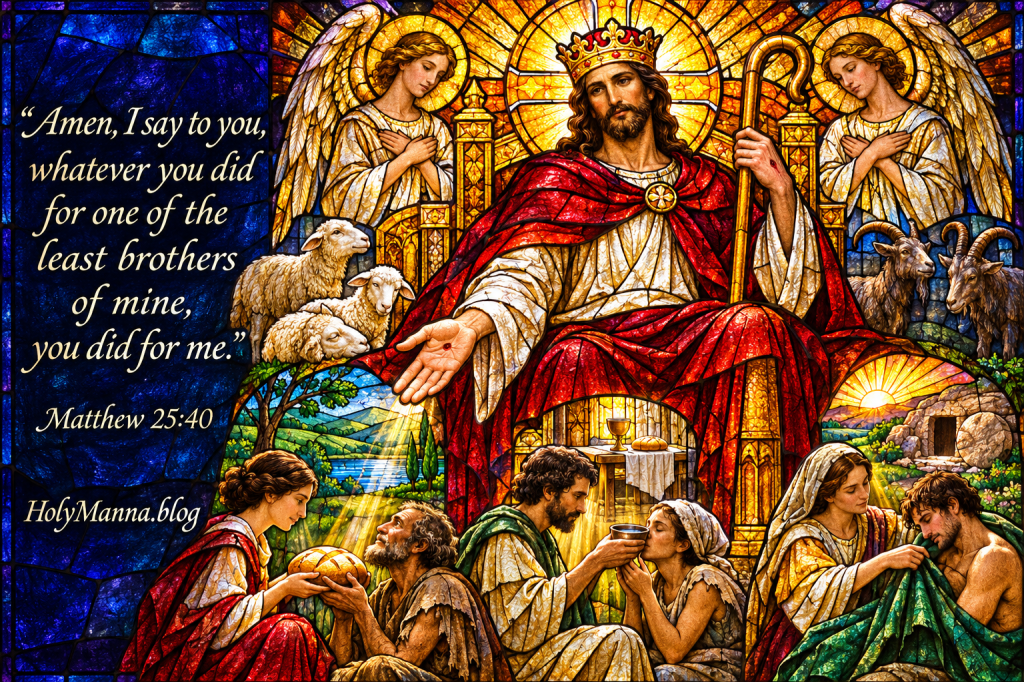
The Solemnity of Our Lord Jesus Christ, King of the Universe – Lectionary: 160
The King Who Carries a Shepherd’s Staff
Every kingdom eventually reveals what kind of king sits on its throne, and the last Sunday of the liturgical year reveals a King unlike any other. On November 22nd, 2026, the Church celebrates the Solemnity of Our Lord Jesus Christ, King of the Universe, and all 4 readings tell one story. The King of the Universe rules as a shepherd, and He will judge the world by love.
The feast itself is young. Pope Pius XI established it on December 11th, 1925, in the encyclical Quas Primas, during the 1600th anniversary year of the Council of Nicaea. Europe was still wounded from the First World War, and aggressively secular regimes were rising in Russia, in Mexico, and beyond. The Pope’s diagnosis was simple, and he wrote that “Men must look for the peace of Christ in the Kingdom of Christ.” The feast was first kept on the last Sunday of October. The calendar reform promulgated by Pope Saint Paul VI in 1969 moved it to the final Sunday of the liturgical year and expanded its title to Our Lord Jesus Christ, King of the Universe, so that the whole year now ends at the foot of His throne.
The readings paint the portrait in 4 strokes. In The Book of Ezekiel, God promises to shepherd His scattered flock in person. In Psalm 23, the sheep sing about that Shepherd’s care. In The First Letter to the Corinthians, Saint Paul shows the risen King conquering every enemy, including death. In The Gospel of Matthew, the Shepherd takes His seat as Judge and asks about the hungry, the stranger, and the sick. In Jesus Christ, royal power and tender mercy turn out to be the same thing.
First Reading — Ezekiel 34:11-12, 15-17
God Dismisses the Bad Shepherds and Takes the Job Himself
Ezekiel was a priest who was carried off to Babylon in 597 BC, and he received his prophetic call there among the exiles. Chapter 34 comes after the worst possible news has arrived, because Jerusalem and its Temple have fallen. In the ancient Near East, the word shepherd was a common title for a king, and the first 10 verses of the chapter are a blistering indictment of Israel’s rulers, who fed themselves and let the flock scatter. Then comes the turn. God does not merely promise better management. He announces that He will do the shepherding in person. On the Solemnity of Christ the King, this reading supplies the King’s job description, and it quietly sets the stage for the sheep and goats of the Gospel.
Ezekiel 34:11-12, 15-17
Thus says the Lord GOD:
I myself will look after and tend my sheep.
As a shepherd tends his flock
when he finds himself among his scattered sheep,
so will I tend my sheep.
I will rescue them from every place where they were scattered
when it was cloudy and dark.
I myself will pasture my sheep;
I myself will give them rest, says the Lord GOD.
The lost I will seek out,
the strayed I will bring back,
the injured I will bind up,
the sick I will heal,
but the sleek and the strong I will destroy,
shepherding them rightly.As for you, my sheep, says the Lord GOD,
I will judge between one sheep and another,
between rams and goats.
Detailed Exegesis
Verse 11: “Thus says the Lord GOD: I myself will look after and tend my sheep.”
The key words are “I myself.” After generations of failed kings, God refuses to delegate the care of His people any longer. Christians hear in this promise an early whisper of the Incarnation, because the God who speaks here is the same Lord who later stood in Judea and said, “I am the good shepherd. A good shepherd lays down his life for the sheep” (John 10:11). The possessive matters as well. The sheep never stopped being His, even in exile.
Verse 12: “As a shepherd tends his flock when he finds himself among his scattered sheep, so will I tend my sheep. I will rescue them from every place where they were scattered when it was cloudy and dark.”
The shepherd in this image stands “among” his scattered sheep and does not shout directions from a distance. The “cloudy and dark” day points first to the catastrophe of 587 BC, when Jerusalem fell, and the prophets use similar language for the day of the Lord’s judgment. No place of exile lies beyond His reach. For the Church, this verse describes the whole mission of Christ, who entered the darkness of a fallen world to gather the children of God into one flock.
Verse 15: “I myself will pasture my sheep; I myself will give them rest, says the Lord GOD.”
The phrase “I myself” sounds twice more, like a king signing his name to a decree. Pasture and rest are exactly what the selfish shepherds withheld. The Lord promises food and sabbath peace, and the Church recognizes both gifts in the Eucharist and in the eternal rest of heaven. The Catechism describes the Church as a sheepfold, “the sole and necessary gateway to which is Christ” (CCC 754).
Verse 16: “The lost I will seek out, the strayed I will bring back, the injured I will bind up, the sick I will heal, but the sleek and the strong I will destroy, shepherding them rightly.”
Here 4 verbs of mercy answer 4 kinds of misery, and each one reverses a failure named earlier in the chapter. The hard line follows. “The sleek and the strong” are the powerful who grew fat at the expense of the weak. The Hebrew text, which the NABRE follows, says that God will “destroy” them, while the ancient Greek Septuagint and the Latin Vulgate read instead that He will watch over them. In either reading the final phrase governs the meaning, because the Lord shepherds “rightly,” which is to say with justice. Mercy for the wounded and judgment for the oppressor are 2 sides of the same love.
Verse 17: “As for you, my sheep, says the Lord GOD, I will judge between one sheep and another, between rams and goats.”
The indictment now moves from the leaders to the flock itself. Membership in the flock is not a guarantee. God sees how the sheep treat one another, and He will sort them. Jesus takes up this exact image in Matthew 25, where the Shepherd King separates sheep from goats according to how they treated the weakest members of the flock.
Teachings
God kept this promise in a way that no exile could have predicted. A few verses later the Lord adds, “I will appoint one shepherd over them to pasture them, my servant David” (Ezekiel 34:23). King David had been dead for roughly 4 centuries, so the promise looks forward to the Son of David. In Jesus the 2 promises meet, because He is both God shepherding in person and the Davidic King.
Saint Augustine preached a long sermon on this chapter to the people of Hippo, known as Sermon 46 or On Pastors. He spoke as a bishop who knew that he would answer to Christ for his flock. He took the Lord’s words as his own marching orders and declared, “I shall recall the straying; I shall seek the lost.” The Church has never lowered that standard, and she still reads portions of this sermon each year in the Liturgy of the Hours. Every bishop and priest shares in the work of the one Shepherd, and in a real way so does every parent, catechist, and friend.
Reflection
This reading asks 2 honest questions. The first is about being a sheep. Where are you lost, strayed, injured, or sick right now? The Lord’s verbs are aimed at exactly those places, and the confessional is where He most often binds up wounds. The second question is about being a shepherd, because everyone has a small flock. It may be children, employees, students, younger siblings, or a circle of friends that looks to you. A concrete step this week is to name 1 person in your care who has drifted from the faith and to reach out with a phone call, a meal, or an invitation to Mass. Another step is to examine the areas of life where personal comfort has come at somebody else’s expense. Who in your flock has wandered, and what would it look like to go after that person the way God came after you? Do you use whatever strength you have to feed others, or mostly to feed yourself?
Responsorial Psalm — Psalm 23:1-3, 5-6
The Song of the Sheep Who Trust Their King
Psalm 23 is attributed to David, the shepherd boy of Bethlehem who became king, and it may be the most beloved prayer in the whole Bible. Its place in today’s Mass is deliberate. Ezekiel has just heard God promise to pasture His sheep and give them rest, and the psalm lets the flock answer. The early Church loved this psalm for another reason. Fathers such as Saint Cyril of Jerusalem and Saint Ambrose taught the newly baptized to hear in it the sacraments they had just received at Easter, because water, oil, a table, and a cup all appear in order. The Lectionary uses verses 1 to 3 and verses 5 to 6 today.
Psalm 23:1-3, 5-6
R. (1) The Lord is my shepherd; there is nothing I shall want.
The LORD is my shepherd; I shall not want.
In verdant pastures he gives me repose.
R. The Lord is my shepherd; there is nothing I shall want.
Beside restful waters he leads me;
he refreshes my soul.
He guides me in right paths
for his name’s sake.
R. The Lord is my shepherd; there is nothing I shall want.
You spread the table before me
in the sight of my foes;
you anoint my head with oil;
my cup overflows.
R. The Lord is my shepherd; there is nothing I shall want.
Only goodness and kindness follow me
all the days of my life;
and I shall dwell in the house of the LORD
for years to come.
R. The Lord is my shepherd; there is nothing I shall want.
Detailed Exegesis
Verse 1: “The LORD is my shepherd; I shall not want.”
A king calls God his shepherd, which means that even the ruler is a sheep. The verse does not promise that a believer will receive everything wished for. It promises that nothing truly necessary will be missing for the one who belongs to God. Saint Augustine heard the whole Church praying this line to Jesus and wrote, “The Lord Jesus Christ is my Shepherd, and I shall lack nothing.”
Verse 2: “In verdant pastures he gives me repose. Beside restful waters he leads me;”
In the dry hill country of Judea, green grass and calm water were hard to find, and a flock reached them only by following its shepherd. The Fathers read these waters as Baptism. Augustine explains, “By the water of baptism, whereby they are refreshed who have lost health and strength, has He brought me up.”
Verse 3: “he refreshes my soul. He guides me in right paths for his name’s sake.”
The Shepherd restores life and then gives direction. The “right paths” are the ways of righteousness, which means the moral life lived in friendship with God. He does this “for his name’s sake,” because His own faithfulness is at stake. Augustine adds that God leads the soul “not for my merit’s sake, but for His Name’s sake.” Grace always comes first.
Verse 5: “You spread the table before me in the sight of my foes; you anoint my head with oil; my cup overflows.”
The image shifts from the pasture to the palace. The Shepherd becomes a royal Host who seats His guest at table while enemies can only watch. Anointing a guest’s head with oil was a gesture of honor and gladness in the ancient world. Christians cannot hear of a table, oil, and a cup without thinking of the altar, the sacred chrism, and the chalice. This verse makes the psalm a perfect fit for Christ the King, because here the sheep are treated like royalty.
Verse 6: “Only goodness and kindness follow me all the days of my life; and I shall dwell in the house of the LORD for years to come.”
The Hebrew verb translated “follow” is a strong one, and it can also mean to pursue. Enemies once chased the psalmist, and now God’s goodness and covenant mercy do the chasing. The destination is the Lord’s house, which meant the sanctuary in Israel and ultimately means heaven. Augustine comments, “Now Your mercy shall follow me not here only, but also that I may dwell in the house of the Lord for ever.”
Teachings
Saint Cyril of Jerusalem, a Doctor of the Church, is the traditional author of a famous set of lectures preached to the newly baptized in Jerusalem during the 4th century. The lecture on the Eucharist turns to verse 5 and asks, “When the man says to God, You have prepared before me a table, what other does he indicate but that mystical and spiritual Table, which God has prepared for us over against, that is, contrary and in opposition to the evil spirits?” Of the oil the same lecture says, “With oil He anointed your head upon your forehead, for the seal which you have of God.” For Cyril, the psalm is a map of Christian initiation that moves from Baptism to Confirmation to the Eucharist.
The Catechism echoes this reading when it explains the anointing of Confirmation, where oil is called “a sign of abundance and joy” (CCC 1293).
The psalm also looks ahead to the end of the story. The Book of Revelation shows the Shepherd enthroned: “For the Lamb who is in the center of the throne will shepherd them and lead them to springs of life-giving water” (Revelation 7:17). The Shepherd of Psalm 23 and the King on the throne are the same Lord.
Reflection
Praying this psalm slowly is one of the simplest ways to let Christ reign in an anxious heart. Try praying it each morning this week before picking up a phone, and pause at the words “I shall not want.” What are you afraid of lacking right now, and have you actually told the Shepherd about it? The table of verse 5 is set at every Mass, so a second step is to arrive a few minutes early next Sunday and thank God for the Baptism, Confirmation, and Eucharist that made you part of His flock. A third step is to look back over the past year and write down 3 moments when goodness and kindness were clearly following you. Do you treat Sunday Mass as a royal banquet prepared for you personally, or as an obligation to get through? Where has God’s mercy been pursuing you, even when you were not looking for it?
Second Reading — 1 Corinthians 15:20-26, 28
The Risen King and the Death of Death
Saint Paul wrote to the Christians of Corinth from Ephesus in the mid 50s AD. Corinth was a wealthy Greek port city, and many Greeks found the idea of a bodily resurrection embarrassing. Some members of the community were even saying that there is no resurrection of the dead. Chapter 15 is Paul’s answer, and it is the fullest teaching on the resurrection in the New Testament. The passage chosen for today presents the Kingship of Christ as a campaign already underway. The King has risen, He reigns now, and He will not stop until every enemy, even death, is defeated and all creation is handed back to the Father.
1 Corinthians 15:20-26, 28
Brothers and sisters:
Christ has been raised from the dead,
the firstfruits of those who have fallen asleep.
For since death came through man,
the resurrection of the dead came also through man.
For just as in Adam all die,
so too in Christ shall all be brought to life,
but each one in proper order:
Christ the firstfruits;
then, at his coming, those who belong to Christ;
then comes the end,
when he hands over the kingdom to his God and Father,
when he has destroyed every sovereignty
and every authority and power.
For he must reign until he has put all his enemies under his feet.
The last enemy to be destroyed is death.
When everything is subjected to him,
then the Son himself will also be subjected
to the one who subjected everything to him,
so that God may be all in all.
Detailed Exegesis
Verse 20: “Christ has been raised from the dead, the firstfruits of those who have fallen asleep.”
The word “firstfruits” comes from Israel’s worship. The first sheaf of the harvest was offered to God as a pledge that the rest would follow (Leviticus 23:10-11). Christ’s Resurrection is that first sheaf. Saint John Chrysostom draws the conclusion: “But if their first-fruits, then themselves also, must needs rise again.” Paul also calls death a sleep, because for those who belong to Christ it is temporary.
Verse 21: “For since death came through man, the resurrection of the dead came also through man.”
The remedy matches the wound. Death entered through a human being, so God chose to defeat it through a human being. This is why the Incarnation matters so much. Chrysostom puts it memorably when he says that “the nature which was cast down must itself also gain the victory.”
Verse 22: “For just as in Adam all die, so too in Christ shall all be brought to life,”
Paul sees 2 heads of the human family. Everyone is born into Adam’s family and inherits mortality. Those united to Christ by faith and Baptism receive His life. The Catechism states plainly, “Death is a consequence of sin” (CCC 1008), and Christ is God’s answer to both.
Verse 23: “but each one in proper order: Christ the firstfruits; then, at his coming, those who belong to Christ;”
The Greek word for “order” is a military term for a rank of troops. The King rises first, and His people will rise at His “coming,” a word that was used for the arrival of a king. The Church lives between those 2 moments.
Verse 24: “then comes the end, when he hands over the kingdom to his God and Father, when he has destroyed every sovereignty and every authority and power.”
“The end” means the goal of history and not merely its last page. The sovereignty, authority, and power named here are the forces opposed to God, especially the fallen spiritual powers. Christ conquers in order to give, and He presents a redeemed creation to His Father.
Verse 25: “For he must reign until he has put all his enemies under his feet.”
Paul is echoing Psalm 110:1, the royal psalm quoted more often than any other in the New Testament. The word “must” is important. Christ’s reign is happening now, from the Father’s right hand and through His Church. The Catechism says, “Jesus Christ is Lord: he possesses all power in heaven and on earth” (CCC 668).
Verse 26: “The last enemy to be destroyed is death.”
Death is pictured as a tyrant, the last holdout against the King. Easter morning was the decisive battle, and the general resurrection will be the final surrender. Chrysostom explains the timing: “Virtually then indeed it is even now abolished: but actually, at that time.”
Verse 28: “When everything is subjected to him, then the Son himself will also be subjected to the one who subjected everything to him, so that God may be all in all.”
This verse has puzzled many readers, and the Arians of the 4th century twisted it to claim that the Son is less than the Father. The Fathers answered firmly. The Son is equal to the Father in divinity, and the subjection describes the obedient love of the Son, who as man and as Head of His Body brings all creation home to the Father. Chrysostom insists that Paul speaks this way “not as though the Son were without power.” The goal is breathtaking. God will be “all in all,” filling everything with His presence.
Teachings
The Catechism teaches that Christ’s Resurrection is “the principle and source of our future resurrection” (CCC 655). It also describes the finish line in the same words that Paul uses: “God will then be ‘all in all’” (CCC 1060).
Saint Augustine ends his great work The City of God by meditating on this very verse: “This, too, is the right interpretation of the saying of the apostle, ‘That God may be all in all.’ He shall be the end of our desires who shall be seen without end, loved without cloy, praised without weariness.” Heaven is not boredom on a cloud. It is the satisfaction of every desire in God Himself.
Pope Pius XI applied the present reign of Christ to everyday life in Quas Primas: “He must reign in our minds, which should assent with perfect submission and firm belief to revealed truths and to the doctrines of Christ. He must reign in our wills, which should obey the laws and precepts of God. He must reign in our hearts, which should spurn natural desires and love God above all things, and cleave to him alone.” The Kingship of Christ is cosmic, and it is also intensely personal.
Reflection
This reading speaks directly to anyone who has stood at a graveside. Death is real, and it is an enemy, yet it is a defeated enemy whose days are numbered. November is the month when the Church prays especially for the dead, so a concrete step this week is to visit a cemetery or have a Mass offered for a loved one, and to pray there with hope. Another step is to take the test of Pope Pius XI and ask where Christ actually reigns. Does He reign in your mind, or do the news cycle and the social media feed set your beliefs? Does He reign in your will when obedience costs something? A simple habit is to begin each day with a short act of surrender that asks Jesus to reign in you that day. Which enemy in your life, whether a habit of sin, a fear, or a grudge, still needs to be placed under the feet of Christ the King? How would your daily choices change if you truly believed that your body will rise?
Holy Gospel — Matthew 25:31-46
The King’s Only Question at the End of the World
These are the closing words of the final discourse of Jesus in The Gospel of Matthew, spoken on the Mount of Olives only days before His Passion. After 3 parables about readiness, Jesus describes the Last Judgment itself. The title “Son of Man” reaches back to the prophet Daniel, who saw “One like a son of man” coming on the clouds to receive everlasting kingship (Daniel 7:13). The Shepherd promised by Ezekiel now sits as King and Judge, and the measure of His judgment is mercy.
Matthew 25:31-46
Jesus said to his disciples:
“When the Son of Man comes in his glory,
and all the angels with him,
he will sit upon his glorious throne,
and all the nations will be assembled before him.
And he will separate them one from another,
as a shepherd separates the sheep from the goats.
He will place the sheep on his right and the goats on his left.
Then the king will say to those on his right,
‘Come, you who are blessed by my Father.
Inherit the kingdom prepared for you from the foundation of the world.
For I was hungry and you gave me food,
I was thirsty and you gave me drink,
a stranger and you welcomed me,
naked and you clothed me,
ill and you cared for me,
in prison and you visited me.’
Then the righteous will answer him and say,
‘Lord, when did we see you hungry and feed you,
or thirsty and give you drink?
When did we see you a stranger and welcome you,
or naked and clothe you?
When did we see you ill or in prison, and visit you?’
And the king will say to them in reply,
‘Amen, I say to you, whatever you did
for one of the least brothers of mine, you did for me.’
Then he will say to those on his left,
‘Depart from me, you accursed,
into the eternal fire prepared for the devil and his angels.
For I was hungry and you gave me no food,
I was thirsty and you gave me no drink,
a stranger and you gave me no welcome,
naked and you gave me no clothing,
ill and in prison, and you did not care for me.’
Then they will answer and say,
‘Lord, when did we see you hungry or thirsty
or a stranger or naked or ill or in prison,
and not minister to your needs?’
He will answer them, ‘Amen, I say to you,
what you did not do for one of these least ones,
you did not do for me.’
And these will go off to eternal punishment,
but the righteous to eternal life.”
Detailed Exegesis
Verse 31: “When the Son of Man comes in his glory, and all the angels with him, he will sit upon his glorious throne,”
The One who will soon wear a crown of thorns speaks calmly about His throne. Saint John Chrysostom marks the contrast: “For now is He come in dishonor, now in affronts and reproaches; but then shall He sit upon the throne of His glory.”
Verse 32: “and all the nations will be assembled before him. And he will separate them one from another, as a shepherd separates the sheep from the goats.”
Verse 33: “He will place the sheep on his right and the goats on his left.”
Nobody is exempt, because “all the nations” stand before Him. Sheep and goats often grazed together by day and were separated at evening, and history works the same way. Chrysostom observes, “For now they are not separated, but all mingled together, but the division then shall be made with all exactness.”
Verse 34: “Then the king will say to those on his right, ‘Come, you who are blessed by my Father. Inherit the kingdom prepared for you from the foundation of the world.”
Jesus now calls Himself “the king” outright. The kingdom is an inheritance, which means that it is a gift given to children and not wages paid to employees. Chrysostom savors the word: “And He said not, Take, but, ‘Inherit,’ as one’s own, as your Father’s, as yours, as due to you from the first.”
Verse 35: “For I was hungry and you gave me food, I was thirsty and you gave me drink, a stranger and you welcomed me,”
Verse 36: “naked and you clothed me, ill and you cared for me, in prison and you visited me.’”
Here are 6 of the corporal works of mercy. None of them requires wealth, education, or special talent. Chrysostom notes, “And mark how easy are His injunctions.” The King does not ask that the sick be cured or that prisoners be freed. He asks for presence.
Verse 37: “Then the righteous will answer him and say, ‘Lord, when did we see you hungry and feed you, or thirsty and give you drink?”
Verse 38: “When did we see you a stranger and welcome you, or naked and clothe you?”
Verse 39: “When did we see you ill or in prison, and visit you?’”
The righteous are surprised. They were not keeping score or performing for a reward, because mercy had become second nature to them. Real holiness forgets itself.
Verse 40: “And the king will say to them in reply, ‘Amen, I say to you, whatever you did for one of the least brothers of mine, you did for me.’”
The King identifies Himself so closely with the lowly that mercy shown to them lands on Him. The Catechism teaches that Jesus “makes active love toward them the condition for entering his kingdom” (CCC 544).
Verse 41: “Then he will say to those on his left, ‘Depart from me, you accursed, into the eternal fire prepared for the devil and his angels.”
The kingdom was “prepared for you,” while the fire was “prepared for the devil and his angels.” Hell was never designed for human beings. Chrysostom hears the King explain, “I, says He, prepared the kingdom for you, but the fire no more for you, but ‘for the devil and his angels.’”
Verse 42: “For I was hungry and you gave me no food, I was thirsty and you gave me no drink,”
Verse 43: “a stranger and you gave me no welcome, naked and you gave me no clothing, ill and in prison, and you did not care for me.’”
The charge sheet lists no murders, thefts, or blasphemies. Every item is a sin of omission, which is why Catholics confess at Mass both what they have done and what they have failed to do.
Verse 44: “Then they will answer and say, ‘Lord, when did we see you hungry or thirsty or a stranger or naked or ill or in prison, and not minister to your needs?’”
Verse 45: “He will answer them, ‘Amen, I say to you, what you did not do for one of these least ones, you did not do for me.’”
They still call Him “Lord,” and they would gladly have served Him if He had appeared in glory. They never recognized Him in disguise.
Verse 46: “And these will go off to eternal punishment, but the righteous to eternal life.”
The same word, “eternal,” describes both destinies. The Church takes the Lord at His word, and the Catechism defines hell as “definitive self-exclusion from communion with God and the blessed” (CCC 1033). Nobody arrives there except by a free and final refusal of love.
Teachings
Heaven is never earned apart from grace. The works of mercy are the fruit of a living faith, and the Catechism defines them as “charitable actions by which we come to the aid of our neighbor” (CCC 2447). Saint John of the Cross summed up the whole scene in a single line: “At the evening of life, we shall be judged on our love” (CCC 1022).
Saint Augustine imagined the King explaining Himself on that day, in words the Catechism preserves: “If you gave anything to my members, what you gave would reach their Head” (CCC 1039). Saint John Chrysostom tied this Gospel to the altar: “Would you do honor to Christ’s body? Neglect Him not when naked; do not while here you honor Him with silken garments, neglect Him perishing without of cold and nakedness.” The Catechism makes the same connection: “The Eucharist commits us to the poor” (CCC 1397).
Reflection
The final exam has been published in advance, and it has 6 questions. A practical response is to choose 1 work of mercy and schedule it before Advent begins. That could mean serving at a parish food pantry, bringing a meal to a new mother, visiting a nursing home, or writing to someone in prison. Begin close to home, because the “least ones” often live under your own roof or sit at the next desk. Add sins of omission to your examination of conscience before your next Confession. Who is the hungry, lonely, sick, or forgotten person you pass every week without really seeing? If the King asked you today when you last fed Him or visited Him, what specific moment could you name?
Long Live Christ the King
The liturgical year ends the way every human life will end, with a person standing before a King. The story told today began in the ruins of Jerusalem, where God looked at a scattered flock and said that He would shepherd it Himself. It continued in the song of a shepherd boy turned king, who discovered that he was a sheep with a table set for him. It reached its turning point on Easter morning, when the firstfruits rose from the tomb and death began to lose its grip. It will reach its final chapter when the Son of Man takes His throne and asks every person about the hungry, the stranger, and the sick.
Blessed Miguel Agustín Pro understood that story. On November 23rd, 1927, the Jesuit priest stood before a firing squad in Mexico City after ministering in secret to his persecuted flock. He stretched out his arms in the form of a cross, and his last words were “Viva Cristo Rey!” That cry means “Long live Christ the King!” His King was worth dying for, because his King had first died for him.
The invitation this week is to let that King reign in earnest. His reign begins wherever a believer kneels in the confessional, receives Him at the altar, and then goes looking for Him in someone who is hungry, lonely, or forgotten. Advent begins in 7 days. There is no better way to close one year of grace and open another than to say with the whole Church, and to prove with works of mercy, that Jesus Christ is King.
Engage With Us!
Share your reflections in the comments below. The whole community grows when readers tell how the Word of God is working in their lives.
- In Ezekiel 34:11-12, 15-17, God promises to seek the lost, bring back the strayed, bind up the injured, and heal the sick. Which of those 4 promises do you most need Him to keep in your life right now, and who in your own flock needs you to go looking?
- In Psalm 23:1-3, 5-6, the Shepherd spreads a table and fills the cup to overflowing. How has the Lord provided for you this past year in ways that you did not expect?
- In 1 Corinthians 15:20-26, 28, Saint Paul says that Christ must reign until every enemy is under His feet. Which part of your mind, will, or heart still resists His reign?
- In Matthew 25:31-46, the King identifies Himself with the least of His brothers and sisters. Which work of mercy is He asking you to carry out before Advent begins, and for whom?
- All 4 readings reveal a King who rules by shepherding and judges by love. What would change in your home, your work, and your parish if Jesus Christ were truly King of every part of your life?
May these readings send you into the final week of the liturgical year with courage and joy. Live a life of faith, stay close to the sacraments, and do everything with the love and mercy that Jesus taught, so that you may one day hear the King say, “Come, you who are blessed by my Father.”
Sacred Heart of Jesus, we trust in You!
Immaculate Heart of Mary, pray for us!
Saint Michael the Archangel, defend us in battle!
Follow us on YouTube, TikTok, Instagram and Facebook for more insights and reflections on living a faith-filled life.


Leave a Reply