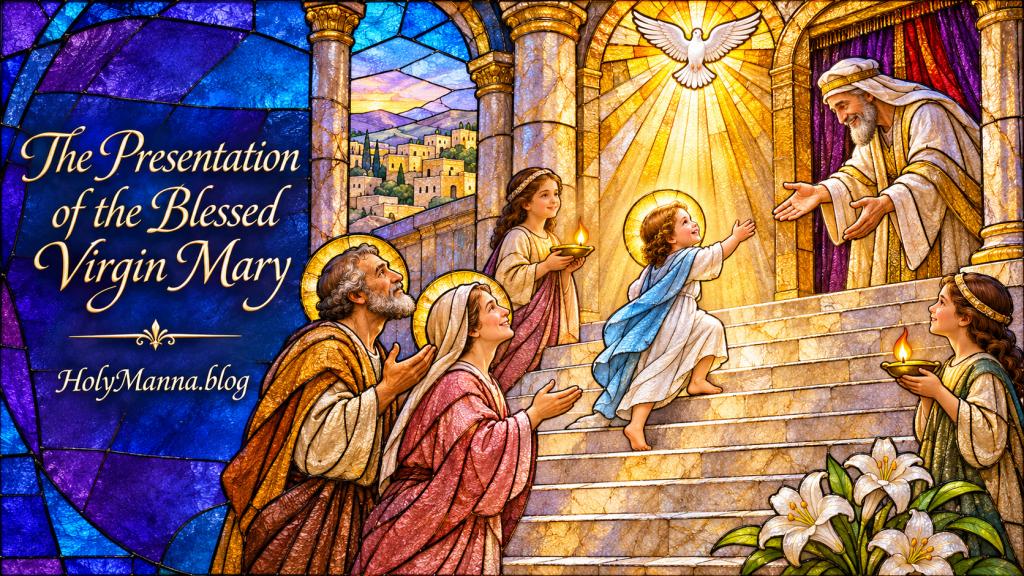
The Little Girl on the Temple Steps
Every year on November 21st, the Church stops to look at a scene that no Gospel records. A little girl climbs the steps of the Temple in Jerusalem, and her grateful parents hand her life back to the God who gave it. This is the Memorial of the Presentation of the Blessed Virgin Mary, an obligatory memorial on the General Roman Calendar that arrives in the last days of Ordinary Time, just before Advent begins.
The Church is refreshingly honest about this day. The story of Mary’s childhood in the Temple comes from ancient Christian writings that are not part of the Bible, and the liturgy never pretends otherwise. What the Church actually celebrates is the truth underneath the story. The introduction to the day in the Liturgy of the Hours explains that the memorial honors the gift of herself that Mary made to God from her earliest childhood, moved by the Holy Spirit who had filled her with grace from her Immaculate Conception. The feast is about belonging. Long before the angel Gabriel arrived in Nazareth, Mary already belonged entirely to the Lord.
That is why this quiet day sits so close to the heart of Marian devotion. The Catechism of the Catholic Church teaches that everything the Church believes about Mary flows from what she believes about Christ, and that Marian teaching in turn sheds light on faith in Christ (CCC 487). A child given to God in the Temple points straight ahead to the Child who would later be carried in her womb.
The memorial also reaches deep into the life of the Church today. It joins East and West, since Byzantine Christians keep the same mystery as a major feast. It is the day the Church sets aside to pray for cloistered monks and nuns, the men and women who spend their whole lives doing what the feast describes. It is even the anniversary of the great Marian teaching of the Second Vatican Council. A small memorial turns out to hold a very large invitation.
From an Ancient Story to the Roman Calendar
The story itself comes from a 2nd-century writing called the Protoevangelium of James, which historians date before the year 200. It is an apocryphal text, which means the Church did not receive it into the canon of Scripture, the complete list of inspired books (CCC 120). It is also the source of the names Joachim and Anne for the parents of Mary, names that appear nowhere in the Bible. Everything in the next paragraph is therefore a pious tradition and not established history.
According to the story, Joachim and Anne were childless for many years, and Anne promised that any child granted to her would be given to the Lord. When Mary was 3 years old, her parents brought her to the Temple, escorted by young girls carrying lamps so that the child would not look back. The priest welcomed her with a blessing, declaring that the Lord had “magnified your name in all generations.” He set her on the 3rd step of the altar, where the little girl danced for joy, and the story says that all the people took her to their hearts. The account adds that she lived in the Temple until the age of 12 and was fed by an angel. The same tradition appears in 2 later apocryphal writings, the Gospel of Pseudo-Matthew and the Gospel of the Nativity of Mary. None of these details can be verified, and the Church does not teach them as facts of history.
The feast grew out of this tradition in the Christian East. The Catholic Encyclopedia suggests that it probably began in Syria, the homeland of these writings. Its date is tied to a real building. On November 21st, 543, a great church known as Saint Mary the New, built by the Emperor Justinian I, was dedicated in Jerusalem near the ruins of the Temple. The basilica did not last, and the Marian Library at the University of Dayton reports that the Persians destroyed it within a century. The feast outlived the stones. A Greek liturgical poem for the day survives from the 7th or 8th century, and by the 11th century the celebration appears in Byzantine calendars such as the Menology of Basil II. In 1166, the Emperor Manuel Comnenus recognized it as a full festival on which the law courts did not sit. Saint Germanus of Constantinople and Saint John Damascene are remembered among the Fathers who celebrated Mary’s entrance into the Temple.
The West took much longer. Vatican News notes that monasteries in Italy were keeping the feast in the 9th century. The decisive push came from Philippe de Mézières, a French nobleman and chancellor to the King of Cyprus, who had come to love the celebration in the East. He brought it to the papal court at Avignon under Pope Gregory XI, where it was celebrated before the cardinals in 1372, according to the Catholic Encyclopedia. Other sources give 1373 for Avignon, so the exact year should be held loosely. From there the feast spread to Paris, Metz, and Cologne.
Rome followed in stages. Pope Sixtus IV placed the feast in the Roman Breviary, an act usually dated to 1472. Pope Saint Pius V removed it during his reform of the calendar in 1568, and Pope Sixtus V restored it on September 1st, 1585. It has stayed ever since. The reformed calendar of 1969 lists it as a memorial, which is the rank it holds today.
What Scripture and Tradition Actually Say
A plain statement belongs at the start of this section. No apparition of the Blessed Virgin is connected with this memorial, so there is no visionary, no message, and no Church investigation to report. The apocryphal story is not a private revelation either. The Catechism explains that private revelations, even those recognized by the authority of the Church, do not belong to the deposit of faith (CCC 67), and the Protoevangelium does not even fall into that category. It is simply an old devotional writing. The Presentation stands on different ground, which is the witness of Scripture about who Mary is and the long memory of the praying Church.
Scripture offers a striking pattern for the story. Hannah, long childless, brought her small son Samuel to the sanctuary and said, “Now I, in turn, give him to the LORD” (1 Samuel 1:28). The tradition about Joachim and Anne is told in that same key, and Butler’s Lives of the Saints observes that devout Jewish parents did at times offer their children to God in the Temple. The Gospel then shows the grown woman such a childhood would produce. When Gabriel brings her the news of the Incarnation, she answers, “May it be done to me according to your word” (Luke 1:38). A yes like that does not come out of nowhere. The memorial invites the faithful to see it as the fruit of a lifetime of smaller yeses.
The readings that the Lectionary provides for the memorial make the point without ever mentioning the story. The prophet cries out, “Sing and rejoice, daughter Zion! Now, I am coming to dwell in your midst” (Zechariah 2:14). The Church hears those words fulfilled in Mary, in whom the Lord truly came to dwell. In the Gospel, Jesus points to his disciples and says that “whoever does the will of my heavenly Father” is his brother, sister, and mother (Matthew 12:50). That can sound like a slight against Mary. Saint Augustine, whose sermon the Church reads in the Liturgy of the Hours on this day, says it is the opposite. Mary did the will of the Father perfectly, and so, in his words, “she was more blessed in her discipleship than in her motherhood.”
The Fathers of the East loved to linger over the image of the child in the sanctuary. Saint John Damascene, a Doctor of the Church, writes in An Exposition of the Orthodox Faith that Mary was brought to the Temple and, “planted in the House of God and increased by the Spirit,” grew into a dwelling place of every virtue. Centuries later Saint Alphonsus Liguori, another Doctor of the Church, preached in The Glories of Mary that her offering of herself was “prompt, without delay; entire, without reserve.” Neither saint claims to prove the historical details. Both are after the same thing, which is the portrait of a heart that held nothing back from God. In that portrait the Church recognizes Mary as mother, intercessor, and model of faith, the earliest and best disciple of her own Son.
The Living Temple
The deepest meaning of the day is found in a single image. The Temple of stone was the place where God chose to dwell among his people, and Mary became the living temple in whom he dwelt in the flesh. The Catechism presents her as the crowning work of the joint mission of the Son and the Holy Spirit, and it teaches that the Spirit prepared her by grace so that the Father found in her a dwelling place for his Son (CCC 721, 722). Reflecting on the greeting of the angel, it sees in her the daughter of Zion and the true ark of the covenant, where the glory of God has come to rest (CCC 2676).
This is where the memorial touches the great Marian doctrines. The preparation of that living temple began at the very start of her existence. God enriched Mary with gifts suited to her mission, and the Church confesses in the dogma of the Immaculate Conception, defined by Blessed Pius IX in 1854, that she was redeemed from the moment of her conception (CCC 490, 491). The Eastern Fathers call her the All-Holy, and by the grace of God she remained free from personal sin throughout her life (CCC 493). A reflection on the feast published by the Vatican City State notes that the Eastern Churches saw in the Presentation the same total openness to the Spirit that the West later celebrated in the Immaculate Conception.
The feast points toward the other dogmas as well. The One she bore is the eternal Son of God, which is why she is truly Mother of God (CCC 495). Her perpetual virginity is presented by the Catechism as the sign of her faith and of her undivided gift of herself to God (CCC 499, 506). The temple God prepared on earth was not abandoned at the end, since she was taken up body and soul into heaven (CCC 966).
The Second Vatican Council gathered these threads in chapter 8 of Lumen Gentium, which was promulgated on November 21st, 1964, the very day of this memorial. The Council calls Mary “the beloved daughter of the Father and the temple of the Holy Spirit” (Lumen Gentium 53), and it teaches that she gave herself entirely, as the handmaid of the Lord, to the person and work of her Son (Lumen Gentium 56). She is a figure of the Church (Lumen Gentium 63), her model of faith and charity (CCC 967), and a mother to believers in the order of grace (CCC 968). On that same November day, Pope Saint Paul VI proclaimed her Mother of the Church, a title the Catechism takes up in its own teaching (CCC 963).
Later popes kept returning to the memorial. In Marialis Cultus, issued on February 2nd, 1974, Pope Saint Paul VI named November 21st among the celebrations that, apocryphal elements aside, “present lofty and exemplary values” and continue ancient traditions that arose in the East (Marialis Cultus 8). Pope Saint John Paul II, in the encyclical Redemptoris Mater of March 25th, 1987, wrote that at the Annunciation Mary “entrusted herself to God completely” (Redemptoris Mater 13), which is exactly the disposition this feast places at the beginning of her story. The Catechism agrees that she is the most perfect example of the obedience of faith and that her trust held firm to the end (CCC 148, 149). It even gives the feast its best summary when it describes her prayer as the desire “to be wholly God’s, because he is wholly ours” (CCC 2617).
Cloisters, Vows, and Pilgrim Roads
Devotion on this day has taken a shape all its own. Since 1953, by the wish of Venerable Pius XII, the Church has kept November 21st as Pro Orantibus Day, a Latin name for a day dedicated to those who pray. It is a day of gratitude and support for cloistered and contemplative communities. Pope Benedict XVI, speaking at the Angelus on November 19th, 2006, invited the faithful to thank the Lord for the many people in monasteries and hermitages who give themselves entirely to prayer, and he pointed to Mary in her Presentation “as Mother and model of the Church.” Pope Francis asked in his 2018 message for the day, “What would become of the Church without the contemplative life?” Pope Leo XIV renewed the appeal at his general audience on November 19th, 2025, asking the whole Church to support those who consecrate their lives to prayer. The Catechism explains why this matters, since consecrated men and women who give their lives to prayer praise God and intercede for everyone else (CCC 2687).
Religious families have also made the day their own. Saint Francis de Sales chose it as the day on which the Sisters of the Visitation renew their vows each year, a custom that Visitation monasteries still keep. Father Jean-Jacques Olier, founder of the Society of Saint-Sulpice, made the Presentation the principal feast of his seminary, and Sulpician priests renew the promises of their ordination on this day. Whole congregations carry the name. In 1775, in Cork, Ireland, Venerable Nano Nagle founded the community that became the Sisters of the Presentation of the Blessed Virgin Mary. On November 21st, 1796, in the middle of the French Revolution, Saint Anne-Marie Rivier and 4 companions consecrated themselves to God in the village of Thueyts and began the Sisters of the Presentation of Mary. Pope Francis canonized her on May 15th, 2022.
The day draws pilgrims too. In Venice the faithful walk to the Basilica of Santa Maria della Salute, and in Ecuador they walk through the night to the National Marian Shrine of El Quinche. The Catechism teaches that such expressions of popular piety extend the liturgical life of the Church without replacing it (CCC 1674, 1675), and that pilgrimages call to mind the earthly journey toward heaven (CCC 2691). Like all Marian devotion, these practices belong to authentic Christian worship while remaining essentially different from the adoration given to God alone (CCC 971). The intercession of Mary takes nothing away from the unique mediation of Christ and depends on it entirely (CCC 970). These customs nourish faith precisely because they lead the pilgrim through the Mother to the Son.
Candles in Venice, Footsteps in the Andes
The feast looks different depending on where a person stands on the map. In the Byzantine tradition it is called the Entrance of the Most Holy Mother of God into the Temple, and it ranks among the 12 great feasts of the year. The Catholic Encyclopedia records that the Greeks kept it for 5 days. Pope Saint John Paul II, at the Angelus on November 21st, 1999, called it “one of the most beloved feasts of the Eastern tradition” and noted that the West has celebrated it since the 14th century.
In Venice, November 21st is the feast of the Madonna della Salute, which means Mary of Health. In 1630 a terrible plague was emptying the city. According to Vatican News, on October 22nd, 1630, the Doge vowed to build a church in honor of the Virgin if Venice were spared, and the Patriarch of Venice has recalled that the Senate of the Republic established a public pilgrimage of thanksgiving for every year to come. The great basilica rose at the mouth of the Grand Canal. Vatican News gives November 28th, 1687, for its inauguration, though other sources give different days. Venetians still keep the promise. Each November a temporary votive bridge is laid across the Grand Canal, families cross it to light candles before the Mother of God, and the Patriarch celebrates a solemn Mass. This devotion honors a vow and an answered prayer, not an apparition.
Half a world away, the people of Ecuador honor Mary under the title of the Presentation at El Quinche, near Quito. The shrine holds a cedar image of the Virgin carved in 1586 by the sculptor Diego de Robles. The image was crowned in 1943, and Vatican Radio reports that the present shrine was built in 1928 and proclaimed the National Marian Sanctuary in 1985. The Vatican Information Service reported in 2015 that more than 800,000 pilgrims set out each November on a night pilgrimage from the village of Calderón and reach the church at dawn. Pope Francis visited on July 8th, 2015, and the text prepared for his meeting with clergy and religious says, “In the Presentation of the Virgin we find some suggestions for our own call.” That text also recalls the traditional images of the feast, in which the child Mary climbs the Temple steps without looking back.
Artists have loved that same image for centuries. Giotto painted the scene in the Scrovegni Chapel in Padua around 1305, and Titian gave Venice a famous version of it in the 16th century. In paint, in candlelight, and in the tired feet of pilgrims, Mary under this title has taught whole peoples that faith is something a person walks toward.
Bringing Your Own Life to the Temple Steps
The lesson of this memorial is simple enough to fit on a sticky note and deep enough to fill a lifetime. Belong to God completely, and start now. Mary did not wait until she was grown, accomplished, or certain of the future. The tradition pictures her climbing toward God as a small child, and the Gospel shows where that road led.
You were given to God once already. Baptism made you a new creation, an adopted child of the Father, and a temple of the Holy Spirit (CCC 1265). Saint Paul presses the point home when he writes, “your body is a temple of the holy Spirit within you” (1 Corinthians 6:19). The Presentation is a good day to say yes to that gift again on purpose. A short morning offering works well, something as plain as telling the Lord that the day, the work, the worries, and the people in it all belong to him.
Parents and godparents can take a cue from Joachim and Anne. The Catechism teaches that parents are the first ones responsible for bringing up their children and that handing on the faith should begin in the earliest years of a child (CCC 2223, 2226). Blessing a child at bedtime, praying a decade of the Rosary in the car, or bringing little ones to Mass even when it is hard are modern ways of walking a child up the Temple steps.
The hidden years of Mary also teach resilience. Nothing about her early life looked important, yet God was building a dwelling place for his Son. If your days feel small or stuck, this feast says that hidden faithfulness is never wasted. Venetians facing a plague and a young French woman facing a revolution both answered fear by entrusting themselves to God through Mary, and their answers are still bearing fruit centuries later.
Finally, let the day turn you outward in compassion. Pray by name for a cloistered community near you, and consider sending a note or a gift, since those hidden men and women are already praying for you. Then set aside 10 quiet minutes with the Gospel and ask for the grace to listen the way Mary listened. The Collect of the Mass gives you the words when your own run out, asking through her intercession “that we, too, may merit to receive from the fullness of your grace.”
Engage With Us!
Share your thoughts and reflections in the comments below, because your story may be exactly what another reader needs to hear today.
- Where in your life is God inviting you to give yourself more promptly and more completely, the way Mary did?
- Who first brought you to God, and how can you thank that person or pray for that person this week?
- What would change if you treated your body, your home, and your daily schedule as a temple where God dwells?
- Is there a cloistered or contemplative community that you could support with prayer, a letter, or a gift?
- Which hidden, ordinary part of your day could become an offering to the Lord?
Keep walking, even when the steps feel steep. A life of faith is built the way the life of Mary was built, with a faithful yes repeated day after day, and no yes offered to God is ever lost. May all who read these words grow together in faith under the guidance of the Blessed Mother, who still leads her children by the hand to her Son.
Blessed Virgin Mary, pray for us!
Follow us on YouTube, TikTok, Instagram and Facebook for more insights and reflections on living a faith-filled life.


Leave a Reply