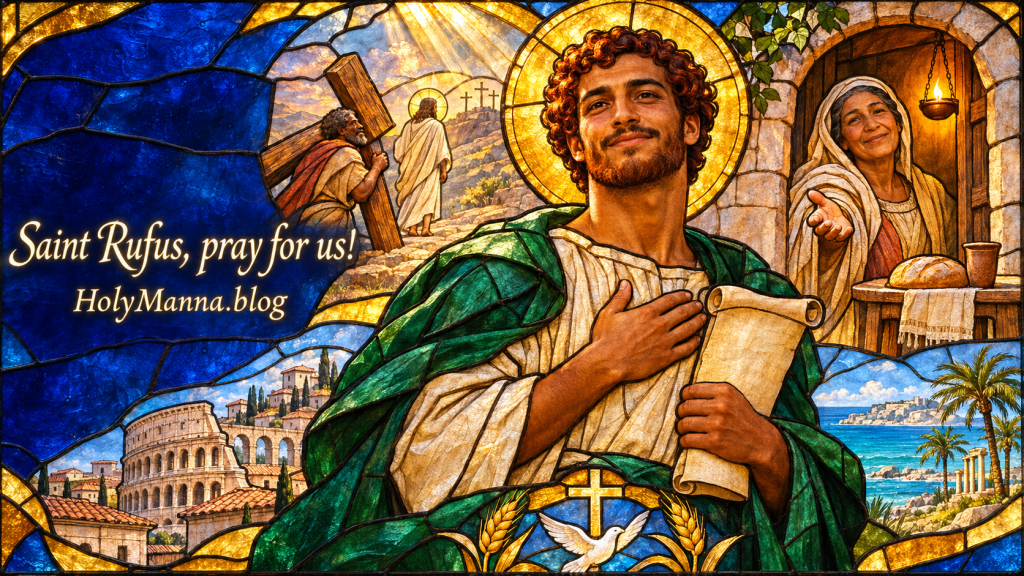
Chosen in the Lord
Saint Rufus is remembered by the Church on November 21st, and nearly everything known about him fits inside a single line of Scripture. Near the end of The Letter to the Romans, Saint Paul works through a long list of greetings and writes, “Salute Rufus, elect in the Lord, and his mother and mine” (Romans 16:13). There is no sermon from Rufus, no account of his death, and no catalogue of wonders worked by his hands. There is a name, a title of honor, and a mother whom the greatest missionary in Christian history claimed as his own.
That alone would make him worth knowing, but Scripture seems to say more. The Gospel of Mark also mentions a Rufus, and it does so at the most solemn moment in human history. As Jesus is led out to be crucified, Mark writes, “And they forced one Simon a Cyrenian, who passed by coming out of the country, the father of Alexander and of Rufus, to take up his cross” (Mark 15:21). Catholic tradition and scholarship have long judged it probable that these 2 men named Rufus are the same person. If that reading is right, the Rufus greeted in Rome grew up as the son of the man who carried the Cross of Christ.
The Roman Martyrology, the Church’s official catalogue of her saints, keeps his memory with striking restraint. An older edition reads, “The same day, the birthday of blessed Rufus, mentioned by the apostle St. Paul in his epistle to the Romans.” In the language of that book, a saint’s birthday is the day of entry into eternal life. The current edition commemorates him simply as the one whom Saint Paul calls “chosen in the Lord.” His commemoration falls on the same day as the Memorial of the Presentation of the Blessed Virgin Mary, which takes precedence in the liturgy, so his name often passes unnoticed.
Rufus is revered as a disciple of the Apostles and a member of the first generation of Christians in Rome. In holding up the saints as models and intercessors, the Church recognizes the Spirit of holiness at work within her and strengthens the hope of believers (CCC 828). Rufus strengthens that hope in a particular way, because his greatness was almost entirely unseen.
A Family from Cyrene on the Road to Calvary
No ancient source records where or when Rufus was born. What Scripture provides instead is a family. His father, Simon, came from Cyrene, a Greek city on the coast of North Africa in what is now Libya. Cyrene was home to a large Jewish community with strong ties to Jerusalem. On the day of Pentecost the crowd included pilgrims from “the parts of Libya about Cyrene” (Acts 2:10), and Jerusalem had a synagogue associated with “the Cyrenians” (Acts 6:9). Simon was therefore most likely a Jew of the diaspora who had come to the Holy City, either as a Passover pilgrim or as a settled resident. The names in the household tell their own story. Simon is a Hebrew name, Alexander is a Greek name, and Rufus is a Latin name that means red or red-haired. This was a family at home in 3 cultures at once.
Then came the Friday that changed everything. The Gospel of Matthew records, “And going out, they found a man of Cyrene, named Simon: him they forced to take up his cross” (Matthew 27:32). The Gospel of Luke adds that the soldiers “laid the cross on him to carry after Jesus” (Luke 23:26). Simon did not volunteer for this task. He was coming in from the countryside, and all 3 of these Gospels agree that the soldiers compelled him. A man with his own plans for the day found a condemned stranger’s cross laid across his shoulders.
Only Mark stops to name Simon’s sons, and that detail is the key to the story of Rufus. The Catholic Encyclopedia gives the reasoning that Catholic scholars have long followed. Saint Mark composed his Gospel for the Christians of Rome, so a Rufus named in passing for Roman readers is probably the same Rufus whom Saint Paul greets in his letter to Rome. Mark names the brothers the way a person mentions mutual friends. His first readers knew Alexander and Rufus personally, and through them they knew that the man who carried the Cross was a real father with a real family.
Cardinal Joseph Ratzinger drew out the meaning of this detail in the meditations he wrote for the Way of the Cross at the Colosseum on Good Friday of 2005, only weeks before his election as Pope Benedict XVI. He pointed out that the Evangelist would hardly have named the sons unless his readers already knew them as fellow believers, and he concluded, “From this chance encounter, faith was born.”
No one recorded the moment when Rufus himself first believed. Scripture does not say whether he was a boy in the crowd that day or whether he first heard the story years later at his father’s table. What can be said is where the faith of this household began. It began under the weight of the wood. The Catechism teaches that Christ calls His disciples to take up their cross and follow Him, because He wishes to draw into His own saving sacrifice the very people it was offered to save (CCC 618). Simon did with his body what every Christian is asked to do with his whole life. The Lord had said it plainly: “If any man will come after me, let him deny himself and take up his cross daily and follow me” (Luke 9:23).
The deepening of that faith in Rufus most likely happened at home. The Catechism teaches that parents are the first to announce the faith to their children, by word and by example (CCC 1656), and that this formation should begin in the earliest years of a child’s life (CCC 2226). Rufus appears to have received exactly that. Before he inherited anything else from his father, he inherited a story about a road, a cross, and the face of Jesus.
The Root Agrees with the Fruit
Saint Paul wrote to the Romans around A.D. 57 or 58, before he had ever set foot in the city. His final chapter greets 24 believers by name, including Prisca and Aquila, in whose home a congregation gathered, for Paul salutes “the church which is in their house” (Romans 16:5). Rufus belonged to this first generation of Roman Christians, whose faith, Paul says, was “spoken of in the whole world” (Romans 1:8).
Within that list Rufus receives a description given to no one else: “elect in the Lord.” Every baptized person is chosen by God, as Paul teaches when he writes that the Father “chose us in him before the foundation of the world, that we should be holy and unspotted in his sight in charity” (Ephesians 1:4). Applied to one man in particular, the phrase points to something more. It marks Rufus as a believer of outstanding quality, a choice disciple whose holiness was visible to those around him.
Saint John Chrysostom, preaching on this verse in the 4th century, heard the whole household praised in it. He said, “Here again the good things are without any drawback, since the son and the mother are each of such a character, and the house is full of blessing, and the root agrees with the fruit; for he would not have simply said, ‘his mother and mine,’ unless he had been bearing testimony to the woman for great virtue.” Chrysostom also explained why Paul took the trouble to praise so many ordinary believers by name: “Wherefore to lead them all to greater emulation, he keeps no man’s encomiums concealed.” The list of greetings was meant to make holiness contagious.
The words “his mother and mine” open a window onto the heart of the Apostle. At some point, in some city that Scripture does not name, this woman cared for Paul the way a mother cares for a son. Paul had left everything for the Gospel, and Jesus had promised that those who did so would receive “an hundred times as much, now in this time: houses and brethren and sisters and mothers and children and lands, with persecutions” (Mark 10:30). The mother of Rufus was part of that hundredfold. The Catechism teaches that to become a disciple of Jesus is to accept a place in the family of God (CCC 2233), and that from the beginning the core of the Church was often formed by entire households who came to believe together (CCC 1655). The home of Rufus was one of those households, and its door was open.
Scripture and reliable history record no miracles worked by Saint Rufus during his lifetime. The only wonder stories attached to his name come from a later apocryphal writing called the Acts of Peter and Andrew. In that story, Rufus and his brother Alexander travel with Saint Peter, Saint Andrew, and Saint Matthias toward a hostile city, and they join in praying a blessing over a farmer’s freshly sown field. This writing is not Scripture, the Church has never treated it as history, and the story cannot be verified.
The true marvel in his life is quieter. The Catechism describes grace as a free gift, a help from God that no one earns, given so that people can answer His call (CCC 1996). An interruption on a road outside Jerusalem became, by grace, the making of a Christian family, and that family became a home for an Apostle. Rufus matters because he shows what The Catechism means when it teaches that every Christian, in every state of life, is called to holiness in its fullness (CCC 2013). He was not one of the 12 Apostles, and nothing suggests that he ever wrote a word. He was simply faithful, and the Holy Spirit saw to it that his name was written down.
A Hard City in Which to Be Chosen
Saint Rufus is not honored as a martyr. The Roman Martyrology gives him a simple commemoration and attaches no title of martyrdom to his name, and no trustworthy account of his death has survived. He should not be confused with the martyr Saint Rufus who is honored on December 18th with Saint Zosimus. The hardships of the Rufus of November 21st have to be read from the world in which he lived.
The family story began in humiliation. Carrying a condemned man’s cross through a hostile festival crowd was a disgrace, and Simon was forced into it without warning. A household that treasured that memory had already learned that following Jesus could cost a person his plans, his reputation, and his comfort.
Rome added its own trials. Less than a decade before Paul wrote his letter, the Emperor Claudius had driven the Jewish community out of the capital. Saint Luke mentions it when he introduces Aquila and Priscilla, who had left Italy “because that Claudius had commanded all Jews to depart from Rome” (Acts 18:2). Scripture does not say whether Rufus and his mother were living in Rome at that time. As believers of Jewish background, however, they belonged to a community that knew how quickly an imperial decree could empty a neighborhood.
Worse trials were on the way. In A.D. 64, roughly 6 or 7 years after Paul’s greeting reached Rome, a great fire destroyed much of the city, and the Emperor Nero turned on the Christians. Many believers in Rome were put to death with terrible cruelty, and Catholic tradition holds that Saint Peter and Saint Paul both gave their lives in Rome under this same emperor. No source says whether Rufus was still alive, whether he died in that persecution, or whether he survived it.
What is certain is that he was among the first people on earth to hear these words read aloud in the Christian assembly: “Who then shall separate us from the love of Christ? Shall tribulation? Or distress? Or famine? Or nakedness? Or danger? Or persecution? Or the sword?” (Romans 8:35). The letter that greeted him by name also told him and his neighbors that they were “joint heirs with Christ: yet so, if we suffer with him, that we may be also glorified with him” (Romans 8:17). For the son of Simon of Cyrene, suffering with Christ was not an abstraction. It was the family inheritance.
The Catechism offers the surest key to his endurance: “The way of perfection passes by way of the Cross” (CCC 2015). It adds that holiness always involves self-denial and spiritual combat. The Catechism also teaches that it is not enough for a disciple to believe privately, because the faith must be professed and witnessed to with confidence (CCC 1816). Rufus did so in the capital of a pagan empire, in a community small enough to be greeted by name and brave enough to be remembered for 2,000 years.
The Long Echo of a Short Verse
No tomb, no relic, and no miracle after death can be historically verified for the Rufus of The Letter to the Romans. What exists instead is a remarkable trail of devotion, and honesty requires telling it as tradition.
The best known tradition comes from Avignon in southern France. Older editions of the Roman Martyrology carried this entry on November 12th: “At Avignon, St. Rufus, first bishop of that city.” According to the tradition of Avignon, this bishop was none other than the son of Simon of Cyrene and the disciple of Saint Paul, who came to Provence, gathered the first Christians there, and built a small church outside the walls. A church of Saint Rufus is documented on that spot from the year 917. In 1039, 4 canons of the cathedral settled there to live a common life, and from that small beginning grew the Order of Saint-Ruf, a congregation of canons regular. Pope Urban II approved its way of life in 1092. One of its abbots, an Englishman named Nicholas Breakspear, was elected pope in 1154 and took the name Adrian IV, and he remains the only English pope in history. The order moved its mother house to Valence in 1158 and lasted into the 18th century, and the ruins of the abbey still stand in Avignon today.
The history behind the tradition is less certain. The Catholic Encyclopedia states that there is no historical proof that this Rufus was the first bishop of Avignon, and it notes that the first bishop of the city known to history is Nectarius, who lived in the 5th century. The current Roman Martyrology lists Saint Rufus of Avignon separately, on November 14th, as the one believed to have first led the Christian community there, and it keeps him distinct from the Rufus of November 21st. The identification of these 2 saints as one man cannot be verified.
A second tradition belongs to Tortosa in Catalonia. Saint Paul told the Romans of his plan to travel west: “When I shall begin to take my journey into Spain, I hope that, as I pass, I shall see you” (Romans 15:24). The story told in Tortosa is that Paul landed there, founded a Christian community, and left Rufus behind as its first bishop, and that Rufus died there and was buried in the first cathedral. For centuries the cathedral kept his feast with great solemnity, claimed to possess his relics, and honored him at a side altar that still holds a painting by Vicente López, court painter to King Ferdinand VII. The cathedral’s own 12th century Missal of Saint Rufus, however, was brought from Avignon in 1151, and it speaks of the body of the saint resting at Avignon. The Diocese of Tortosa itself now explains that the belief rests on false chronicles and that the devotion arrived with the Augustinian canons of Saint-Ruf, whose abbot Gaufred became bishop of Tortosa after the city returned to Christian rule in 1148. This story cannot be verified.
Fainter echoes survive in other places. Byzantine tradition counts a Rufus among the 70 disciples sent out by the Lord, makes him bishop of Thebes in Greece, and keeps his memory on April 8th. Blessed Anne Catherine Emmerich, the German mystic who died in 1824, is the source of the visions published as The Dolorous Passion of Our Lord Jesus Christ, which describe Simon of Cyrene as a pagan gardener walking with his 3 sons, 2 of whom, Rufus and Alexander, later joined the disciples. These visions are private revelation. The Catechism teaches that private revelations are not part of the deposit of faith (CCC 67), and the Church has made no judgment that the details in these writings are historical. None of these accounts can be verified.
The most widespread memorial of this family hangs on the wall of nearly every Catholic church in the world. The Fifth Station of the Cross shows Simon of Cyrene helping Jesus to carry the Cross, and The Catechism names the Stations of the Cross among the forms of popular piety that extend the liturgical life of the Church (CCC 1674 to 1675). Every Lent, millions of Catholics pause before the father of Rufus.
The confidence of the Church in Saint Rufus does not depend on any relic. The Catechism teaches that the saints in heaven, united closely to Christ, never stop interceding with the Father for those still on earth (CCC 956). A man whom the Apostle called chosen in the Lord is a friend worth asking for prayers.
Your Name in the Greeting
The life of Saint Rufus is short on details and rich in lessons, and the first lesson is that holiness does not need an audience. Rufus is known from 1 verse, perhaps 2, and that was enough for heaven. Saint Paul wrote that the life of a Christian “is hid with Christ in God” (Colossians 3:3), and Jesus told His disciples to rejoice “that your names are written in heaven” (Luke 10:20). You may never be widely known, and you do not need to be. Scripture promises, “For God is not unjust, that he should forget your work and the love which you have shewn in his name” (Hebrews 6:10). What hidden act of faithfulness is God asking of you this week that no one else will ever see?
The second lesson is that faith is handed on at home. Rufus was chosen in the Lord, but he was also raised by a father who carried the Cross and a mother with room in her heart for a weary Apostle. The Catechism presents the home as the first classroom of Christian living, the place where a person learns endurance, generous forgiveness, and prayer (CCC 1657). If you are a parent, a godparent, an aunt, or an uncle, tell the children in your life how you met Jesus. Tell them plainly, the way Simon must have told his sons. Saint Paul praised the faith of Timothy by recalling that it “dwelt first in thy grandmother Lois and in thy mother Eunice” (2 Timothy 1:5). Who first handed the faith to you, and have you ever thanked that person?
The third lesson is that the cross you did not choose can become the grace you most needed. Simon was forced to carry a burden that was not his, and it became the best thing that ever happened to his family. The Catechism teaches that the surest path of penance is to shoulder the cross of each day and follow Jesus (CCC 1435). An interruption, a diagnosis, a difficult coworker, or a plan that fell apart may be the very place where Christ is waiting to walk beside you. Saint Paul gives this lesson its practical form: “Bear ye one another’s burdens: and so you shall fulfil the law of Christ” (Galatians 6:2). This week, look for 1 person whose load is heavy and carry part of it. You could drive someone to an appointment, cook a meal for a tired family, or sit with a friend who is grieving. Whose cross is Jesus asking you to help carry right now?
The fourth lesson belongs to the mother of Rufus, whose name no one knows. She made her home a place where an Apostle could rest. The Catechism teaches that the Church is meant to be a true home for every person, and that Christian households should open their doors to those who have no family of their own (CCC 1658). Scripture says simply, “And hospitality do not forget” (Hebrews 13:2). You could invite a single friend, a widow, a college student, or your parish priest to Sunday dinner. The Catechism teaches that even the smallest act done in charity benefits the whole Body of Christ (CCC 953). Who needs a place at your table?
A simple way to keep this saint close is to pray the Fifth Station of the Cross on Fridays and ask for the grace to accept the burdens you did not plan. Then read the 16th chapter of The Letter to the Romans and imagine the Apostle adding 1 more line with your name in it. What would you want him to be able to say about you?
Engage With Us!
Share your thoughts and reflections in the comments below. Saint Rufus left behind only a name and a reputation for holiness, and your own story of quiet faithfulness may be exactly what another reader needs to hear today.
- Saint Rufus is known from a single greeting in Scripture. How does his hidden life challenge the way you measure success in your own walk with God?
- Simon of Cyrene did not choose the Cross, yet it changed his family forever. When has an unwanted burden become a blessing in your life?
- Saint Paul called the mother of Rufus his own mother. Who has been a spiritual mother or father to you, and how can you be one for someone else?
- The faith of this family appears to have passed from a father to his sons. What is 1 concrete way you can hand on the faith in your home this week?
- Saint John Chrysostom saw in this household a root that agreed with its fruit. What would the people closest to you say about the roots of your faith?
May Saint Rufus, chosen in the Lord, pray for you and for your household. Carry your cross with patience, open your door with generosity, and live a life of faith, doing everything with the love and mercy that Jesus taught.
Saint Rufus, pray for us!
Follow us on YouTube, TikTok, Instagram and Facebook for more insights and reflections on living a faith-filled life.


Leave a Reply