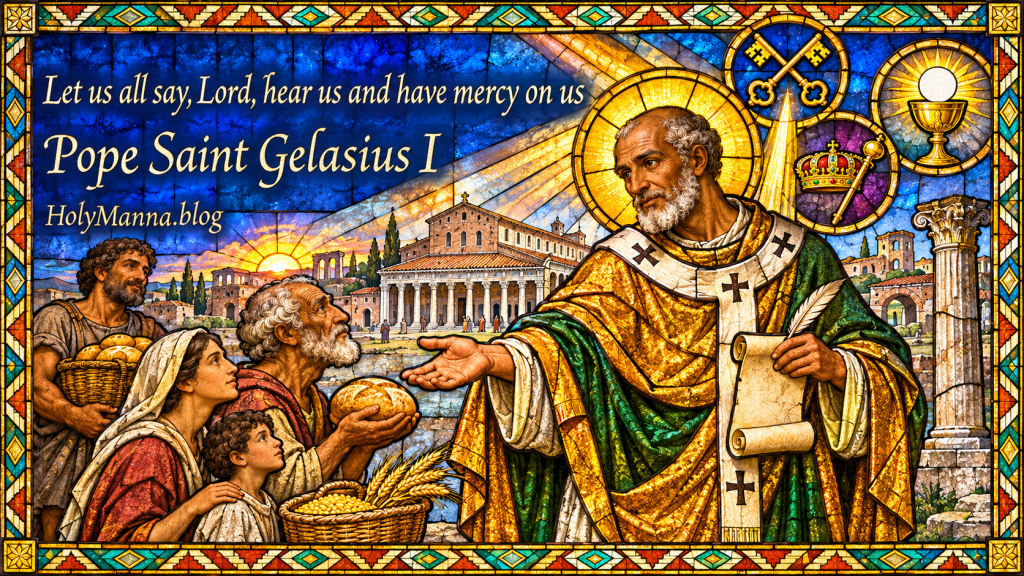
A Shepherd for a World Coming Apart
Picture Rome near the end of the 5th century. The last emperor in the West has been gone for 16 years, barbarian kings who hold the Arian heresy are fighting over Italy, the Christian East has broken communion with the Pope, and the poor of the city are hungry. Into that moment, on March 1st, 492, stepped Pope Saint Gelasius I. He reigned for only about 4 and a half years, and the Church has never stopped feeling his influence.
The older English edition of The Roman Martyrology remembers him on November 21st with one weighty line: “At Rome, St. Gelasius, pope, distinguished for learning and sanctity.” The current edition says more. It honors a pope outstanding in doctrine and holiness, who explained clearly the roles of the spiritual and temporal powers so that the unity of the Church would not be harmed, and who died in great poverty because of his charity toward the needy.
Gelasius was a brilliant theologian, a fearless defender of the See of Peter, a pastor who loved the sacred liturgy, and a true father to the poor of Rome. He is counted as the third pope of African heritage, after Pope Saint Victor I and Pope Saint Miltiades, and he is the first pope known to have been publicly acclaimed as the Vicar of Christ. His feast is kept on November 21st, the anniversary of his burial at Saint Peter’s, and it shares the day with the Memorial of the Presentation of the Blessed Virgin Mary.
The Church holds up saints like Gelasius for a reason. The Catechism teaches that when the Church solemnly proclaims that certain of her members lived heroic virtue, she acknowledges the power of the Holy Spirit at work in her and gives believers examples to follow and friends to pray for them (CCC 828). Gelasius is an example for anyone who wants to hold on to the truth without letting go of charity.
Roman by Birth, African by Blood
Almost nothing is known about the childhood of Gelasius, and no ancient writer recorded the year of his birth, his schooling, or any stories from his youth. What survives are 2 small clues, and at first they seem to pull in different directions.
The first clue comes from the Liber Pontificalis, the ancient book of papal biographies first compiled at Rome in the 6th century. It describes Gelasius with the Latin words “natione Afer,” which means African by nation, and it gives his father’s name as Valerius. The second clue comes from Gelasius himself. In his most famous letter, addressed to the Emperor Anastasius I, he wrote: “I as a Roman born love, honor, and accept you as the Roman Prince.”
Catholic scholars have read these statements in 2 ways. Many hold that he was born in the city of Rome to a family of African origin. Others hold that he was born in Roman North Africa, and that his own phrase simply meant that he was born a Roman citizen. The sources do not settle the question. What can be said with confidence is that Roman Africa, the homeland of Saint Augustine, stands somewhere in his family story, and that his writings show a mind formed by the thought of Augustine and the example of Pope Saint Leo the Great.
There is no dramatic conversion story attached to Gelasius. His story is one of steady deepening. By the time he appears clearly in the historical record, he is already archdeacon of the Roman Church, working at the side of Pope Saint Felix III and drafting that pope’s official letters. For years before his own election, he was already helping the Church think through the greatest crisis of the day.
That crisis is known as the Acacian Schism. In 482 the Emperor Zeno issued a document called the Henotikon, a compromise formula intended to win back Christians who rejected the Council of Chalcedon and its teaching that Christ is one Person in two natures. Acacius, the Patriarch of Constantinople, supported the formula and entered into communion with a bishop who rejected Chalcedon. Pope Felix excommunicated Acacius in 484, and East and West fell out of communion. The Catechism still hands on the faith of Chalcedon, confessing that the one Lord Jesus Christ is true God and true man, without confusion and without division (CCC 467). Gelasius spent years learning why that truth could never be bargained away. When Felix died early in 492, the Roman Church chose the man who had been his right hand.
The old Catholic Encyclopedia describes Gelasius as a man of prayer, penance, and study, who took great delight in the company of monks. That hidden discipleship explains what he later became known for: his defense of the papacy, his teaching on the two powers, his care for divine worship, and his generosity toward the poor.
The Pen, the Altar, and the Bread Line
Once elected, Gelasius governed like a man who knew that his time was short. The Catholic Encyclopedia counts 42 surviving letters, fragments of 49 more, and 6 theological treatises, and it reports that he is said to have been the most prolific papal writer of the first 5 centuries. Father Alban Butler, in The Lives of the Saints, describes his style as “elegant and noble,” while admitting that it is sometimes hard to follow.
His pen served the faith first. Gennadius of Marseilles, a priest and author of the same era, records that Gelasius composed a large work against Eutyches and Nestorius, the teachers of 2 opposite errors about who Christ is. Gelasius also warned against a revival of Pelagianism, the old error that human beings can reach salvation by their own effort. The Catechism teaches that grace is the unearned gift of God, the help he freely gives so that people can answer his call, and that even the first stirring of the human heart toward him is already his work (CCC 1996, 2001). A Christianity built on self-reliance leaves no room for a Savior, and Gelasius knew it.
His heart belonged to the altar. The Liber Pontificalis reports that he composed prefaces and prayers for the sacraments in carefully chosen words. Gennadius adds that he wrote hymns in the manner of Saint Ambrose, although those hymns are now lost. A litany of intercession called the Deprecatio Gelasii carries his name, and historians of the liturgy connect it with the story of how the cry “Lord, have mercy” found its place at the beginning of Mass. All of this reflects a principle that the Church still treasures, which is that the way the Church prays both expresses and shapes what the Church believes (CCC 1124).
One of his liturgical decisions shows how practical he could be. Members of the Manichaean sect were hiding among the Catholics of Rome. They considered wine to be evil, so they would receive the Host and quietly avoid the chalice. According to the traditional account, Gelasius required everyone to receive Holy Communion under both kinds, and those who refused the Precious Blood revealed themselves. The Liber Pontificalis adds that he sent the Manichaeans into exile and burned their books before the doors of the basilica of Saint Mary. When the danger passed, the older custom returned. The Catechism explains why both practices are legitimate. Christ is truly and entirely present under each of the sacred species, so Communion under the form of bread alone gives the full grace of the Eucharist, while Communion under both kinds makes the sign of the Eucharistic meal more complete (CCC 1390).
Gelasius also took on a stubborn leftover of pagan Rome. Every February 15th, the city still held the Lupercalia, an ancient fertility rite marked by wild running through the streets and by crude songs. By the 490s the people keeping the custom were baptized Christians, and when a pestilence struck the region of Campania, a senator named Andromachus and others blamed the neglect of the old rite. Gelasius answered with a sharp open letter. He pointed out that plagues had struck plenty of times while the Lupercalia was being faithfully observed, and he challenged its noble defenders to do the running themselves if they truly believed it protected the city. The Catholic Encyclopedia reports that the festival was finally abolished after a long contest. The Catechism teaches that superstition bends the religious instinct out of shape, and it warns against trusting in outward practices as though they worked by themselves (CCC 2111). A baptized Christian cannot keep one foot at the altar and the other foot in the old rites.
Above all, Gelasius loved the poor. A Roman synod held under his leadership in 494 enforced the rule that the income of the Church be divided into 4 parts, with one part for the bishop, one for the clergy, one for the upkeep of churches and divine worship, and one for the poor. He did not claim to have invented the rule, which he described as long established, but he made sure that it was kept. The Liber Pontificalis records that he delivered the city of Rome “from danger of famine,” and later historians describe him feeding the hungry with supplies from the estates of the Church. He kept so little for himself that the Catholic Encyclopedia describes him as “dying empty-handed as a result of his lavish charity.” The Catechism says it plainly: “The Church’s love for the poor . . . is a part of her constant tradition” (CCC 2444). It also teaches that giving to the poor ranks among the chief expressions of brotherly love and is at the same time an act of justice that pleases God (CCC 2447).
The record of miracles must be handled honestly. No early source attributes any miracle to Gelasius during his lifetime. There is, however, a famous tradition that places a heavenly event during his pontificate. According to the story, a wealthy man’s bull wandered off on Monte Gargano in southern Italy and was found at the mouth of a cave. When an arrow was shot at the animal, the arrow turned around and struck the archer. The bishop of nearby Siponto, whom later tradition identifies as Saint Lawrence Maiorano, ordered 3 days of fasting and prayer, and Saint Michael the Archangel then appeared to him and declared that the cave was under his protection. The tradition continues that the bishop later asked Pope Gelasius whether the cave should be consecrated as a church, and that the Archangel appeared again to say that he had already consecrated the place himself. The Church gladly honors the holy angels and teaches that they assist her throughout her earthly life (CCC 334, 335). The details of this story, however, come from a medieval account written long after the events, so the story cannot be verified.
Standing Firm When the Empire Pushed Back
Gelasius was not a martyr, and no ancient source describes a miraculous escape or a dramatic rescue in his life. His suffering was the slow, grinding kind that comes from carrying responsibility in a broken time. He became Pope while 2 barbarian kings, Odoacer and Theodoric, were still fighting over Italy, and Theodoric did not finish that war until 493. Famine threatened the city, and the new ruler was an Arian who did not share the Catholic faith. Gelasius nevertheless kept good relations with Theodoric.
The heaviest cross came from Constantinople. The Emperor Anastasius I continued the policy of the Henotikon, and the Catholic Encyclopedia speaks of the threats and schemes by which he tried to win recognition from Rome. Euphemius, the new Patriarch of Constantinople, was personally orthodox and wanted peace. The sticking point was the name of his dead predecessor Acacius, which still stood in the diptychs, the list of those remembered at the altar. Leaving one name on a list could look like a small price for ending a painful division. Gelasius would not pay that price, because it would mean accepting that an emperor and a patriarch could rewrite the faith of a Council and set aside the judgment of the Apostolic See.
In 494 he wrote to the Emperor directly. The letter is respectful and even affectionate, and in it he addresses the Emperor as a dear son. Then he draws the line that made him famous: “There are two powers, august Emperor, by which this world is chiefly ruled.” He names them as the sacred authority of the priests and the royal power. He goes on to explain that the responsibility of the priests is the weightier of the 2, because they will have to answer before God at the judgment even for the souls of kings. Gelasius grants that the Emperor rightly governs earthly affairs. In the things of God, however, the Emperor is a son of the Church who must bow his head before her ministers and receive from their hands the means of his salvation.
Gelasius was not inventing a political theory. He was applying the words of Jesus, “repay to Caesar what belongs to Caesar and to God what belongs to God” (Mt 22:21), and the words of the Apostles before the Sanhedrin, “We must obey God rather than men” (Acts 5:29). The Catechism points to both passages when it teaches that believers must refuse in conscience to obey civil commands that contradict the moral law or the Gospel (CCC 2242). It also teaches that the Church must never be confused with the political community, and that she has the duty to speak a moral word about public life whenever human dignity or the salvation of souls is at stake (CCC 2245, 2246).
His firmness about the authority of Rome grew from the same root. He insisted that the primacy of the Roman See did not come from a council or from the political importance of a city. It came from Christ, who said to Simon: “you are Peter, and upon this rock I will build my church” (Mt 16:18). The Catechism teaches the same faith today. The Lord made Simon alone the rock of his Church, and the Pope, as Bishop of Rome and successor of Peter, is the enduring and visible principle that holds the bishops and all the faithful together in unity (CCC 881, 882).
Firmness was never the whole story. In 495 Gelasius gathered a synod in Rome to hear the case of Misenus of Cumae, a bishop who had been sent to Constantinople years earlier as a papal envoy, had failed in his mission, and had been excommunicated. Misenus repented, and Gelasius restored him to communion. It was at that synod that the assembled bishops acclaimed the Pope as the Vicar of Christ, which is the first recorded use of that title for a Bishop of Rome. The title was first spoken over a pope while he was showing mercy to a brother who had fallen.
Gelasius never saw the end of the schism he fought. East and West were not reconciled until 519, under Pope Saint Hormisdas, more than 20 years after his death. He died in Rome in November of 496. Most Catholic reference works give the date as November 19th, while the Liber Pontificalis records his burial at Saint Peter’s on November 21st, which is why some older writers give the 21st as the day of his death. His kind of endurance has a name. The Catechism describes fortitude as the virtue that keeps a person steady under pressure and persevering in what is good (CCC 1808).
A Legacy Larger Than a Lost Tomb
The Catholic sources consulted for this post preserve no account of a miracle worked through the intercession of Gelasius after he died, and no tradition of healings at his tomb or of the veneration of his relics has come down. He was buried at Saint Peter’s Basilica, and the exact location of his tomb is no longer known. His veneration as a saint goes back to antiquity, long before the modern process of canonization existed, and his name stands in The Roman Martyrology to this day. The faithful can ask for his prayers with confidence, because those who dwell in heaven keep praying to the Father for the Church on earth (CCC 956).
His real monuments are made of words. Dionysius Exiguus, the learned monk who later gave the world the custom of numbering years from the birth of Christ, was summoned to Rome by Gelasius to put the papal archives in order, and he arrived around the time of the Pope’s death. Dionysius paid tribute to the learning and virtue of Gelasius in the preface to his collection of papal decrees, and through collections like that one many of the decisions of Gelasius passed into the canon law of the Church. His letter to Anastasius was cited for a thousand years whenever popes and kings argued about where one authority ended and the other began. The standard handbook of Church teaching known as Denzinger calls it “the most famous document of the ancient Church” on the subject of the two powers.
Later generations honored him by attaching his name to works that he did not personally write. The Gelasian Sacramentary, one of the oldest surviving Roman Mass books, was compiled well after his death, although it may preserve some prayers that he composed. The Gelasian Decree, with its list of the books of Scripture, is now thought to be a later compilation. The canon of Scripture does not depend on that question, since the Church recognized the inspired books through the Tradition handed down from the Apostles (CCC 120).
A popular claim also deserves a gentle correction. Many websites say that Gelasius replaced the Lupercalia with Saint Valentine’s Day or with the feast of Candlemas. No ancient source says that he created either feast as a substitute for the pagan festival, and the Candlemas claim has been traced to a mistaken guess made in the 16th century.
There is no great shrine dedicated to Gelasius. Pilgrims who climb to the Sanctuary of Saint Michael the Archangel on Monte Gargano, which welcomes more than 2 million visitors a year, are nevertheless visiting a holy place that tradition links to his pontificate. Catholics in Africa and Catholics of African descent around the world also remember him with affection as one of the 3 popes of the ancient Church with roots in Africa.
What an Empty-Handed Pope Teaches a Busy World
Gelasius lived in an age that felt like an ending. The old order had collapsed, the powerful demanded compromise, and the Church seemed to be losing ground. He answered with 3 things that any Catholic can imitate: clarity about who God is, courage joined to mercy, and open hands toward the poor.
The first lesson is clarity. Gelasius knew that Caesar has a real claim on the Christian, and he also knew that the claim has a limit. Today the pressure rarely comes from an emperor. It comes from a boss, a political tribe, a social media feed, or a circle of friends who expect agreement on everything. When loyalty to Christ and loyalty to the crowd pull in different directions, which one usually wins in your life? The Catechism reminds every baptized person of the duty to bear witness to the truth of the Gospel without being ashamed of the Lord (CCC 2471, 2472). Gelasius called the Emperor a dear son in the same letter in which he corrected him.
The second lesson is courage joined to mercy. The same Pope who would not bend on the faith welcomed back a bishop who had failed badly. Holding the line on the truth and holding the door open for the repentant belong together. Is there someone you have written off who is actually looking for a way back?
The third lesson is open hands. Gelasius did not merely preach about the poor. He built generosity into the budget, with a fixed share set aside for those in need. You can do the same on a smaller scale by deciding in advance what portion of each paycheck belongs to the poor and to the Church, so that giving becomes a plan and stops being an afterthought. Jesus taught the reason in a single line: “For where your treasure is, there also will your heart be” (Mt 6:21). Saint Paul points to the deepest reason for Christian generosity, which is the Lord himself: “for your sake he became poor although he was rich” (2 Cor 8:9). The Catechism teaches that Christ asks his followers to put him ahead of every possession and every person, and that a heart free from attachment to wealth is required of anyone who wants to enter the Kingdom of heaven (CCC 2544). If someone looked only at your bank statement, what would that person conclude that you love?
Gelasius also cleared out the Lupercalia. Plenty of baptized Catholics today check horoscopes, carry lucky charms, or treat crystals and manifesting as harmless fun. The Church asks for an undivided heart, and the Catechism names horoscopes, astrology, and charms among the practices that contradict the honor owed to God alone (CCC 2116, 2117). What small superstition have you been keeping around because everyone else keeps it too?
Take heart, finally, from the fact that Gelasius died without seeing the schism healed. Faithfulness is the assignment that God gives, and the results belong to him.
Engage With Us!
Readers are warmly invited to share their thoughts and reflections in the comments below. The story of Pope Saint Gelasius I raises questions that are worth praying over and talking through with others.
- Where in your life do you feel pressure to give to Caesar what belongs to God, and what would a respectful but firm answer look like?
- Gelasius corrected an emperor and still called him a dear son. How can you speak a hard truth this week with real charity?
- What fixed share of your income, your time, or your attention could you set aside for the poor, starting now?
- Is there a superstition, a habit, or a compromise that you need to clear out so that Christ has your whole heart?
- Who is the Misenus in your life, and how might you help open the door for that person to come home?
May the example of Pope Saint Gelasius I encourage you to love the truth, to stand firm with a gentle heart, and to keep your hands open to those in need. Go and live a life of faith, and do everything with the love and mercy that Jesus taught.
Pope Saint Gelasius I, pray for us!
Follow us on YouTube, TikTok, Instagram and Facebook for more insights and reflections on living a faith-filled life.


Leave a Reply