Memorial of the Presentation of the Blessed Virgin Mary – Lectionary: 502
Handed Over to God and Alive Forever
Some lives look like a loss from the outside, and today’s readings were written for exactly those lives. On November 21st the Church keeps the Memorial of the Presentation of the Blessed Virgin Mary, and the weekday readings for Saturday of the 33rd week in Ordinary Time carry one steady message. A life handed over entirely to God is never lost, because He is the God of the living.
Scripture says nothing about Mary’s childhood. The tradition that her parents brought her to the Temple at the age of 3 comes from the Protoevangelium of James, an apocryphal text of the 2nd century, which is also the source for the names Joachim and Anne. The feast took root in the East after a church called Saint Mary the New was dedicated near the Temple site in Jerusalem on November 21st, 543. It reached the West slowly, and Pope Sixtus V restored it to the Roman calendar in 1585. Pope Saint Paul VI wrote in Marialis Cultus 8 of Marian celebrations that, apart from their apocryphal content, present “lofty and exemplary values” and carry on venerable traditions born in the East. The Church celebrates not a disputed detail but a certain truth, which is that Mary belonged completely to God from the very beginning.
That total gift is the thread to follow. In The Book of Revelation, 2 witnesses give everything and are raised. In Psalm 144, a warrior king admits that every victory was a gift. In The Gospel of Luke, Jesus tells the Sadducees that those who belong to God can no longer die. Fittingly, the Church also keeps this date as Pro Orantibus Day, a day of gratitude for cloistered religious that Pope Pius XII instituted in 1953.
First Reading — Revelation 11:4-12
Two Lamps That Could Not Be Put Out
The Book of Revelation was written for Christians who were learning that fidelity could cost them their livelihood, their standing, and sometimes their lives. Near the end of the 1st century, the churches of Asia Minor lived under steady pressure to honor the emperor as a god and to blend in. Saint John answers with a vision soaked in Old Testament imagery. Chapter 11 sits between the 6th and 7th trumpets, and it tells of 2 witnesses who preach, suffer, die, and rise. The passage carries the day’s theme, because those who give themselves entirely to God follow Christ through the grave and out the other side.
Revelation 11:4-12
I, John, heard a voice from heaven speak to me:
Here are my two witnesses:
These are the two olive trees and the two lampstands
that stand before the Lord of the earth.
If anyone wants to harm them, fire comes out of their mouths
and devours their enemies.
In this way, anyone wanting to harm them is sure to be slain.
They have the power to close up the sky
so that no rain can fall during the time of their prophesying.
They also have power to turn water into blood
and to afflict the earth with any plague as often as they wish.When they have finished their testimony,
the beast that comes up from the abyss
will wage war against them and conquer them and kill them.
Their corpses will lie in the main street of the great city,
which has the symbolic names “Sodom” and “Egypt,”
where indeed their Lord was crucified.
Those from every people, tribe, tongue, and nation
will gaze on their corpses for three and a half days,
and they will not allow their corpses to be buried.
The inhabitants of the earth will gloat over them
and be glad and exchange gifts
because these two prophets tormented the inhabitants of the earth.
But after the three and a half days,
a breath of life from God entered them.
When they stood on their feet, great fear fell on those who saw them.
Then they heard a loud voice from heaven say to them, “Come up here.”
So they went up to heaven in a cloud as their enemies looked on.
Detailed Exegesis
Verse 4. “I, John, heard a voice from heaven speak to me: Here are my two witnesses: These are the two olive trees and the two lampstands that stand before the Lord of the earth.”
The image comes straight from Zechariah 4, where 2 olive trees feed oil to a golden lampstand and stand for the anointed leaders who rebuilt the Temple. The law required 2 witnesses for valid testimony, as Deuteronomy 19:15 teaches, and Jesus sent His disciples out in pairs. These witnesses burn with a light that is not their own.
Verse 5. “If anyone wants to harm them, fire comes out of their mouths and devours their enemies. In this way, anyone wanting to harm them is sure to be slain.”
Elijah called down fire on the soldiers sent to seize him in 2 Kings 1. Here the fire comes from the mouth, which points to the power of preaching. God promised Jeremiah that His words would be a fire in the prophet’s mouth, as Jeremiah 5:14 records. Truth spoken faithfully burns away lies.
Verse 6. “They have the power to close up the sky so that no rain can fall during the time of their prophesying. They also have power to turn water into blood and to afflict the earth with any plague as often as they wish.”
The closed sky recalls Elijah’s drought in 1 Kings 17, and the water turned to blood recalls Moses before Pharaoh in Exodus 7. Moses and Elijah together stand for the Law and the Prophets, the same pair who appeared beside Jesus at the Transfiguration.
Verse 7. “When they have finished their testimony, the beast that comes up from the abyss will wage war against them and conquer them and kill them.”
The beast attacks only when their testimony is finished, which means evil does not get to set the schedule. This creature echoes the beasts of Daniel 7, and the Fathers saw in it the Antichrist. God permits the apparent defeat, just as He permitted Calvary, because the death of the witnesses will itself become testimony.
Verse 8. “Their corpses will lie in the main street of the great city, which has the symbolic names ‘Sodom’ and ‘Egypt,’ where indeed their Lord was crucified.”
The great city carries the names of Scripture’s most notorious places of sin and slavery, and it is tied to the place where Jesus was crucified. Isaiah had already called Jerusalem’s rulers princes of Sodom in Isaiah 1:10. The servants are treated exactly as their Master was treated.
Verse 9. “Those from every people, tribe, tongue, and nation will gaze on their corpses for three and a half days, and they will not allow their corpses to be buried.”
To be left unburied was the deepest dishonor in the ancient world, yet the number matters most. The figure of 3 and a half is half of 7, the biblical number of fullness. Evil’s triumph is real, but it is brief, broken, and already counted by God.
Verse 10. “The inhabitants of the earth will gloat over them and be glad and exchange gifts because these two prophets tormented the inhabitants of the earth.”
The world throws a party and trades presents, in a dark parody of the gift-giving at Purim in Esther 9. The reason is revealing, because the prophets tormented people simply by telling the truth. A conscience that refuses to repent would rather celebrate the silence of the preacher.
Verse 11. “But after the three and a half days, a breath of life from God entered them. When they stood on their feet, great fear fell on those who saw them.”
This is Ezekiel 37 fulfilled, where breath enters the dry bones and they stand on their feet. The same breath that God breathed into Adam in Genesis 2:7 enters the martyrs. Laughter turns to fear, because God has the final word over every grave.
Verse 12. “Then they heard a loud voice from heaven say to them, ‘Come up here.’ So they went up to heaven in a cloud as their enemies looked on.”
Elijah was taken up in a whirlwind, and Jesus ascended in a cloud in Acts 1:9. The witnesses now follow their Lord in death, in rising, and in glory. Heaven’s invitation is the destiny of every faithful life, and the Church professes in CCC 966 that Mary already shares in that glory, body and soul.
Teachings
The Fathers did not all read this passage the same way. Tertullian, in A Treatise on the Soul 50, identified the witnesses as Enoch and Elijah, the 2 men of the Old Testament who never died. He wrote that they are kept for a future death so “that by their blood they may extinguish Antichrist.” Saint Hippolytus held the same view. Saint Hilary thought Moses would return with Elijah, and other Catholic commentators have read the pair as the united witness of the Old and New Testaments. The Church has never defined a single answer.
The Catechism gives the frame. CCC 675 teaches that a last and severe testing awaits the Church before the Lord returns, one that will unsettle many believers. CCC 677 adds that she will enter the glory of the Kingdom “only through this final Passover,” following her Lord in His death and Resurrection. The witnesses are therefore a portrait of the Church herself. CCC 2473 says, “Martyrdom is the supreme witness given to the truth of the faith.” The Greek word for witness is the very word that became martyr. Tertullian told the persecutors in his Apology 50, “the blood of Christians is seed.”
Reflection
Most readers will never face a beast from the abyss, but everyone knows the smaller version. There is the meeting where staying quiet about the faith would be easier, the family dinner where a moral conviction draws eye rolls, and the group chat where mockery of the Church gets a laughing reply. Speak the truth with love, expect resistance, and leave the outcome to God. Learn the faith well enough to explain 1 teaching clearly this week. Pray by name for someone who mocks what you believe. Accept 1 small humiliation without defending yourself, and offer it for persecuted Christians. Where is your witness being asked to cost you something right now? Do you trust that God sets the limit on every trial you face? What would change if you believed that heaven’s invitation is the last word over your life?
Responsorial Psalm — Psalm 144:1-2, 9-10
The Warrior Who Knew Where His Strength Came From
Psalm 144 is a royal psalm placed on the lips of David, the shepherd boy who became a warrior king. Much of it borrows from Psalm 18, David’s great song of thanks after God rescued him from Saul and from all his enemies. In ancient Israel, a king’s victory was never treated as a personal achievement. It was received as a sign that God was faithful to His covenant. Sung after the vision of the 2 witnesses, the psalm becomes the prayer of everyone who has to stand firm. It shows where a witness finds the courage to keep going, and it promises that the battle ends in a song.
Psalm 144:1-2, 9-10
R. (1b) Blessed be the Lord, my Rock!
Blessed be the LORD, my rock,
who trains my hands for battle, my fingers for war.
R. Blessed be the Lord, my Rock!
My mercy and my fortress,
my stronghold, my deliverer,
My shield, in whom I trust,
who subdues my people under me.
R. Blessed be the Lord, my Rock!
O God, I will sing a new song to you;
with a ten stringed lyre I will chant your praise,
You who give victory to kings,
and deliver David, your servant from the evil sword.
R. Blessed be the Lord, my Rock!
Detailed Exegesis
Verse 1. “Blessed be the LORD, my rock, who trains my hands for battle, my fingers for war.”
David does not begin with his own skill, because he begins by blessing God. A rock in the Judean wilderness meant shelter, height, and safety from pursuers, and David hid among such rocks for years. Christians pray this verse about a different kind of combat. Saint Paul teaches in Ephesians 6:12 that the struggle is not with flesh and blood but with the spiritual powers of evil. Saint Augustine, in his Exposition on Psalm 144, hears the whole Body of Christ speaking here, and he reads David’s victory over Goliath as a figure of Christ defeating the devil.
Verse 2. “My mercy and my fortress, my stronghold, my deliverer, My shield, in whom I trust, who subdues my people under me.”
David piles up 5 titles because a single title is not enough. The first is the most surprising, since God is not only the one who shows mercy but is called mercy itself. Augustine loved this line. He explained that any mercy people show has first been received from God, so “to Him rightfully do we say, My Mercy.” The king’s authority over his people is also named as a gift, which keeps power humble.
Verse 9. “O God, I will sing a new song to you; with a ten stringed lyre I will chant your praise,”
A new song in Scripture is sung when God does something new, and in Revelation 14 the redeemed sing a new song before the throne. Augustine teaches that the new song belongs to grace and to the New Covenant. He adds that the 10 strings are the 10 Commandments, played well only by a heart that loves, since “love is the fulfillment of the law” (Romans 13:10).
Verse 10. “You who give victory to kings, and deliver David, your servant from the evil sword.”
The warrior king calls himself a servant. Every rescue in David’s life points forward to the Son of David, whom the Father delivered not from dying but from death itself. The 2 witnesses of the First Reading were not spared the sword either, and yet they were delivered through it.
Teachings
The Catechism does not treat spiritual combat as a metaphor for dramatic people. CCC 409 teaches that conflict with evil runs through all of human history, and that doing good always costs a person real effort and the help of grace. CCC 2015 is blunt about it and says, “There is no holiness without renunciation and spiritual battle.” CCC 2725 adds that “prayer is a battle” fought against the self and against the tempter. The people who live this best are rarely soldiers. On Pro Orantibus Day, the Church thanks God for cloistered monks and nuns, whose hidden life of praise is frontline service. Their hands are trained for a battle that is fought on their knees. Mary is their model. The tradition of her Presentation pictures a child given to the house of God, and the Church honors in her a whole life that became a new song. Her Magnificat is exactly what this psalm promises, a hymn of victory sung by a lowly servant.
Reflection
This psalm is a good one to pray before the hard parts of an ordinary day. Before a difficult conversation, a temptation that keeps returning, or a long shift of caring for children or aging parents, bless God first and ask Him to train your hands for what is coming. Then practice David’s honesty afterward by naming 1 victory from the day and giving God the credit for it. It also helps to choose 1 of the 5 titles in verse 2 and repeat it slowly through the week. Which name for God do you need most right now, mercy, fortress, stronghold, deliverer, or shield? What battle have you been trying to fight on your own strength? When was the last time you thanked God for a victory instead of quietly taking the credit?
Holy Gospel — Luke 20:27-40
The Trick Question That Opened Heaven
Jesus is teaching in the Temple during the last days before His Passion, and one group after another is trying to trap Him. Now come the Sadducees, the wealthy priestly aristocracy who ran the Temple. They treated only the 5 books of Moses as binding, and Acts 23:8 records that they denied the resurrection, angels, and spirits. Their question is a riddle designed to make the resurrection look ridiculous. Jesus answers with one of the clearest teachings on eternal life in all the Gospels, and it is the heart of the day’s theme. Those who belong to God are alive to Him, and death cannot cancel that belonging.
Luke 20:27-40
Some Sadducees, those who deny that there is a resurrection,
came forward and put this question to Jesus, saying,
“Teacher, Moses wrote for us,
If someone’s brother dies leaving a wife but no child,
his brother must take the wife
and raise up descendants for his brother.
Now there were seven brothers;
the first married a woman but died childless.
Then the second and the third married her,
and likewise all the seven died childless.
Finally the woman also died.
Now at the resurrection whose wife will that woman be?
For all seven had been married to her.”
Jesus said to them,
“The children of this age marry and remarry;
but those who are deemed worthy to attain to the coming age
and to the resurrection of the dead
neither marry nor are given in marriage.
They can no longer die,
for they are like angels;
and they are the children of God
because they are the ones who will rise.
That the dead will rise
even Moses made known in the passage about the bush,
when he called ‘Lord’
the God of Abraham, the God of Isaac, and the God of Jacob;
and he is not God of the dead, but of the living,
for to him all are alive.”
Some of the scribes said in reply,
“Teacher, you have answered well.”
And they no longer dared to ask him anything.
Detailed Exegesis
Verse 27. “Some Sadducees, those who deny that there is a resurrection, came forward and put this question to Jesus,”
Saint Luke names their unbelief before they say a word. They are not seeking the truth, because they have come to defend a position and to win.
Verse 28. “saying, ‘Teacher, Moses wrote for us, If someone’s brother dies leaving a wife but no child, his brother must take the wife and raise up descendants for his brother.”
They cite the law of levirate marriage from Deuteronomy 25:5-6. Its purpose was merciful, since it protected a widow and kept a dead man’s name and inheritance alive in Israel. The law quietly assumes that a man lives on only through his descendants.
Verse 29. “Now there were seven brothers; the first married a woman but died childless.”
The number 7 signals a complete set, and the scenario may echo Sarah in The Book of Tobit, who lost 7 husbands.
Verse 30. “Then the second”
The riddle moves quickly, because the brothers matter to the Sadducees only as pieces of an argument.
Verse 31. “and the third married her, and likewise all the seven died childless.”
All 7 marriages end without a child, so no brother has a stronger claim than another. The law’s own remedy has failed 7 times, and death appears to have won every round.
Verse 32. “Finally the woman also died.”
Everyone in the story is now dead, and for the Sadducees that is simply where every human story stops.
Verse 33. “Now at the resurrection whose wife will that woman be? For all seven had been married to her.’”
Here the trap is finally sprung. They imagine the resurrection as this present life started over again with its paperwork intact. If that picture is absurd, they reason, then the doctrine must be absurd too.
Verse 34. “Jesus said to them, ‘The children of this age marry and remarry;”
Jesus does not mock marriage, and He gives it its proper place. Marriage belongs to this age, where death keeps emptying the world and new life must keep filling it.
Verse 35. “but those who are deemed worthy to attain to the coming age and to the resurrection of the dead neither marry nor are given in marriage.”
The coming age is not a sequel to this one. The phrase about being deemed worthy shows that eternal life is a gift received and not a prize seized. Marriage is not despised in heaven. It gives way to what it always pointed toward, which is the union of Christ with His people.
Verse 36. “They can no longer die, for they are like angels; and they are the children of God because they are the ones who will rise.”
The risen do not become angels, since they will have glorified bodies. They are like angels in being deathless and wholly turned toward God. Their deepest identity is stated plainly, for they are children of God.
Verse 37. “That the dead will rise even Moses made known in the passage about the bush, when he called ‘Lord’ the God of Abraham, the God of Isaac, and the God of Jacob;”
Jesus meets the Sadducees on their own ground by pointing to Exodus 3:6, from the books they accepted. God spoke to Moses centuries after the patriarchs were buried, and He still named Himself as their God.
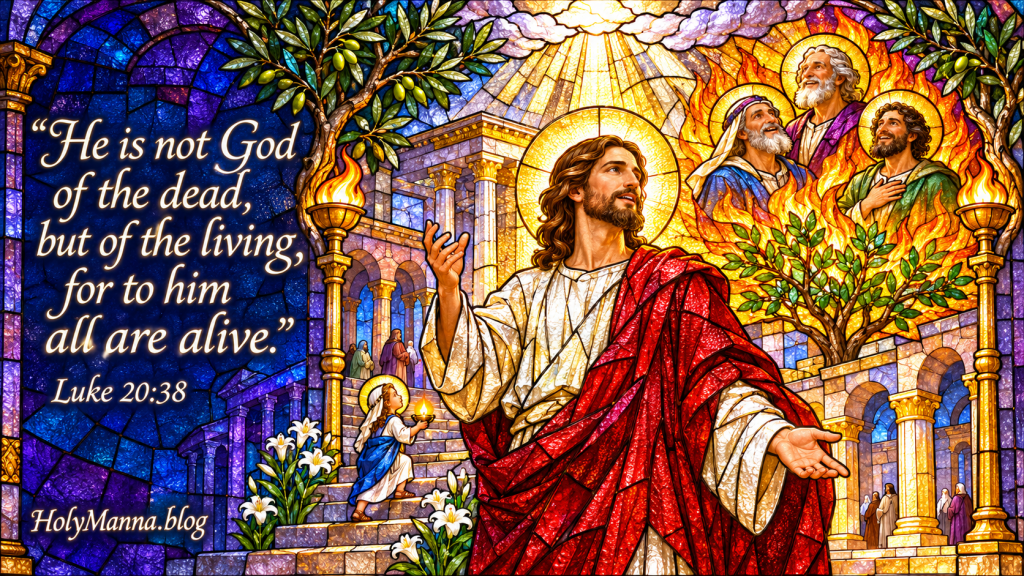
Verse 38. “and he is not God of the dead, but of the living, for to him all are alive.’”
This is the center of the reading. God does not make covenants with people and then let them dissolve into nothing. If He is still their God, they are still alive to Him, and His faithfulness will reach even their bodies.
Verse 39. “Some of the scribes said in reply, ‘Teacher, you have answered well.’”
The scribes, many of whom shared the Pharisees’ belief in the resurrection, cannot help applauding. Truth sometimes wins praise even from rivals.
Verse 40. “And they no longer dared to ask him anything.”
The traps stop here. The remaining questions will be asked at His trial, and His final answer will be an empty tomb.
Teachings
CCC 993 recalls that hope in the resurrection was already common among the Pharisees and many others in the time of Jesus, and that “Jesus teaches it firmly.” The same paragraph roots that faith in the God who is God of the living. CCC 994 then shows the step Jesus takes beyond anyone before Him, since He ties the resurrection to His own person and says, “I am the resurrection and the life” (John 11:25). Saint Cyril of Alexandria preached on this very passage in his Commentary on Luke, Sermon 136. He taught that the risen will live as saints already brought near to God, and that doubting the resurrection is “altogether unworthy of those who love Christ.”
This Gospel also explains the memorial. CCC 1619 calls virginity for the sake of the Kingdom a sign that marriage is “a reality of this present age which is passing away.” Mary, given wholly to God, already lived on earth the life of the coming age, and consecrated men and women continue that sign. Saint Augustine’s sermon in the Liturgy of the Hours for this memorial says Mary was “more blessed in her discipleship than in her motherhood.” Belonging to God is the bond that death cannot touch. Pope Francis said of this Gospel in his Angelus of November 10th, 2013, that “our pilgrimage goes from death to life.”
Reflection
The Sadducees’ mistake is easy to repeat. It is the habit of measuring God’s promises by what seems possible right now. This Gospel invites a different way of living, with eternity setting the priorities instead of the calendar. Pray for your dead by name this week, and have a Mass offered for them during November, the month traditionally devoted to praying for the faithful departed. If you are married, thank God for your spouse as a companion on the road to heaven. If you are single or consecrated, remember that your life already says something true about where everyone is headed. Do you live as though death is the end, or as though it is a door? How would your choices this week change if you truly believed that to God all are alive? Who taught you to hope in the resurrection, and have you thanked God for that person?
The Voice That Calls Every Faithful Life Home
Set the 3 readings side by side and they tell a single story. It begins with 2 witnesses who hold nothing back, who are silenced in the street while the world celebrates, and who rise when the breath of God returns. It continues with a king who has every reason to boast and instead blesses the Rock who trained his hands. It ends in the Temple, where Jesus looks past a clever riddle and announces that Abraham, Isaac, and Jacob are alive, because the God who claimed them does not let go.
Standing quietly inside that story is a little girl on the Temple steps. Whatever the details of her childhood may have been, the Church is certain of this much. Mary gave God everything from the beginning, and He gave her everything in return. She is the proof that a surrendered life is not a smaller life.
That is the invitation for anyone reading today. No one is asked to be impressive. Each person is asked to belong to God in the ordinary battles of work, family, prayer, and conscience, and to trust that nothing handed to Him is ever wasted. The witness that costs something, the prayer nobody sees, and the grief carried with hope are all safe in the hands of the living God. The same voice that called the witnesses is still speaking, and it is calling every faithful heart higher. The best response is the one Mary gave, a wholehearted yes that is offered again today.
Engage With Us!
Share your reflections in the comments below. Your insight may be exactly what another reader needs to hear today, and the conversation is always richer when the whole community joins in.
- First Reading, Revelation 11:4-12: The 2 witnesses kept speaking the truth even when it cost them everything. Where is God asking you to be a faithful witness, and what fear holds you back?
- Responsorial Psalm, Psalm 144:1-2, 9-10: David blessed God as his rock, his fortress, and his shield. Which battle in your life do you need to hand over to the Lord this week?
- Holy Gospel, Luke 20:27-40: Jesus teaches that God is the God of the living. How does the promise of the resurrection change the way you think about loved ones who have died?
- All 3 readings, together with the Memorial of the Presentation of the Blessed Virgin Mary, point to lives given completely to God. What is 1 concrete part of your life that you can place in His hands today?
Keep walking in faith, even when the road is steep. The God of the living holds every moment of your story, and He never wastes a life that is given to Him. Go into this day ready to do everything with the love and mercy that Jesus taught us.
Sacred Heart of Jesus, we trust in You!
Immaculate Heart of Mary, pray for us!
Saint Michael the Archangel, defend us in battle!
Follow us on YouTube, TikTok, Instagram and Facebook for more insights and reflections on living a faith-filled life.


Leave a Reply