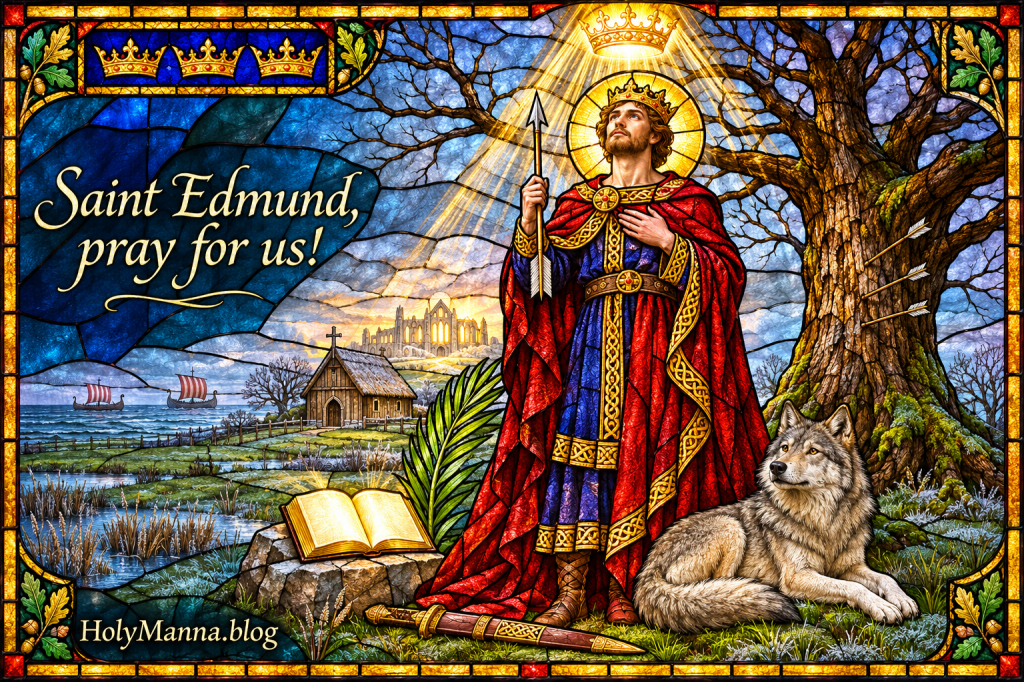
The King Who Would Not Bow
On November 20th the Church remembers Saint Edmund, the young king of the East Angles who was killed by a pagan Viking army in the winter of 869. He ruled a small English kingdom for roughly 15 years, he lost it in a single season, and he has been loved for more than 1,100 years because of the way he lost it. The Roman Martyrology keeps his memory on this day and records that the king, captured in the war against pagan invaders, was “crowned with martyrdom for faith in Christ.”
Saint Edmund does not appear on the General Roman Calendar, so most parishes will not hear his name at Mass this week. His feast is kept with special love in the Diocese of East Anglia in England, which honors him as one of its diocesan patrons, and at Douai Abbey, the English Benedictine community dedicated to him. Medieval England looked to him, together with Saint Edward the Confessor, as a heavenly patron of the whole kingdom long before Saint George held that place. By long tradition he is also invoked by rulers and by people facing plague and epidemic disease.
The Catechism explains why a death like his matters so much to the Church: “Martyrdom is the supreme witness given to the truth of the faith” (CCC 2473). Edmund is revered because he gave that witness as a king, with everything to lose and an easy way out offered to him.
An honest telling of his story needs one note at the start. The life of Saint Edmund reaches the modern reader in two layers. The first is a thin layer of documented history, written within about 20 years of his death. The second is a much richer layer of tradition, first written down about 100 years later. Both layers are precious to the Church, and this post keeps them clearly apart.
A Teenage King in the Age of the Longships
Edmund’s kingdom covered what is now Norfolk and Suffolk, the rounded shoulder of eastern England that juts into the North Sea. Very little is known for certain about his birth or his family. He was born around the year 841, and the earliest and most reliable accounts present him as a descendant of the old royal line of East Anglia. Abbo of Fleury, his first biographer, says only that he came from noble and ancient Saxon stock.
A later tradition, first recorded in the 12th century by Geoffrey of Wells, tells a more colorful story. In this account Edmund was born in Nuremberg as the son of a King Alcmund of Saxony, and a childless King Offa of East Anglia chose the boy as his heir while travelling to Rome on pilgrimage. Alban Butler repeats part of this account in his Lives of the Saints, but The Catholic Encyclopedia treats the German birth as a later addition, and the Vatican’s own notice on the saint calls these traditions unreliable. This account of his birth cannot be verified.
What can be said is that Edmund came to the throne very young. Tradition holds that he was acclaimed king on Christmas Day in 855, at about 14 or 15 years of age, and that he was consecrated at Bures on the River Stour by Bishop Humbert of Elmham. The sources differ on whether the crowning took place on that same day or on Christmas Day a year later. Silver pennies stamped with his name survive to this day, and they are the firmest physical evidence that King Edmund really reigned.
Edmund was not a convert. He was born into a Christian people, in a land evangelized more than 200 years earlier by Saint Felix of Burgundy. His story is one of faith that deepened, and one tradition captures that deepening beautifully. It is said that the young king withdrew for a full year to a royal tower at Hunstanton on the Norfolk coast in order to learn the entire Psalter by heart, so that he could pray it every day for the rest of his life. Butler adds that the very book he used was shown at the abbey of Bury Saint Edmunds until the 16th century. This tradition comes from later sources and cannot be verified.
Whether or not the tower at Hunstanton ever held him, the tradition points to something true about how saints are made. The Catechism teaches that “The Psalter is the book in which the Word of God becomes man’s prayer” (CCC 2587). A king who carried all 150 psalms in his memory would have carried words like these into the darkest day of his life: “The LORD is my light and my salvation; whom should I fear?” (Ps 27:1).
A Father to His People
The sources agree about the kind of king Edmund became. Abbo of Fleury, and the English abbot Ælfric who translated him, describe a ruler who was wise, humble, and devoted to God, generous to the poor and to widows like a father, and firm with the cruel. Butler adds that Edmund had no patience for flatterers or informers, and that he looked into matters himself so that he would not hand down an unjust judgment.
That portrait matches what the Church asks of anyone who holds power. The Catechism says, “Those who exercise authority should do so as a service” (CCC 2235), and it teaches that authority is exercised legitimately only when it seeks the common good (CCC 1903). The care for the poor and the widowed that the sources praise in Edmund belongs to the works of mercy that the Church asks of every Christian (CCC 2447). Edmund seems to have understood his crown as a task given to him for the sake of other people.
Readers who come looking for dazzling miracles in this part of the story will find very few. The early sources do not record Edmund healing the sick or multiplying food during his lifetime. The same later tradition that brings Edmund from across the sea says that when he first came ashore at Hunstanton he knelt on the beach to give thanks, and that springs of fresh water rose from the ground where he prayed. This story cannot be verified.
The absence of wonders is part of the lesson. For about 15 years Edmund’s holiness looked like fair judgments, alms for the poor, and daily psalms. The Catechism teaches that all Christians, in every state of life, are “called to the fullness of Christian life” (CCC 2013). Edmund answered that call in the ordinary duties of his office, and those quiet years prepared him for the hour that made him famous. Butler makes the same point when he observes that the saint’s whole life was a preparation for martyrdom.
That hour was already on its way. In 865 a huge Viking force, remembered as the Great Heathen Army, landed in East Anglia. The Anglo-Saxon Chronicle records that the East Angles made peace with the invaders and supplied them with horses, and the army rode north to break the kingdom of Northumbria and to threaten Mercia. Four years later it came back.
The Winter the Great Army Returned
The documented history of Edmund’s death is brief. The Anglo-Saxon Chronicle, compiled within about 20 years of the events, reports that the army rode across Mercia into East Anglia and took winter quarters at Thetford. That winter King Edmund fought against them, and “the Danes had the victory, and killed the king.” Bishop Asser, the biographer of King Alfred the Great, tells the same story in his own words. That is everything the contemporary record offers.
Even the year needs a careful word. Older Catholic sources, including Butler and The Catholic Encyclopedia, date the martyrdom to November 20th, 870, because that is the year the Chronicle prints. The chronicler began his year in the autumn, however, so most historians today place the death on November 20th, 869.
The fuller story comes from the Passio Sancti Eadmundi, written by the monk Abbo of Fleury between 985 and 987. Abbo explains where he heard it. As an old man, Edmund’s own armor bearer had told the story at the court of King Athelstan. A young man named Dunstan was listening, and decades later, as Archbishop of Canterbury, Saint Dunstan repeated it to Abbo. That chain gives the account real weight. It was still written more than a century after the events, in the style of a martyr’s passion, so its details belong to tradition and cannot be confirmed as history.
In Abbo’s telling, the Viking chieftain Hinguar, usually identified with Ivar, arrived by sea with his brother Hubba and slaughtered men, women, and children. He then sent a messenger to Edmund with his terms. The king was to hand over his treasure and reign from then on as Hinguar’s underling. A bishop at Edmund’s side, fearing for the king’s life, advised him to submit or to flee. Edmund refused both. In the Old English version by Ælfric, rendered here in modern English, the king answers that “Edmund will never bow in life to Hinguar the heathen chieftain” unless that chieftain first bows in faith to Christ. The speech was composed long after the event, so it gives the heart of his answer and not a word for word record. The Catholic Encyclopedia sums up the same refusal by describing the king as “declaring his religion dearer to him than his life.”
When Hinguar’s men came for him, Edmund stood in his hall and threw his weapons aside. Abbo says he did this because he wished to imitate Christ, who told Peter in the garden, “Put your sword back into its sheath” (Mt 26:52). The Danes bound him, mocked him, and beat him with cudgels. They tied him to a tree and scourged him, and through all of it he kept calling on the name of Jesus. His constancy enraged them, so they made him a target until, in Abbo’s unforgettable image, he bristled with arrows like a hedgehog, much as Saint Sebastian had centuries before. Hinguar finally ordered him beheaded. Edmund was about 29 years old. A tradition adds that Bishop Humbert of Elmham was put to death by the same army. That detail cannot be verified.
The two layers do not perfectly agree. The Chronicle says that Edmund fought, while Abbo presents a king who refused to fight. Butler and The Catholic Encyclopedia weave the two together by having Edmund give battle first, then dismiss his outnumbered men to spare them a pointless slaughter, and then fall into Danish hands. The place of his death is uncertain as well. Abbo names it Haegelisdun. Tradition has long identified that spot with Hoxne in Suffolk, while a writer for the Diocese of East Anglia notes that modern scholarship points to Hellesdon, near Norwich.
Abbo records no miraculous escape and no angel staying the arrows. The divine help in this story is the patience of the king himself, who suffered in the pattern of his Lord: “When he was insulted, he returned no insult” (1 Pt 2:23).
What makes this death a martyrdom, and not simply a battlefield loss, is the reason for it. The tradition is unanimous that Edmund could have kept his life by accepting terms that were incompatible with his faith and with the justice he owed his people. The Catechism teaches that a citizen is obliged in conscience to refuse directives that are contrary to the moral order or to the Gospel, and it quotes the apostles: “We must obey God rather than men” (CCC 2242, citing Acts 5:29). Edmund obeyed God, and it cost him everything he had on earth.
A Voice in the Brambles and the Shrine of a Nation
The most famous story about Saint Edmund begins after his death. Abbo relates that the Danes carried off the king’s head and threw it into the thick brambles of Haegelisdun wood so that it could not be buried with his body. When the invaders had gone, his people came out of hiding and searched the forest, calling to one another as they went. A voice answered them: “Here, here, here!” They followed it and found the head resting between the paws of a great gray wolf, which had guarded it from every other beast and had not harmed it. The wolf walked beside them like a tame animal until they reached the town, and then it turned back into the woods. This story comes from Abbo’s account and cannot be verified.
The people buried their king and raised a simple wooden chapel over the grave. Years later the body was carried to the royal town of Beodricesworth. The sources disagree about when this happened. The Catholic Encyclopedia gives the year 903, while other Catholic reference works place it in the reign of King Athelstan, between 924 and 939. Abbo reports that when the coffin was opened the body was found whole and incorrupt, with the wounds healed and only a thin red line, like a silken thread, around the neck. He adds that a devout widow named Oswen kept watch at the tomb for many years, and that each year she trimmed the saint’s hair and nails and kept them as relics. These reports cannot be verified.
Other stories gathered around the tomb. One tells of 8 thieves who tried to break into the church at night and were held frozen in place until morning, each one fixed at his work with his tool in his hand. Bishop Theodred had them hanged, and he regretted that harsh sentence for the rest of his life. Another tells of a powerful man named Leofstan, who arrogantly demanded to see whether the body was truly incorrupt and lost his mind the moment he looked. Neither story can be verified.
One piece of evidence from these years stands on solid ground. Within about a generation of Edmund’s death, silver pennies were being struck in East Anglia with an inscription honoring him as a saint. East Anglia was under Danish rule at the time. The Danish king Guthrum had accepted baptism in 878, and the settlers who followed him were now honoring the king their own fathers had killed.
In 1010, with Viking raiders in the region again, a monk named Egelwin carried the body to London for safety, and it came home in 1013. Abbey tradition holds that miracles accompanied the journey, and that the body rested for a night at the little wooden church at Greensted in Essex, which still stands. These traditions cannot be verified.
The most dramatic story concerns the Danish king Sweyn Forkbeard, who conquered England in 1013 and demanded a heavy tribute from the lands of Saint Edmund. The monks of the abbey later told how Sweyn, surrounded by his army at Gainsborough early in February of 1014, suddenly saw the martyr coming toward him in arms. According to the 12th century chronicler John of Worcester, he screamed, “Help, fellow-warriors, help! St. Edmund is coming to kill me!” and he died that same evening. The Anglo-Saxon Chronicle records only that Sweyn died at Candlemas that year. This story cannot be verified.
Sweyn’s son thought differently about the saint. King Cnut, a Dane and a Christian, founded a Benedictine abbey at the shrine in 1020, and Butler presents the gift as reparation for the harm his father had done. The town took the martyr’s name and became Bury Saint Edmunds. In 1095 the body was moved into a magnificent new abbey church. In 1198, after a fire damaged the shrine, Abbot Samson opened the coffin by night in the presence of 12 monks. The abbey’s chronicler, Jocelin of Brakelond, recorded the scene and described a body that was still intact.
For centuries Bury was among the great pilgrim shrines of Europe. Kings came there on pilgrimage, including Henry VI, who arrived to spend Christmas at the abbey in 1433. King Richard II had himself painted in the famous Wilton Diptych with Saint Edmund standing beside him, arrow in hand, presenting him to the Blessed Virgin and the Christ Child. Butler notes that a national council at Oxford in 1222 ranked Edmund’s feast among the holy days of obligation in England. The chronicler Roger of Wendover relates that in 1214 the barons of England swore at the abbey’s high altar to hold King John to a charter of liberties, the oath that led to Magna Carta the following year. Local tradition dates that oath to Saint Edmund’s own feast day.
Then the shrine fell silent. In 1539 the abbey was dissolved under Henry VIII, the shrine was destroyed, and the fate of the body is unknown. The Basilica of Saint Sernin in Toulouse has claimed since at least the 15th century to hold Edmund’s relics, said to have been carried to France in 1217. The people of Toulouse credited his intercession when plague left their city in the years around 1630, and in 1644 the bones were solemnly examined and enshrined anew. In 1901 Pope Leo XIII allowed those relics to be sent to England for the high altar of the new Westminster Cathedral. Scholars then challenged their authenticity, the plan was halted, and the relics have remained ever since at Arundel in the care of the Dukes of Norfolk. The Catholic Encyclopedia notes that the Holy See appointed a commission to investigate and that no report was published. Whether those bones are truly Saint Edmund’s cannot be verified.
The Church encourages the veneration of relics as a form of popular piety that surrounds her sacramental life (CCC 1674), but devotion to Edmund has never depended on knowing where his body lies. The Catechism teaches that the saints in heaven “do not cease to intercede with the Father for us” (CCC 956). Edmund was never canonized through the formal process used today, because his veneration began centuries before that process existed. The Church honors him in the Roman Martyrology for the same reason she canonizes anyone, which is that such men and women “practiced heroic virtue and lived in fidelity to God’s grace” (CCC 828).
Today pilgrims still walk among the abbey ruins in Bury Saint Edmunds, a Catholic parish church in the town bears his name, and the Catholics of East Anglia celebrate their royal patron every November 20th.
What a 9th Century King Asks of a Modern Heart
You will probably never face a Viking army. You will almost certainly face a quieter version of Hinguar’s offer, which is the suggestion that life would go more smoothly if your faith stayed private, flexible, and negotiable. It might come as a workplace expectation, as pressure inside a relationship, or as a slow drift toward whatever everyone else is doing. Edmund’s answer was that some things are not for sale.
The virtue behind that answer has a name. The Catechism says, “Fortitude is the moral virtue that ensures firmness in difficulties”, and it adds that this virtue “enables one to conquer fear, even fear of death” (CCC 1808). Fortitude is rarely built in a single heroic moment. Edmund’s courage at the tree was the fruit of thousands of ordinary days of prayer and honest work. Jesus told His disciples, “do not be afraid of those who kill the body” (Mt 10:28), and Edmund could live those words at the end because he had been praying with the word of God for years.
Edmund also shows what leadership looks like when it is modeled on Christ, who said, “A good shepherd lays down his life for the sheep” (Jn 10:11). Every reader has a small kingdom of some kind. It may be a household, a classroom, a team at work, or a circle of friends. Who depends on your fairness, your patience, and your example this week?
A few practical steps can bring Saint Edmund’s lessons into daily life. You can choose one psalm, perhaps Psalm 27 or Psalm 23, and learn it by heart this month, so that God’s word is ready when a hard day arrives. You can practice justice in small things by refusing gossip, by hearing both sides before judging, and by giving something real to someone in need. You can pray this week for Christians who are still persecuted for the faith. You can also ask Saint Edmund’s intercession for the sick, as the faithful have done for centuries in times of epidemic.
Where are you tempted to keep the peace by quietly setting Christ aside? What would it look like to lay down your own weapons, such as sarcasm, resentment, or the need to win, and to answer an insult the way Edmund did?
The Catechism reminds every believer that “Because of Christ, Christian death has a positive meaning” (CCC 1010). Edmund lost a kingdom that lasted 15 years and received one that never ends. The promise he trusted is the same promise made to you: “Remain faithful until death, and I will give you the crown of life” (Rv 2:10).
Engage With Us!
Share your thoughts and reflections in the comments below. The story of Saint Edmund raises questions worth sitting with, and your perspective may be exactly what another reader needs to hear.
- Edmund refused to keep his throne at the price of his faith. Where in your own life do you feel pressure to compromise what you believe in order to keep the peace or get ahead?
- Tradition says that Edmund learned the whole Psalter by heart. Which psalm or passage of Scripture do you turn to when you are afraid, and why?
- The sources remember Edmund as a father to the poor and the widowed. Who are the people in your care, and how could you serve them more justly this week?
- Edmund laid down his weapons in imitation of Christ. What is one situation where you could respond to hostility with patience instead of retaliation?
- Within a generation, the descendants of Edmund’s killers were honoring him as a saint. What does that say to you about the power of a faithful witness over time?
Saint Edmund never saw the fruit of his sacrifice in this life, and he was faithful anyway. Let his courage send you back into your own week with a steadier heart. Live your faith out loud, stay close to Christ in prayer, and do everything with the love and mercy that Jesus taught.
Saint Edmund, King and Martyr, pray for us!
Follow us on YouTube, TikTok, Instagram and Facebook for more insights and reflections on living a faith-filled life.


Leave a Reply