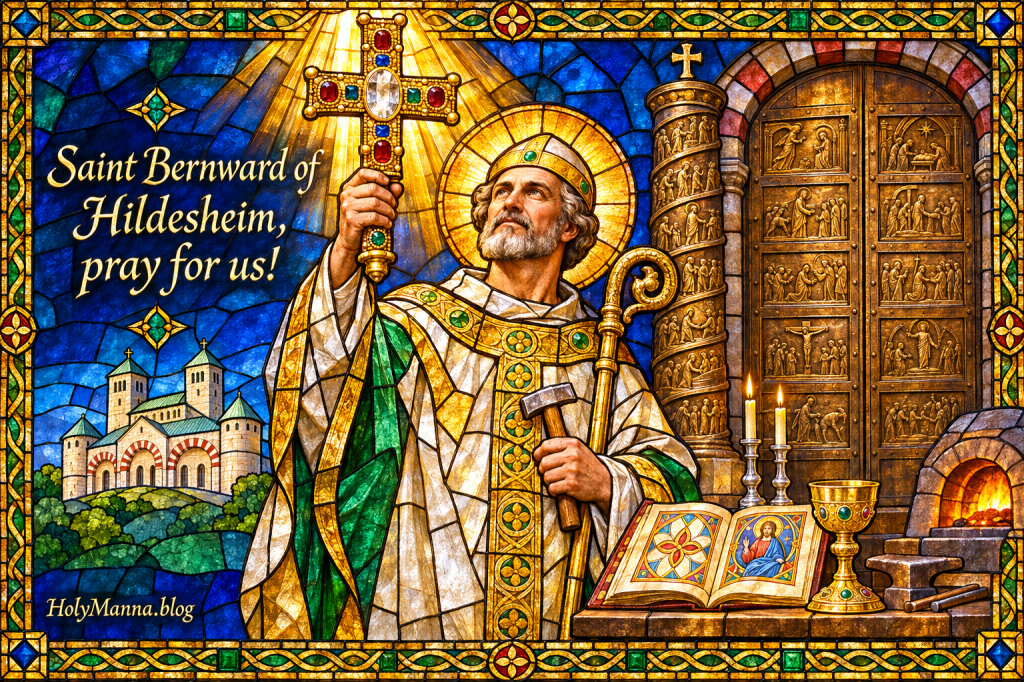
A Bishop With a Hammer in His Hand
Picture a bishop who finishes Mass in his cathedral, sets aside his vestments, and then walks straight into a noisy workshop to check on the goldsmiths, the painters, and the bronze casters. That is Saint Bernward of Hildesheim, the 13th Bishop of Hildesheim in Saxony, who shepherded his diocese from 993 until his death on November 20th, 1022. He tutored an emperor, defended his people behind walls that he ordered built, reformed his clergy through synods, cared for the poor, and filled his city with some of the most beautiful sacred art of the Middle Ages. The bronze doors and the bronze column of Hildesheim, along with the Church of Saint Michael, still carry his name 1,000 years later.
The Church remembers him every year on November 20th. The Roman Martyrology sums up his life by recalling that he protected his flock from invasion, renewed the discipline of the clergy through many synods, and encouraged monastic life. He is venerated as the patron saint of architects, goldsmiths, painters, and sculptors, and he is honored as a patron of the Diocese of Hildesheim. In sacred art he usually appears as a bishop holding a jeweled cross, or as a craftsman shaping a chalice with a goldsmith’s hammer.
Bernward matters today because he shows that holiness and hard work, prayer and skill, beauty and truth all belong together. The Catechism teaches that “man also expresses the truth of his relationship with God the Creator by the beauty of his artistic works” (CCC 2501). Bernward lived that sentence with his whole life. By canonizing saints like him, the Church “recognizes the power of the Spirit of holiness within her” and offers the faithful models and intercessors (CCC 828).
A Saxon Orphan in the Cathedral School
Bernward was born around the year 960 into the high nobility of Saxony. The exact date was never recorded, and the sources that offer a year range from about 950 to 960. His maternal grandfather was Adalbero, Count Palatine of Saxony, whose name also appears as Athelbero. His uncle Volkmar, also written Folkmar, was Bishop of Utrecht. The family was personally connected to the Saxon emperors who ruled the Holy Roman Empire.
The Catholic Encyclopedia reports that Bernward lost his parents at an early age and came under the care of his uncle Volkmar. The bishop entrusted the boy to a gifted teacher named Thangmar, the master of the cathedral school. A small correction belongs here. The 1907 Catholic Encyclopedia article places this school at Heidelberg, and many websites repeat that detail. The New Catholic Encyclopedia, the Diocese of Hildesheim, and the wider historical record all place Thangmar and his school at Hildesheim itself.
Thangmar became the great friend of Bernward’s life. He later served as dean of the cathedral, traveled with Bernward to Rome, and began the biography known as the Vita Bernwardi, the Life of Bernward, which remains the main source for the saint’s story. Much of it comes from an eyewitness who loved his subject, although scholars have shown that later hands expanded the Life around 1150 and again in 1192, when Hildesheim was seeking Bernward’s canonization. An honest telling therefore separates what Thangmar saw from what later generations added.
Under Thangmar, the young Bernward advanced quickly in piety, in the sciences, and in the practical arts. He became skilled in mathematics, painting, architecture, and especially in the making of sacred vessels of silver and gold. He completed his studies at Mainz, where he was ordained a priest by Archbishop Saint Willigis, the Chancellor of the Empire.
Then came a choice that reveals his heart. Offered a valuable position in his uncle’s diocese, Bernward turned it down. He chose instead to stay beside his aged grandfather Adalbero and to comfort him in his final years. The career could wait, and the grandfather could not. The Catechism teaches that the fourth commandment asks grown children to give their elders “material and moral support in old age and in times of illness, loneliness, or distress” (CCC 2218). Bernward gave exactly that.
After his grandfather died in 987, Bernward entered the imperial court as a chaplain. Empress Theophanu, the Byzantine princess who was governing as regent, soon made him tutor to her son, the boy king Otto III, who was about 6 or 7 years old. Bernward shared the work of forming the young ruler with the brilliant scholar Gerbert of Aurillac, who later became Pope Sylvester II. Otto grew into a learned and devout prince, and he never forgot his teacher.
In January of 993, Bernward was elected Bishop of Hildesheim, and he was consecrated on January 15th, 993. He would hold the office for nearly 30 years.
Gold for the Altar, Walls for the Flock
As bishop, Bernward kept a rhythm that would exhaust most people. Thangmar describes how, after carrying out his duties in the cathedral, he made the rounds of the workshops attached to the cathedral school, and how he fashioned vessels of gold and silver for the altars with his own hands. Butler’s Lives of the Saints adds that he gave the day to the work of his office and a great part of the night to prayer. The Catholic Encyclopedia calls him a man of extraordinary piety, devoted to prayer and to mortification.
The fruit of those workshops is still standing. The Bernward Doors, dated 1015, are two bronze leaves about 4.7 meters tall, and each leaf was cast as a single piece, a staggering technical feat for the time. The left leaf carries 8 scenes from Genesis, and the right leaf carries 8 scenes from the life of Christ. The scenes are paired on purpose. The fall of Adam and Eve sits directly across from the Crucifixion, so that the wound and the cure face one another. The Catechism, quoting Saint Augustine, says that “the New Testament lies hidden in the Old and the Old Testament is unveiled in the New” (CCC 129). It also teaches that “Christian iconography expresses in images the same Gospel message that Scripture communicates by words” (CCC 1160). For people who could not read, Bernward’s doors were a Bible in bronze. A Latin inscription added after his death records the gift: “In the year of the Lord’s Incarnation 1015, Bishop Bernward, of blessed memory, had these cast doors hung on the front of the angelic temple as a memorial of himself.”
Around 1020 came the Bernward Column, a bronze pillar modeled on the Column of Trajan, which Bernward had seen in Rome. Where the Roman emperor’s column spirals upward with scenes of war, Bernward’s column spirals upward with scenes from the public life of Christ. It once carried a cross at its summit, which was destroyed in 1544. A pair of candlesticks associated with him bears an inscription that is almost playful in its pride: “Bishop Bernward ordered his servant to cast this candlestick in the first flowering of this art, not of gold, not of silver, and yet as you see.”
Thangmar says that Bernward worked at the bench himself. Modern scholars are more careful, and they tend to see him as the patron and guiding mind of the workshops. The jeweled Bernward Cross, for example, probably took its present form around 1130 to 1140, although it holds the relic of the Holy Cross that he gave to Hildesheim. What no one disputes is that the vision was his.
Thangmar’s narrative is plain and factual, and the standard Catholic reference works record no catalogue of miracles performed by Bernward while he lived. One cherished tradition does survive, and it concerns the relic of the True Cross. The documented part is that Emperor Otto III gave Bernward a relic of the Cross of Christ, and that Bernward built a chapel of the Holy Cross and prepared a precious reliquary to honor it. The tradition, preserved in later art such as the Stammheim Missal, goes further and says that an angel brought Bernward a fragment of the Cross so that he could complete the reliquary. It is a beautiful story, but it cannot be verified. The Church teaches that the miracles of Christ and the saints are signs that support faith (CCC 156), and she is careful to separate what is attested from what is simply loved.
Bernward’s holiness shows most clearly in ordinary pastoral work. He held diocesan synods to shape the worship and the discipline of his parishes. He founded houses of religious women at Heiningen and Steterburg, established a community of canons at Ölsburg, and supported the monastic reform of his age. Accounts of his life also stress his care for the poor, which the Catechism counts among the works of mercy by which Christians “come to the aid of our neighbor in his spiritual and bodily necessities” (CCC 2447).
He also protected his people in the most literal way. The Catholic Encyclopedia speaks of fortifications raised against pagan Norman raiders, and German sources describe a campaign against rebellious Slavs along the Elbe in 994 and 995, the building of fortresses at Mundburg and Wahrenholz, and a wall around the cathedral district, parts of which still stand. A shepherd who builds walls is not abandoning the Gospel. The Catechism teaches that “legitimate defense can be not only a right but a grave duty for one who is responsible for the lives of others” (CCC 2265).
His crowning work was the Benedictine monastery and church of Saint Michael. Most sources date the foundation stone to 1010. Bernward consecrated the crypt on September 29th, 1015, and he designed it as his own burial place. In a testament dated 1019, he compared his project to Solomon building the Temple, and he wrote of pondering by what “architecture of merits” he might gain heaven. That phrase can sound like a man trying to buy his salvation, but the Catechism teaches that “the charity of Christ is the source in us of all our merits before God” (CCC 2011), because God “has freely chosen to associate man with the work of his grace” (CCC 2008). Bernward was not bribing heaven. He was answering grace with everything he had. Later writers gave him a title taken from The First Letter to the Corinthians, where Saint Paul describes himself “as a wise architect” (1 Cor 3:10).
Riots, Rivals, and a Humble Grave
Bernward was not a martyr, and he died in his bed. His cross came in the form of a long and bitter quarrel, some real danger, and at least one serious mistake.
The quarrel is known as the Gandersheim dispute. Gandersheim was a wealthy abbey of canonesses that had been founded on land belonging to Hildesheim and had later moved just across the border into the territory of Mainz. When Sophia, the daughter of Emperor Otto II and the sister of Otto III, entered the abbey, she wanted the powerful Archbishop Willigis of Mainz to preside in place of the local bishop, and Mainz then claimed the abbey as its own. Bernward inherited the conflict, and it grew worse after he sent Sophia back to her cloister from a long stay at her brother’s court.
Matters exploded in September of 1000. Bernward arrived on September 14th to consecrate the rebuilt abbey church and found that nothing had been prepared, because the ceremony had been moved without him. He celebrated Mass, protested publicly, and the liturgy dissolved into an uproar. Willigis arrived a week later and summoned a synod to settle the matter in favor of Mainz.
Bernward did not answer with force. He appealed to Rome. He reached the city on January 4th, 1001, and laid his case before Pope Sylvester II and Emperor Otto III. On January 13th, a papal synod annulled the proceedings at Gandersheim, confirmed the rights of Hildesheim, and sent Willigis a sharp letter. Back in Germany, the decision was simply ignored. Armed supporters of the archbishop broke up a synod at Pöhlde in June of 1001 before the papal letter could be read, and soldiers gathered by Sophia barred Bernward from the abbey.
The conflict dragged on until about the turn of 1006 to 1007, when King Saint Henry II attended the consecration of the abbey church and declared that Gandersheim belonged to the bishops of Hildesheim. Willigis accepted the ruling, and the two bishops were reconciled. The quarrel flared again shortly before Bernward died, and it was settled for good only after his death. Two details deserve honesty. Thangmar tells this story as a partisan of his bishop, and Willigis is himself venerated as a saint. Holy people can disagree sharply, and what matters is that they submit their quarrel to the Church and seek peace in the end.
The journey to Rome also brought physical danger. In early 1001, the Romans rose against Otto and besieged him in his own palace. According to Thangmar, who was present, Bernward heard the confessions of the emperor’s companions, celebrated Mass for them, and then went out at their head carrying the Holy Lance, one of the most treasured relics of the empire. Thangmar was an eyewitness, and he was also an admirer, so the scene should be received with that in mind. Otto III died in January of 1002, at only 21 years of age, and Bernward lost his pupil and his friend.
Then came the mistake. In the struggle over the succession, Bernward at first backed Margrave Ekkehard of Meissen and not the future Henry II. Ekkehard’s sudden death spared Bernward the consequences, and Thangmar quietly leaves the episode out of the Life. It should be told anyway. The Catechism is frank that “all members of the Church, including her ministers, must acknowledge that they are sinners” (CCC 827). Bernward recovered, served Henry II loyally, and around 1007 made a pilgrimage to Saint Denis and to the tomb of Saint Martin at Tours, where he met King Robert II of France and received relics for his diocese.
His final weeks read like a carefully prepared farewell. On September 29th, 1022, the feast of Saint Michael, he consecrated his still unfinished abbey church. On November 11th, the feast of Saint Martin, he received the Benedictine habit. He died 9 days later, on November 20th, 1022, and was buried in the crypt he had built. This is why he is sometimes called a Benedictine bishop, although he wore the habit for little more than a week.
The words he left on his tomb are the closest thing to a personal testimony that survives. Around the lid of his stone sarcophagus runs the cry of Job: “For I know that my Redeemer liveth, and in the last day I shall rise out of the earth” (Job 19:25). On the slab above it, the builder of Saint Michael’s speaks with startling humility: “I, Bernward, was part of a man. Now I am pressed down in this dread sarcophagus, worthless and, behold, ashes. Alas, that I did not bear the height of my office well. May gentle peace be upon my soul, and you, sing Amen.” The Church firmly believes that the righteous will live forever with the risen Christ and that He will raise them up on the last day (CCC 989). Bernward carved that hope in stone and then lay down beneath it.
A Tomb That Became a Destination
The Diocese of Hildesheim records that Bernward’s grave in the crypt of Saint Michael quickly became a destination for pilgrims. Around 1150, a first effort was made to have him recognized as a saint. The sources describe the result differently, with some speaking of a local recognition that allowed an altar to be raised over his remains, and others calling it an attempt that fell short.
The decisive moment came in 1192. A papal legate, Cardinal Cinthius, was returning from Scandinavia when war left him stranded in Hildesheim, and the monks of Saint Michael gave him lodging. He advised that the miracles attributed to Bernward be sworn to under oath before himself and the local bishop, and he encouraged the abbot of Saint Michael to carry the cause to Rome. Pope Celestine III canonized Bernward. The dates vary from source to source. Several place the Pope’s decision in December of 1192, others give January 8th, 1193, and Butler points to 1194. The simplest reading is that the canonization was decided at the end of 1192, published at the start of 1193, and celebrated at Hildesheim in 1194, where the raising of his relics is still commemorated on August 16th.
The miracles presented for the canonization were of the kind expected at the time. They included the blind receiving sight, the paralyzed walking, prisoners set free, and people rescued from shipwreck through his intercession. These accounts come from the versions of the Life that were prepared for the canonization itself, and the individual stories cannot be independently verified today. The Church’s judgment in canonizing him stands on its own authority (CCC 828). The Catechism explains why Catholics turn to the saints at all, since those who dwell with Christ “do not cease to intercede with the Father for us” (CCC 956).
The fate of his relics follows the troubled history of Germany. After the Reformation, the Church of Saint Michael became Lutheran, while the crypt with Bernward’s tomb remained in Catholic hands, an arrangement that continues today. When the monastery was dissolved in 1803, the sarcophagus was emptied. Most of his relics now rest in the Church of Saint Magdalene in Hildesheim, and medieval reliquaries made in his honor are kept in the cathedral treasury. The veneration of relics and the practice of pilgrimage are forms of piety that the Catechism names among the religious expressions of the Christian people (CCC 1674), and it recalls that “the honor rendered to an image passes to its prototype” (CCC 2132). Pilgrims honor Bernward’s bones and Bernward’s bronze because both point beyond themselves to Christ.
His city remains his monument. Saint Mary’s Cathedral and Saint Michael’s Church in Hildesheim were inscribed together as a UNESCO World Heritage Site in 1985. The Bernward Doors and the Bernward Column now stand in the cathedral, and the Church of Saint Michael, completed under his successor Saint Godehard, is regarded as one of the key buildings of early Romanesque architecture. Churches bear his name in Hildesheim and in Hanover, a 13th century chapel in Klein Düngen is dedicated to him, and a hospital in Hildesheim carries his name.
Building With What Has Been Given
Bernward’s life asks a simple question of every Christian. What are you building, and for whom are you building it?
The first lesson is that your work can be an offering. Bernward did not treat prayer as holy and craftsmanship as merely useful. The Catechism teaches that “work honors the Creator’s gifts and the talents received from him” (CCC 2427). Saint Paul says the same thing more bluntly: “Whatsoever you do, do it from the heart, as to the Lord, and not to men” (Col 3:23). The spreadsheet, the lesson plan, the weld, and the family meal can all be placed on the altar. What would change about your Monday if you began your work by offering it to God?
The second lesson is that beauty serves the truth. Bernward’s doors have preached the Gospel without a word for 10 centuries. Sacred art, the Catechism says, is “true and beautiful when its form corresponds to its particular vocation”, which is to draw the heart to adoration and to love of God (CCC 2502). You do not need a foundry to practice this. You can keep a crucifix where you will see it, give time to a beautiful church, sing at Mass with your whole voice, or bring care and order to your home. Where could a little more beauty help your household pray?
The third lesson is how to carry a conflict. Bernward was wronged, publicly and repeatedly, and he answered by appealing to the proper authority, waiting years for a resolution, and accepting reconciliation when it came. Jesus says, “Blessed are the peacemakers: for they shall be called the children of God” (Mt 5:9). Is there a dispute in your family, your parish, or your workplace that you are trying to win and not to heal?
The fourth lesson is the one carved on his tomb. The man who had every reason to boast asked only for mercy. The Catechism observes that “remembering our mortality helps us realize that we have only a limited time in which to bring our lives to fulfillment” (CCC 1007). A nightly examination of conscience and regular confession keep that perspective alive. The psalmist adds the warning that every builder needs: “Unless the Lord build the house, they labour in vain that build it” (Ps 127:1).
Finally, remember the young priest who gave up a promotion to sit with his grandfather. Before the bronze and the gold, there was a quiet act of faithfulness that no one would have recorded if his teacher had not noticed. Who in your life needs your presence more than your success?
Engage With Us!
Share your thoughts and reflections in the comments below. Saint Bernward’s story touches work, beauty, conflict, and the hope of resurrection, and your experience can encourage someone else who is reading today.
- Bernward offered his artistic talent entirely to the service of the Church. What gift or skill has God given you, and how are you using it for Him right now?
- The Bernward Doors place the fall of Adam and Eve directly across from the Crucifixion. Where have you seen God answer a wound in your own life with His mercy?
- Bernward turned down an attractive position in order to care for his aging grandfather. What sacrifice might love of family be asking of you in this season?
- During the Gandersheim dispute, Bernward appealed to the Church and waited years for peace. How do you usually respond when you are treated unjustly, and what would patience look like?
- On his tomb, Bernward confessed his failings and proclaimed that his Redeemer lives. If you wrote one honest sentence for your own epitaph today, what would it say?
Saint Bernward spent his strength so that others could see the beauty of God and walk through the door that is Christ. Take up your own tools today, whatever they are, and build something that will last. Live a life of faith, and do everything with the love and mercy that Jesus taught.
Saint Bernward of Hildesheim, pray for us!
Follow us on YouTube, TikTok, Instagram and Facebook for more insights and reflections on living a faith-filled life.


Leave a Reply