Friday of the Thirty-third Week in Ordinary Time – Lectionary: 501
Honey on the Tongue, Fire in the Belly
Some words go down easy and then change everything once they settle in. Anyone who has ever heard a hard truth from a good friend knows the feeling. On Friday, November 20th, 2026, the Church stands 2 days away from the Solemnity of Christ the King, the final Sunday of the liturgical year, and the readings for this Friday of the 33rd Week in Ordinary Time carry the urgency of an ending. The weekday Lectionary spends these closing weeks in The Book of Revelation, while The Gospel of Luke follows Jesus into Jerusalem before His Passion.
The central theme uniting today’s readings is that the Word of God is meant to be taken in whole, tasted as sweetness, and then lived at a cost. In the First Reading, John is told to eat a scroll that tastes like honey and then turns his stomach sour. In the Responsorial Psalm, the longest psalm in the Bible sings that God’s promises are “sweeter than honey.” In the Gospel, Jesus clears the Temple of commerce so that it can be what God intended, “a house of prayer,” and then He fills that cleared space with daily teaching while the people hang on His words.
In ancient Israel, a prophet absorbed a message before he delivered it. Ezekiel ate a scroll centuries before John did, and Jeremiah spoke of devouring God’s words. The Temple was the one place on earth where Israel believed heaven touched the ground. Put together, these readings show a God who wants His Word inside His people and His people inside His house. The sweetness is real, the cost is real, and both come from a Father who knows how to feed His children.
First Reading — Revelation 10:8-11
The Scroll That Tastes Like Honey and Sits Like a Stone
By the time John wrote down his visions, the Church in Asia Minor was learning what it cost to belong to Christ. An early tradition, recorded by Saint Victorinus of Pettau, a bishop and martyr who died around the year 304, holds that John received these visions while condemned to the mines on the island of Patmos under the emperor Domitian. By chapter 10, 6 trumpets have sounded, the 7th is still waiting, and a mighty angel plants one foot on the sea and one on the land with a small scroll lying open in his hand. Only yesterday the weekday readings showed a sealed scroll that no one but the Lamb could open. Today that Word lies open, and a disciple is told to eat it. This scene sets the pattern for the whole day, because God’s Word must be taken in before it can be given out.
Revelation 10:8-11
I, John, heard a voice from heaven speak to me.
Then the voice spoke to me and said:
“Go, take the scroll that lies open in the hand of the angel
who is standing on the sea and on the land.”
So I went up to the angel and told him to give me the small scroll.
He said to me, “Take and swallow it.
It will turn your stomach sour,
but in your mouth it will taste as sweet as honey.”
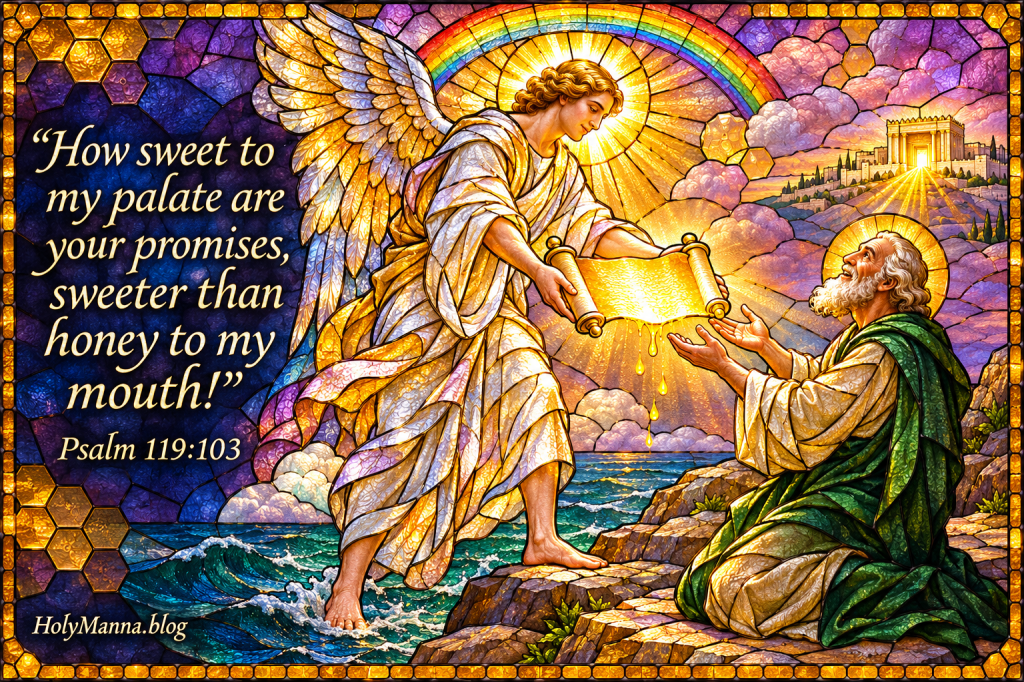
I took the small scroll from the angel’s hand and swallowed it.
In my mouth it was like sweet honey,
but when I had eaten it, my stomach turned sour.
Then someone said to me, “You must prophesy again
about many peoples, nations, tongues, and kings.”
Detailed Exegesis
Verse 8
“I, John, heard a voice from heaven speak to me. Then the voice spoke to me and said: ‘Go, take the scroll that lies open in the hand of the angel who is standing on the sea and on the land.’”
John is not handed the scroll while he sits still, because he is told to go and take it. The scroll lies open, which means its message is no longer sealed or secret. The angel who holds it stands on both sea and land, a sign that this Word concerns the whole created world. God offers His revelation freely, yet He waits for the disciple to step forward and receive it.
Verse 9
“So I went up to the angel and told him to give me the small scroll. He said to me, ‘Take and swallow it. It will turn your stomach sour, but in your mouth it will taste as sweet as honey.’”
John obeys and asks. Saint Bede the Venerable saw a lesson for every believer in that simple request: “Let him come to the Lord who wishes to receive the sacraments of teaching.” Bede explains that to take the scroll means to “place it in thy inward parts, and write it down in the breadth of the heart.” The image comes straight from Ezekiel 3:3, where the prophet says, “I ate it, and it was as sweet as honey in my mouth,” even though his scroll was filled with lamentation and woe. The angel names the sour stomach before John takes a single bite, because God never hides the cost of discipleship in the fine print.
Verse 10
“I took the small scroll from the angel’s hand and swallowed it. In my mouth it was like sweet honey, but when I had eaten it, my stomach turned sour.”
Everything happens exactly as promised. Saint Victorinus explains the eating in very practical terms: “To take the book and eat it up, is, when exhibition of a thing is made to one, to commit it to memory.” He then accounts for both flavors: “To be sweet in the mouth is the reward of the preaching of the speaker, and is most pleasant to the hearers; but it is most bitter both to those that announce it, and to those that persevere in its commandments through suffering.” The sweetness is real, because the Gospel is mercy, victory, and the promise of heaven. The bitterness is real too, because the same Word announces judgment on sin and asks its messengers to suffer for it.
Verse 11
“Then someone said to me, ‘You must prophesy again about many peoples, nations, tongues, and kings.’”
The meal was never meant to be private. The word “must” signals a divine necessity, and the audience is as wide as the world. Victorinus connects this verse to the tradition of John’s release after the death of Domitian: “And John being dismissed from the mines, thus subsequently delivered the same Apocalypse which he had received from God.” Whatever the exact history, the spiritual logic is clear. The Word that has been swallowed has to be spoken, even when the stomach is still turning.
Teachings
The Church takes this image of eating the Word with great seriousness. CCC 103 teaches that the Church honors the Scriptures with the same reverence she gives the Lord’s Body, because both are served to the faithful from a single table. The Second Vatican Council used the same picture in Dei Verbum 21, speaking of “the table both of God’s word and of Christ’s body.” At every Mass, Catholics are fed twice, first from the ambo and then from the altar.
Saint Jerome, the great Doctor of Scripture, put the stakes bluntly in a line the Church repeats in CCC 133: “Ignorance of the Scriptures is ignorance of Christ.” Believers cannot love a Lord they have never listened to.
The command to “prophesy again” also belongs to every baptized person. CCC 904 and CCC 905 teach that lay people share in the prophetic office of Christ by announcing Him through their words and through the witness of their lives. CCC 1816 adds that a disciple is called to guard the faith, to confess it openly, to pass it on, and to be ready to walk the way of the Cross, since persecution has never been absent from the life of the Church.
Reflection
The scroll teaches that Scripture is food and not decoration. A practical first step is to read the daily Mass readings slowly over morning coffee, so that the Word is already familiar when you hear it proclaimed. A second step follows Victorinus. Choose one verse each week and commit it to memory, so that it is available when temptation or anxiety arrives. A third step is to stay at the table when the Word turns bitter, whether that means a teaching that challenges a habit or a moment when speaking up for the faith will cost you some comfort.
Which part of the Catholic faith tastes sweet to you right now, and which part is sitting heavy in the stomach? Is there a teaching of Christ that you have admired from a distance but never fully swallowed? Who is the one person who needs to hear a word of faith from you this week?
Responsorial Psalm — Psalm 119:14, 24, 72, 103, 111, 131
A Love Song Written in Alphabetical Order
Psalm 119 is the giant of the Psalter. Pope Benedict XVI, in his General Audience of November 9th, 2011, noted that it contains 176 verses arranged in 22 stanzas of 8 verses each, with one stanza for every letter of the Hebrew alphabet. Within each stanza, every line begins with the same Hebrew letter, as if the poet wanted to praise the Word of God with everything from A to Z. Nearly every verse uses a different name for that Word, including law, decrees, commands, and promises. Benedict XVI taught that for this psalmist the divine Law is no crushing burden. It is “a liberating gift of grace that brings happiness.” Today’s selection lifts 6 verses from 6 different stanzas and crowns them with a refrain that answers the First Reading directly: “How sweet to my taste is your promise!”
Psalm 119:14, 24, 72, 103, 111, 131
R. (103a) How sweet to my taste is your promise!
In the way of your decrees I rejoice,
as much as in all riches.
R. How sweet to my taste is your promise!
Yes, your decrees are my delight;
they are my counselors.
R. How sweet to my taste is your promise!
The law of your mouth is to me more precious
than thousands of gold and silver pieces.
R. How sweet to my taste is your promise!
How sweet to my palate are your promises,
sweeter than honey to my mouth!
R. How sweet to my taste is your promise!
Your decrees are my inheritance forever;
the joy of my heart they are.
R. How sweet to my taste is your promise!
I gasp with open mouth
in my yearning for your commands.
R. How sweet to my taste is your promise!
Detailed Exegesis
Verse 14
“In the way of your decrees I rejoice, as much as in all riches.”
The psalmist compares obedience to a windfall. In a culture where wealth meant security, he says that walking the path of God makes him feel as secure as a man with a full treasury. Saint Augustine, preaching on this verse, taught that there is no quicker or surer way to the testimonies of God than Christ Himself. He pointed to Colossians 2:3 and its promise that in Christ are hidden “all the treasures of wisdom and knowledge.” The way of God’s decrees turns out to be a Person.
Verse 24
“Yes, your decrees are my delight; they are my counselors.”
Ancient kings surrounded themselves with advisers. In this stanza the psalmist says that princes are speaking against him, so he assembles a different cabinet. The decrees of God sit at his table and advise him. When powerful voices pull in one direction, the believer asks first what God has already said.
Verse 72
“The law of your mouth is to me more precious than thousands of gold and silver pieces.”
The phrase “the law of your mouth” is tender. This is not a rulebook dropped from the sky, because it is speech from a Father to a child. The verse closes a stanza in which the psalmist admits that affliction taught him to value the statutes of God. Saint Augustine summed up the verse in one memorable line: “love loves the law of God more than avarice loves thousands of gold and silver.” Greed is a powerful engine, and Augustine insists that love is a stronger one.
Verse 103
“How sweet to my palate are your promises, sweeter than honey to my mouth!”
Honey was the sweetest thing an ancient Israelite could taste, and it was woven into the promise of a land flowing with milk and honey. The psalmist says that the promises of God outdo it. Saint Augustine explains what kind of sweetness this is. It means doing good “not from the dread of carnal evil, but from the gladness of spiritual good,” and he adds that this honey “is sweet to the mouth of the heart, not to the mouth of the flesh.” Holiness stops being a chore and starts being a craving.
Verse 111
“Your decrees are my inheritance forever; the joy of my heart they are.”
In Israel an inheritance meant land, the family plot handed down through generations. The psalmist claims something that cannot be foreclosed on or lost in exile. Augustine read this verse as the voice of a witness who holds onto the testimonies of God through suffering and receives eternal glory instead of passing fame.
Verse 131
“I gasp with open mouth in my yearning for your commands.”
The image is of someone out of breath and panting for air. Augustine heard in it the confession of a weak person who cannot keep the commands of God alone, who opens his mouth to admit that weakness, and who draws in the Holy Spirit as strength. The open mouth also links back to John. Both men open wide, and both are fed.
Teachings
CCC 2587 teaches that in the Psalter the Word of God turns into human prayer. Psalm 119 is that teaching in miniature, since every line takes what God has spoken and hands it back to Him as love. The Church prays portions of this psalm throughout the Liturgy of the Hours.
This psalm also corrects a common misunderstanding about law. CCC 1950 describes the moral law as the work of divine Wisdom and as a kind of fatherly instruction that shows God’s children the paths leading to happiness. CCC 1966 teaches that the New Law is the Holy Spirit’s own grace, poured into believers through faith in Christ, which is why Augustine could say that the open mouth of the psalmist drinks in the Spirit. In his 2011 catechesis, Pope Benedict XVI pointed to the Blessed Virgin Mary as the model of everything this psalm describes. She is the one who kept the Word of God and pondered it in her heart, as Luke 2:19 records.
Reflection
Psalm 119 invites an honest look at what actually delights you. A simple practice is to take the refrain, “How sweet to my taste is your promise,” and repeat it slowly a few times during the day, especially when you reach for a phone out of boredom. Another practice is to seat God’s counselors first. Before a big decision about work, money, or a relationship, read what Scripture and the Catechism say before polling friends or scrolling for opinions. A third practice is to pray for the craving itself, since the hunger of the psalmist was a gift before it was a habit.
What would your bank statement and your screen time say you treasure more than gold? Whose advice gets heard first when your life gets complicated? When was the last time a verse of Scripture tasted sweet to you, and what would it take to return to that table?
Holy Gospel — Luke 19:45-48
Clearing the House So the Word Can Be Heard
Jesus has just ridden into Jerusalem to shouts of praise, and He has just wept over the city because it did not recognize “the time of your visitation,” as Luke 19:44 puts it. His very next stop is the Temple. It is the week of Passover, and the city is packed with pilgrims who need animals for sacrifice and the proper coinage for the Temple offering. A marketplace had grown up inside the sacred precincts to meet that need, most likely in the large outer court, which was the only place where Gentiles were permitted to pray. Luke tells this story more briefly than any other evangelist. He gives the action in one sentence and then lingers on what follows, which is Jesus teaching every day while the people hang on His words. The house is cleared so that the Word can fill it, and that is exactly where the scroll and the psalm have been leading.
Luke 19:45-48
Jesus entered the temple area and proceeded to drive out
those who were selling things, saying to them,
“It is written,
My house shall be a house of prayer,
but you have made it a den of thieves.”
And every day he was teaching in the temple area.
The chief priests, the scribes, and the leaders of the people, meanwhile,
were seeking to put him to death,
but they could find no way to accomplish their purpose
because all the people were hanging on his words.
Detailed Exegesis
Verse 45
“Jesus entered the temple area and proceeded to drive out those who were selling things,”
Pope Saint Gregory the Great noticed the sequence of events: “When He had related the evils that were to come upon the city, He straightway entered the temple, that He might cast out them that bought and sold in it.” For Gregory, the order is a diagnosis. He taught that the ruin of the people was owed above all to the sins of those who served the Temple. CCC 584 teaches that Jesus went up to the Temple as “the privileged place of encounter with God” and that His anger at the merchants flowed from love for His Father.
Verse 46
“saying to them, ‘It is written, “My house shall be a house of prayer, but you have made it a den of thieves.”’”
Jesus stitches together 2 prophets. The first half comes from Isaiah 56:7, where God promises that foreigners who love Him will be welcome in “a house of prayer for all peoples.” The second half comes from the Temple sermon in Jeremiah 7, where the prophet warns people who lived unjustly and then ran to the Temple for cover. A den is not where thieves rob. It is where they hide afterward and feel safe. Jesus is saying that worship had become a hiding place from conversion. Saint Ambrose draws the lesson plainly: “For God wishes not His temple to be a house of traffic, but the dwelling-place of holiness, nor does He fix the priestly service in a salable performance of religion, but in a free and willing obedience.”
Verse 47
“And every day he was teaching in the temple area. The chief priests, the scribes, and the leaders of the people, meanwhile, were seeking to put him to death,”
The cleansing was a means, and the teaching was the goal. Having cleared the space, Jesus fills it with His own voice day after day. The 3 groups named here represent the religious and civic leadership of Jerusalem, and their response to daily truth is a plot to kill. Saint Bede names one likely motive: “they sought to destroy Him because they perceived their own authority set aside, and multitudes flocking to hear Him.” The same Word that tastes like honey to the hungry turns sour in the stomach of those who refuse it.
Verse 48
“but they could find no way to accomplish their purpose because all the people were hanging on his words.”
The Greek of Luke paints a vivid picture here, since the people are described as literally hanging upon Jesus as they listen. Their attention becomes His protection. This is the gasping mouth of the psalmist and the open hand of John in the form of a crowd. Ordinary people, standing in a freshly cleared court, cannot get enough of the Word made flesh.
Teachings
CCC 583 through CCC 586 teach that Jesus revered the Temple, that He did the heart of His teaching there, and that He presented Himself as the place where God definitively dwells with humanity. CCC 1197 carries this forward by naming Christ as the true temple and by teaching that grace makes each Christian a temple of the Holy Spirit and a living stone in the Church. Saint Paul says it directly to the baptized in 1 Corinthians 3:16: “you are the temple of God.”
That is why the Fathers refused to leave this Gospel in the past. Gregory the Great applied it to every soul: “The temple also is the soul of the faithful, which if it put forth corrupt thoughts to the injury of a neighbor, then is it become as it were a lurking place of thieves.” He then added the hopeful half: “But when the soul of the faithful is wisely instructed to shun evil, truth teaches daily in the temple.”
The parish church inherits this dignity as well. CCC 2691 names the church building as the home of the liturgical prayer of the parish and as the favored place for adoring Christ present in the Blessed Sacrament. The Jerusalem Temple itself was destroyed by Roman armies in the year 70, as Jesus had foretold, and CCC 585 connects that prophecy to His own Passover.
Reflection
Jesus still walks into temples and looks around. The first practical step is to name the tables that have been set up in your own heart, whether that is a phone that interrupts every prayer, a grudge that has been given free rent, or a habit of bargaining with God instead of adoring Him. The second step is to let Him do the clearing in the Sacrament of Confession, where the cleansing of the Temple becomes personal. The third step is to imitate the crowd by giving Jesus a daily appointment, even 10 minutes with the Gospel, because He taught “every day.” A fourth step is to treat your parish church as a house of prayer by arriving early, keeping silence, and greeting the Lord in the tabernacle before anyone else.
What is being bought and sold in your heart during the time that belongs to God? Has church become a place to hide from conversion or a place to be changed? What would it look like this week for you to hang on the words of Jesus?
The Honey Is Still on the Table
Picture the day as a single story. An old apostle reaches out and takes a small scroll from the hand of an angel. It tastes like honey, it sits like a stone, and he is sent back out to speak to the nations. Centuries earlier, a poet in Israel had run out of alphabet trying to say how sweet the promises of God are, gasping for them the way a runner gasps for air. Then the Word Himself walks into His Father’s house, clears away the clutter, and teaches until an entire crowd is hanging on every syllable.
The thread running through all 3 readings is simple. God wants to feed His people with His Word, and He is willing to clear out whatever stands in the way. The sweetness is His mercy, His promises, and His presence. The sourness is the conversion that His Word demands and the witness that it requires. Neither one can be skipped, and both are gifts from a Father who loves His children too much to leave them unfed or unchanged.
As the liturgical year draws to its close and the Solemnity of Christ the King approaches, today’s readings ask every believer to make room. The call is to open the Scriptures and eat, to let Christ drive out what does not belong, and to stay near Him long enough to hang on His words. A heart that does this becomes what the Temple was always meant to be, a house of prayer where the King is at home. The honey is still on the table, and the invitation is still open.
Engage With Us!
Share your reflections in the comments below. The Word of God is meant to be tasted together, and your insight might be exactly what another reader needs today. Here are some questions to pray with and discuss.
- In Revelation 10:8-11, John finds the scroll sweet in his mouth and sour in his stomach. Where has the Word of God been both a comfort and a challenge in your life recently?
- In Psalm 119:14, 24, 72, 103, 111, 131, the psalmist treasures the Word of God above riches. What practical change would help you treasure Scripture more than the things competing for your attention?
- In Luke 19:45-48, Jesus clears the Temple and the people hang on His words. What needs to be driven out of your heart so that it can become a house of prayer again?
- Taken together, today’s readings show a God who feeds His people with His Word and clears a space for them to receive it. How is the Lord inviting you to take in His Word more deeply and then carry it to someone else?
Keep walking in faith, even on the days when the Word asks something hard. Open the Scriptures, guard the temple of your heart, and speak the truth with gentleness. Do everything with the love and mercy that Jesus taught, and trust that He will supply the sweetness along the way.
Sacred Heart of Jesus, we trust in You!
Immaculate Heart of Mary, pray for us!
Saint Michael the Archangel, defend us in battle!
Follow us on YouTube, TikTok, Instagram and Facebook for more insights and reflections on living a faith-filled life.


Leave a Reply