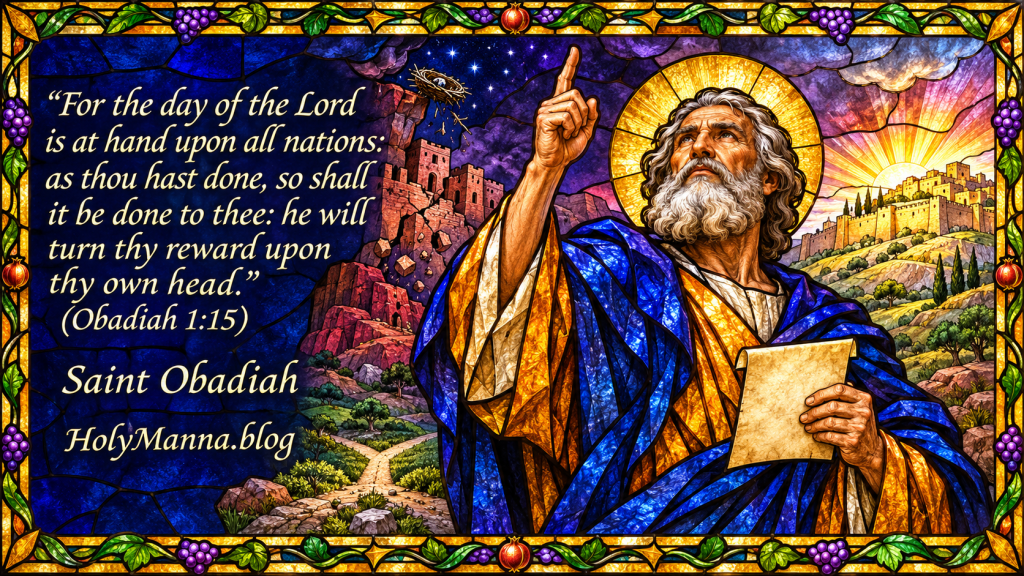
The Smallest Book With the Loudest Echo
Every November 19th, the Church remembers a man who left behind exactly 21 verses and almost nothing else. Saint Obadiah is the author of the shortest book in the Old Testament, a single page tucked between Amos and Jonah that most people flip past without noticing. His name means servant of the Lord, and older Catholic Bibles call him Abdias, the form his name took in Greek and Latin. No one knows his hometown, his family, or the year he died. What survives is his voice, and that voice has been echoing for more than 2,500 years.
The Church has never treated him as a footnote. The Catechism teaches that the patriarchs, the prophets, and certain other figures of the Old Testament have always been honored as saints in every liturgical tradition of the Church, and that they always will be (CCC 61). Obadiah has his own line in the Roman Martyrology on November 19th, where the current edition remembers him as the prophet who, once Israel had gone into exile, announced the anger of the Lord against the nations that had turned on His people.
Saint Jerome, the great Doctor of Scripture, was fascinated by this little book his whole life. Bishop Richard Challoner preserved Jerome’s verdict in his notes to the Douay-Rheims Bible, where he wrote that the prophecy “is the shortest of any in number of words, but yields to none, says St. Jerome, in the sublimity of mysteries.” Obadiah’s message is simple enough to memorize and hard enough to spend a lifetime living. Pride comes before a fall, a brother’s suffering is never a spectator sport, and in the end the kingdom belongs to the Lord. The Scripture quotations in this post come from the Douay-Rheims Bible, which is why the prophet appears as Abdias and Zion appears as Sion inside them.
A Servant With No Biography
Most prophets introduce themselves. Isaiah names his father, Amos mentions his flocks, and Jeremiah gives his hometown and the kings he served. Obadiah offers only this: “The vision of Abdias” (Obadiah 1:1). The old Catholic Encyclopedia is blunt about that silence. Nothing is known of his family, his station in life, his birthplace, or the manner of his death, and the only safe inference from the book itself is that he belonged to the Kingdom of Judah.
The date of his life is honestly disputed. Everything hinges on which disaster he describes when he speaks of foreigners entering the gates of Jerusalem and casting lots over the city. One school places him in the 9th century before Christ, when Philistines and Arabs plundered Jerusalem during the reign of King Joram (2 Chronicles 21:16 to 17). A second school, the most widely held today, places him around the Babylonian destruction of Jerusalem in 587 BC, making him a contemporary of Jeremiah, whose oracle against Edom in Jeremiah 49 closely resembles his own. A third school dates the book later still, and the current Roman Martyrology leans toward a later setting when it describes him as preaching after the exile.
There is also a much older tradition about who he was, and it is a beautiful one. The First Book of Kings describes a court official who served the wicked King Ahab and his queen Jezebel in Samaria: “And Achab called Abdias the governor of his house: now Abdias feared the Lord very much. For when Jezabel killed the prophets of the Lord, he took a hundred prophets and hid them by fifty and fifty in caves, and fed them with bread and water” (1 Kings 18:3 to 4). Ancient Jewish tradition identified this courageous steward with the prophet, and held that God rewarded him with the gift of prophecy because he had sheltered the prophets. Saint Jerome handed that tradition on to the Latin Church, and for centuries the Roman Martyrology reflected it with the simple entry “At Samaria, the holy prophet Abdias.” It fits neatly with the promise of the Lord Jesus: “He that receiveth a prophet in the name of a prophet, shall receive the reward of a prophet” (Matthew 10:41). It must be said plainly that this identification cannot be verified. The steward lived in the 9th century before Christ, the book seems to describe much later events, and many scholars, Catholic ones included, consider the identification mistaken.
What can be said with confidence is how his vocation began, because he says so himself. He received a vision. The Catechism teaches that God is the author of Sacred Scripture and that He inspired its human authors, who wrote as true authors everything He wanted written and nothing more (CCC 105 to 106). At some point the Lord showed Obadiah something, and he wrote it down.
To understand what he saw, it helps to know an old family story. Isaac and Rebekah had twin sons, Esau and Jacob, who struggled with each other even in the womb (Genesis 25:22 to 26). Esau sold his birthright for a bowl of stew, and the brothers spent decades estranged. Jacob’s descendants became Israel. Esau’s descendants became Edom, a nation settled in the red sandstone mountains south of the Dead Sea. The Law of Moses never let Israel forget the bond, commanding that an Edomite was not to be despised “because he is thy brother” (Deuteronomy 23:7). Obadiah’s whole book is about what happened when that brother chose to forget.
The Vision That Named a Brother’s Sin
Obadiah is known for one thing, which is a fearless, compact, poetic indictment of Edom. The setting, on the most common reading, is the worst day in the history of Old Testament Jerusalem. In 587 BC the armies of Babylon broke through the walls, burned the Temple of Solomon, and marched the survivors into exile. Edom, safe in its cliffs, did not come to help. Psalm 136, numbered 137 in most modern Bibles, remembers the Edomites cheering the destruction on with the cry “Rase it, rase it, even to the foundation thereof” (Psalm 136:7).
Obadiah begins with the root of the problem, and it is pride. Edom’s fortresses were carved into high rock, and the nation had come to believe that nothing could touch it. The Lord answers through His prophet: “The pride of thy heart hath lifted thee up, who dwellest in the clefts of the rocks, and settest up thy throne on high: who sayest in thy heart: Who shall bring me down to the ground? Though thou be exalted as an eagle, and though thou set thy nest among the stars: thence will I bring thee down, saith the Lord” (Obadiah 1:3 to 4).
Then comes the charge itself: “For the slaughter, and for the iniquity against thy brother Jacob, confusion shall cover thee, and thou shalt perish for ever. In the day when thou stoodest against him, when strangers carried away his army captive, and foreigners entered into his gates, and cast lots upon Jerusalem: thou also wast as one of them” (Obadiah 1:10 to 11). That last line is the heart of the book. Edom did not start the fire. Edom stood by, and in the eyes of God the bystander became one of the attackers.
The prophet then traces the stages of a betrayal, as Edom first watched, then gloated, and finally joined in. The lowest point is this: “Neither shalt thou stand in the crossways to kill them that flee: and thou shalt not shut up them that remain of him in the day of tribulation” (Obadiah 1:14). Refugees running for their lives found their own relatives waiting for them at the crossroads.
This is why Obadiah matters far beyond ancient politics, for he teaches that sin is not only what a person does, but also what a person refuses to do. The Catechism teaches that the moral law forbids refusing assistance to a person in danger (CCC 2269), and that the Last Judgment will reveal the good that each person has done or failed to do (CCC 1039).
He also announces the principle by which God will judge every nation: “For the day of the Lord is at hand upon all nations: as thou hast done, so shall it be done to thee: he will turn thy reward upon thy own head” (Obadiah 1:15). Yet the book does not end in ashes. Its last movement turns from judgment to hope, and its final verse is one of the great closing lines of the Bible: “And saviours shall come up into mount Sion to judge the mount of Esau: and the kingdom shall be for the Lord” (Obadiah 1:21). The Catechism teaches that through the prophets God formed His people in the hope of salvation and in the expectation of a new and everlasting Covenant meant for all (CCC 64).
As for miracles, honesty requires a plain statement. Sacred Scripture records no miracle worked by Obadiah, and no reliable ancient source attributes one to him during his life. There are 2 stories attached to him through the tradition that identifies him with Ahab’s steward. The first, found in an ancient Jewish work called The Lives of the Prophets, says that he was a disciple of Elijah and the third captain sent to arrest him, the one who begged for mercy and was spared with his 50 soldiers (2 Kings 1:13 to 15). The second says that the poor widow whose jar of oil the prophet Elisha miraculously multiplied was Obadiah’s own widow (2 Kings 4:1 to 7). Scripture names neither the captain nor the widow’s husband, and neither story can be verified.
There is, however, one sign connected to Obadiah that history does confirm, and it is the fulfillment of his word. The Catechism counts prophecies among the signs of divine Revelation which show that the assent of faith is not a blind impulse of the mind (CCC 156). In the centuries after the fall of Jerusalem, Edom lost its mountain homeland to the Nabataean Arabs. Around 125 BC the Jewish ruler John Hyrcanus conquered them and compelled them to accept the Jewish law, and after the Roman destruction of Jerusalem in AD 70 the Edomites vanish from the historical record entirely. The house of Jacob endures to this day, and the nest among the stars is empty.
No Martyr’s Crown, But a Heavy Cross
Obadiah is not honored as a martyr. The Roman Martyrology gives him the title of prophet and nothing more, and no trustworthy account of his death exists. His hardships were of a different kind, and they deserve to be taken seriously.
If he lived through the fall of Jerusalem, as most scholars now think, then he watched everything he loved destroyed. The Temple was burned, the king was blinded and led away in chains, and the survivors who fled south ran straight into Edomite ambushes. To lose a homeland is a terrible suffering. To watch family celebrate the loss is a deeper wound still.
Then came the burden that every true prophet carries. He was asked to speak for God at a moment when, to every outward appearance, God’s cause had been defeated. Babylon was triumphant and Edom was smug, yet Obadiah announced that the proud mountain would fall and the ruined city would be holy again. He had only the word of the Lord to stand on, and he staked everything on it.
It is also worth noticing what he did not do. He did not raise a militia or plot a personal revenge. He named the sin, declared that God had seen it, and left the judgment in God’s hands. That is exactly the path Saint Paul later commands, quoting the Lord: “Revenge is mine, I will repay, saith the Lord” (Romans 12:19). The Catechism teaches that deliberate hatred is contrary to charity and that desiring vengeance in order to do evil to someone is illicit (CCC 2302 to 2303). Obadiah’s oracle is not a tantrum. It is an act of trust that the justice of God is real.
If the ancient tradition about Ahab’s steward is true, his hardships began much earlier. Jezebel was hunting down the prophets of the Lord, and the man who ran the royal household was quietly smuggling bread and water to 100 of them in caves, during a famine, under the queen’s own nose. When Elijah asks him to announce the prophet’s return to Ahab, the steward protests that the king will kill him (1 Kings 18:9 to 14), and then he goes and does it anyway. The Catechism teaches that a citizen is obliged in conscience not to follow the directives of civil authorities when they are contrary to the moral order (CCC 2242), and that fortitude ensures firmness in difficulties and constancy in the pursuit of the good (CCC 1808). Whether the steward and the prophet were the same man cannot be verified, but the steward’s courage shows what a servant of the Lord looks like inside a corrupt system.
A Tomb Beside the Baptist and a Word That Came True
The story of Obadiah after his death leads to a hillside in Samaria. From at least the 4th century, Christians venerated 3 tombs side by side in the city of Sebaste, the Roman name for ancient Samaria. They were honored as the tombs of the prophet Elisha, of Obadiah, and of Saint John the Baptist. Whether the grave shown there truly held the author of the book cannot be verified, and the tradition clearly depends on the identification with Ahab’s steward, who served in that very city. The veneration itself, however, is solidly documented.
The best witness is Saint Jerome. In 404 he wrote a long memorial letter about his friend Saint Paula, the Roman noblewoman who had toured the Holy Land in 385 and 386. He reports that at Sebaste she visited the place where Elisha, Obadiah, and John the Baptist lay, and that what she saw there shook her: “for she saw demons screaming under different tortures before the tombs of the saints, and men howling like wolves, baying like dogs, roaring like lions, hissing like serpents and bellowing like bulls.” Jerome adds: “Paula pitied them all, and shedding tears over them prayed Christ to have mercy on them.” This is the nearest thing to a miracle account connected with Obadiah’s tomb. It comes from a Doctor of the Church writing within 20 years of the visit, so the report itself is historical. Jerome speaks of the tombs of the saints together, however, and no specific healing or deliverance is attributed to Obadiah by name, so his individual part in those events cannot be verified.
The Catechism teaches that the coming of God’s kingdom means the defeat of Satan’s kingdom (CCC 550), that the veneration of relics and the making of pilgrimages are genuine expressions of the piety of the faithful (CCC 1674), and that the saints in heaven do not cease to intercede with the Father for those on earth (CCC 956).
Those tombs had already suffered by the time Paula arrived. During the reign of the emperor Julian the Apostate, from 361 to 363, pagans attacked the shrine. The ancient Church historians Rufinus, Theodoret, and Philostorgius describe the remains of John the Baptist and Elisha being torn from their tombs and burned. None of these writers mentions the remains of Obadiah, so what became of them is unknown. The site itself endured. In the 12th century the Crusaders built a cathedral of Saint John the Baptist over the burial crypt, and the building later became the Nabi Yahya Mosque, which still stands in the village of Sebastia near Nablus. Beneath it, a narrow stairway descends to a chamber with 6 burial niches, where tradition places John the Baptist between Elisha and Obadiah.
Obadiah’s memory also lives in the liturgy. In the 16th century, the Church historian Caesar Baronius added many Old Testament saints to the Roman Martyrology, generally on or near the dates when the Christian East already celebrated them, and Obadiah received November 19th. Byzantine Rite Catholics and the Orthodox Churches keep his feast that day, during their season of preparation for Christmas, and their hymns picture him as something like a wedding attendant of the Church who foretold that the Savior would come forth from Zion.
There is a surprising twist here. In the Roman Rite, Obadiah has no feast on the general calendar, and his book is one of the very few in the Old Testament that is not read at Mass. Yet his day always falls in the final stretch of the liturgical year, shortly before the Solemnity of Christ the King. The Church ends her year proclaiming exactly what Obadiah’s last verse proclaims.
The Fathers treasured him. Saint Jerome wrote his very first Scripture commentary on Obadiah as a young man, and later admitted that he was embarrassed by it. In a letter of 394 he summed the prophet up this way: “Obadiah, whose name means the servant of God, thunders against Edom red with blood and against the creature born of earth. He smites him with the spear of the spirit because of his continual rivalry with his brother Jacob.” Saint Augustine, in The City of God, called him “the briefest of all the prophets” and read his final verses as a prophecy of the Church. In his reading, the saviours who come up from Mount Sion are the Apostles and the first believers from Judea, and the mount of Esau stands for the Gentile nations, whom the Apostles rescued by preaching the Gospel. Of that prophecy he wrote: “This was obscure before it took place; but what believer does not find it out now that it is done?” The Catechism teaches that Christians read the Old Testament in the light of Christ crucified and risen (CCC 129). Read that way, the sternest little book in the Bible ends with enemies becoming family.
When the Proud Mountain Is the Human Heart
Obadiah’s book takes about 3 minutes to read, and it works like a mirror. It is easy to read about Edom and feel righteous. The harder and holier thing is to ask where Edom lives in your own heart.
Begin with pride, because Obadiah does. Edom’s sin started long before the crossroads, with a quiet question in the heart about who could ever bring such a nation down. Pride rarely announces itself. The Catechism lists pride first among the capital sins (CCC 1866) and teaches that “humility is the foundation of prayer” (CCC 2559). The Lord Jesus put Obadiah’s warning into a single line: “Because every one that exalteth himself, shall be humbled; and he that humbleth himself, shall be exalted” (Luke 14:11). Where have you built your nest among the stars, and what would be left of your faith if it were brought down?
Then consider the sin of the spectator. Very few people set out to destroy a brother, but many people watch. A coworker is torn apart by gossip or a stranger is mocked online, and the easiest thing in the world is to keep scrolling. The Catechism names the works of mercy as the concrete way a Christian comes to the aid of a neighbor in spiritual and bodily need (CCC 2447). Who is suffering within your reach right now, and what is one thing you could do this week instead of looking on?
Be honest, too, about gloating. Obadiah forbids rejoicing over another person’s destruction, and that includes the small, private satisfaction that comes when a rival fails or someone on the other side of an argument is humiliated. The Catechism teaches that envy gives birth to joy at a neighbor’s misfortune, and that the baptized person must struggle against it by exercising good will and learning to live in humility (CCC 2539 to 2540). A simple practice helps. When you catch yourself enjoying someone’s fall, stop and pray one Hail Mary for that person by name.
Remember that Edom and Israel were brothers. The deepest wounds usually come from the people who share your last name, your pew, or your history. The Catechism acknowledges that it is not in a person’s power to stop feeling or to forget an offense, but it teaches that a heart offered to the Holy Spirit turns injury into compassion and transforms the hurt into intercession (CCC 2843). Obadiah handed his grievance to God instead of carrying it as a weapon. Is there a brother, a sister, a parent, or a former friend whose name you need to place in God’s hands today?
Finally, take Obadiah’s last line as your own. The closing words, “the kingdom shall be for the Lord,” were written in the smoke of a burned city. The Catechism teaches that in the Lord’s Prayer the petition for the kingdom looks first to the final coming of God’s reign through the return of Christ, and that this hope commits the Christian all the more strongly to the work of justice and peace in the present world (CCC 2818 and 2820). When the news is grim, and when your own life feels like rubble, you can pray with the same hope that Obadiah’s faith rested on: “Thy kingdom come” (Matthew 6:10). Remember, too, that God did all of this through a man whose entire legacy fits on one page.
Engage With Us!
Share your thoughts and reflections in the comments below. Saint Obadiah left only 21 verses, yet they speak to pride, family wounds, and hope in ways that feel strikingly current. These questions may help you pray with his message and start a conversation.
- Obadiah warns that pride lifts the heart up before a fall. What success, security, or strength are you most tempted to rely on instead of God?
- Edom stood by while a brother suffered. When have you been a bystander, and what would it look like to step in next time?
- Have you ever felt satisfaction at someone else’s failure? How might you turn that moment into prayer for that person?
- Is there a family relationship in your life that resembles Jacob and Esau? What is one small step toward reconciliation that you could take this month?
- Obadiah proclaimed hope while his city lay in ruins. Where do you most need to hear that the kingdom belongs to the Lord?
- Obadiah is honored as a saint for one short, faithful work. What small task has God placed in front of you that deserves your whole heart?
Saint Obadiah never saw the end of the story he announced. He simply told the truth, trusted the justice of God, and pointed to a kingdom he could not yet see. May his example give you the courage to walk humbly, to stand with those who suffer, to forgive the brothers and sisters who have hurt you, and to live a life of faith that does everything with the love and mercy that Jesus taught.
Saint Obadiah, servant of the Lord, pray for us!
Follow us on YouTube, TikTok, Instagram and Facebook for more insights and reflections on living a faith-filled life.


Leave a Reply