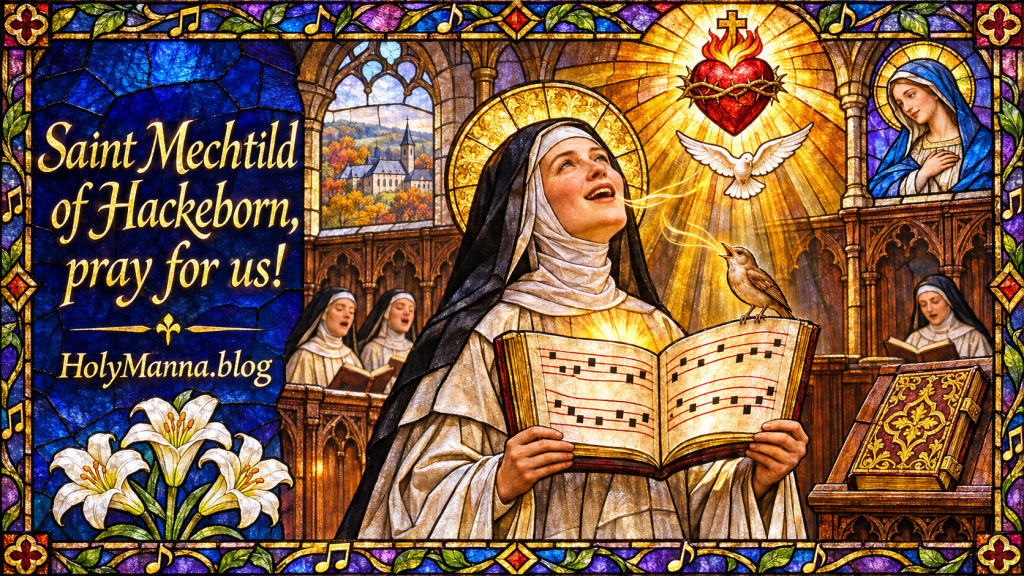
God’s Nightingale
Some saints are remembered for the kingdoms they converted or the persecutions they survived. Saint Mechtild of Hackeborn is remembered for the way she sang. In a monastery in 13th century Saxony, this Benedictine nun led the choir, taught the young, comforted the troubled, and prayed with such joy that, according to the book that preserves her spiritual life, Christ Himself called her His “nightingale.” The Church remembers her on November 19th, the anniversary of her death in 1298.
Her name appears in several forms, including Mechtilde, Mechthild, Mechtildis, and Matilda, and all of them point to the same woman. She belonged to the monastery of Helfta, a community so rich in learning and holiness that it produced some of the greatest spiritual writing of the Middle Ages. Mechtild was the teacher and spiritual mother of Saint Gertrude the Great. Her revelations, gathered by her sisters in the Book of Special Grace, helped prepare the Church for devotion to the Sacred Heart of Jesus roughly 400 years before that devotion spread across the Catholic world. She is also closely tied to the beloved practice of the Three Hail Marys.
Recent popes have not forgotten her. Pope Benedict XVI gave an entire General Audience to her life on September 29th, 2010, and Pope Francis named her in his 2024 encyclical Dilexit Nos among the holy women who wrote about resting in the Heart of the Lord.
The Church holds up the saints as models and intercessors, because their lives show what the Holy Spirit can do in a human heart (CCC 828). Mechtild’s life shows something that a busy, distracted age badly needs to see. Holiness can sound like a song, and a hidden life offered to God can echo for centuries.
A Little Girl Who Refused to Go Home
Mechtild was born at her family’s castle at Helfta, near Eisleben in Saxony. The Catholic Encyclopedia places her birth in 1240 or 1241, while Pope Benedict XVI gave 1241 or 1242, so the exact year is uncertain. There is no uncertainty about her family’s standing. The Barons of Hackeborn were among the noblest and most powerful families of Thuringia, and they were related to Emperor Frederick II. Because they were also Lords of Wippra, Mechtild is sometimes called Matilda von Hackeborn-Wippra, and older writers occasionally mistook the two names for two different women. She was the third daughter of the house, and her older sister Gertrude of Hackeborn would become one of the great abbesses of medieval Germany.
Her life nearly ended on the day it began. The account handed down from Helfta says that the newborn was so weak that her attendants feared she would die without Baptism, so they hurried her to a priest who was preparing to say Mass. He baptized her at once and then calmed the frightened household. According to this account, he told them that the child would not die, that she would become a holy religious through whom God would work many wonders, and that she would reach a good old age. This story comes from the tradition of her own monastery, and it cannot be independently verified. What it does show clearly is the Church’s ancient conviction about Baptism. The sacrament is the doorway to life in Christ, and the Church has always urged that children receive it without delay (CCC 1213, CCC 1250).
When Mechtild was 7 years old, her mother took her to visit Gertrude, who was then a nun at the monastery of Rodersdorf. The little girl was so taken with the cloister that she begged to stay. Her parents, who were devout people, recognized grace at work and gave their consent. Mechtild entered the monastery school, where she grew quickly in both learning and virtue.
In 1251 her sister Gertrude was elected abbess. In 1258 the community moved to Helfta, onto an estate given by Mechtild’s own brothers, Louis and Albert. That same year, at about 17, Mechtild became a nun there. Helfta lived under the Rule of Saint Benedict while following Cistercian customs, which explains why Mechtild is called a Benedictine in some sources and a Cistercian in others.
There is no dramatic conversion in Mechtild’s story, and there are no years of wandering followed by a sudden return. Her conversion was the quiet kind that the Church asks of every baptized person, a daily turning of the heart toward God that deepens over a lifetime (CCC 1428). She answered a call in childhood and then kept answering it for 50 years.
Her gifts were recognized early. While still young she was placed in charge of the monastery school, the choir, and the formation of novices. In 1261 a 5 year old girl was brought to Helfta and entrusted to Mechtild, who was then about 20. That child grew up to be Saint Gertrude the Great. A common confusion deserves a moment of attention here. Abbess Gertrude of Hackeborn was Mechtild’s sister by blood. Gertrude the Great was her pupil and spiritual daughter, and the two Gertrudes were not related. Years later, when the younger Gertrude began to receive extraordinary graces of her own, it was Mechtild who helped her recognize that these gifts truly came from God.
The Friend of the Sacred Heart
What Mechtild is most known for can be said in one word, and that word is praise. She had a beautiful voice and a special gift for sacred music, and she served as the monastery’s chantress for her entire religious life. She trained the choir with tireless care, and she praised God without growing weary even when her body was in pain. The Catholic Encyclopedia calls divine praise the keynote of her life and of her book.
The Catechism explains why this matters so much: “Praise is the form of prayer which recognizes most immediately that God is God” (CCC 2639). Praise asks for nothing. It simply delights in God because He is God. The Church also teaches that sacred song is closely bound to the liturgy and is one of its great treasures (CCC 1156). Mechtild lived both truths at once. The Psalmist cried out, “Let every spirit praise the Lord” (Psalm 150:6), and she spent her life doing exactly that.
Pope Benedict XVI drew the central lesson of her life from this. He pointed out that her spirituality was rooted in the Liturgy of the Hours, in Holy Mass, and above all in Holy Communion, and that Sacred Scripture was her daily bread. He then called the liturgy “a great school of spirituality.” Mechtild found God in the prayers that the Church already placed on her lips every day (CCC 1174, CCC 1324). She also composed prayers of her own, so many that her sisters said they would fill a book larger than the Psalter.
Mechtild was also a mystic. One account says that her first vision came as she received Holy Communion, when the Lord took her hands and left His imprint on her heart “like a seal in wax.” From then on, according to the Book of Special Grace, she lived in close familiarity with Christ, the Blessed Virgin Mary, the angels, and the saints, especially on the great feasts of the Church year.
A word about such experiences is needed. The Church calls them private revelations. They do not belong to the deposit of faith, and they cannot add to or correct what Christ has definitively revealed. Their purpose is to help believers live the Gospel more fully in a particular moment of history (CCC 67). Mechtild’s revelations should be read in that light, as the testimony of a holy woman that the Church has long treasured without ever requiring anyone to believe it.
The center of that testimony is the Heart of Jesus. In her visions Christ gave Mechtild His Heart as a pledge of His love, as a refuge during her life, and as her comfort at the hour of death. He asked her to greet His Heart each morning and to offer Him her own, and He added a promise: “Whoever breathes a sigh toward Me, draws Me to himself.” This saying has been handed down in devotional tradition from her book. In another vision He showed her the wound in His Heart and told her that His love is expressed nowhere more clearly than in the Gospel, pointing to His own words: “As the Father hath loved me, I also have loved you” (John 15:9). This matches what the Church teaches about the Sacred Heart. Jesus knew and loved each person during His life and Passion, and His pierced Heart is the great sign of that love (CCC 478).
Mechtild is also connected to the devotion of the Three Hail Marys. The story is that she was troubled about her eternal salvation and begged the Blessed Virgin to be with her at the hour of death. Mary agreed, and she asked in return that Mechtild pray 3 Hail Marys every day. The first would honor the power that Mary received from the Father, the second the wisdom that she received from the Son, and the third the love with which the Holy Spirit filled her. This account belongs to private revelation and cannot be verified. Later saints and popes nevertheless encouraged the practice warmly, and it fits comfortably within the Church’s teaching that devotion to the Blessed Virgin belongs to Christian worship and that the faithful rightly ask her prayers “now and at the hour of our death” (CCC 971, CCC 2677).
Mechtild did not raise the dead or multiply loaves. The wonders reported of her are quieter. Pope Benedict XVI recalled that she was often caught up in ecstasy, sometimes so deeply that she did not hear those who called her. People inside and outside the monastery testified that she had freed them from their afflictions and that they had never known such consolation as they found with her. She was said to read the secrets of hearts. Learned Dominican friars came to consult a cloistered nun about the spiritual life. Sacred art sometimes shows her healing a blind nun, although the details of that healing cannot be verified. The Church teaches that such gifts are charisms, graces given by the Holy Spirit for the good of others and for the building up of the Church (CCC 799, CCC 2003).
Mechtild is worth remembering and imitating because she shows that a life of praise is not an escape from other people. Her joy in God did not make her distant. It made her the person to whom everyone in trouble wanted to go.
The Cross Behind the Song
Mechtild was not a martyr. Her cross was the long, hidden kind, and it was heavy.
She had been fragile from birth, and the Catholic Encyclopedia speaks of continual and severe physical suffering throughout her life. She added to it voluntarily. Pope Benedict XVI noted that she took on serious penances for the conversion of sinners and that she shared in the Lord’s Passion through constant suffering. The Church teaches that suffering united to Christ’s Passion becomes a share in His saving work, and that the sick can be configured to Christ in a special way (CCC 618, CCC 1521). Mechtild seems to have understood this from the inside.
Around the age of 50, everything grew harder. She passed through a grave spiritual crisis together with serious illness, and the last 8 years of her life were marked by sickness. During these same years she lost her sister, Abbess Gertrude, who had guided Helfta for 40 years. Sources give the abbess’s death as 1291 or 1292.
It was in this dark season that Mechtild finally spoke about the graces she had received. She confided them to two sisters whom she trusted, one of whom was Gertrude the Great. She did not know that they were writing everything down. When she discovered that a book about her inner life was nearly finished, she was deeply distressed. A woman who had spent decades hiding her gifts now saw them set down on parchment.
Her response says a great deal about her. She did not demand that the pages be burned, and she did not quietly enjoy the attention. She went to prayer. There, according to the account, she saw Christ holding the book and heard Him say: “All this has been committed to writing by my will and inspiration.” He told her that the book would lead many to grow in His love, and that He wished it to be called the Book of Special Grace, because it would prove to be exactly that for many souls. Once Mechtild understood that the work served God’s glory and not her own, her distress ended. She even corrected the manuscript herself. This is what real humility looks like. It is not pretending to have no gifts. It is knowing that every gift comes from God and belongs to Him, which is why the Church calls humility the foundation of prayer (CCC 2559).
She died at Helfta on November 19th, 1298, at about 58 years of age, although at least one reference work allows that the year may have been 1299. Saint Gertrude the Great left a description of her last hours. They were very hard, yet they were lit by her awareness of the Holy Trinity, of the Lord, of the Virgin Mary, and of the saints. Near the end, Mechtild asked to go on living a little longer in her suffering for the salvation of souls. Some retellings add that the Blessed Virgin took her hand and promised to watch over the nuns of Helfta, and that Christ placed a shining necklace upon her as a sign of glory. These details come from the visions recorded by her sisters, and they cannot be verified.
Gertrude’s grief was plain. She wrote that no one like Mechtild had ever arisen in their monastery, and she feared that no one like her ever would again. The Church teaches that for the Christian the day of death is the fulfillment of the new birth begun at Baptism (CCC 1682). The frail baby who had been rushed to the font ended her life as the priest had foretold, as a holy religious who had reached a full age for her century.
A Book That Travelled Farther Than Its Author Ever Did
The story of Mechtild after her death has to begin with honesty. She was never formally canonized. There is no official record of miracles examined for a cause, and there is no documented catalog of healings at her tomb. Her body is believed to rest at Old Helfta alongside that of Saint Gertrude, but the exact place is unknown, so there is no shrine of her relics for pilgrims to visit. The closing pages of the Book of Special Grace describe visions in which her sisters saw her in glory. These belong to private revelation and cannot be verified.
Her great work after death was done through her book. The Book of Special Grace follows the rhythm of the Church year, and Saint Gertrude admitted that the written text captures only a part of what Mechtild actually experienced. It was made public soon after she died, and copies multiplied quickly, thanks largely to the Dominican friars who knew the nuns of Helfta well. The book was especially loved in Italy. The Catholic Encyclopedia notes that Boccaccio mentions its praises being popular in Florence, where people recited them before sacred images. It was later translated into several languages, including a Middle English version known as The Booke of Gostlye Grace.
This leads to one of the most intriguing questions attached to her name. In the Purgatorio of his Divine Comedy, Dante meets a gracious woman named Matelda, who sings as she gathers flowers and guides him through the Earthly Paradise. Many scholars identify her with Countess Matilda of Tuscany. Others, including the author of the Catholic Encyclopedia article on Mechtild, argue that the gentle singer fits the nun of Helfta far better. They note that Dante wrote when her book was popular in Florence and that her book also describes purification on a mountain of 7 terraces. A further group points to her companion at Helfta, Mechtild of Magdeburg. The identification cannot be verified, and it remains a scholarly debate.
The two women are easily confused. Mechtild of Magdeburg was a former beguine who entered Helfta in her old age, around 1270, and wrote The Flowing Light of the Godhead. She is a different person from Saint Mechtild of Hackeborn.
Mechtild’s deepest influence is on the Church’s prayer. Together with Saint Gertrude’s Herald of Divine Love, her book prepared the ground for devotion to the Sacred Heart, which reached its full flowering after the revelations to Saint Margaret Mary Alacoque in the 17th century. The devotion of the Three Hail Marys spread across the Catholic world as well.
The Church has confirmed the veneration of Mechtild in her own way. By special permission of the Holy See, monasteries of her order kept her feast, at one time on February 26th or 27th in some houses. Today she is commemorated on November 19th in Benedictine and Cistercian calendars, and she is inscribed on that date in the Roman Martyrology. The Church teaches that the saints in heaven do not stop interceding for those still on earth, and that their fraternal concern is a great help to human weakness (CCC 956).
Helfta itself has a story worth telling. The monastery was devastated in the 14th century, sacked during the Peasants’ War in 1525, and suppressed in the 1540s as the Reformation swept through the region. Eisleben, the nearby town, is the birthplace of Martin Luther. For centuries the site fell into decay. Then, in 1999, Cistercian nuns from the Bavarian abbey of Seligenthal returned and refounded the monastery, incorporating some of the old ruins into the new buildings. In November of 2024 the community celebrated 25 years since its restoration. Visitors can once again join the sisters for prayer in the place where Mechtild sang.
Learning to Sing in a Noisy World
Mechtild lived more than 700 years ago behind monastery walls, yet her life speaks directly to anyone trying to follow Christ in a loud and hurried age. Her first lesson is praise. It is easy to treat prayer as a list of requests, and there is nothing wrong with asking. Mechtild shows that there is also a prayer that asks for nothing and simply rejoices that God is God (CCC 2639). You can begin tomorrow morning the way Christ asked her to begin, by greeting His Heart and offering Him your own before reaching for a phone.
When was the last time you praised God simply for who He is, without asking for anything?
Her second lesson is that the ordinary prayer of the Church is enough to make a saint. She did not need novelty. She had the Mass, the Psalms, the Gospel, and the feasts of the year, and she let them soak into her until they became her own voice. The Eucharist is the source and summit of the Christian life (CCC 1324), and the Church urges all the faithful to frequent reading of Scripture (CCC 133). You might choose one Mass this week and prepare for it by reading the Gospel ahead of time, and then listen to every prayer as if it were being said for the first time.
How attentive are you at Mass, and what is one concrete thing you could do to participate more fully?
Her third lesson concerns gifts and humility. Mechtild hid her graces for decades, and when they came to light she neither clung to them nor denied them. She handed them back to God. Whatever talents you have been given, at work, at home, or in your parish, belong to Him first.
Is there a gift you have been hiding out of fear, or one you have been using mainly for your own credit?
Her fourth lesson is about suffering. Mechtild’s song came from a body that hurt and a heart that sometimes feared. She did not wait to feel well before praising God. Saint Paul heard the Lord say, “My grace is sufficient for thee” (2 Corinthians 12:9), and Mechtild proved it across years of illness. You can offer a headache, a hard diagnosis, or an anxious night for someone who needs grace (CCC 1521).
What suffering are you carrying right now that could be offered to God for someone else?
Her last lesson is trust in the Blessed Virgin Mary. When Mechtild was afraid for her soul, she did not let the fear run her life. She asked her Mother for help. The Three Hail Marys take less than a minute, and they can be prayed each morning or night for the grace of a holy death.
Who in your life might need the kind of patient, joyful spiritual friendship that Mechtild gave to the young Gertrude?
Engage With Us!
Readers are warmly invited to share their thoughts and reflections in the comments below. Saint Mechtild’s story touches praise, suffering, friendship, and trust, and every reader will hear something different in it.
- Which part of Saint Mechtild’s life speaks most strongly to you, her joy in praising God, her hidden suffering, or her humility about her gifts?
- Christ asked Mechtild to greet His Heart each morning. What does your first act of the day usually look like, and how could it change?
- Pope Benedict XVI called the liturgy a great school of spirituality. What has the Mass taught you about God that you could not have learned anywhere else?
- Mechtild feared for her salvation and turned to the Blessed Virgin Mary. Where do you turn when your faith feels fragile?
- Mechtild formed Saint Gertrude the Great from childhood. Who formed you in the faith, and whom are you forming now?
May the nightingale of Helfta teach you to make your whole life a song of praise. Keep the faith, stay close to the Heart of Jesus, lean on His Mother, and do everything with the love and mercy that Jesus taught.
Saint Mechtild of Hackeborn, pray for us!
Follow us on YouTube, TikTok, Instagram and Facebook for more insights and reflections on living a faith-filled life.


Leave a Reply