A Sleeping Child and a Watchful Mother
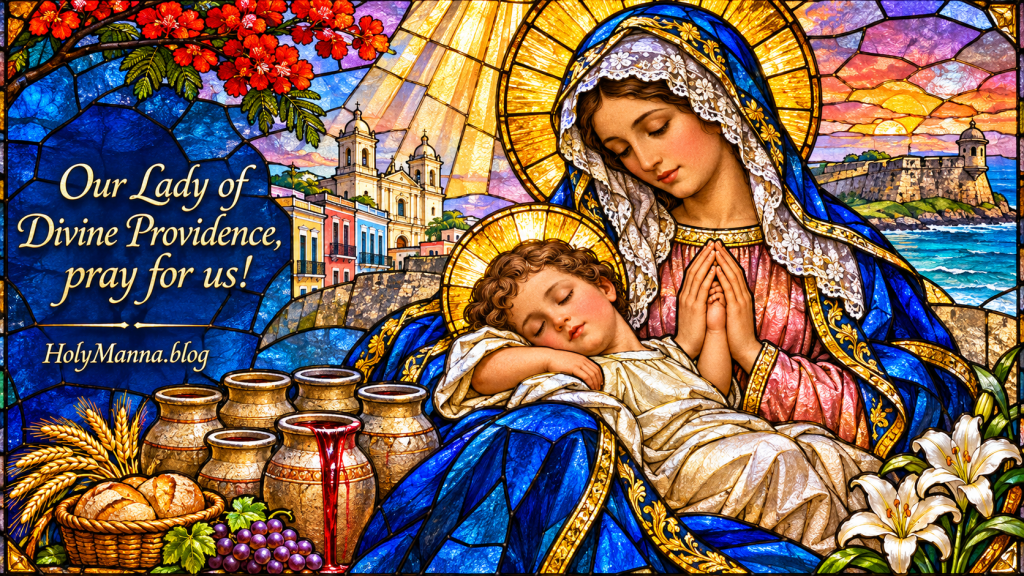
Every November 19th, the Church in Puerto Rico pauses to honor the Blessed Virgin Mary under a gentle and deeply consoling title, Our Lady of Divine Providence, known in Spanish as Nuestra Señora Madre de la Divina Providencia. The image most Puerto Ricans carry in their hearts shows Mary seated and bending over the Child Jesus, who is sound asleep on her lap. Her hands are joined in prayer, and they softly hold his left hand. Nothing dramatic is happening in the scene. There is only a child resting without a care in the world, because his mother is watching.
That quiet picture carries a big idea. Divine providence is the Church’s name for the wise and loving way God guides all of creation toward its goal, a truth the Catechism lays out in CCC 302 and sums up in CCC 321. Mary receives the title Mother of Divine Providence because she is the mother of Jesus Christ, the Son through whom the Father’s plan is carried out, and because she keeps caring for his brothers and sisters with a mother’s attention.
A clear word about liturgical rank belongs at the start. This celebration does not appear on the General Roman Calendar, so most of the world keeps November 19th as an ordinary weekday. In Puerto Rico, the day is a Solemnity, the highest rank the liturgy knows, because Pope Saint Paul VI declared Our Lady of Divine Providence the principal patroness of the Puerto Rican nation on November 19th, 1969. The Barnabite Fathers, who first spread the devotion from Rome, also keep a Solemnity in her honor, on the Saturday before the 3rd Sunday of November. Many people simply call it her feast day.
The story behind the title moves from a tight budget in 17th-century Rome to a ruined cathedral in San Juan, and at every stop the same lesson appears. God provides, and he loves to provide through a mother who notices.
From a Roman Corridor to a Caribbean Cathedral
The oldest thread of the story is a tradition from 13th-century Italy. According to that tradition, Saint Philip Benizi, the 5th superior of the Servants of Mary, turned to the Blessed Virgin on a day when his friars had nothing to eat, and 2 baskets of food were then found at the convent door with no sign of who had left them. The account is a pious tradition handed down in devotional sources, not a documented event, and it is often named as the seed of the title.
The documented history begins in Rome with the Clerics Regular of Saint Paul, better known as the Barnabites. Around 1611, the community was building the church of San Carlo ai Catinari and ran out of money. Barnabite accounts relate that the pastor, Father Blaise Palma, made a pilgrimage to the Holy House of Loreto to ask for Mary’s help, that the needed funds arrived after his return, and that he left a written record urging his brothers to trust the Blessed Mother in every difficulty.
Decades later, a painting entered the story. The Italian artist Scipione Pulzone, who died in 1598, had painted a tender Madonna cradling the Infant Jesus, a work usually dated to about 1580. The Barnabites’ own history says the painting came to them in 1663, while the Sisters of Providence give 1664. The Fathers kept it in a chapel of their house and gathered before it for daily prayer.
For years the devotion stayed inside the community. Then, in July of 1732, a faithful copy of the painting was placed near the main altar of San Carlo ai Catinari under the inscription Mater Divinae Providentiae, which means Mother of Divine Providence. The Barnabites report that many graces were attributed to Mary’s intercession there.
The popes took notice of the devotion. Pope Benedict XIV approved a Mass of the Blessed Virgin Mary, Mother of Divine Providence, in 1744, to be celebrated on the Saturday before the 3rd Sunday of November, and he authorized a confraternity in her honor. Several popular sources date that confraternity to 1774, which cannot be right, because Benedict XIV reigned from 1740 to 1758. Pope Gregory XVI raised the confraternity to an archconfraternity in 1839. Pope Leo XIII ordered the solemn crowning of the image in 1888 and approved a Mass and Office, and Pope Saint Pius X later allowed the votive Mass on Saturdays throughout the year and approved a scapular.
The devotion crossed the ocean with a bishop. Gil Esteve y Tomás, a Catalan who had loved this title since his seminary days, was appointed Bishop of Puerto Rico in 1848. He found his cathedral in San Juan in ruins and his diocese short on funds. He placed the whole situation in the hands of Divine Providence, chose Our Lady of Providence as the special title of Mary for his diocese, and commissioned an image from Barcelona. In less than 5 years the cathedral was rebuilt. The image was enthroned there on January 2nd, 1853, according to the fullest account, although another source gives 1854. From that day, Puerto Rico had a new way of calling on its Mother.
No Apparition, Only a Wedding
A point of clarity belongs here. No apparition of Mary is associated with this title. The Church has never been asked to judge a vision or a message in connection with it, so there is no private revelation to approve or reject, and the careful discernment that CCC 67 describes for private revelations does not come into play. The favors reported at San Carlo ai Catinari and the tradition about Saint Philip Benizi have received no formal judgment from the Church as miracles. They remain grateful testimonies and pious tradition. The title itself, however, has the Church’s full liturgical approval, expressed in Masses approved by popes and in the declaration of Paul VI.
The real foundation of the title is Scripture, and above all the wedding at Cana. A newly married couple is about to be embarrassed in front of the whole village, and only a single guest sees it coming. “They have no wine,” Mary says to her Son (John 2:3). She turns to the servants and gives the last words of hers recorded in the Gospels: “Whatsoever he shall say to you, do ye” (John 2:5). The servants fill 6 stone jars with water, the water becomes wine, and the evangelist sums it up: “This beginning of miracles did Jesus in Cana of Galilee; and manifested his glory, and his disciples believed in him” (John 2:11).
The Catechism reads this scene as a lesson in how Mary prays. In CCC 2618, it teaches that at Cana the mother of Jesus asks her Son for the needs of a wedding feast, and that this feast is a sign of another, the wedding of the Lamb, where Christ gives his Body and Blood. The Second Vatican Council points to the same moment in Lumen Gentium 58, noting that Mary was moved with pity and that her intercession brought about the beginning of the miracles of Jesus.
The idea of providence itself runs through the whole Bible. On the way up Mount Moriah, Abraham answers his son’s question with words of pure trust: “God will provide himself a victim for an holocaust, my son” (Genesis 22:8). The Book of Wisdom prays, “But thy providence, O Father, governeth it” (Wisdom 14:3). Through the prophet Isaiah, God even describes his care in a mother’s terms: “As one whom the mother caresseth, so will I comfort you” (Isaiah 66:13). That passage from Isaiah 66 is the first reading in the Mass of the Blessed Virgin Mary, Mother of Divine Providence, which is number 40 in the Collection of Masses of the Blessed Virgin Mary issued by the Holy See in 1986, and the Gospel of that Mass is the wedding at Cana.
The deepest root is the Incarnation. When Saint John Paul II celebrated Mass in San Juan on October 12th, 1984, he taught that Divine Providence is bound up with Mary’s divine motherhood, because God’s eternal plan reached its fullness when the Father sent his Son, born of a woman. Mary said yes to that plan with her whole heart: “Behold the handmaid of the Lord; be it done to me according to thy word” (Luke 1:38). The Catechism calls this the obedience of faith in CCC 148 and CCC 494. The Mother of Divine Providence is first of all the woman who trusted Providence completely.
What Providence Means
A Marian title is only as solid as the doctrine underneath it, and this title stands on very solid ground. The Catechism teaches that creation did not come from God’s hands finished, and that divine providence is the way God guides his creatures toward their final perfection (CCC 302). This care is concrete and immediate, reaching from the smallest things to the great events of history (CCC 303). Then the Catechism says something that sounds like a caption for the Puerto Rican image: “Jesus asks for childlike abandonment to the providence of our heavenly Father” (CCC 305). The Child asleep on Mary’s lap is a picture of exactly that abandonment.
Jesus teaches the same trust in the Sermon on the Mount, where he assures his disciples that their needs are known: “For your Father knoweth that you have need of all these things” (Matthew 6:32). Then he sets the order of priorities: “Seek ye therefore first the kingdom of God, and his justice, and all these things shall be added unto you” (Matthew 6:33). The Catechism gathers this teaching in CCC 322, which speaks of filial trust in the Father’s providence, and in CCC 2547, which adds that such abandonment frees the heart from anxiety about tomorrow.
Mary’s place in this teaching follows from a principle the Catechism states in CCC 306 through CCC 308. God is the sovereign master of his plan, yet he chooses to carry it out with the cooperation of his creatures. Among all creatures, no one cooperated more fully than Mary. That is why the Church can say, in CCC 968 and CCC 969, that she is a mother in the order of grace and that her motherly role continues without interruption until all the elect reach heaven. The Council puts it in a single line: “By her maternal charity, she cares for the brethren of her Son” (Lumen Gentium 62).
Saint John Paul II unpacked the same truth in his encyclical Redemptoris Mater. Reflecting on Cana, he wrote that “Mary places herself between her Son and mankind” in the reality of human wants, needs, and sufferings (Redemptoris Mater 21). In his San Juan homily, he applied the point directly to this title. In words translated here from the original Spanish text published by the Holy See, he said that “Mary is the Mother of Divine Providence, because she cares for our human affairs.” He added that the title is also revealed in her command to the servants, because her essential task is to lead people to the will of the Father made known in Christ.
None of this puts Mary in competition with her Son. The Catechism is firm in CCC 970 that her role as mother in no way obscures or diminishes the unique mediation of Christ, and that it draws all its power from him. Everything the Church believes about Mary rests on what it believes about Christ (CCC 487). She is honored as Mother of God (CCC 495), preserved from every stain of original sin from the first moment of her conception (CCC 490 through CCC 492), taken up body and soul into heaven (CCC 966), and given to the Church as its mother (CCC 963). A mother who lives with God in glory is free to pay attention to everyone else.
The Church also has an honest answer for the harder question that arises when providence seems to fail. The Catechism teaches that God is never the cause of moral evil, that he permits it, and that he knows how to draw good from it (CCC 311 and CCC 312). It also teaches that the full shape of his plan will be seen only at the end, face to face (CCC 314). Devotion to Our Lady of Divine Providence is not a promise that the wine will never run out. It is the confidence that someone has already noticed.
Finally, in the apostolic exhortation Marialis Cultus, Saint Paul VI presents Mary at Cana as the Virgin in prayer (Marialis Cultus 18), and he says her maternal mission moves the People of God to “turn with filial confidence to her who is ever ready to listen” (Marialis Cultus 57). That devotion, the Catechism insists, is intrinsic to Christian worship and yet differs essentially from the adoration given to God alone (CCC 971).
Where Pilgrims Bring Their Empty Jars
The mother church of the devotion is still San Carlo ai Catinari in the heart of Rome, where Pulzone’s painting is kept in the chapel of the Barnabite Fathers and its copy is venerated in the church. According to the Barnabites’ history, Pope Pius VII visited on February 2nd, 1815, and Blessed Pius IX, who had spent his early years as a priest nearby, celebrated Mass at the altar and left the chasuble he wore when he proclaimed the dogma of the Immaculate Conception in 1854. Among the order’s prayers is the plea, “O sweet Mother of Divine Providence, turn your eyes toward us.” The Barnabites also offer a triduum of prayer in her honor, and the scapular approved by Saint Pius X remains part of the devotion. Like every sacramental, it prepares the faithful to receive grace and disposes them to cooperate with it (CCC 1667 and CCC 1670).
Other religious families adopted the title. Saint Luigi Guanella, who was canonized in 2011, venerated the image at San Carlo ai Catinari. His spiritual family keeps its own Solemnity of the Mother of Divine Providence on November 12th.
In the United States, the devotion found a home in Indiana. In 1925, Monsignor A. J. Rawlinson, chaplain to the Sisters of Providence of Saint Mary-of-the-Woods, noticed a reproduction of the Roman painting at the Catholic University of America while on his way to Rome. He brought home the history and documents of the devotion from the Barnabites. On May 1st, 1925, the National Shrine of Our Lady of Providence was canonically erected at Saint Mary-of-the-Woods, the motherhouse of the congregation founded by Saint Mother Theodore Guerin in 1840, and a confraternity was established there. The Sisters gave the devotion a family accent, encouraging households to honor the image at home and to ask Mary to “be queen of our home.” The shrine now stands in the vestibule of the Church of the Immaculate Conception.
In Puerto Rico, the heart of the devotion is the Cathedral of San Juan Bautista in Old San Juan. The first image, a seated figure made to be dressed in fabric, was venerated there for 67 years. In 1920 it was replaced by a carving made entirely of wood, which is the image most familiar to Puerto Rican families today. A national shrine has also been taking shape for decades. Saint John Paul II encouraged the project during his 1984 visit. Cardinal Luis Aponte Martínez blessed the first stone on November 19th, 1990, and a monumental cross was blessed on the grounds in the Cupey district of San Juan on November 19th, 2000. Recent reports describe the shrine itself as still unfinished, yet Masses, confessions, youth gatherings, and the patronal Solemnity are already celebrated on the site.
Pilgrimages, medals, processions, and the veneration of sacred images are all forms of popular piety that the Church encourages and guides (CCC 1674 through CCC 1676). The honor paid to an image, the Catechism explains, passes on to the person it represents (CCC 2132). Pilgrims who kneel before the Mother of Divine Providence are doing what the servants at Cana did. They are bringing what is empty to the place where it can be filled.
An Island, a Flag, and a Mother
Puerto Rico’s love for its patroness grew steadily for more than a century. In 1862, the Puerto Rican writer Alejandro Tapia y Rivera composed a hymn in her honor. The formal act came when Archbishop Luis Aponte Martínez, the first Puerto Rican to serve as Archbishop of San Juan, asked the Holy See to confirm what the people already believed. Paul VI did so in an Apostolic Letter dated November 19th, 1969, which names her under the Latin title Beata Maria Virgo a Divina Providentia and declares her the principal patroness of the whole Puerto Rican nation.
The date carries meaning. November 19th is the day in 1493 when Christopher Columbus landed on the island during his 2nd voyage. Puerto Rican accounts report that the celebration was moved to that date from January 2nd, the anniversary of the image’s arrival in the cathedral, so that love of the homeland and love of the Mother of God would be joined in a single day. A different source gives the earlier date as November 2nd, and the Apostolic Letter itself does not mention the change, so the details rest on the local accounts.
The most moving chapter came in 1976. The older image, which had arrived in 1853, was chosen to be solemnly crowned during an assembly of the Latin American bishops in San Juan. On the eve of the ceremony, the image was set on fire at the parish of Santa Teresita in Santurce. The coronation went ahead anyway. Accounts describe thousands of the faithful in tears as the burned image was crowned in the presence of cardinals and bishops from across Latin America. A source connected to the national shrine dates the coronation to December 5th, 1976, which fits an assembly that opened on November 30th, while several popular accounts say November 5th. The burned image was later sent to Spain, was restored in Seville, and was welcomed home on November 19th, 2009.
Today the Solemnity is kept across the island, and it travels wherever Puerto Ricans have made a home. An annual Mass of Our Lady of Divine Providence fills Saint Patrick’s Cathedral in New York, where the 2023 celebration was the 43rd. Similar celebrations take place in Brooklyn, Tampa, and many other communities, often with the Puerto Rican flag carried beside the image. A saying remembered from island childhoods captures the feeling: “¿Quién a Puerto Rico orienta? La Virgen de la Providencia.” In English, it asks who guides Puerto Rico and answers that Our Lady of Providence does. During his 1984 homily, John Paul II recalled that the country people of the island, in hard times for the faith, wore the rosary around their necks as the sign of their faith. The Church honors Mary with special love throughout the liturgical year (CCC 1172), and in Puerto Rico that love has a face, a date, and a song.
Learning to Rest While the Mother Keeps Watch
The lesson of this celebration fits into a single image. The Child sleeps because the Mother is awake. You are invited into that same rest, not because your problems are small, but because your Father knows what you need and has given you a mother who notices.
Start with honesty about your own empty jars. Mary did not pretend the wine was fine. She named the need in 4 plain words and handed it to Jesus. Name the bill, the worry, the strained marriage, or the child who has drifted from the faith, and say it to the Lord without decoration. Then ask Mary to say it with you. The Catechism teaches that Mary is wholly transparent to Jesus and shows the way to him (CCC 2674), and that the Church loves to pray in communion with her (CCC 2679).
Next, do the part that belongs to you. The servants at Cana still had to carry the water. Providence is not an excuse for passivity, since God gives human beings the dignity of sharing freely in his plan through their actions, their prayers, and their sufferings (CCC 307). Fill your jars to the brim. Update the résumé, make the appointment, have the hard conversation, and then leave the miracle to Christ.
Then become providence for someone else. Bishop Esteve rebuilt a cathedral with the help of his people. God very often answers the prayer of a person in need through the generosity of a neighbor, which is why the works of mercy stand at the center of Christian life (CCC 2447). Who in your life is running out of wine right now, and what would it cost you to notice?
Finally, bring this devotion home. The Catechism calls the Christian family a domestic church (CCC 2204). You could place an image of Our Lady of Divine Providence where your family gathers. You could pray the Our Father slowly at dinner and mean the request for daily bread, which the Catechism explains as an act of filial trust (CCC 2830). You could end the day by handing tomorrow back to God before you sleep. What would change in your home if you trusted that tomorrow is already in the Father’s hands? The people of Puerto Rico crowned a burned image and kept singing. Resilient faith does not deny the fire. It trusts the Mother who stayed.
Engage With Us!
Share your thoughts and reflections in the comments below. Your story of trust may be the encouragement another reader needs today.
- Where in your life do you most need to hear that your Father already knows what you need?
- When has God provided for you through the kindness of another person, and how did that moment change your faith?
- Which empty jar can you name in prayer this week and place in Mary’s hands?
- How can your family or your friends become a sign of God’s providence for someone in need this month?
- What does Mary’s instruction at Cana, to do whatever Jesus says, ask of you right now?
Keep walking in faith, even when the jars look empty. Trust the Father who provides, follow the Son who turns water into wine, and stay close to the Blessed Mother who notices every need. May all who read these words grow together in faith under her guidance, and may Our Lady of Divine Providence watch over your home today and always.
Our Lady of Divine Providence, pray for us!
Follow us on YouTube, TikTok, Instagram and Facebook for more insights and reflections on living a faith-filled life.


Leave a Reply