Thursday of the Thirty-third Week in Ordinary Time – Lectionary: 500
Two Sets of Tears and One Worthy Lamb
Some days the Lectionary reads like two halves of a single story, and Thursday of the 33rd Week in Ordinary Time is one of those days. Two men weep in these readings. On the island of Patmos, the Apostle John weeps in a vision of heaven because no one in all creation can open the sealed scroll in the right hand of God. On the Mount of Olives, Jesus weeps over Jerusalem because the city cannot see the peace standing right in front of it. The central theme that unites the readings is recognition. The Lamb who was slain is the only One who can unlock the meaning of history, and everything depends on recognizing Him when He draws near.
The historical setting matters here. The Church spends the final weeks of the liturgical year reading The Book of Revelation, which was written for Christians living under the pressure of the Roman Empire, where Caesar claimed honors that belong to God alone. Those believers needed to know who really holds history, and John saw the answer in a Lamb standing as though slain. The Gospel of Luke then shows that same Lamb days before His Passion, coming down toward a city whose very name was associated with peace, and foretelling a siege that Rome would carry out in the year 70. Between the two readings, Psalm 149 hands the assembly its own part in the story, with a refrain taken straight from the First Reading: “The Lamb has made us a kingdom of priests to serve our God.”
The Solemnity of Christ the King arrives on Sunday, November 22nd, and these readings prepare the heart to answer one honest question. When the King comes near, will He be recognized?
First Reading — Revelation 5:1-10
The Only One Who Can Open the Scroll
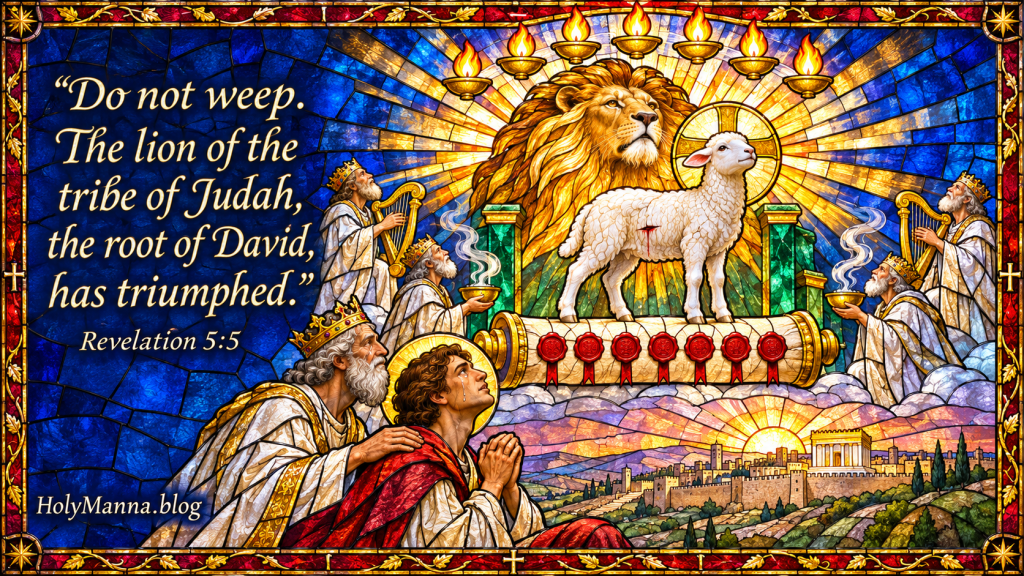
The Book of Revelation comes from the exile of the Apostle John on the island of Patmos. Saint Irenaeus, writing in the 2nd century, placed the vision near the end of the reign of the emperor Domitian, around the year 95. Saint John Paul II pointed out in a General Audience on this canticle that Domitian had himself addressed as lord and god. Chapter 5 introduces a crisis, a sealed scroll that no creature can open, and its answer reveals who Jesus really is. The One who weeps over Jerusalem in the Gospel is the Lion and the Lamb whom all of heaven adores.
Revelation 5:1-10
I, John, saw a scroll in the right hand of the one who sat on the throne.
It had writing on both sides and was sealed with seven seals.
Then I saw a mighty angel who proclaimed in a loud voice,
“Who is worthy to open the scroll and break its seals?”
But no one in heaven or on earth or under the earth
was able to open the scroll or to examine it.
I shed many tears because no one was found worthy
to open the scroll or to examine it.
One of the elders said to me, “Do not weep.
The lion of the tribe of Judah, the root of David, has triumphed,
enabling him to open the scroll with its seven seals.”Then I saw standing in the midst of the throne
and the four living creatures and the elders
a Lamb that seemed to have been slain.
He had seven horns and seven eyes;
these are the seven spirits of God sent out into the whole world.
He came and received the scroll from the right hand
of the one who sat on the throne.
When he took it,
the four living creatures and the twenty-four elders
fell down before the Lamb.
Each of the elders held a harp and gold bowls filled with incense,
which are the prayers of the holy ones.
They sang a new hymn:“Worthy are you to receive the scroll
and break open its seals,
for you were slain and with your Blood you purchased for God
those from every tribe and tongue, people and nation.
You made them a kingdom and priests for our God,
and they will reign on earth.”
Detailed Exegesis
Verse 1: “I, John, saw a scroll in the right hand of the one who sat on the throne. It had writing on both sides and was sealed with seven seals.”
Writing on both sides recalls the scroll shown to the prophet in Ezekiel 2:9-10 and signals a plan so complete that nothing can be added. The 7 seals mean it is perfectly closed. Saint Victorinus of Pettau, a bishop martyred around the year 304, wrote in the oldest surviving Latin commentary on this book: “This book signifies the Old Testament, which has been given into the hands of our Lord Jesus Christ.”
Verse 2: “Then I saw a mighty angel who proclaimed in a loud voice, ‘Who is worthy to open the scroll and break its seals?’”
The issue is worthiness, not raw strength. Opening the scroll means both revealing the plan of God and carrying it out.
Verse 3: “But no one in heaven or on earth or under the earth was able to open the scroll or to examine it.”
Heaven, earth, and the realm of the dead cover the entire created order. No angel, emperor, or philosopher can make sense of history or rescue it from the inside.
Verse 4: “I shed many tears because no one was found worthy to open the scroll or to examine it.”
These are the tears of every person who has looked at suffering and wondered whether anyone is in charge. Pope Benedict XVI explained in his General Audience of August 23rd, 2006, that history stays unreadable without Christ, and he taught that “only the sacrificed Lamb can open the sealed scroll and reveal its content.”
Verse 5: “One of the elders said to me, ‘Do not weep. The lion of the tribe of Judah, the root of David, has triumphed, enabling him to open the scroll with its seven seals.’”
The lion of Judah recalls the blessing of Jacob in Genesis 49:9-10, and the root of David recalls the promise of Isaiah 11:1-10. The Messiah has already conquered.
Verse 6: “Then I saw standing in the midst of the throne and the four living creatures and the elders a Lamb that seemed to have been slain. He had seven horns and seven eyes; these are the seven spirits of God sent out into the whole world.”
John looks for a lion and sees a Lamb, and this surprise is the heart of the vision. The Lamb stands because He is alive, yet He bears the marks of slaughter, as the risen Jesus showed His wounds in John 20:27. The 7 horns signify the fullness of power, and the 7 eyes signify the fullness of knowledge, as in Zechariah 4:10. The 7 spirits point to the Holy Spirit, whom the Lamb sends into the whole world.
Verse 7: “He came and received the scroll from the right hand of the one who sat on the throne.”
The Lamb approaches the throne and takes what no creature could touch. The Son receives all authority from the Father, as He declares in Matthew 28:18.
Verse 8: “When he took it, the four living creatures and the twenty-four elders fell down before the Lamb. Each of the elders held a harp and gold bowls filled with incense, which are the prayers of the holy ones.”
The Lamb receives the worship that belongs to God alone, which is a clear confession of His divinity. The Catechism reads the living creatures as all creation and the elders as the servants of the Old and New Covenants (CCC 1138). The harps carry praise and the gold bowls carry petition, fulfilling Psalm 141:2: “Let my prayer be incense before you.”
Verse 9: “They sang a new hymn: ‘Worthy are you to receive the scroll and break open its seals, for you were slain and with your Blood you purchased for God those from every tribe and tongue, people and nation.”
The Lamb is worthy precisely because He was slain. The word purchased comes from the marketplace, where slaves were ransomed, and the price here is His own Blood. The redeemed come from every tribe and tongue, so the Church is universal from her first hymn. Victorinus marveled at the newness: “It is a new thing that the Son of God should become man.”
Verse 10: “You made them a kingdom and priests for our God, and they will reign on earth.’”
The promise made at Sinai in Exodus 19:6, “You will be to me a kingdom of priests, a holy nation,” is fulfilled in the baptized. They reign by serving, since the Catechism teaches that for the Christian “to reign is to serve him” (CCC 786).
Teachings
The Church sees her own liturgy in this chapter. CCC 1137 teaches that the Lamb standing as though slain is “Christ crucified and risen, the one high priest of the true sanctuary.” At every Mass the assembly sings the Lamb of God, the priest lifts the Host and announces the Lamb, and incense still rises on solemn days. CCC 1090 describes the earthly liturgy as a foretaste of the heavenly one. Baptism gives every Catholic a place in it, and CCC 1546 states: “The whole community of believers is, as such, priestly.” The baptized exercise this common priesthood, which differs in essence from the ordained priesthood (CCC 1547), by offering their work, sufferings, and prayers with Christ. Pope Benedict XVI reflected on the gold bowls in his General Audience of September 12th, 2012, and drew a consoling conclusion: “there is no such thing as superfluous or useless prayers; no prayer is wasted.”
Reflection
The tears of John are honest, and so are yours. Every life has a sealed scroll, whether it is a diagnosis, a loss, or an unanswered prayer. The word of the elder is meant for you, because the Lamb has already triumphed. Try 3 concrete steps this week. Pray the Lamb of God at Mass slowly. Offer one hard part of your day as a priestly sacrifice united to His. Place one specific intention in the gold bowl and trust that it has reached the throne.
What sealed scroll in your life have you been trying to open by your own strength? Do you live your Baptism as a real priesthood by offering your ordinary day to God? When you hear the words Lamb of God at Mass, whom do you see?
Responsorial Psalm — Psalm 149:1-6, 9
The Song Only the Redeemed Can Sing
Psalm 149 belongs to the final crescendo of the Psalter, the 5 psalms of praise from Psalm 146 through Psalm 150 that each begin and end with Alleluia. The Church prays it at Morning Prayer on Sunday of Week 1 and on feasts and solemnities. Saint John Paul II noted in his General Audience of May 23rd, 2001, that the psalm names its singers with two rich Hebrew words, the hasidim, who are the faithful, and the anawim, who are the poor and lowly. The refrain today comes from the First Reading itself, “The Lamb has made us a kingdom of priests to serve our God,” so the congregation literally joins the hymn of the elders. The psalm serves the theme of the day because it is what recognition sounds like. People who know their King sing.
Psalm 149:1-6, 9
R. (Rev. 5:10) The Lamb has made us a kingdom of priests to serve our God.
or:
R. Alleluia.
Sing to the LORD a new song
of praise in the assembly of the faithful.
Let Israel be glad in their maker,
let the children of Zion rejoice in their king.
R. The Lamb has made us a kingdom of priests to serve our God.
or:
R. Alleluia.
Let them praise his name in the festive dance,
let them sing praise to him with timbrel and harp.
For the LORD loves his people,
and he adorns the lowly with victory.
R. The Lamb has made us a kingdom of priests to serve our God.
or:
R. Alleluia.
Let the faithful exult in glory;
let them sing for joy upon their couches;
Let the high praises of God be in their throats.
This is the glory of all his faithful. Alleluia.
R. The Lamb has made us a kingdom of priests to serve our God.
or:
R. Alleluia.
Detailed Exegesis
Verse 1: “Sing to the LORD a new song of praise in the assembly of the faithful.”
A new song answers a new act of salvation, which is exactly what heaven sings in Revelation 5:9. Saint Augustine heard the whole Gospel in this line: “The old man has an old song, the new man a new song.” The song also belongs to the assembly, because praise is never a solo project.
Verse 2: “Let Israel be glad in their maker, let the children of Zion rejoice in their king.”
God is both Maker and King. His people exist because He made them, and they are free because He rules them. This line lands hard beside the Gospel, where the children of Zion do not recognize their King when He arrives.
Verse 3: “Let them praise his name in the festive dance, let them sing praise to him with timbrel and harp.”
Praise involves the whole body, as it did when David danced before the ark in 2 Samuel 6:14. The harp reappears in the hands of the elders in the First Reading. Saint Augustine applied the image to unity: “A chorus is the union of singers. If we sing in chorus, let us sing in concord.”
Verse 4: “For the LORD loves his people, and he adorns the lowly with victory.”
Here is the reason for all the singing. The Lord delights in His people, and He crowns the anawim, the humble poor who depend entirely on Him. The victory of the Lamb came through lowliness. Saint Augustine wrote that God deals kindly “in converting him that was turned away, in aiding him that is fighting, in crowning the conqueror.”
Verse 5: “Let the faithful exult in glory; let them sing for joy upon their couches;”
The couches may be beds, where praise continues in the quiet of the night, or the cushions of a festive banquet. Either way, joy moves from the sanctuary into the home. Saint Augustine went one step deeper and located these resting places “in their hearts.”
Verse 6: “Let the high praises of God be in their throats.”
Praise is meant to be heard. Faith that stays permanently silent has not finished its work. The Lectionary stops before the battle imagery of the two-edged sword, which Saint Augustine read as the word of God, in keeping with Hebrews 4:12.
Verse 9: “This is the glory of all his faithful. Alleluia.”
The glory of the faithful is not wealth, influence, or reputation. Their glory is belonging to God and praising Him. The final Alleluia is the same word heaven sings at the wedding feast of the Lamb in Revelation 19:1-9.
Teachings
The Catechism gives praise a privileged place among the forms of prayer. CCC 2639 teaches: “Praise is the form of prayer which recognizes most immediately that God is God.” That sentence explains why this psalm sits between a vision of heaven and the tears of Jesus. Praise is an act of recognition. Jerusalem failed to recognize her visitation, while the elders and the faithful recognize the Lamb and cannot stay quiet. The Catechism also teaches that the Psalms are the place where the word of God becomes the prayer of man (CCC 2587), and that the sung prayer of the Church is a treasure bound closely to the liturgy (CCC 1156). Saint Augustine preached on this psalm that love is the secret of the new song: “Love itself is new and eternal; therefore is it ever new, because it never grows old.” In another sermon on the same verse, he reminded the newly baptized that the best hymn is a holy life: “Live good lives, and you yourselves will be his praise.” Saint John Paul II heard an echo of the faithful and the poor of this psalm in the Magnificat of the Blessed Virgin Mary in Luke 1:46-55.
Reflection
Praise is a decision before it is a feeling. You do not have to wait for a perfect day to sing a new song, because the reason for the song, the victory of the Lamb, has already happened. Start small and concrete. Begin tomorrow morning with one spoken line of praise before you touch your phone. Sing at Mass on Sunday, even if your voice is nothing special, because the assembly needs every voice in the chorus. Thank God out loud at the dinner table for one specific gift. End the day with praise from your couch or your bed, exactly as the psalm suggests.
Is your prayer mostly a list of requests, or does it make room for praise? What old song of complaint or cynicism is the Lord inviting you to trade for a new one? Would the people in your home describe you as someone who rejoices in your King?
Holy Gospel — Luke 19:41-44
The Tears of the King
This scene appears only in The Gospel of Luke. Jesus has just ridden down the Mount of Olives while His disciples shouted, “Peace in heaven and glory in the highest” (Luke 19:38). The city comes into view across the Kidron Valley, with the Temple at its heart, and the King stops and weeps. A small Franciscan church called Dominus Flevit, a Latin name meaning that the Lord wept, stands today on the slope where tradition places this moment. Luke began his Gospel with Zechariah praising the God who “has visited and brought redemption to his people” (Luke 1:68). Now that visitation reaches its climax, and the city misses it. The reading completes the theme of the day by showing what is at stake in recognizing the Lamb.
Luke 19:41-44
As Jesus drew near Jerusalem,
he saw the city and wept over it, saying,
“If this day you only knew what makes for peace–
but now it is hidden from your eyes.
For the days are coming upon you
when your enemies will raise a palisade against you;
they will encircle you and hem you in on all sides.
They will smash you to the ground and your children within you,
and they will not leave one stone upon another within you
because you did not recognize the time of your visitation.”
Detailed Exegesis
Verse 41: “As Jesus drew near Jerusalem, he saw the city and wept over it,”
Luke uses a strong Greek verb that means to sob or wail aloud, a stronger word than the one used for the tears at the tomb of Lazarus in John 11:35. The Son of God grieves with a human heart. Saint Gregory the Great, as cited by Saint Thomas Aquinas in the Catena Aurea, preached on this passage: “The merciful Redeemer wept then over the fall of the false city, which that city itself knew not was about to come upon it.” The early Christian writer Origen observed in his homilies on Luke that Jesus lived every Beatitude He taught, including the blessing on those who mourn.
Verse 42: “saying, ‘If this day you only knew what makes for peace–but now it is hidden from your eyes.”
The sentence breaks off, as speech does when grief interrupts it. The very name of Jerusalem was associated with peace, yet the Prince of Peace stands at her gates unrecognized. CCC 558 says that when the city comes into view, Jesus “weeps over her and expresses once again his heart’s desire.” The hiddenness follows a long history of refusals, which Jesus lamented earlier in Luke 13:34.
Verse 43: “For the days are coming upon you when your enemies will raise a palisade against you; they will encircle you and hem you in on all sides.”
The language echoes the prophets, especially Isaiah 29:3 and Jeremiah 6:6. It was fulfilled with painful precision in the year 70, when the Roman general Titus besieged the city. The Jewish historian Josephus, an eyewitness of the siege, recorded that the legions built a wall around the entire city and that “the whole was completed in three days.”
Verse 44: “They will smash you to the ground and your children within you, and they will not leave one stone upon another within you because you did not recognize the time of your visitation.’”
The Temple was burned and the city was leveled. Eusebius of Caesarea, the 4th-century historian of the Church, set this prophecy beside the account of Josephus and wrote that Christ “by divine power saw them beforehand as if they were already present, and wept and mourned.” The decisive word is visitation. In Scripture God visits in order to save, as the crowd confesses in Luke 7:16. The tragedy is a missed grace, a King who came in mercy and was not known.
Teachings
The Church reads this Gospel carefully. CCC 597 insists that the Jewish people as a whole cannot be blamed for the death of Jesus, and that they must never be presented as rejected or accursed by God. CCC 598 turns the lesson where it belongs, toward every sinner, since sinners are the authors of the Passion. Saint Gregory the Great read the passage the same way in his 39th homily on the Gospels, where he applied the besieged city to any soul that delights in the passing day and ignores the coming of the Lord. Pope Francis preached on this Gospel at Santa Marta on November 17th, 2016, and said: “Jesus wept not only for Jerusalem, but for all of us.” He added that the Lord knocks at the door every day. Eusebius also noticed the patience of God, since about 40 years passed between the Passion and the siege, a long season of mercy that left time for repentance. The peace Jesus speaks of is finally Himself. Saint Paul writes, “For he is our peace” (Ephesians 2:14), and CCC 2305 teaches that earthly peace is the image and fruit of the peace of Christ. The Catechism also teaches that the encounter with God happens in the present, in the events of each day (CCC 2659).
Reflection
Jesus still draws near, and He still weeps over whatever blocks His peace. Your visitation rarely looks dramatic. It comes in the Eucharist, in the confessional, in a line of Scripture that will not leave you alone, in a spouse who needs patience, in a poor person on the corner, and in a quiet nudge to pray. Missing it usually happens through distraction, not hatred. A few habits can sharpen your sight. Make a brief examination of conscience each night and ask where the Lord came close that day. Go to Confession this month, since Advent is near. Spend 10 minutes before the tabernacle and let Him look at your city, your home, and your heart.
Where is Jesus drawing near to you right now, and are you too busy to notice? What walls have you built that keep His peace out? If Jesus looked over your life today, what would bring Him to tears, and what would bring Him joy?
Dry Your Eyes and Open the Gates
The day begins with tears and ends with tears, and a song rises between them. John weeps in heaven because the scroll of history is sealed, and an elder tells him to stop, because the lion of Judah has triumphed. When John looks up, he sees a Lamb, slain and standing, taking the scroll from the hand of the Father while all creation falls down in worship. The psalm then places the new song on the lips of the faithful and the lowly, the people whom the Lamb has purchased with His Blood and made a kingdom of priests. Finally the Gospel shows that same Lamb on the Mount of Olives, sobbing over a city that cannot recognize its own King.
Put together, the readings tell one story. God has visited His people. The only real tragedy is to miss Him, and the only fitting response is to recognize Him, adore Him, and sing. The Lamb who weeps over Jerusalem is not a distant judge. He is a Savior who chose to shed His Blood for every soul, and He is still drawing near in every Mass, every Confession, and every ordinary Thursday.
The invitation is simple. Bring Him the sealed scrolls, the questions that have no answers yet. Take up the new song, even on a tired morning. Open the gates where He stands waiting, and let Him be the peace of the home and of the heart. The word of the elder to John is the word of heaven to every weary believer: “Do not weep.” The Lamb has already won the victory.
Engage With Us!
Share your reflections in the comments below. The readings for this Thursday are rich, and the conversation is better when many voices join the chorus. These questions can guide your prayer and your comment.
- In the First Reading from Revelation 5:1-10, John weeps until he sees the Lamb take the scroll. What sealed scroll in your life do you need to place in the hands of the Lamb who was slain?
- In the Responsorial Psalm, Psalm 149:1-6, 9, the faithful sing a new song in the assembly. What would it look like for praise to become a daily habit in your home this week?
- In the Holy Gospel from Luke 19:41-44, Jesus weeps because Jerusalem did not recognize the time of her visitation. Where is the Lord visiting you right now, and how will you welcome Him?
- Taken together, these readings reveal the Lamb who weeps, who wins, and who makes His people a kingdom of priests. How will you recognize Him and serve Him today?
Keep walking in faith, even when the scroll looks sealed and the city looks hopeless. The Lamb is on the throne, and He holds every page of your story. Live as someone purchased by His Blood, sing as someone who knows the ending, and do everything with the love and mercy that Jesus taught.
Sacred Heart of Jesus, we trust in You!
Immaculate Heart of Mary, pray for us!
Saint Michael the Archangel, defend us in battle!
Follow us on YouTube, TikTok, Instagram and Facebook for more insights and reflections on living a faith-filled life.


Leave a Reply