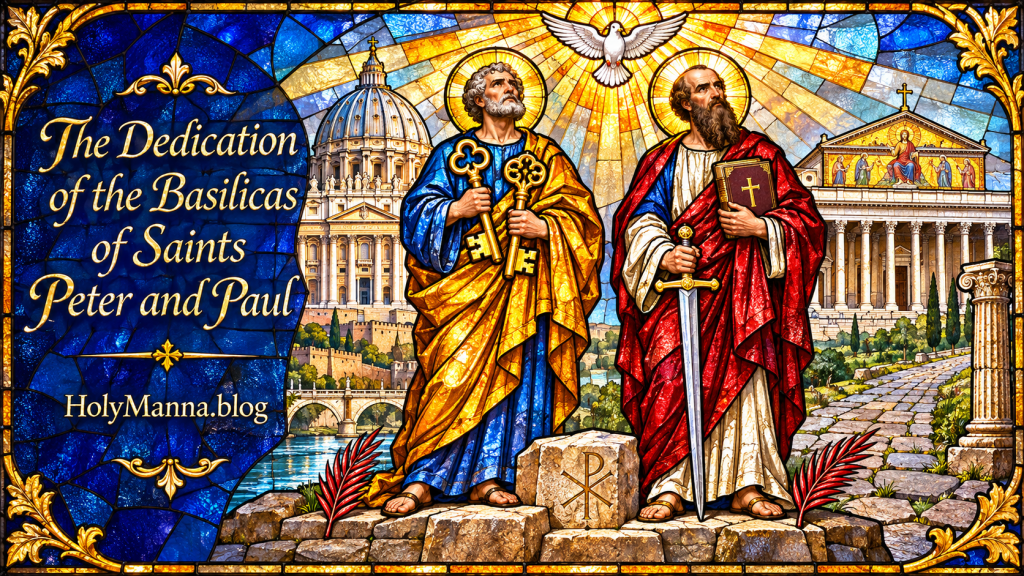
Two Tombs, One Church
Every year on November 18th, the Roman Rite pauses to remember 2 buildings. That might sound like a strange thing for a Church to celebrate, yet the optional memorial of the Dedication of the Basilicas of Saints Peter and Paul, Apostles, is one of the quiet treasures of the liturgical calendar, because the 2 buildings in question are not ordinary churches. They are the Papal Basilica of Saint Peter in the Vatican and the Papal Basilica of Saint Paul Outside the Walls, and both were raised over graves. Beneath the papal altar of each lies the tomb of an apostle put to death in Rome under the Emperor Nero.
The Church keeps anniversaries of dedication for the same reason a family keeps a wedding anniversary. The Catechism of the Catholic Church teaches that church buildings are not simply gathering places but signify and make visible the Church living in this place, the dwelling of God with men reconciled and united in Christ (CCC 1180). When the place shelters the bones of Peter, the fisherman who received the keys, and Paul, the persecutor who became the Apostle to the Nations, the building becomes a sermon in itself. It preaches that the Church is apostolic, that the faith handed down today is the faith those 2 men died for, and that the communion of saints is a fellowship with real people whose remains can still be venerated.
Pope Francis put it simply at the Angelus on June 29th, 2018: Today the Church, pilgrim in Rome and throughout the world, goes to the root of her faith and celebrates the Apostles Peter and Paul. He added that their mortal remains, safeguarded in the two Basilicas dedicated to them, are very dear to the people of Rome and to the countless pilgrims who come from all over to venerate them. The November memorial is the Church’s way of going back to those roots a second time each year, not on the day the apostles died, but on the day their houses were consecrated. The same Church that buried Peter on the Vatican hill and Paul on the Ostian Way is still celebrating Mass over their graves.
From Nero’s Circus to Michelangelo’s Dome
After the great fire of Rome in July 64, the Emperor Nero turned on the Christians of the city. Eusebius of Caesarea, writing his Ecclesiastical History in the early 4th century, records the memory that Paul was beheaded in Rome and that Peter was crucified there under Nero. Eusebius also preserves a far older witness, a Roman churchman named Gaius (often spelled Caius) who, around the year 200, debated a Montanist named Proclus and pointed to evidence anyone in Rome could go and see: But I can show the trophies of the apostles. For if you will go to the Vatican or to the Ostian way, you will find the trophies of those who laid the foundations of this church. A trophy was a victory monument, and by the year 200 the graves of both apostles were already marked as the places where 2 martyrs had won their crowns.
After the Edict of Milan in 313, the Emperor Constantine began raising churches over the most sacred sites of the city. On the Vatican hill he built a 5-aisled basilica directly over the memorial of Peter. The Roman liturgical books record the tradition that Pope Saint Sylvester I consecrated this first Saint Peter’s on November 18th, 326. That date comes from later liturgical tradition rather than from a contemporary record, so it is best held as a venerable tradition rather than a documented fact. Constantine also built a smaller church on the Ostian Way over the grave of Paul. Under the Emperors Valentinian II, Theodosius I, and Arcadius a far larger basilica rose on the same spot. Pope Siricius consecrated it in 390, and it was completed under Honorius around 395. That building, known as the basilica of the 3 emperors, stood essentially intact for more than 1,400 years.
Old Saint Peter’s stood for nearly 1,200 years, but by the 15th century, after the long absence of the popes in Avignon, it was crumbling. In the spring of 1506 Pope Julius II laid the foundation stone of a new basilica designed by Bramante. Michelangelo later designed the great dome, completed after his death in 1564, and Carlo Maderno built the facade. On November 18th, 1626, Pope Urban VIII solemnly consecrated the new Saint Peter’s, deliberately choosing the anniversary of the traditional dedication, 1,300 years earlier.
Saint Paul’s story took a darker turn. On the night of July 15th to 16th, 1823, a fire left by workmen repairing the roof gutted the ancient basilica in a few hours. The popes who followed, Leo XII, Pius VIII, Gregory XVI, and Pius IX, spent 3 decades rebuilding it on the same dimensions under the architect Luigi Poletti. On December 10th, 1854, Pope Pius IX consecrated the whole basilica before some 50 cardinals and the many bishops who had gathered in Rome 2 days earlier for the solemn definition of the dogma of the Immaculate Conception.
How did these dedications become a feast? The most ancient Roman liturgical books contain no anniversary of dedication for either basilica. The joint commemoration on November 18th is a product of the early Middle Ages; some scholars place its first appearance in the 11th century, others in the 12th, and the discrepancy is real. For centuries it was kept almost nowhere outside Rome, until the liturgical reform that followed the Council of Trent under Pope Saint Pius V placed it on the calendar of the whole Roman Rite. In the calendar in force before 1969 it held a higher rank; after the reform of the General Roman Calendar under Pope Saint Paul VI it became an optional memorial. Even after Pius IX reconsecrated Saint Paul’s in December 1854, the annual commemoration of both basilicas remained fixed on November 18th, as the Roman Martyrology still records.
Built on the Foundation of the Apostles
A feast about buildings rests on the Scriptures that make those buildings meaningful. The first foundation is Christ’s promise to Simon at Caesarea Philippi in The Gospel of Matthew 16:18: And so I say to you, you are Peter, and upon this rock I will build my church, and the gates of the netherworld shall not prevail against it. The Catechism explains that because of the faith he confessed Peter will remain the unshakable rock of the Church (CCC 552), and that the power of the keys designates authority to govern the house of God, which is the Church (CCC 553).
The second foundation is Paul’s teaching about what the Church is. In The Letter to the Ephesians 2:19-20 he tells Gentile converts that they are no longer strangers and sojourners, but you are fellow citizens with the holy ones and members of the household of God, built upon the foundation of the apostles and prophets, with Christ Jesus himself as the capstone. Peter uses his own image in The First Letter of Peter 2:5, urging believers to let yourselves be built into a spiritual house to be a holy priesthood. The Catechism gathers these images together when it teaches that the Church is called the building of God and that as living stones we are built up into it here on earth (CCC 756).
Scripture also places both men in Rome. The Acts of the Apostles ends with Paul under house arrest in the capital, and the reading proper to this memorial, Acts 28:11-16, 30-31, describes his final 2 years there: He remained for two full years in his lodgings. He received all who came to him, and with complete assurance and without hindrance he proclaimed the kingdom of God and taught about the Lord Jesus Christ. Neither apostle’s martyrdom is narrated in the New Testament; knowledge of it comes from the earliest tradition, which is remarkably unanimous. Saint Irenaeus of Lyons, around 180, described in Against Heresies the very great, the very ancient, and universally known Church founded and organized at Rome by the two most glorious apostles, Peter and Paul.
Between 1939 and 1949, under Pope Pius XII, excavations beneath Saint Peter’s uncovered a Roman necropolis and, directly under the papal altar, a small 2nd-century shrine built into a red wall, matching the trophy Gaius described. In his Christmas radio message of December 23rd, 1950, Pius XII announced that the tomb of the Prince of the Apostles had been found, while candidly admitting that the bones recovered could not be proven to be Peter’s. Later study of bones removed from a niche in a nearby graffiti-covered wall led Pope Saint Paul VI, on June 26th, 1968, to declare that the relics of Saint Peter had been identified in a manner the Church could regard as convincing. In 2019 Pope Francis gave several fragments of those relics to the Ecumenical Patriarchate of Constantinople as a gesture of unity.
At Saint Paul’s, excavations between 2002 and 2006 exposed a white marble sarcophagus beneath the altar, resting under a 4th-century slab inscribed Paulo Apostolo Mart, that is, to Paul, Apostle and Martyr. In his homily at Saint Paul Outside the Walls on June 28th, 2009, Pope Benedict XVI reported that a probe inserted through a tiny hole had found traces of linen and incense, and that bone fragments sent for carbon-14 testing proved to belong to someone who had lived between the first and second centuries. He concluded that this would seem to confirm the unanimous and undisputed tradition that these are the mortal remains of the Apostle Paul. The Church does not stake her faith on a laboratory result, but she is glad when evidence and tradition speak with one voice.
What the Buildings Teach About the Church
At bottom, this is a feast about the nature of the Church herself. The Catechism teaches that the Church is apostolic because she is founded on the apostles, in three ways: she was built on their foundation, she keeps and hands on their teaching, and she continues to be taught, sanctified, and guided by them through their successors (CCC 857). The Bishop of Rome celebrates the Eucharist over the bones of the man whose office he holds, and he goes to the tomb of Paul to entrust his mission to the apostle whose letters he must preach.
Pope Benedict XVI drew out this inseparability in his homily on June 29th, 2012: Christian tradition has always considered Saint Peter and Saint Paul to be inseparable: indeed, together, they represent the whole Gospel of Christ. Rome holds both tombs, and the November memorial honors both basilicas on a single day, because the Church needs both charisms and because both men shed their blood in the same city under the same persecutor.
Pope Saint Leo the Great preached on this very point in the 5th century. In Sermon 82, delivered on the feast of the Apostles, he addressed the city of Rome and said of Peter and Paul: These are your holy Fathers and true shepherds. He went on to say that these 2 men raised the city to become the head of the world through the blessed Peter’s holy See, and he insisted that the 2 must not be divided in devotion, since they were equal in their election, alike in their toils, undivided in their death. 15 centuries later, The Catechism makes the same claim about the Roman Church when it quotes Saint Maximus the Confessor: from the incarnate Word’s descent to us, all Christian churches everywhere have held and hold the great Church that is here [at Rome] to be their only basis and foundation since, according to the Savior’s promise, the gates of hell have never prevailed against her (CCC 834).
The feast also illuminates the Petrine office. The Catechism teaches that the Pope, Bishop of Rome and Peter’s successor, is the perpetual and visible source and foundation of the unity both of the bishops and of the whole company of the faithful (CCC 882). That office is tied to a place because it is tied to a grave. When the newly elected Pope Leo XIV went to Saint Paul Outside the Walls on May 20th, 2025, he spoke of my own mission as the Successor of Peter and the heir to Paul’s apostolic zeal, and he ended his homily with a prayer that could belong to every Christian: May the Lord grant me the grace to respond faithfully to his call.
Finally, the feast teaches the communion of saints. The Catechism explains that the Church venerates the memory of the saints not merely as examples, but so that by this devotion to the exercise of fraternal charity the union of the whole Church in the Spirit may be strengthened (CCC 957). The relics beneath the altars of Rome are the bodies of men who are alive in Christ, and who intercede for the Church (CCC 946-948, 956).
Walking to the Thresholds of the Apostles
The oldest devotion tied to these basilicas is pilgrimage. From the earliest centuries Christians came to Rome ad limina Apostolorum, to the thresholds of the Apostles, to pray at the 2 tombs. That ancient phrase survives in canon law: every diocesan bishop in the world is bound to travel to Rome every 5 years, in the year he submits his report on the state of his diocese, to venerate the tombs of Peter and Paul and to meet the Pope. The Catechism lists pilgrimages, visits to sanctuaries, and the veneration of relics among the forms of popular piety that extend the liturgical life of the faithful (CCC 1674).
At Saint Peter’s, devotion centers on the Confessio, the sunken area before the papal altar where 2 curving staircases lead down toward the tomb. There, in the Niche of the Pallia, rest the pallia, the woven bands of white lamb’s wool that the Pope confers on new metropolitan archbishops each June 29th as a sign of their communion with the See of Peter. The wool comes from lambs blessed on the feast of Saint Agnes, and the finished pallia rest at Peter’s tomb before they are given.
At Saint Paul’s, the heart of devotion is likewise the Confessio beneath the papal altar, where since 2006 part of the apostle’s sarcophagus can be seen below the ancient inscribed slab. Nearby, pilgrims venerate the chains kept as those that bound Paul during his Roman imprisonment. The nave is ringed with mosaic medallions of every pope from Peter to the present, a visual catechism of apostolic succession. A few miles away stands the Abbey of the Three Fountains, the Tre Fontane, which tradition identifies as the place of Paul’s beheading. That identification rests on tradition rather than contemporary documentation.
Both basilicas possess a Holy Door, opened only during Jubilee years. During the Jubilee of Hope, Pope Francis opened the Holy Door of Saint Peter’s on December 24th, 2024. Pope Leo XIV entered Saint Paul’s through its Holy Door when he came to venerate the apostle’s tomb on May 20th, 2025, and the Jubilee concluded with the closing of the Holy Door of Saint Peter’s on January 6th, 2026. The Catechism teaches that to enter a church is to cross a threshold, which symbolizes passing from the world wounded by sin to the world of the new Life to which all men are called (CCC 1186). At these 2 doors, that symbolism is joined to the memory of 2 men who crossed the final threshold through martyrdom.
A Roman Feast With a Universal Heart
The memorial of November 18th is a Roman Rite observance. Eastern Catholics do not keep an anniversary of these dedications. The Byzantine calendar, like the Roman one, honors the 2 apostles together on June 29th, and it also keeps a Synaxis of the Twelve Apostles on June 30th and a feast of the precious chains of Peter on January 16th. Within the Latin Church, the other 2 papal basilicas have their own dedication days, the Lateran on November 9th and Saint Mary Major on August 5th.
Parishes named for Saint Peter or Saint Paul often treat the day as a secondary patronal celebration. In the United States, November 18th is also the optional memorial of Saint Rose Philippine Duchesne, so a priest may choose either observance or the ordinary weekday. Because the memorial is optional and falls in the final weeks of Ordinary Time, it tends to be a feast for those who seek it out.
The liturgy for November 18th, 2026, a Wednesday of the 33rd week in Ordinary Time, offers 2 paths. The weekday readings, Lectionary 499, proclaim The Book of Revelation 4:1-11, in which John sees an open door to heaven and the heavenly court crying out in worship; the response from Psalm 150 answers, Holy, holy, holy Lord, mighty God!; and The Gospel of Luke 19:11-28 presents the parable of the gold coins. Read in the light of the memorial, these texts speak of a liturgy that opens a door onto heaven and of stewards who must bear fruit while the Master is away.
The proper readings for the optional memorial, Lectionary 679, are even more pointed. Acts 28:11-16, 30-31 brings Paul to Rome at last, where he preaches with complete assurance and without hindrance. Psalm 98 responds, The Lord has revealed to the nations his saving power. The Alleluia verse comes from the Te Deum: We praise you, O God, we acclaim you as Lord; the glorious company of Apostles praise you. The Gospel, Matthew 14:22-33, recounts Peter stepping out of the boat onto the water at Jesus’s command, sinking when his faith falters, and crying Lord, save me! Jesus catches him, asks O you of little faith, why did you doubt?, and those in the boat confess, Truly, you are the Son of God. Taken together, the 2 readings capture the whole feast: the fisherman who learned to trust, and the preacher who could not be silenced, both brought to Rome by a providence neither of them could have planned.
Living Stones in a Shaky World
What does a feast about 2 Roman basilicas ask of you? First, it asks you to remember that your faith has a foundation older than any doubt you will ever have. The Church you belong to is the household of God, built upon the foundation of the apostles and prophets, with Christ Jesus himself as the capstone (Ephesians 2:20). When you kneel at Mass this week, you kneel in continuity with Gaius pointing to the trophies around the year 200, with Constantine’s workmen digging into the Vatican hill, with Leo the Great preaching to Rome, and with a fisherman and a tentmaker who gave their lives rather than deny what they had seen.
Second, it asks you to hold Peter and Paul together in your own life. Peter is the grace of stability: staying in the Church, trusting the shepherds Christ has given, confessing the faith even after you have failed. Paul is the grace of mission: refusing to keep the Gospel to yourself, carrying it to your coworkers, friends, and family with the same complete assurance he showed in Rome. The feast gently insists that the Church, and the Christian, need both.
Third, it asks you to take your own parish church seriously. The basilicas of Rome are extraordinary, but The Catechism says of every consecrated church that it is the proper place for the liturgical prayer of the parish community and the privileged place for adoration of the real presence of Christ in the Blessed Sacrament (CCC 2691). The same Lord adored beneath Michelangelo’s dome is present in the tabernacle down the street. Visiting a church outside of Mass, even for 5 minutes, is a small way of living this feast. If a pilgrimage to Rome is ever possible for you, go to the 2 tombs and pray there. If it is not, the nearest tabernacle is no less a threshold of heaven.
Finally, this memorial asks you to be a living stone. Peter urged believers to let yourselves be built into a spiritual house (1 Peter 2:5). Stones do not choose their place in the wall; they are set by the builder and they bear weight for others. There is something countercultural about allowing Christ to set you where he wills and asking him to make you strong enough to carry your neighbor. Pope Benedict XVI, standing at Paul’s tomb in 2009, summed up the apostle’s message in a single line: the world cannot be renewed without new people. What God is building out of you is meant to stand forever.
Engage With Us!
The story of these 2 basilicas belongs to the whole Church, and that includes every reader of this post. Share your thoughts and reflections in the comments below. Have you ever prayed at the tombs of Peter and Paul, or at a church that bears one of their names?
Here are a few questions to carry into your prayer this week:
- Which apostle do you naturally resemble more, Peter with his steadiness and his stumbles, or Paul with his restless zeal, and how might God be inviting you to grow in the other’s gift?
- The Catechism teaches that a church building makes visible the Church living in that place. How does your own parish church shape the way you pray, and how might you treat it more as a threshold of heaven?
- Paul preached in Rome with complete assurance and without hindrance. Where in your daily life is the Gospel being hindered by fear or hesitation, and what is one concrete step toward greater boldness?
- When Peter began to sink, he cried out, Lord, save me! What storm are you facing right now, and have you asked Jesus to reach out his hand?
- Both apostles were brought to Rome by circumstances they did not choose. Where has God used an unplanned detour in your life to put you exactly where he wanted you?
The 2 fishermen of souls buried in Rome were ordinary men who said yes to an extraordinary call, and the Church still stands on their witness. Go and live your faith with the same courage, and do everything with the love and mercy Jesus taught us.
Saints Peter and Paul, pray for us!
Follow us on YouTube, TikTok, Instagram and Facebook for more insights and reflections on living a faith-filled life.


Leave a Reply