The Woman Who Always Prays
Picture a woman of 49, raised in wealth in the shadow of the French Alps, kneeling to kiss the dirt of a New Orleans dock. Picture her months later hauling water outside a log cabin in the remotest village in the United States, teaching children in a language she would never master. Then picture her at 72, so frail her own sisters assumed she would be left behind, riding a covered wagon toward a Potawatomi village because a Jesuit insisted her prayers alone would make the mission succeed. That is Saint Rose Philippine Duchesne, celebrated on November 18th.
She is remembered as the pioneer who brought the Society of the Sacred Heart to the Americas, opened the first free school west of the Mississippi in 1818, and founded 6 houses in a single decade. She is remembered even more for what she did when she could no longer do anything at all. Unable to speak Potawatomi, she simply prayed, and the people she had crossed an ocean to serve named her Quahkahkanumad, Woman Who Prays Always.
Pope Saint John Paul II canonized her on July 3rd, 1988, and the Church honors her as the patroness of perseverance amid adversity. She is also a co-patroness of the Archdiocese of St. Louis and the patroness of the Diocese of Springfield-Cape Girardeau in Missouri. The Catechism explains why the Church lifts up such a life: “By canonizing some of the faithful, i.e., by solemnly proclaiming that they practiced heroic virtue and lived in fidelity to God’s grace, the Church recognizes the power of the Spirit of holiness within her and sustains the hope of believers by proposing the saints to them as models and intercessors” (CCC 828). Philippine’s heroic virtue was not flashy. It was the virtue of a woman who kept saying yes long after the answer kept being no.
A Daughter’s Stubborn Heart
Rose Philippine Duchesne was born on August 29th, 1769, in Grenoble, the old capital of the Dauphiné in southeastern France. She was baptized at the Church of St. Louis and given two patrons who would quietly shape her destiny: Saint Rose of Lima, the first canonized saint of the New World, and Saint Philip the Apostle, who told Nathanael, “Come and see” (John 1:46). Her father, Pierre-François Duchesne, was a prominent lawyer and civic leader; her mother, Rose-Euphrosine Périer, came from one of the wealthiest and most politically connected families in the region. Philippine was the second of 8 children, and she grew up next door to her Périer cousins, including Josephine, who remained her closest confidante for life.
She survived smallpox as a child and was, by every account, strong willed. The decisive spark came when a Jesuit who had served in the Louisiana missions visited the household and spoke of the native peoples of North America. The stories lodged in the young girl’s heart, and she later said she had wanted to be a missionary to the American Indians from that moment. It would take more than 60 years.
Around age 12 she was sent to the Visitation convent of Sainte-Marie-d’en-Haut, perched above Grenoble. There her devotion to the Sacred Heart took root. Her parents sensed where things were heading, brought her home, introduced her to society, and when she was 17 arranged a promising marriage. She refused it. In 1788, at 18 or 19 (sources differ), she walked back up the hill with an aunt as chaperone and asked to be admitted as a novice. Her father refused to allow vows until she turned 25. She obeyed a wise priest’s counsel and stayed inside the enclosure anyway.
The Church recognizes this tension: “Family ties are important but not absolute. Just as the child grows to maturity and human and spiritual autonomy, so his unique vocation which comes from God asserts itself more clearly and forcefully” (CCC 2232). Philippine honored her parents, but she would not surrender a call she believed came from God.
Then the Revolution came. In 1791 and 1792 the new government suppressed religious communities, and the Visitation nuns of Grenoble were dispersed. Philippine, still without final vows, returned to her family’s country home. Through the Reign of Terror she nursed prisoners, carried food and messages to priests in hiding, fed the poor, and gathered abandoned children to teach them, all at real risk to her liberty and her life. This was the Church’s teaching lived in the dark: “The works of mercy are charitable actions by which we come to the aid of our neighbor in his spiritual and bodily necessities” (CCC 2447).
When the Concordat of 1801 reopened the door to religious life, Philippine leased the ruined monastery and tried to rebuild the Visitation community. A few elderly nuns returned and soon left again, and by 1802 she was superior of 3 companions and no future. Her first dream had failed.
Twelve Years of Waiting
In 1804 Philippine’s confessor told her about a congregation founded in Paris 4 years earlier by 25 year old Madeleine Sophie Barat: the Society of the Sacred Heart of Jesus, devoted to educating girls and making known the love of Christ’s Heart. Philippine offered Sophie Barat the monastery, the community, and herself. In December 1804 Mother Barat arrived in Grenoble, and Philippine, 10 years older than her new superior, knelt before her as a novice. She made her first vows in 1805 at age 36. What began that winter was one of the great spiritual friendships in the history of the Church, documented in hundreds of surviving letters. Philippine was fire and granite; Sophie was patience and prudence, and both women would later be canonized.
The turning point of Philippine’s inner life came on the night of Holy Thursday, April 3rd into April 4th, 1806. She spent the entire night in adoration before the Blessed Sacrament, and in a letter to Mother Barat the next morning she described feeling herself carried across the New World bearing the Eucharist, offering up everything she loved: her mother, her sisters, her family, even her beloved mountains. Then she wrote the line that defined the rest of her life: “Dear Mother, when you say to me, ‘Behold I send you,’ I shall answer quickly, ‘I will go.’”
It is impossible not to hear the prophet in those words: “Here I am; send me!” (Isaiah 6:8). The Catechism describes such prayer in the words of Saint John Damascene: “Prayer is the raising of one’s mind and heart to God or the requesting of good things from God” (CCC 2559). Philippine raised her heart that night and asked for one good thing, and then she waited 12 years to receive it.
She served as mistress of novices and, in 1815, as the Society’s secretary general, and still she begged to be sent. Finally Bishop Louis William DuBourg of Louisiana came to Paris looking for religious women to educate French and native children. On January 14th, 1817, Philippine knelt before Mother Barat and begged permission to go, and Sophie at last relented.
Across the Ocean and Up the River
On March 21st, 1818 (a few sources say March 14th), Philippine and 4 companions, Eugénie Audé, Octavie Berthold, Catherine Lamarre, and Marguerite Manteau, sailed from Bordeaux aboard the Rebecca. After roughly 70 stormy days they landed in New Orleans on May 29th, 1818, the Feast of the Sacred Heart that year, and Philippine knelt and kissed the ground. The steamboat journey up the Mississippi took another 6 or 7 weeks. Philippine expected to open a school in St. Louis. Bishop DuBourg instead sent the sisters 20 miles upriver to St. Charles, Missouri, a settlement he described as the remotest village in the United States. The sisters arrived on September 7th, 1818, and moved into a log cabin. There, within weeks, they opened the first free school west of the Mississippi and the first house of the Society of the Sacred Heart outside France.
The Church teaches that mission is not optional: “It is from God’s love for all men that the Church in every age receives both the obligation and the vigor of her missionary dynamism, ‘for the love of Christ urges us on’” (CCC 851). When Saint John Paul II canonized Philippine, he chose that same verse from 2 Corinthians 5:14 as the lens for her life. She did not go to America because it was sensible. She went because love would not let her stay.
The first winter nearly broke them. The cold was savage, food was scarce, students were few, mail from France took months, and Philippine could not make herself understood in English. Within a year hunger and lack of pupils forced the St. Charles school to close, and in 1819 the sisters moved to Florissant. There the Society finally took root. A chapel was ready by Christmas 1819, Philippine opened a novitiate for American vocations, and in 1825 she began a school for native girls. Foundations followed at Grand Coteau and St. Michael’s in Louisiana, in St. Louis, and at a reopened St. Charles in 1828. In 10 years the woman who could not speak English properly had founded 6 houses and was superior of them all.
Her holiness was visible to those around her. The Jesuit Father Pierre-Jean De Smet, who knew her well, called her “the greatest saint of Missouri and probably of all the American States.” She slept little, prayed through the night, and did the humblest chores herself. Catholic biographers do not attribute dramatic wonders to her during her lifetime, and none will be invented here. Her miracle, if it can be called that, was fidelity: 34 years of showing up in the cold.
When the Dream Looked Like Failure
Philippine’s hardships were a long, grinding decade rather than a single heroic moment. She fell gravely ill in 1820 and received Viaticum. Yellow fever struck the Louisiana houses. In 1826 her great ally Bishop DuBourg left America for good, and she wrote with aching simplicity, “Today, we have no other zealous friend than Jesus.” Money was always short, Mother Barat’s letters from Paris were at times sharply critical of the American houses, and younger, more polished sisters began to eclipse her. By 1829, at age 60, she described herself in a letter as “a worn-out stick, ready to be thrown away at the first opportunity.”
Through all of it she kept the Divine Office, nursed the sick, scrubbed floors, and waited. The Catechism speaks of this grace: “Illness can lead to anguish, self-absorption, sometimes even despair and revolt against God. It can also make a person more mature, helping him discern in his life what is not essential so that he can turn toward that which is” (CCC 1501).
There is one hardship that must be named honestly, because the Society of the Sacred Heart itself has named it. Philippine and the American houses she governed held enslaved persons. In an 1822 letter she wrote of her repugnance for slavery and in the same breath accepted that the houses might be obliged to purchase enslaved laborers to survive on the frontier. The Society has formally acknowledged that its communities enslaved more than 100 men, women, and children between 1818 and the Civil War, and it has committed to reconciliation with their descendants. The Church’s teaching is unambiguous: the seventh commandment “forbids acts or enterprises that for any reason… lead to the enslavement of human beings, to their being bought, sold and exchanged like merchandise, in disregard for their personal dignity” (CCC 2414). Saints are not people who never sinned; the Catechism reminds the faithful that “all members of the Church, including her ministers, must acknowledge that they are sinners” (CCC 827). Philippine’s holiness is not diminished by telling the truth about her age and its evils; it is only understood rightly.
In 1840, at 71, she was relieved as superior of the American houses, and her life’s work was handed to others. Then the dream she had carried since childhood came knocking.
The Jesuits were opening a mission among the Potawatomi at Sugar Creek, in what is now eastern Kansas near Mound City. Many of those Potawatomi had survived the forced removal of 1838 remembered as the Trail of Death. Four sisters were chosen for the new school, Philippine among them, though as departure drew near the other 3 assumed she was too sick to go. The Society tells that Father Peter Verhaegen, the Jesuit superior, asked where the fourth sister was and, on hearing that Mother Duchesne was too frail, gave the answer preserved in the Vatican’s own biography of her: “She must come; she may not be able to do much work, but she will assure success to the mission by praying for us.”
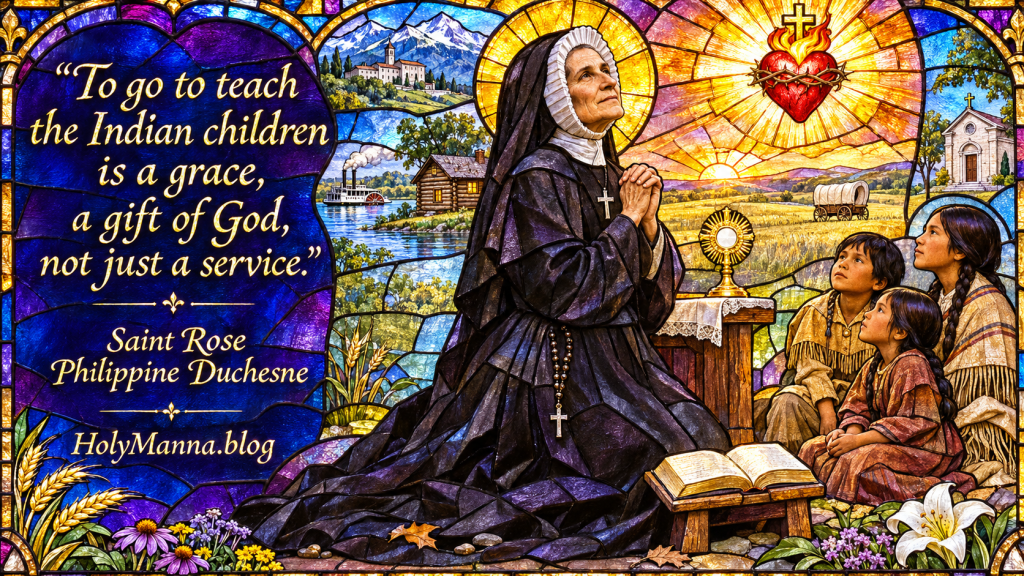
So in 1841, at 72, Philippine traveled by boat up the Missouri and then by covered wagon to Sugar Creek. She had written to Mother Barat that “to go to teach the Indian children is a grace, a gift of God, not just a service,” words John Paul II would quote at her canonization. But when she arrived she found that the Potawatomi language was beyond her. She could not teach. She could not nurse. She could barely do manual work. What she could do was pray, and she did, for hours at a time.
The Potawatomi noticed, and they named her Quahkahkanumad, Woman Who Prays Always. A tradition holds that the children, wanting to test whether she ever moved, would creep up and scatter pebbles, leaves, bits of paper, or kernels of corn on her habit while she knelt, and return hours later to find everything exactly where it had fallen. The story is depicted in art at Mound City, but it cannot be verified from primary sources. What can be documented is something almost identical from decades earlier in Grenoble, where a student named Aloysia Rambaud dropped bits of paper on Mother Duchesne’s skirt one Holy Thursday night and found them undisturbed at dawn. Whether or not the Potawatomi children repeated the experiment, the woman they named was the same woman.
After about a year her health collapsed, and in July 1842 she was recalled to St. Charles. She wept at leaving. She had waited 60 years for the Potawatomi and was given 12 months with them. Saint Paul’s command was fulfilled in her more literally than in almost any saint: “Pray without ceasing” (1 Thessalonians 5:17). The Catechism comments on that verse: “It is always possible to pray: the time of the Christian is that of the risen Christ who is with us always, whatever the tempests” (CCC 2743). Philippine proved it when every other possibility had been taken away.
Her final decade was spent at St. Charles in a tiny room under a stairway, in poverty, prayer, and small acts of service. She died around noon on November 18th, 1852, at age 83, murmuring the names of Jesus, Mary, and Joseph.
Intact in the Grave and Honored in Rome
Philippine was buried in the convent cemetery at St. Charles. Three years later, in 1855, as talk of her holiness spread, her body was exhumed and found to be intact. The sisters laid her in a small octagonal chapel on the front lawn of the Academy of the Sacred Heart, remembered as the Round House, where she rested for nearly a century. The intact state of her body is reported by the Society and the Shrine, though the Church has made no formal pronouncement about it.
Her cause was introduced in 1895. She was declared Venerable in 1909 under Pope Saint Pius X, and the decree recognizing her heroic virtues is dated March 17th, 1935, under Pope Pius XI; sources sometimes conflate these two steps. Two miraculous healings attributed to her intercession were approved, and Pope Pius XII beatified her on May 12th, 1940. The official decree confirms the 2 cures but does not name the people healed, so their stories are not told here. Rome then asked that her remains be moved indoors, and on April 18th, 1951, her relics were transferred to a marble sarcophagus as ground was broken for the present Shrine of Saint Rose Philippine Duchesne.
The miracle that opened the way to canonization was examined by Church tribunals in San Francisco and Tokyo in 1960 and 1961. Some accounts identify it as the 1951 cure of a Religious of the Sacred Heart, Mother Marie Bernard, from a malignant tumor of the neck; the official decretal letter does not name the person healed, so this identification is reported as it appears in secondary sources rather than as confirmed fact. What is certain is that after medical and theological review, the miracle was formally approved on October 23rd, 1987.
On July 3rd, 1988, in St. Peter’s Basilica, Pope Saint John Paul II canonized Rose Philippine Duchesne alongside the Spanish Trinitarian Saint Simón de Rojas. The next day, addressing pilgrims, the Pope said: “Saint Rose Philippine was a woman of lively faith and constant prayer, a woman full of zeal for the missionary needs of the Church.” He added that such a life could only be “the result of a heart on fire with love of God, a heart that was always in loving harmony with the Sacred Heart of Jesus the Lord.” He observed that she had overcome the language barrier through the daily witness of her life, and asked whether modern Christians, in a civilization that abuses speech, leave room for that quiet dimension.
Smaller stories of her intercession continue to be told. A Religious of the Sacred Heart has recounted that in 1948, diagnosed with lupus and barred from entering the novitiate, she made a novena to Blessed Philippine and the symptoms disappeared within a month. A Kansas family near the Sugar Creek site has long credited Philippine with saving a small boy who was caught by his sister at the edge of an open well. These are personal testimonies, treasured by those who lived them, and they cannot be verified.
The Catechism teaches why Catholics ask her prayers at all: “Being more closely united to Christ, those who dwell in heaven fix the whole Church more firmly in holiness… they do not cease to intercede with the Father for us” (CCC 956). The woman who prayed always has not stopped.
Her legacy is physical as well as spiritual. The Shrine of Saint Rose Philippine Duchesne in St. Charles, Missouri, holds her tomb, her tiny cell, and relics from the log cabin years. In Kansas, the Saint Philippine Duchesne Memorial Park marks the Sugar Creek mission site near Mound City, and she remains the only canonized saint ever to have lived in that state. Missouri inducted her into its Hall of Famous Missourians in 2006, and the 2018 bicentennial of her arrival was marked by a walking pilgrimage of more than 330 miles from Mound City to her shrine. Schools and parishes bear her name, and the Society she carried across the ocean now serves in about 41 countries.
What a Worn-Out Stick Can Teach a Busy Generation
Philippine Duchesne’s life is a direct challenge to the way most people measure success. She waited 12 years for permission, 30 more for her real dream, and then got only 1 year of it, spent mostly unable to do anything useful. Heaven measured it differently.
The first lesson is about waiting. Most people treat delay as a sign that God has said no. Philippine treated it as the space where obedience and desire are purified. The Catechism defines hope as the virtue by which believers desire eternal life “placing our trust in Christ’s promises and relying not on our own strength, but on the help of the grace of the Holy Spirit” (CCC 1817). What dream have you been carrying that God seems to keep postponing? Is it possible that the waiting itself is the formation?
The second lesson is about failure. The St. Charles school closed in a year, her leadership was criticized by the woman she loved most, and she was replaced. Yet the Church teaches that “Fortitude is the moral virtue that ensures firmness in difficulties and constancy in the pursuit of the good” (CCC 1808), and Philippine simply did not quit. Jesus said that “unless a grain of wheat falls to the ground and dies, it remains just a grain of wheat; but if it dies, it produces much fruit” (John 12:24). The fruit of her apparent failures is a network of schools on 2 continents. Where in your life are you tempted to interpret a setback as a verdict? What would it look like to keep showing up anyway?
The third lesson is the hardest, because it is about uselessness. At Sugar Creek, Philippine could not teach, nurse, build, or speak. She could only pray. Yet the Catechism insists that “Prayer and Christian life are inseparable” (CCC 2745), not an accessory to the real work. If you were stripped of every ability except the ability to pray, would you still believe your life had purpose? How much of your sense of worth depends on being productive rather than being present to God?
You could choose one night this week to sit in adoration longer than feels comfortable. You could pray by name for a mission or a people you will never meet, the way she prayed for the Potawatomi before she ever saw them. You could take the next frustrating delay in your life and, instead of complaining, write the words “I will go” on a card and keep it where you will see it. A heart that holds nothing back is still the thing God wants most.
Engage With Us!
Saint Rose Philippine Duchesne has a way of finding people who feel overlooked, delayed, or spent. If her story spoke to you, please share your thoughts and reflections in the comments below.
Here are a few questions to pray with and discuss:
- Philippine waited 12 years between her Holy Thursday vision and her departure for America. What is God asking you to wait for right now, and how are you using the waiting?
- She crossed an ocean at 49 and a prairie at 72. What fear of being too late or too old is holding you back from a call you sense?
- The Potawatomi named her for what they saw her do, not what they heard her say. If the people around you named you for your most visible habit, what would they call you?
- Philippine’s holiness coexisted with real moral blindness about slavery, which the Church condemns. How does knowing that saints were sinners change the way you think about your own path to holiness?
- At Sugar Creek she could offer only prayer. When have you felt useless, and did you let that season become prayer or resentment?
Whatever field God has given you is probably smaller than you hoped and harder than you expected. Cultivate it anyway. Say yes before you know the details, keep saying it when the answer is slow, and when you finally run out of strength, kneel down and let that be your gift. Do everything, especially the small and hidden things, with the love and mercy that Jesus taught us, and trust that the One who sends is also the One who sustains.
Saint Rose Philippine Duchesne, the Woman Who Always Prays, pray for us!
Follow us on YouTube, TikTok, Instagram and Facebook for more insights and reflections on living a faith-filled life.


Leave a Reply