The Monk Who Came in Peace
Most people who know the name Cluny know it as a place, the great Burgundian abbey whose influence once reached across Europe and whose ruins still draw visitors today. Far fewer know the man who turned a half-built monastery with an empty treasury into the engine of a continent-wide renewal. That man is Saint Odo of Cluny, monk, priest, abbot, writer, peacemaker, and friend of beggars, whose memorial the Church keeps on November 18th, the day of his death in the year 942.
Odo was Cluny’s second abbot, ruling from 927 until his death. In those 15 years he kept the abbey free of outside interference, reformed monasteries from Fleury to Monte Cassino, and left behind writings on the Eucharist, the mercy of Christ, and the holiness possible to laypeople. The 10th century chronicler Flodoard of Reims called him “the restorer of monasteries and of the Holy Rule.” Pope Benedict XVI, preaching on him in 2009, summed up the man in one line: “He was austere, but above all he was good, a man of great goodness, a goodness that comes from contact with the divine goodness.”
The Church has always taught that renewal is part of her very life. The Catechism says the Church, “clasping sinners to her bosom, at once holy and always in need of purification, follows constantly the path of penance and renewal” (CCC 827). Odo’s life shows what that sentence looks like when one man takes it seriously.
A Child Promised to Saint Martin
The one contemporary source for Odo’s life is the Vita Odonis, written shortly after his death by his disciple John of Salerno, who recorded the abbot’s own account of his youth. Later sources, including the Catholic Encyclopedia and Butler’s Lives of the Saints, draw on John.
Odo was born around 878 or 879, though Benedict XVI gives roughly 880, and the sources disagree about where: the Catholic Encyclopedia says near Le Mans, Benedict XVI the border of Maine and Touraine, the New Catholic Encyclopedia Aquitaine, and Butler Tours itself. His father is usually named Abbo, though some sources give Ebbo, a nobleman described by John as surprisingly learned for a layman. His mother is named in some accounts as Arenberga, and his brother Bernard also became a monk.
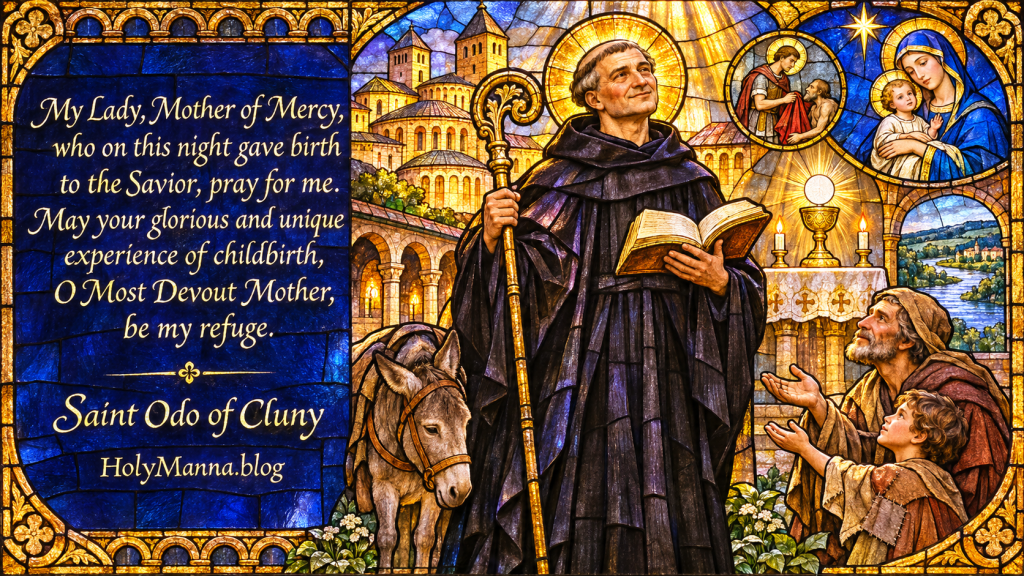
John tells how the long childless couple prayed to Our Lady one Christmas Eve for a son, and how the grateful father offered the newborn to Saint Martin, the great bishop of Tours whose tomb was then among the holiest shrines in Western Christendom. Benedict XVI puts it this way: Odo’s father consecrated him to Saint Martin, “in whose beneficent shadow and memory he was to spend his entire life, which he ended close to St Martin’s tomb.”
For a time the vow went unfulfilled. Odo was sent first to the household of Fulk, Count of Anjou, and then to the court of Duke William the Pious of Aquitaine, the future founder of Cluny, to be trained as a knight. He found hunting and the exercises of war unbearable. Some devotional retellings say the youth suffered violent headaches that lifted only when his father revealed the forgotten vow and Odo renewed it. That detail is absent from the standard sources and cannot be verified. What is clear is that at about 19 he left court for Tours, received the tonsure, and became a canon of the church of Saint Martin.
Something happened in those years that Odo himself told John about decades later. He was about 16, and it was Christmas Eve. Benedict XVI recounts that a prayer rose spontaneously to his lips: “My Lady, Mother of Mercy, who on this night gave birth to the Savior, pray for me. May your glorious and unique experience of childbirth, O Most Devout Mother, be my refuge” (Vita Odonis, I, 9). From that night on, Mother of Mercy was the title by which he most loved to address Mary. The Church herself invokes Mary this way, teaching that “taken up to heaven she did not lay aside this saving office but by her manifold intercession continues to bring us the gifts of eternal salvation” (CCC 969).
At Tours he studied the classics, the Fathers, poetry, and music for 6 years, then spent about 4 years in Paris under Remigius of Auxerre. But he was uneasy. The canons of Saint Martin lived comfortably on pilgrims’ gifts. John of Salerno records Odo’s dry remark that the religious at Tours had stopped attending the night office “for fear of getting their fine shoes dirty.” Odo turned from the pagan authors to Scripture, took up a hard asceticism, and withdrew to a bare cell.
The turning point came when he read the Rule of Saint Benedict. He was, as Butler puts it, confounded to see how far his life fell short of it, and he resolved to become a monk. The Count of Anjou refused permission, so Odo spent nearly 3 years in a cell with one companion, in penance and prayer. Finally, around 909, he resigned his canonry and went secretly to the Abbey of Baume in the diocese of Besançon, where Abbot Berno received him. He brought nothing but his library of about 100 books. The Catechism describes the call Odo answered: “Christ proposes the evangelical counsels, in their great variety, to every disciple” (CCC 915).
The Abbot Who Rode In on a Donkey
At Baume, Odo became master of the monastery school, bore the hostility of some monks with patience, and at Berno’s order was ordained a priest by Bishop Turpio of Limoges, who later asked him to write the Collationes, 3 books of forceful moral conferences modeled on John Cassian.
In 910 Berno founded Cluny on land given by Duke William. When Berno died in 927, he left Déols, Massay, and Cluny to Odo. The monks of Cluny elected Odo abbot; he refused as unworthy and accepted only under threat of excommunication. Then the troubles began. Wido, Berno’s nephew and one of Odo’s old persecutors at Baume, tried to seize Cluny by force, and Pope John X had to write to King Rudolf to intervene. The abbey church was unfinished and the treasury empty.
Here John of Salerno records the first of Odo’s stories. On the feast of Saint Martin, a kindly, bearded old man appeared at the unfinished buildings, told Odo that he was Martin, and promised that if the monks persevered the money would come. A few days later a gift of 3,000 gold solidi arrived. This is told as a story by Odo’s biographer and cannot be independently verified.
Odo governed with strict fidelity to the Rule. He insisted on personal poverty, banned meat, and treated silence as the very mark of a monk; Butler preserves his view that “no one can be called a monk who is not a true lover, and strict observer of silence.” His reforms were not grim for their own sake. In a sermon on Mary Magdalene, Odo described the life he loved: “Mary who, seated at the Lord’s feet, with an attentive spirit listened to his word, is the symbol of the sweetness of contemplative life; the more its savor is tasted, the more it induces the mind to be detached from visible things and the tumult of the world’s preoccupations.” Jesus said of that Mary, “Mary has chosen the good portion, which shall not be taken away from her” (Luke 10:42). The Catechism says the same in its own idiom: “Contemplative prayer is silence, the ‘symbol of the world to come’ or ‘silent love’” (CCC 2717).
Odo secured for Cluny what made the whole movement possible: independence. King Rudolf confirmed the abbey’s immunity, and in 931 Pope John XI granted Cluny exemption and the right to receive any monk from a disorderly monastery who wished to amend his life. Armed with this, Odo reformed or took charge of Romainmôtier, Aurillac, Tulle, Sarlat, Saint-Allyre of Clermont, Saint-Pierre-le-Vif at Sens, and, in the year of his death, Saint-Julien of Tours. The New Catholic Encyclopedia notes that he received 188 deeds of donation as abbot.
The most famous episode of his career is Fleury, the abbey on the Loire that held the relics of Saint Benedict himself. After the Viking raids its monks had scattered and come back with no stomach for the Rule. King Rudolf asked Odo to reform them. John of Salerno reports that when Odo arrived, around 930, the monks met him armed with spears and swords and threatened to kill him. After a standoff of 3 days, Odo rode toward the gates alone on his donkey. The monks laid down their weapons, and some wept and begged forgiveness. The historian George Zarnecki, drawing on John of Salerno but placing the scene at Monte Cassino rather than Fleury, preserves the words with which Odo disarmed the opposition: “I come peacefully, to hurt no one, injure no one, but that I may correct those who are not living according to rule.” Readers should know that the sources differ about where those words were spoken.
Fleury produced two more stories. The monks resented the meat ban and waited for the fish to run out, but Odo always found more. And on Saint Benedict’s feast, John says, Benedict appeared to a sleeping brother and told the monks to fish in the marsh rather than the river, after which they drew a great haul. Both are told as stories and cannot be verified. Fleury later became a center of reform in its own right.
Odo’s charity was a byword. He taught that the blind and the lame would be the doorkeepers of heaven, echoing the Lord’s command, “when you give a feast, invite the poor, the maimed, the lame, the blind” (Luke 14:13). When a monk of his party was harsh with a beggar, Odo made him call the man back and be kind. John of Salerno writes that Odo “sometimes confessed that his means always sufficed both to feed the brethren and to give alms to the poor,” and adds, “Never did a poor man turn away empty from the bosom of his mercy.” In one year Cluny fed more than 7,000 people in need. He walked bent over with his eyes on the ground, earning the nickname the Digger, and he had a real sense of humor. Once, having overpaid absurdly for laurel berries to help a poor seller, he gave his companions a string of ridiculous justifications until they were laughing. The Catechism teaches that “those who are oppressed by poverty are the object of a preferential love on the part of the Church” (CCC 2448), and names feeding the hungry among the corporal works of mercy (CCC 2447).
His writings deserve a word. Besides the Collationes, he wrote the Occupatio, a long poem on the Redemption; a Life of Saint Gerald of Aurillac, one of the first medieval portraits of a saintly layman, a warrior who fought only for peace and refused to shed blood; 3 hymns and 12 antiphons for Saint Martin; some sermons; and a commentary on Saint Gregory’s Moralia. In the Occupatio he taught the Real Presence with striking clarity: at the Lord’s word, “the bread instantly becomes flesh, and the wine becomes blood,” and “the substance changes.” The Church later named this transubstantiation, teaching that “by the consecration of the bread and wine there takes place a change of the whole substance of the bread into the substance of the body of Christ our Lord and of the whole substance of the wine into the substance of his blood” (CCC 1376). He grieved that this “sacrosanct mystery of the Lord’s Body, in whom the whole salvation of the world consists” (Collationes XXVIII) was celebrated carelessly, and he warned that “priests who approach the altar unworthily, stain the bread, that is, the Body of Christ.” The Church still teaches that one must prepare for “so great and so holy a moment” (CCC 1385).
Spears, Snow, and Forty Robbers
Odo was never a martyr, but his life was full of danger and labor. In the winter of 936 he crossed the Alps at the invitation of Alberic II, the ruler of Rome, and Pope Leo VII. John of Salerno, who went with him, records that in deep snow Odo’s horse fell over a cliff; the abbot caught hold of a tree and clung there until help came. On another journey 40 robbers lay in wait, but one of them declared they would never prevail against such men, protected Odo, and later became his disciple. Both are told as stories and cannot be verified.
In Rome, Odo took charge of Saint Paul Outside the Walls, founded Our Lady on the Aventine, and sent his monk Baldwin to replant Monte Cassino, the cradle of the Benedictine order, where observance had collapsed. He made 4 long visits to Italy in all, and twice he mediated between Alberic and his stepfather King Hugh of Italy. John of Salerno names among his great aspirations “concord between kings and princes, the observance of the commandments, attention to the poor, the correction of youth and respect for the elderly” (Vita Odonis, I, 17). The Beatitude fits him: “Blessed are the peacemakers, for they shall be called sons of God” (Matthew 5:9). The Catechism teaches that “peace is the work of justice and the effect of charity” (CCC 2304), and that is how Odo made it, by prayer and by riding into hostile places unarmed.
The hardest trial was his own body. Years of austerity and travel, and what one modern account describes as malaria, wore him down. In the summer of 942 he fell gravely ill in Rome, having already named Aymard as his successor. Sensing that the end was near, he was determined, in Benedict XVI’s words, to return “to St Martin in Tours.” He reached Saint-Julien in Tours in time for Saint Martin’s feast on November 11th, took part in the celebrations, and, as his fever worsened, composed a hymn in honor of Martin. He died on November 18th, 942, within the octave of the feast of the saint to whom his father had given him as an infant. The older edition of the Roman Martyrology records simply: “At Tours, the departure from this life of blessed Odo, abbot of Cluny.”
Ashes, Relics, and a Pope’s Tribute
Odo was buried in the church of Saint-Julien at Tours. The record of his veneration is quieter than the record of his life, and it should be said plainly. The historian Barbara Rosenwein observes that Cluny at first kept his feast rather perfunctorily. Interest grew under Abbot Hugh, who ruled from 1049 to 1109, built a chapel in Odo’s honor, and commissioned a new biography. By the time of Peter the Venerable in the 12th century, Cluny regarded Odo as the first father of the Cluniac order. Benedictines today keep a memorial of the holy abbots of Cluny on May 11th. His name was entered in the Roman Martyrology, which is how the Church confirmed a saint’s cult before formal canonization procedures existed.
The Catholic sources consulted for this post record no specific miracles attributed to Odo’s intercession after his death, and none will be invented here. The one story of divine protection attached to his memory concerns a book. John of Salerno tells that a glossary Odo wrote on the life of Saint Martin sat in a cellar that flooded, and when the water drained only the margins were soaked while the text was untouched. Odo credited God and Saint Martin. This is told as a story and cannot be verified.
His relics have a sad history. Butler records that the Huguenots burned the greater part of his remains at Saint-Julien. Some surviving relics are kept at L’Isle-Jourdain in the Gers region of southwestern France, according to the New Catholic Encyclopedia. A few popular accounts blame the French Revolution instead; Butler’s account is older and more specific. The Catechism counts the veneration of relics among the authentic forms of popular piety (CCC 1674).
Odo’s deepest impact after death is not a shrine but a civilization. The Cluniac system he set in motion grew under his successors into the most powerful spiritual force in Western Europe for 2 centuries, producing popes and shaping the Gregorian reform. Benedict XVI noted that Cluny “still today reveals to us, through its majestic ruins, the signs of a past rendered glorious by intense dedication to ascesis, study and, in a special way, to divine worship.” Most of the abbey church was torn down after the French Revolution, but the surviving transept still draws pilgrims. On September 2nd, 2009, Benedict XVI devoted an entire general audience to Odo, calling him a true spiritual guide for the monks and the faithful of his time.
Two false claims circulate online. Odo is often credited with the musical treatise Dialogus de musica and with inventing letter notation for pitch; scholars have shown that the treatise is the work of an anonymous north Italian monk around the year 1000, now called Pseudo-Odo, and the New Catholic Encyclopedia judges the musical works under his name probably apocryphal. He is also sometimes said to have instituted All Souls’ Day; that was his successor Saint Odilo, around the year 998.
Lessons From a Reformer Who Smiled
What makes Odo worth remembering is not that he was severe but that he was good. Benedict XVI drew attention to the center of his spirituality: he loved to contemplate Christ as “a lover of men,” amator hominum Christus (Collationes LIII), the Savior who bore “the scourging that would have been our due in order to save the creature he formed and loves.” For all the sharpness of his diagnosis of his age, he refused despair. “We do not say this,” he wrote, “in order to plunge those who wish to convert into despair,” and he insisted that “divine mercy is always available; it awaits the hour of our conversion” (Collationes, PL 133, 563). The Catechism says it too: “The Gospel is the revelation in Jesus Christ of God’s mercy to sinners” (CCC 1846).
The first lesson is this. Odo’s conversion did not begin with a lightning bolt. It began when a comfortable young cleric read a rule of life and admitted he did not measure up. The Catechism describes interior repentance as “a radical reorientation of our whole life, a return, a conversion to God with all our heart” (CCC 1431). You do not have to be a monk to do that. When was the last time you read Scripture, a saint’s life, or the Catechism and let it measure you instead of the other way around?
The second lesson is about how reform actually happens. Odo did not storm Fleury with the king’s soldiers, though he could have. He waited 3 days, then rode in on a donkey, like Someone else who once entered a hostile city on a donkey. He came, as he said, to hurt no one, and he outlasted the monks’ stubbornness with patience. Most of the people you want to change, in your parish, your family, or your workplace, will not be changed by force or by winning an argument, but by someone who keeps showing up unarmed and cheerful. Who in your life needs you to come in peace rather than in victory?
The third lesson is Odo’s reverence for the Eucharist. In an age when the Mass was often celebrated carelessly, his answer was to teach, loudly and clearly, that the bread becomes the Body of Christ. The Catechism calls the Eucharist “the source and summit of the Christian life” (CCC 1324). Try arriving at Mass 10 minutes early this week and kneeling in silence, as Odo loved to do in his cell, “removed from the eyes of all, eager to please God alone” (Vita Odonis, I, 14). Does the way you approach the altar reflect what you say you believe is on it?
The fourth lesson is the one Odo would insist on most: the poor. He taught that the blind and the lame are the doorkeepers of heaven, a cheerful way of saying what Jesus said with terrible seriousness: “as you did it to one of the least of these my brethren, you did it to me” (Matthew 25:40). Odo never let a beggar go away empty, and he never let his monks be rude to one. Pick one concrete work of mercy this month and do it with a smile, because, as John of Salerno reminded his readers, “God loves a cheerful giver” (2 Corinthians 9:7).
Finally, there is Mary, Mother of Mercy. A teenage boy’s spontaneous Christmas Eve prayer became the devotion of a lifetime. The Catechism teaches that the saints “do not cease to intercede with the Father for us” (CCC 956), and Odo leaned on that truth with Martin and with Mary every day. Whatever title of Our Lady speaks to you, make it your own. What one prayer could you say every day for the rest of your life, the way Odo kept returning to Mother of Mercy?
Engage With Us!
Saint Odo rebuilt a monastery, a movement, and countless souls with the Rule, the Eucharist, a donkey, and a good heart. Share your thoughts and reflections in the comments below, and take some time with these questions.
- Odo’s conversion began when he read the Rule of Saint Benedict and admitted that his life fell short. What text or teaching has measured you lately, and how did you respond?
- At Fleury, Odo met swords with patience and a donkey. Where are you tempted to win by force when God is asking you to come in peace?
- Odo grieved that the Eucharist was celebrated carelessly. What one change could make your own participation at Mass more reverent?
- Odo called the blind and the lame the doorkeepers of heaven. Who are the doorkeepers in your daily path, and how do you treat them?
- Odo refused despair about his age and insisted that mercy awaits the hour of conversion. Is there a situation or a person you have quietly given up on, and what would hope look like there?
- The young Odo found his lifelong prayer on a single Christmas Eve. What short prayer could become yours?
The saints are not museum pieces. Odo of Cluny was a real man who disliked hunting, loved books, laughed at his own jokes, grieved over a careless Mass, and died where he had asked to die, beside the saint his father had given him to as a baby. The same grace that made him holy is offered to you at every altar and in every beggar you pass. Go, then, and do everything this week, your work, your prayer, and your giving, with the love and the mercy that Jesus taught us.
Saint Odo of Cluny, pray for us!
Follow us on YouTube, TikTok, Instagram and Facebook for more insights and reflections on living a faith-filled life.


Leave a Reply