Wednesday of the Thirty-third Week in Ordinary Time – Lectionary: 499
A Door Opens, and a King Sets Out
Somewhere above the noise of an ordinary Wednesday in November, a door is standing open. That is where today’s readings begin, and where they hope to leave every reader.
On November 18th, the Church reaches the midpoint of the Thirty-third Week in Ordinary Time, the last full week before the Solemnity of Christ the King closes the liturgical year. The weekday First Readings have moved into The Book of Revelation, and the Gospel finds Jesus on the final road into Jerusalem. Both texts are about the same King. Revelation shows him enthroned above the storm, surrounded by living creatures and elders who never stop singing. Luke shows him as a nobleman who leaves to obtain his kingship, entrusts his wealth to servants, and promises to come back. Psalm 150 stands between the two like a hinge, summoning every instrument and every breathing thing to praise.
The thread tying all three together is simple to state and hard to live: everything God gives is meant to come back to him, multiplied and offered. The elders in heaven hold crowns, and their instinct is to throw them before the throne. The servants in the parable hold coins, and the good ones return them with interest. The psalmist holds nothing but breath, and even that is to be spent on praise. Worship and stewardship turn out to be two names for one movement of the heart.
History sharpens the point. John writes to churches under pressure from an empire whose rulers accepted the title of lord. Jesus speaks to crowds near Jericho who remember a Herodian prince sailing to Rome to be named king while his own subjects begged Caesar to refuse him. Both audiences needed to know who the true King is, and what his servants should do until he returns.
First Reading — Revelation 4:1-11
The Throne Room Above the Storm
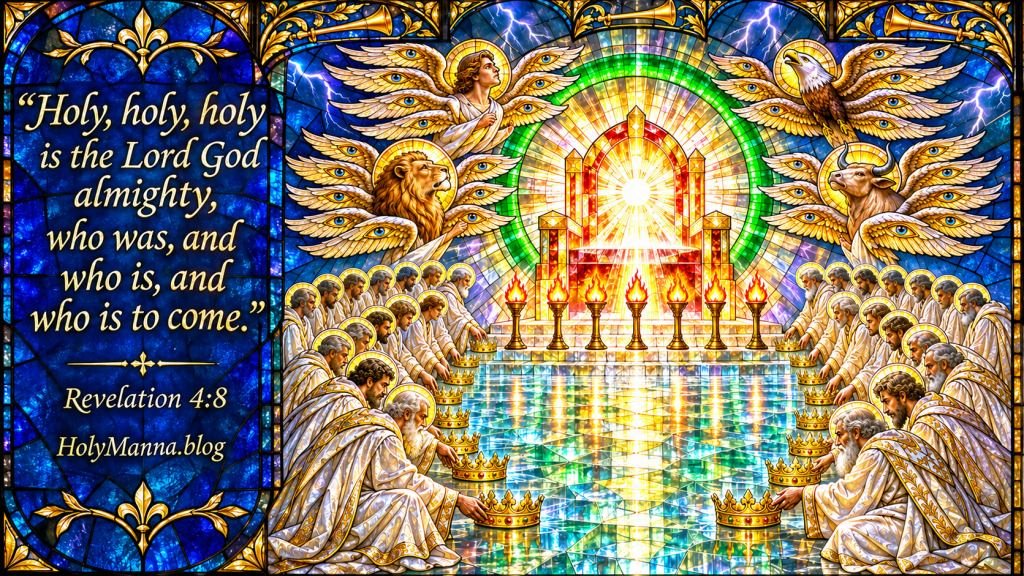
The Book of Revelation was written near the end of the first century to seven churches in the Roman province of Asia, communities under pressure for refusing to honor the emperor as lord. After the letters to those churches, chapter 4 lifts the curtain on heaven itself, building the scene from Isaiah’s seraphim, Ezekiel’s living creatures beneath a crystal firmament, and the thunder of Sinai. John wants his readers to know that the God of the prophets is still on his throne, whatever Rome claims.
The chapter is also unmistakably liturgical, with an assembly, vestments, antiphonal song, and prostration, which is why the Catechism turns to it when describing who celebrates the liturgy. For today’s theme, it supplies the first image of giving back: elders who refuse to keep their crowns.
Revelation 4:1-11
I, John, had a vision of an open door to heaven,
and I heard the trumpetlike voice
that had spoken to me before, saying,
“Come up here and I will show you what must happen afterwards.”
At once I was caught up in spirit.
A throne was there in heaven, and on the throne sat one
whose appearance sparkled like jasper and carnelian.
Around the throne was a halo as brilliant as an emerald.
Surrounding the throne I saw twenty-four other thrones
on which twenty-four elders sat,
dressed in white garments and with gold crowns on their heads.
From the throne came flashes of lightning,
rumblings, and peals of thunder.
Seven flaming torches burned in front of the throne,
which are the seven spirits of God.
In front of the throne was something that resembled
a sea of glass like crystal.In the center and around the throne,
there were four living creatures
covered with eyes in front and in back.
The first creature resembled a lion, the second was like a calf,
the third had a face like that of a man,
and the fourth looked like an eagle in flight.
The four living creatures, each of them with six wings,
were covered with eyes inside and out.
Day and night they do not stop exclaiming:
“Holy, holy, holy is the Lord God almighty,
who was, and who is, and who is to come.”
Whenever the living creatures give glory and honor and thanks
to the one who sits on the throne, who lives forever and ever,
the twenty-four elders fall down
before the one who sits on the throne
and worship him, who lives forever and ever.
They throw down their crowns before the throne, exclaiming:“Worthy are you, Lord our God,
to receive glory and honor and power,
for you created all things;
because of your will they came to be and were created.”
Detailed Exegesis
Verse 1: “I, John, had a vision of an open door to heaven, and I heard the trumpetlike voice that had spoken to me before, saying, ‘Come up here and I will show you what must happen afterwards.’”
The door is already open when John notices it; heaven takes the initiative. The trumpet voice recalls Sinai (Exodus 19:16-19), and the summons echoes Moses called up the mountain.
Verses 2 and 3: “At once I was caught up in spirit. A throne was there in heaven, and on the throne sat one whose appearance sparkled like jasper and carnelian. Around the throne was a halo as brilliant as an emerald.”
John never describes God’s form, only light through stones. Carnelian and jasper are the first and last stones on the high priest’s breastplate in Exodus 28:17-20, a quiet way of saying that the One enthroned is the beginning and the end. The emerald halo is a rainbow, the covenant sign of Genesis 9:13-16; mercy encircles the throne before any judgment is announced.
Verse 4: “Surrounding the throne I saw twenty-four other thrones on which twenty-four elders sat, dressed in white garments and with gold crowns on their heads.”
Twenty-four represents the twelve tribes joined to the twelve Apostles, the whole People of God, as Revelation 21:12-14 confirms. White garments are priestly and crowns are royal: the redeemed are made “a kingdom, priests for his God and Father” (Revelation 1:6).
Verse 5: “From the throne came flashes of lightning, rumblings, and peals of thunder. Seven flaming torches burned in front of the throne, which are the seven spirits of God.”
The storm is Sinai again, and it keeps the vision from becoming cozy. The seven torches are the one Holy Spirit in his fullness, recalling the seven lamps of Zechariah 4 and the sevenfold gifts of Isaiah 11:2.
Verse 6: “In front of the throne was something that resembled a sea of glass like crystal. In the center and around the throne, there were four living creatures covered with eyes in front and in back.”
Ezekiel saw a crystal firmament above the living creatures (Ezekiel 1:22); John sees it as a calm sea, the waters of chaos tamed into glass. The creatures are the cherubim of Ezekiel 10, and their eyes signify that nothing escapes God’s knowledge.
Verse 7: “The first creature resembled a lion, the second was like a calf, the third had a face like that of a man, and the fourth looked like an eagle in flight.”
Wild beasts, domestic animals, humanity, and birds: the four faces gather all living creation around the throne. The Fathers also saw here the four Gospels.
Verse 8: “The four living creatures, each of them with six wings, were covered with eyes inside and out. Day and night they do not stop exclaiming: ‘Holy, holy, holy is the Lord God almighty, who was, and who is, and who is to come.’”
Six wings belong to Isaiah’s seraphim (Isaiah 6:2), so John has fused cherubim and seraphim into one choir. Their hymn is the Trisagion of Isaiah 6:3, expanded with the divine name of the burning bush, and every Mass takes it up at the Sanctus.
Verses 9 and 10: “Whenever the living creatures give glory and honor and thanks to the one who sits on the throne, who lives forever and ever, the twenty-four elders fall down before the one who sits on the throne and worship him, who lives forever and ever. They throw down their crowns before the throne, exclaiming:”
The creatures sing, and the elders answer with their bodies. Vassal kings laid their crowns before an emperor to admit that their authority was borrowed; here the gesture is for God alone.
Verse 11: “‘Worthy are you, Lord our God, to receive glory and honor and power, for you created all things; because of your will they came to be and were created.’”
“Worthy” was the acclamation shouted at a Roman emperor’s accession. Revelation hands the word back to its rightful owner, and the reason is creation itself: everything exists because God freely willed it, so everything owes him praise.
Teachings
The Church reads this chapter as a window onto her own liturgy. The Catechism names the participants in the heavenly worship, including “all creation (the four living beings), the servants of the Old and New Covenants (the twenty-four elders)” (CCC 1138), and concludes: “It is in this eternal liturgy that the Spirit and the Church enable us to participate whenever we celebrate the mystery of salvation in the sacraments” (CCC 1139). This is why the Sanctus is not decoration: “The whole community thus joins in the unending praise that the Church in heaven, the angels and all the saints, sing to the thrice-holy God” (CCC 1352).
Saint Irenaeus of Lyons, writing around the year 180, saw the four living creatures as a prophecy of the fourfold Gospel. In Against Heresies he insists: “It is not possible that the Gospels can be either more or fewer in number than they are.” He reads the faces as “the first living creature was like a lion, symbolizing His effectual working, His leadership, and royal power; the second living creature was like a calf, signifying His sacrificial and sacerdotal order”, the man as Christ’s coming in the flesh, and the eagle as “the gift of the Spirit hovering with His wings over the Church.” Irenaeus gave the lion to John and the eagle to Mark; Saint Jerome’s later pairing, lion for Mark and eagle for John, became the standard in Christian art. Either way, the creatures around the throne announce one Christ proclaimed in four Gospels.
Reflection
You already stand in this throne room every time you go to Mass; the question is whether you know it. This week, when the Sanctus begins, say the words slowly and picture who else is singing them: cherubim, seraphim, the Apostles, and every saint who ever lived.
Then consider the crowns. Everyone carries at least one, whether a career, a reputation, or a talent. The elders do not pretend to have no crowns; they refuse to keep them. Name one accomplishment this week and offer it back to God in prayer, thanking him as its true source.
What crown are you still gripping that belongs before the throne? How would Sunday Mass change if you arrived expecting to join a song that never stops?
Responsorial Psalm — Psalm 150:1-6
The Last Word of the Psalter Is Praise
Psalm 150 is the final psalm in the Bible, the closing doxology not only of Book Five but of the entire Psalter. The last five psalms, 146 through 150, each begin and end with Hallelujah, and this one is almost nothing but that word spelled out in instruments. It contains ten commands to praise, with no petition, no lament, and no argument. Everything that needed saying has been said in the 149 psalms before it; what remains is applause.
The psalm likely accompanied Temple worship after the exile, when the Levitical musicians described in 1 Chronicles 25 led the assembly with the very instruments listed here. Today the Church sets it to a response borrowed from the First Reading, “Holy, holy, holy Lord, mighty God!”, deliberately braiding the Temple orchestra into the heavenly Trisagion. The psalm also carries the day’s theme in its smallest form. The elders give back crowns, the servants give back coins, and the psalmist asks for the one thing every living creature has: breath, given back as praise.
Psalm 150:1-6
R. (1b) Holy, holy, holy Lord, mighty God!
Praise the LORD in his sanctuary,
praise him in the firmament of his strength.
Praise him for his mighty deeds,
praise him for his sovereign majesty.
R. Holy, holy, holy Lord, mighty God!
Praise him with the blast of the trumpet,
praise him with lyre and harp,
Praise him with timbrel and dance,
praise him with strings and pipe.
R. Holy, holy, holy Lord, mighty God!
Praise him with sounding cymbals,
praise him with clanging cymbals.
Let everything that has breath
praise the LORD! Alleluia.
R. Holy, holy, holy Lord, mighty God!
Detailed Exegesis
Verse 1: “Praise the LORD in his sanctuary, praise him in the firmament of his strength.”
Praise rises from two places at once: the sanctuary on earth and the firmament of heaven. The psalm wants no gap between them, which is exactly what Revelation 4 shows. Saint Augustine, reading the Septuagint’s “in his saints,” heard a call to praise God in the people he has made holy.
Verse 2: “Praise him for his mighty deeds, praise him for his sovereign majesty.”
Two motives are given: what God has done and who God is. The first is thanksgiving; the second is pure praise, which the Church calls the highest form of prayer because it wants nothing in return.
Verse 3: “Praise him with the blast of the trumpet, praise him with lyre and harp,”
The trumpet, or shofar, was sounded by priests to announce feasts and the new moon (Numbers 10:10). The lyre and harp belonged to the Levites who led sacred song. Praise begins with the ordained ministers of the Temple.
Verse 4: “Praise him with timbrel and dance, praise him with strings and pipe.”
The timbrel and dance belong to the people: Miriam at the Red Sea (Exodus 15:20) and David before the Ark (2 Samuel 6:14). The pipe was a shepherd’s instrument. Praise moves from the clergy to the congregation and out to the fields.
Verse 5: “Praise him with sounding cymbals, praise him with clanging cymbals.”
The loudest instruments come last. Augustine noticed that cymbals make sound only by striking one another and compared them to human lips, which praise God when they meet in speech and song.
Verse 6: “Let everything that has breath praise the LORD! Alleluia.”
The Hebrew says, literally, let all breath praise the LORD. Breath is the first gift God gave humanity in Genesis 2:7, and the psalm asks for it back. The Psalter ends with Alleluia, the same word heaven sings in Revelation 19.
Teachings
The Catechism defines what this psalm is doing: “Praise is the form of prayer which recognizes most immediately that God is God. It lauds God for his own sake and gives him glory, quite beyond what he does, but simply because HE IS. It shares in the blessed happiness of the pure of heart who love God in faith before seeing him in glory” (CCC 2639). It adds that “praise embraces the other forms of prayer and carries them toward him who is its source and goal” (CCC 2639).
Saint Augustine ended his monumental Expositions on the Psalms with this text, and he read the instruments as a portrait of the Church. On the opening verse he wrote: “‘Praise the Lord in His saints,’ that is, in those whom He has glorified.” On the cymbals he observed: “Cymbals touch one another in order to sound, and therefore are by some compared to our lips.” Having walked through trumpet, harp, timbrel, and strings, he turned to his congregation and told them: “All these are you: let nought that is vile, nought that is transitory, nought that is ludicrous, be here thought of.” The orchestra of Psalm 150 is the Body of Christ.
The Church applies this to her own music. The Catechism teaches that “song and music fulfill their function as signs in a manner all the more significant when they are ‘more closely connected . . . with the liturgical action’” (CCC 1157), naming beauty expressive of prayer, the participation of the whole assembly, and the solemnity of the celebration as the three criteria.
Reflection
Praise is the easiest prayer to neglect because it asks for nothing. Most people pray hardest when they need something, and that is good and right, but Psalm 150 trains a different reflex. Try beginning your prayer tomorrow with sixty seconds of pure praise before a single request: no thank-you for a favor, just telling God who he is.
Think also about what instrument you are. Augustine’s point was that the Church needs trumpets and timbrels, loud cymbals and quiet strings. Your temperament, your work, and even your limitations are a particular sound in the orchestra, and the music is poorer when you stay silent.
When was the last time you praised God for who he is rather than for something he did? Which instrument in this psalm best describes how you give glory to God, and which one is missing from your life? If every breath is a gift, how many breaths today will become praise?
Holy Gospel — Luke 19:11-28
Trade With It Until the King Returns
Jesus has just left the house of Zacchaeus in Jericho (Luke 19:1-10). Jerusalem is about fifteen miles up the road, and many in the crowd expect the Kingdom of God to appear the moment he arrives. The parable corrects that timetable.
His audience would have recognized the plot. In 4 BC, after the death of Herod the Great, his son Archelaus sailed to Rome to have Caesar Augustus confirm him as king. According to the historian Josephus, a delegation of fifty Jewish leaders followed to beg the emperor not to appoint him, and Archelaus later took vengeance on his opponents. He kept a palace in Jericho, where Jesus is speaking. Jesus borrows the story and turns it inside out: the true King is also going away to receive his kingdom, will also be rejected, and will also return to settle accounts. The gold coins are minas, each worth about one hundred drachmas, roughly three months’ wages for a laborer, and unlike the talents in Matthew 25, every servant receives the same amount.
Luke 19:11-28
While people were listening to Jesus speak,
he proceeded to tell a parable because he was near Jerusalem
and they thought that the Kingdom of God
would appear there immediately.
So he said,
“A nobleman went off to a distant country
to obtain the kingship for himself and then to return.
He called ten of his servants and gave them ten gold coins
and told them, ‘Engage in trade with these until I return.’
His fellow citizens, however, despised him
and sent a delegation after him to announce,
‘We do not want this man to be our king.’
But when he returned after obtaining the kingship,
he had the servants called, to whom he had given the money,
to learn what they had gained by trading.
The first came forward and said,
‘Sir, your gold coin has earned ten additional ones.’
He replied, ‘Well done, good servant!
You have been faithful in this very small matter;
take charge of ten cities.’
Then the second came and reported,
‘Your gold coin, sir, has earned five more.’
And to this servant too he said,
‘You, take charge of five cities.’
Then the other servant came and said,
‘Sir, here is your gold coin;
I kept it stored away in a handkerchief,
for I was afraid of you, because you are a demanding man;
you take up what you did not lay down
and you harvest what you did not plant.’
He said to him,
‘With your own words I shall condemn you,
you wicked servant.
You knew I was a demanding man,
taking up what I did not lay down
and harvesting what I did not plant;
why did you not put my money in a bank?
Then on my return I would have collected it with interest.’
And to those standing by he said,
‘Take the gold coin from him
and give it to the servant who has ten.’
But they said to him,
‘Sir, he has ten gold coins.’
He replied, ‘I tell you,
to everyone who has, more will be given,
but from the one who has not,
even what he has will be taken away.
Now as for those enemies of mine who did not want me as their king,
bring them here and slay them before me.’”After he had said this,
he proceeded on his journey up to Jerusalem.
Detailed Exegesis
Verse 11: “While people were listening to Jesus speak, he proceeded to tell a parable because he was near Jerusalem and they thought that the Kingdom of God would appear there immediately.”
The crowd is not wrong about the King, only about the calendar. There will be a departure and a delay.
Verse 12: “So he said, ‘A nobleman went off to a distant country to obtain the kingship for himself and then to return.’”
The nobleman is Christ, and the distant country is heaven. Saint Cyril of Alexandria read this as the Ascension: Jesus goes to the Father to receive the kingdom as man.
Verse 13: “He called ten of his servants and gave them ten gold coins and told them, ‘Engage in trade with these until I return.’”
Servants are told not to guard the coin but to risk it. The Fathers understood the coin as the one faith entrusted to every disciple.
Verse 14: “His fellow citizens, however, despised him and sent a delegation after him to announce, ‘We do not want this man to be our king.’”
This is the Archelaus detail, and also prophecy: within days the crowds will tell Pilate they have no king but Caesar (John 19:15).
Verse 15: “But when he returned after obtaining the kingship, he had the servants called, to whom he had given the money, to learn what they had gained by trading.”
The return is certain and the accounting is personal.
Verses 16 and 17: “The first came forward and said, ‘Sir, your gold coin has earned ten additional ones.’ He replied, ‘Well done, good servant! You have been faithful in this very small matter; take charge of ten cities.’”
Three months’ pay becomes authority over ten cities. Faithfulness in small things is how God measures readiness for great ones.
Verses 18 and 19: “Then the second came and reported, ‘Your gold coin, sir, has earned five more.’ And to this servant too he said, ‘You, take charge of five cities.’”
Half the yield earns half the reward, with no rebuke. God rewards effort in proportion and judges only the refusal to try.
Verses 20 and 21: “Then the other servant came and said, ‘Sir, here is your gold coin; I kept it stored away in a handkerchief, for I was afraid of you, because you are a demanding man; you take up what you did not lay down and you harvest what you did not plant.’”
He did not lose the coin; he hid it. His excuse reveals a false picture of the master as a predator rather than a benefactor, and that fear paralyzed him.
Verses 22 and 23: “He said to him, ‘With your own words I shall condemn you, you wicked servant. You knew I was a demanding man, taking up what I did not lay down and harvesting what I did not plant; why did you not put my money in a bank? Then on my return I would have collected it with interest.’”
The master argues from the caricature without accepting it: even then, fear should have produced minimal effort. The servant is condemned not for failure but for doing nothing.
Verses 24 through 26: “And to those standing by he said, ‘Take the gold coin from him and give it to the servant who has ten.’ But they said to him, ‘Sir, he has ten gold coins.’ He replied, ‘I tell you, to everyone who has, more will be given, but from the one who has not, even what he has will be taken away.’”
Grace unused is grace lost, and grace invested compounds. Faith shared grows; faith hoarded shrinks.
Verse 27: “‘Now as for those enemies of mine who did not want me as their king, bring them here and slay them before me.’”
Those who rejected the king meet judgment, a sober warning that the Kingdom’s delay is not its cancellation.
Verse 28: “After he had said this, he proceeded on his journey up to Jerusalem.”
Jesus walks toward the city where he will be crucified. The nobleman is setting out to obtain his kingship by the Cross.
Teachings
The Catechism explains the delay the parable describes: “According to the Lord, the present time is the time of the Spirit and of witness,” and “it is a time of waiting and watching” (CCC 672).
Saint Cyril of Alexandria, in his Commentary on the Gospel of Luke, wrote: “The scope of the parable briefly represents the whole meaning of the dispensation that was for us and of the mystery of Christ from the beginning even to the end.” On the coins: “To those who believe in him, the Savior distributes a variety of divine gifts. We affirm that this is the meaning of the talent.”
The Catechism applies the parable to the diversity of gifts in the Church: “The ‘talents’ are not distributed equally” (CCC 1936), and God “wills that each receive what he needs from others, and that those endowed with particular ‘talents’ share the benefits with those who need them” (CCC 1937), quoting Saint Catherine of Siena: “I have willed that one should need another” (CCC 1937).
Pope Benedict XVI, preaching on the parallel parable in Matthew 25, said: “Fear is the wrong attitude.” The gifts, he said, are Christ’s Word, Baptism, prayer, forgiveness, the Eucharist, and the Kingdom itself, and “what Christ has given us is multiplied in its giving!”
Reflection
The third servant’s problem was not laziness but theology: he believed in a harsh master, so he played it safe. Many Catholics do the same, keeping the faith wrapped in a handkerchief: never mentioned at work, never risked in a conversation, never invested in service. Ask yourself what picture of God is driving your caution.
Then pick one trade. Invite a lapsed friend to Mass. Volunteer for one shift at the parish. Share one honest sentence about why you believe. Go to Confession, the surest way to hand the coin back to the King and receive it again.
What gift of God have you kept stored away because using it felt risky? If the King returned tonight, what would you be able to show him?
Crowns, Coins, and Breath
Picture the three scenes side by side. In heaven, elders in white rise from their thrones, pull the crowns from their heads, and send them across a floor of crystal toward the One above the storm. In a Temple courtyard, priests lift the shofar, Levites strike their harps, and ordinary people grab timbrels and dance until the place rings with cymbals and the last word anyone can say is Alleluia. On a dusty road outside Jericho, a servant steps forward with his hands full and hears the words every heart was made to hear: “Well done.”
Three gifts, one gesture. Crowns, coins, and breath are all given back to the Giver, and in the giving they are not lost but multiplied. That is the secret today’s readings whisper to anyone who will listen. The King has gone to receive his kingdom, and he is coming back. The time in between is not a waiting room; it is a marketplace and a choir loft at once.
The Church places these readings in the final days before the Solemnity of Christ the King for a reason. The year is ending, and the question is not whether the King will return but what he will find. He is not looking for servants who kept the coin safe in a drawer. He is looking for people who sang when it was hard, who shared the faith when it was awkward, and who laid down every crown because they finally understood where it came from.
So open the drawer. Unwrap the handkerchief. Spend the coin on someone who needs it, sing the Sanctus as if heaven is listening, and let every breath between now and the King’s return say the one word the Psalter ends with. Alleluia.
Engage With Us!
Every reader comes to these readings carrying a different coin, a different crown, and a different song, and HolyManna is better when those stories are shared. Please take a moment to post your reflections in the comments below so that others walking the same road can be encouraged by them.
- In Revelation 4:1-11, the twenty-four elders throw down their gold crowns before the throne. What accomplishment or source of pride in your life is God inviting you to lay before him this week?
- Psalm 150:1-6 calls on everything that has breath to praise the LORD. What would it look like for you to begin each day with praise alone, before any request, and which instrument in the psalm best describes the way you give glory to God?
- In Luke 19:11-28, the third servant hides his coin in a handkerchief out of fear. What gift of faith have you kept hidden, and what one concrete trade could you make with it before Sunday?
- Taken together, today’s readings show crowns, coins, and breath all being returned to God. Where in your life is the line between worship and stewardship starting to blur, and how might you let the two become one?
Living a life of faith does not require a throne room vision or a fortune to invest. It requires the willingness to give back, every day, what was never yours to begin with, and to do it with the love and mercy Jesus taught. He has gone to receive his kingdom, and he is coming back. Until then, trade boldly, sing loudly, and trust that every small faithfulness is seen by the King who already calls you his good servant.
Sacred Heart of Jesus, we trust in You!
Immaculate Heart of Mary, pray for us!
Saint Michael the Archangel, defend us in battle!
Follow us on YouTube, TikTok, Instagram and Facebook for more insights and reflections on living a faith-filled life.


Leave a Reply