The Wonderworker of Neocaesarea
Every November 17th, the Roman Martyrology pauses in the ancient city of Neocaesarea, in Pontus near the Black Sea coast of modern Turkey, to remember a bishop whose nickname has followed him for 1,700 years. The older English edition of the Martyrology puts it this way: “At Neocaesarea, in Pontus, the birthday of St. Gregory, bishop, illustrious by his learning and sanctity. The prodigies and miracles which he wrought to the great glory of the Church gained for him the surname of Wonder-worker.” That surname, Thaumaturgus in Latinized Greek, is the one the Church has used ever since.
Saint Gregory Thaumaturgus, who lived from about 213 to about 270, is one of the earliest Fathers of the Church whose life can be reconstructed in real detail. He was a pagan law student who wandered into the classroom of Origen, the most brilliant Christian teacher of the third century, and walked out a believer. He became bishop of a city that held no more than 17 Christians, and he left it, according to tradition, with roughly that many pagans. He is the first person in Christian history recorded as receiving a vision of the Blessed Virgin Mary, and the short creed connected with that vision is one of the oldest Trinitarian confessions in existence.
The Catechism explains why the Church holds up a man like Gregory at all: “By canonizing some of the faithful, i.e., by solemnly proclaiming that they practiced heroic virtue and lived in fidelity to God’s grace, the Church recognizes the power of the Spirit of holiness within her and sustains the hope of believers by proposing the saints to them as models and intercessors” (CCC 828). Gregory’s veneration is older than any formal process; the Church simply received him as a saint from the generation that remembered him.
He is the patron saint of the Calabrian town of Stalettì, where his relics rest, and Catholic devotion has long invoked him against floods and earthquakes and in desperate, forgotten, and seemingly impossible causes. Each of those patronages grows out of a story, and this post tries to be honest about which stories history can document and which ones tradition has handed down.
The Teacher Who Changed Everything
Gregory was born around the year 213 in Neocaesarea, the leading city of Pontus, into a wealthy and prominent pagan family. His given name was Theodore, which means gift of God. His father died when the boy was about 14, and until then he had known nothing of Christianity. His mother saw to it that he received the best education money could buy: rhetoric, Latin, and law.
Theodore and his brother Athenodorus set out to study law at the famous school in Beirut, escorting their sister on the way to Caesarea in Palestine, where her husband had taken a government post. Caesarea happened to be where Origen had settled after leaving Alexandria. The brothers went to hear him speak, and they never made it to Beirut. Sources differ on whether they stayed 5, 7, or 8 years.
Gregory described the conversion himself. Before leaving Origen years later, he delivered a farewell address, usually called the Panegyric on Origen, and it survives. In it he describes how Origen did not begin with Christian doctrine at all but with philosophy, teaching his students to love the truth wherever it led, and then patiently showing them that the fullness of the truth they loved was found in Christ. Gregory recalled the effect on his own soul: “like some spark lighting upon our inmost soul, love was kindled and burst into flame within us.”
This is exactly the path the Church says the mind can walk. “Man’s faculties make him capable of coming to a knowledge of the existence of a personal God. But for man to be able to enter into real intimacy with him, God willed both to reveal himself to man, and to give him the grace of being able to welcome this revelation in faith” (CCC 35).
Gregory was baptized, taking the name by which the Church knows him, and returned home to Pontus around 238 or 239. He intended to practice law and live quietly, and he soon withdrew from the city toward solitude and prayer. But Phaedimus, bishop of Amasea and metropolitan of Pontus, had other ideas. Gregory of Nyssa tells that the young man hid from the bishop’s messengers and that Phaedimus finally consecrated him in his absence, trusting God to supply what distance could not. Gregory accepted this as the will of God.
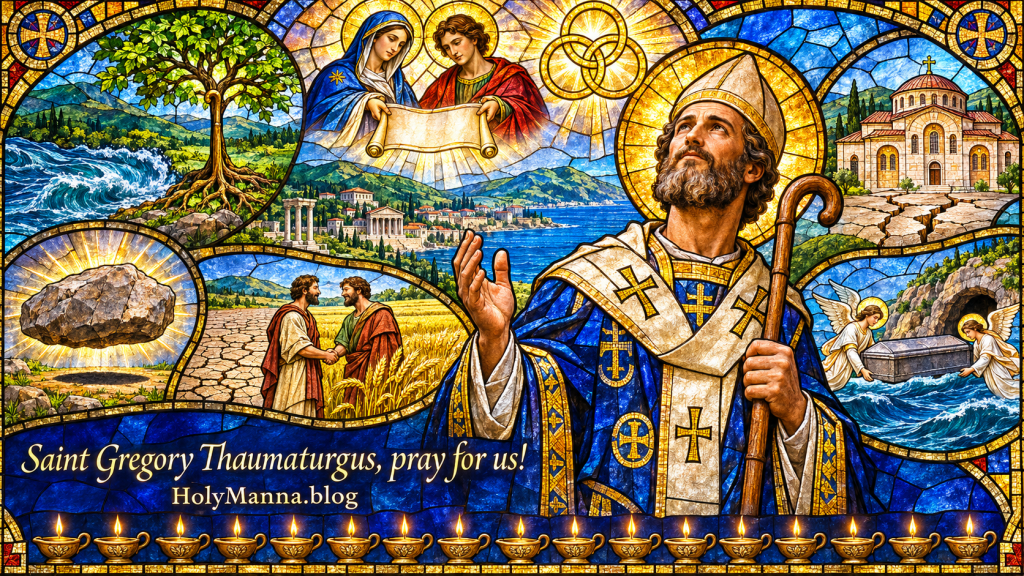
Then came the night that made him famous. Gregory of Nyssa reports that before he began to preach, Gregory, troubled by the false teachings swirling around the doctrine of God, prayed through the night. An aged man in dignified robes appeared and gestured toward a woman of surpassing majesty, shining with a light that seemed lit by another light. Gregory could not bear to look at her, but he could hear. The woman urged John the Evangelist to explain the mystery of the true faith to the young man, and John answered that he was glad to do anything to please the Mother of the Lord. When they vanished, Gregory wrote down what he had heard, and Gregory of Nyssa says the copy in his own hand was still kept at Neocaesarea a century later.
This is the earliest recorded vision of the Blessed Virgin Mary in Christian history, and the Church has honored the tradition for centuries; a fresco in the Borghese Chapel of the Basilica of Saint Mary Major in Rome shows Mary handing the confession of faith to Gregory. Still, the story reaches the present through Gregory of Nyssa writing roughly 110 years later, drawing on the memories of his grandmother Saint Macrina the Elder, and it cannot be verified. The Catechism gives the right frame: “Throughout the ages, there have been so-called ‘private’ revelations, some of which have been recognized by the authority of the Church. They do not belong, however, to the deposit of faith” (CCC 67). The creed itself, though, is securely attested.
The Creed, the Demon’s Temple, and the Stone That Moved
The short confession of faith that Gregory brought to Neocaesarea is one of the treasures of the early Church. In the classic English translation it begins: “There is one God, the Father of the living Word, who is His subsistent Wisdom and Power and Eternal Image: perfect Begetter of the perfect Begotten, Father of the only-begotten Son. There is one Lord, Only of the Only, God of God, Image and Likeness of Deity, true Son of true Father, Invisible of Invisible, and Incorruptible of Incorruptible, and Immortal of Immortal and Eternal of Eternal.” It goes on to confess “One Holy Spirit, having His subsistence from God, and being made manifest by the Son,” and it closes: “There is a perfect Trinity, in glory and eternity and sovereignty, neither divided nor estranged. And thus neither was the Son ever wanting to the Father, nor the Spirit to the Son; but without variation and without change, the same Trinity abides ever.”
Read that again and notice the date. This was written roughly 60 years before the Council of Nicaea, by a bishop in a provincial city, and it already confesses what Nicaea would define. The Catechism teaches: “The mystery of the Most Holy Trinity is the central mystery of Christian faith and life. It is the mystery of God in himself. It is therefore the source of all the other mysteries of faith, the light that enlightens them” (CCC 234). Saint Macrina the Elder learned this creed from Gregory’s own disciples and taught it to her grandchildren, and so it passed to Saint Basil the Great and Saint Gregory of Nyssa.
Gregory of Nyssa then tells of the new bishop’s journey home. On the road, a storm forced Gregory and his companions to shelter overnight in a pagan temple where a demon gave oracles. Gregory invoked the name of Christ, traced the sign of the cross, and passed the night in prayer. In the morning the temple’s priest found his oracle gone, and the demons, he was told, could not return to a place the Christian had purified. The priest raged, and Gregory calmly took a scrap of paper and wrote on it: “Gregory to Satan: Enter.” The priest placed the note on the altar, the oracle resumed, and the shaken man demanded a sign. Gregory pointed to a massive stone and ordered it to move to another place, which it did. The priest left his family, his property, and his priesthood on the spot and followed Gregory, becoming the bishop’s deacon and constant companion. This story is told by Gregory of Nyssa and cannot be verified.
When Gregory reached Neocaesarea, he found a Christian community of no more than 17 and began to preach. Gregory of Nyssa describes healings, exorcisms, and care for the poor, and something quieter: Gregory used his legal training to settle disputes among his people so that they would not have to drag one another before pagan magistrates. He built a church, and within a generation the flock had grown so large that a bishop was needed for the neighboring town of Comana. The townspeople kept proposing candidates on the strength of wealth and bearing, and Gregory kept asking for proven virtue, until someone jeered that by that standard they might as well choose Alexander the charcoal burner. Gregory took the joke seriously, had the man brought in, and discovered beneath the soot a learned philosopher who had hidden his gifts in a life of humility. He had Alexander washed, dressed in his own vestments, and ordained bishop of Comana, remarking only, “Nothing new has happened.” Saint Alexander of Comana later died a martyr. This story is told by Gregory of Nyssa and cannot be verified.
Two miracles in particular gave Gregory his patronages. In the first, two brothers inherited a lake from their father and could not agree on how to divide it. The quarrel grew until one of them raised an armed band and the other prepared to meet him. Gregory persuaded them to delay the fight for one night, spent that night praying on the shore, and at dawn the lake was gone, dried so completely that no water remained in the hollows. With nothing left to fight over, the brothers made peace, and the lakebed became farmland. In the second, the River Lycus, whose name means wolf, was tearing through the fields and villages along its banks in a flood. Gregory walked to the river with his staff, told the people that no one can hold back the force of water and that “only God’s power can contain it,” and drove the staff into the flooded bank. It took root and grew into a tree, and the river bent around it and never passed that spot again. These stories are told by Gregory of Nyssa and cannot be verified, though Saint Basil, writing independently a century later, also mentions rivers changing course at his word and a lake dried up.
The Church has a name for this kind of gift. “There are furthermore special graces, also called charisms after the Greek term used by St. Paul and meaning ‘favor,’ ‘gratuitous gift,’ ‘benefit.’ Whatever their character, sometimes it is extraordinary, such as the gift of miracles or of tongues, charisms are oriented toward sanctifying grace and are intended for the common good of the Church” (CCC 2003). Jesus had promised as much: “If you have faith the size of a mustard seed, you will say to this mountain, ‘Move from here to there,’ and it will move. Nothing will be impossible for you” (Matthew 17:20).
When the Emperor Came Hunting
Gregory was not martyred, but his 30 years as bishop were anything but peaceful. In 250 the Emperor Decius ordered every inhabitant of the empire to sacrifice to the gods, the first empire-wide persecution, and it broke many Christians. Gregory counseled his people to withdraw rather than risk the apostasy that torture so often produced, and he led the way himself, retreating with his deacon into the mountains. He was following the Lord’s own instruction: “When they persecute you in one town, flee to another” (Matthew 10:23).
Gregory of Nyssa tells what happened next. An informer led soldiers to the hillside where the bishop and his deacon were praying with their hands raised to heaven. The soldiers searched the whole slope and returned to report that there was no one there, only two trees standing a short distance apart. The informer went up to see for himself, found the bishop and deacon at prayer in the open, and was so shaken that he became a Christian. This story cannot be verified.
Flight was not cowardice; it was prudence in the service of fortitude, the virtue that “enables one to conquer fear, even fear of death, and to face trials and persecutions” (CCC 1808). A shepherd who keeps his flock alive to confess Christ for another 20 years has not dodged the trial. When the persecution ended in 251, Gregory came home, gathered the relics of those who had died for the faith, and established annual feasts in their honor, with public celebrations meant to draw pagans into the joy of the Church. It is one of the earliest records of what became the calendar of saints.
Hardship kept coming. A plague swept the region, which Gregory of Nyssa connects to a pagan festival in the city’s theater; Gregory prayed, the sickness lifted, and many who had clung to the old idols turned to Christ. Then, in the mid 250s, the Goths and a neighboring people called the Boradi came by sea and raided Pontus, burning, looting, and carrying off captives. His Canonical Epistle, which survives, lays down in 11 canons how the Church should treat Christians who had looted their neighbors’ abandoned homes, guided the raiders to hidden goods, or held fellow Christians captive for ransom. It is one of the earliest documents of Christian penitential discipline.
Around 264, Gregory and his brother Athenodorus, by then also a bishop in Pontus, traveled to Antioch for the synod that examined Paul of Samosata, a bishop who denied that Christ was truly God. Eusebius names the two brothers among the pastors gathered there. The law student set on fire by the truth about Christ spent his last years defending it.
The end came quietly. Gregory of Nyssa says the bishop foresaw his death and, as the moment approached, asked how many unbelievers were left in Neocaesarea and the countryside around it. The answer, in the words of the old Roman Breviary lesson, was 17, and Gregory gave thanks and said: “There was just that number of believers when I became bishop.” That number has been repeated for 1,600 years, though at least one modern English rendering of Nyssa’s Greek reads seventy here. Either way, Gregory had inherited a handful and left behind a city. His last request was to be buried as a stranger in another’s grave, owning nothing at all. He died, most sources say, around the year 270, though dates from 266 to 275 are given.
A Lead Coffin on the Tide
Gregory of Nyssa mentions one sign that the people of Neocaesarea took as God’s verdict on their bishop. A violent earthquake leveled nearly every building in the city, and the church Gregory had built stood, in Nyssa’s words, “unscathed and unshaken.” The story cannot be verified, but it is the root of his patronage against earthquakes, and it is likely that he was buried in or near that church.
According to a tradition preserved in Calabria, during the iconoclast persecutions of the eighth century the body of Saint Gregory was sealed in a lead coffin and cast into the sea. The tradition holds that the coffin drifted across the Mediterranean and came ashore at a sea cave below the Calabrian village of Stalettì, carried by the hands of angels, and that miracles accompanied its arrival. None of this can be verified.
What can be verified is the devotion that followed. The relics of Saint Gregory Thaumaturgus are venerated to this day in the ancient Byzantine-era church that bears his name at Stalettì, and the sea cave is still called the Grotta di San Gregorio. He is the town’s patron saint, and November 17th is its patronal feast. The skull was venerated at Stalettì until 1587, when Don Juan de Borja, a son of Saint Francis Borgia, gave it to the Church of São Roque in Lisbon, where it remains today. The Catechism lists “the veneration of relics, visits to sanctuaries, pilgrimages” among the forms of popular piety that have always surrounded the Church’s sacramental life (CCC 1674).
His memory has traveled even farther. In Rome, the Borghese Chapel fresco carries an inscription recording that the Virgin “gives the confession of faith against heretics to Gregory Thaumaturgus.” In Moscow, a seventeenth-century church dedicated to Saint Gregory of Neocaesarea was restored to worship after the fall of communism. The Byzantine Churches keep his feast on November 17th, as does the Roman Martyrology, and the Armenian Church honors him on the Saturday before the first Sunday of Advent. Gregory of Nyssa’s panegyric was most likely preached on November 17th in the year 380, so the Church has gathered on this date to tell these stories for more than 1,640 years.
Perhaps the most remarkable monument is invisible. Saint Basil the Great, defending the Church’s way of praising the Trinity, pointed to the Church of Neocaesarea and wrote that “not a practice, not a word, not a mystic rite has been added to the Church besides what he bequeathed to it.” The doxology Basil was defending, the ancient form of “Glory to the Father, with the Son, together with the Holy Spirit,” was by his account one of Gregory’s institutions. Every Catholic who prays the Glory Be is, in a small way, praying as Gregory taught his 17 to pray. The Catechism reminds the faithful that the saints in heaven “do not cease to intercede with the Father for us” (CCC 956), and Catholic devotion has long turned to Gregory in exactly the situations his life illustrates: when the waters are rising, when the ground is shaking, and when a cause looks lost.
What the Wonderworker Teaches
It would be easy to think Gregory’s story is about spectacular miracles, with nothing to say to someone who has never moved a stone. But the thread running through every episode is far more ordinary. Gregory began with 17 people. He did not wait for a crowd, a budget, or a sign. He preached to the handful in front of him, settled their quarrels, cared for their sick, and trusted God with the growth. What is the seventeen in your own life, the small circle that God has actually given you to love, and have you been waiting for something bigger before taking it seriously?
Consider, too, how Gregory came to faith. Nobody argued him into the Church; Origen befriended him, taught him to love the truth, and let the truth do its work. The Catechism says that the disciple of Christ “must not only keep the faith and live on it, but also profess it, confidently bear witness to it, and spread it” (CCC 1816), and Gregory’s life shows that the most effective witness is often the patient kind. Is there someone in your life who needs less of an argument and more of a friend who loves the truth?
Then there is the creed. A grandmother taught it to her grandchildren, and those grandchildren became Basil and Gregory of Nyssa. The faith was passed hand to hand, kitchen table to kitchen table. The Catechism notes that the saints “share in the living tradition of prayer by the example of their lives, the transmission of their writings, and their prayer today” (CCC 2683). One practical way to honor Saint Gregory this week is to pray the Nicene Creed slowly, one phrase at a time, noticing how much of it he had already confessed 60 years before Nicaea. When was the last time you really listened to the words of the Creed instead of reciting them?
His patronage of impossible causes is not sentimental. He prayed all night on the shore of a lake while two armed bands waited for dawn, and he walked toward a flood with a stick. The Catechism defines hope as the virtue by which one desires heaven and eternal life, “placing our trust in Christ’s promises and relying not on our own strength, but on the help of the grace of the Holy Spirit” (CCC 1817). That is what Gregory’s miracles look like from the inside: not confidence in himself, but a refusal to believe that God had run out of options. The angel said it to Mary first: “for nothing will be impossible for God” (Luke 1:37). What situation in your life have you quietly filed under impossible, and have you actually brought it to prayer, or only to worry?
Engage With Us!
The story of Saint Gregory Thaumaturgus has been told on November 17th for more than 1,600 years, and now it is your turn. Share your thoughts and reflections in the comments below, starting with these questions:
- Gregory began his ministry with 17 believers. Who are the seventeen God has placed in your care right now, and what is one concrete way you can serve them this week?
- Origen converted Gregory by teaching him to love the truth before ever mentioning doctrine. Who in your life might be reached the same way, and how could you be that kind of friend?
- Gregory’s creed was passed from a grandmother to her grandchildren and shaped the whole Church. Who handed the faith to you, and to whom are you handing it on?
- Gregory is invoked for impossible causes because he prayed when the situation looked hopeless. What lost cause in your life needs to be brought back to prayer today?
- Gregory chose Alexander the charcoal burner over the polished candidates. Where might you be judging someone by appearances and missing what God sees?
Saint Gregory Thaumaturgus never set out to be a wonderworker. He set out to practice law, and God had other plans. What made him a saint was not the stone or the lake or the river but the willingness, day after day, to give the handful in front of him everything he had. Go and do the same. Love the people God has given you, pray boldly over the things that seem impossible, and do everything, large and small, with the love and mercy that Jesus taught.
Saint Gregory Thaumaturgus, pray for us!
Follow us on YouTube, TikTok, Instagram and Facebook for more insights and reflections on living a faith-filled life.


Leave a Reply