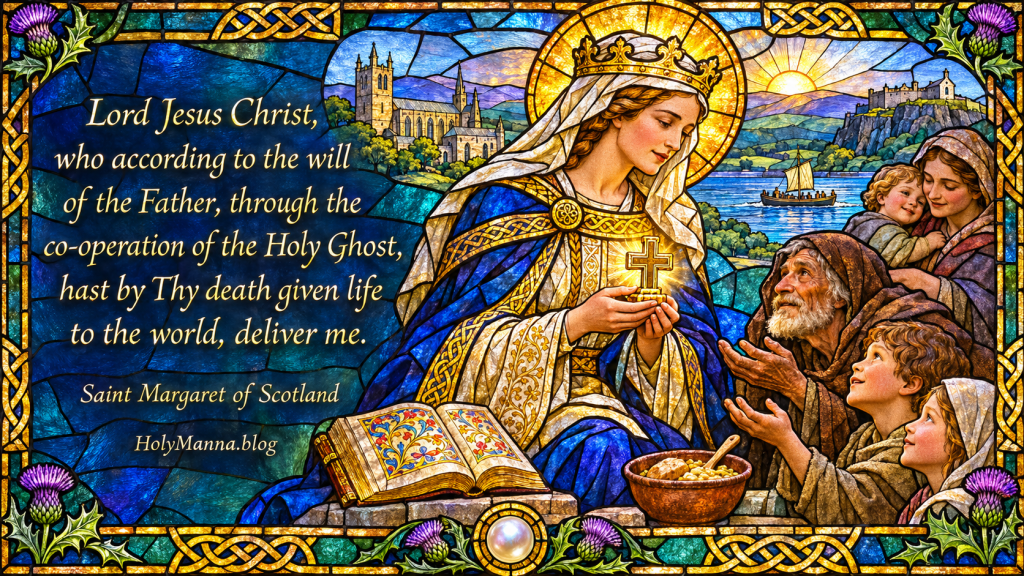
The Queen Who Ruled on Her Knees
Every November 16th, the Church remembers a queen who was never supposed to be one. Saint Margaret of Scotland was born in exile, shipwrecked onto a coast she had not chosen, and married to a warrior king whose language she could not speak. Out of that unlikely story God shaped one of the most beloved royal saints in Christian history, a woman whose name means pearl and whose confessor, Turgot, Prior of Durham, said the name was fitting for one such as she.
Margaret is honored as the Patroness of Scotland, a title formally granted by Pope Clement X in 1673. Popular devotion has also long invoked her as a patron of queens, widows, parents of large families, students, and those grieving the death of a child, and Dunfermline and Fife claim her as their own. She is revered as a reformer of the Church in Scotland, a mother who raised three kings and a queen, and a woman of staggering charity who washed the feet of the poor every day. What makes her story remarkable is that almost all of it comes from a man who knew her personally. Turgot wrote his Life of Saint Margaret within fifteen years of her death at the request of her daughter Matilda, Queen of England, and that is a rare gift for an eleventh-century saint. The reader meets Margaret not as a pious silhouette but as a real woman.
Born an Exile, Raised Among Saints
Margaret came into the world around the year 1045 as a refugee. Her father was Edward the Exile, son of King Edmund Ironside of England. When the Danish king Cnut seized the English throne in 1016, the infant Edward was sent abroad and eventually found shelter at the court of Saint Stephen, the first Christian king of Hungary. There Edward married a noblewoman named Agatha, and there Margaret and her siblings, Edgar and Christina, were born. Tradition places Margaret’s birth at the castle of Réka near Nádasd in southern Hungary, though no document confirms the spot. Even her mother’s origins puzzle historians; the Catholic Encyclopedia calls Agatha a kinswoman of Saint Stephen’s queen, Gisela, while other sources make her a Hungarian princess or a German noblewoman. What is certain is that Margaret spent her childhood in a kingdom only recently converted to Christ, where the memory of a saintly king was fresh.
In 1057, King Edward the Confessor of England, who had no heir, invited his nephew Edward the Exile home to secure the succession. Tragedy struck almost immediately. Edward the Exile died within days of landing, before he had even seen the king, and Margaret, perhaps twelve years old, was fatherless in a foreign land. The Confessor took in the widow and her children, and Margaret spent roughly nine years at the court of a king who would himself be canonized, receiving a fine education and developing a love of Scripture and the liturgy that marked everything she later did.
Then came 1066. The Confessor died, Harold Godwinson fell at Hastings, and William of Normandy took England. Margaret’s brother Edgar was briefly elected king but never crowned, and the family fled north in 1067 or 1068. The story told from the earliest times is that they intended to sail for the Continent, but a storm drove their ship into the Firth of Forth, where they came ashore at a bay still called Saint Margaret’s Hope. King Malcolm III of Scotland, known as Canmore, received the exiles under his protection. Malcolm was a widower roughly twenty years older than Margaret, a tough and warlike king, and he soon asked for her hand.
Margaret did not say yes right away. Turgot records that she had hoped to enter religious life. But the needs of her family and the persistent devotion of the king won her over, and around the year 1070 she married Malcolm at Dunfermline. The Church teaches that the vocation to marriage is written in the very nature of man and woman as they came from the hand of the Creator (CCC 1603), and in Margaret’s case that vocation became the instrument of her sanctity and the salvation of a nation. She brought into Scotland a treasure she would cherish to her dying breath, a golden reliquary cross containing a fragment of the True Cross, known as the Black Rood.
The Queen Who Reformed a Kingdom
Margaret’s marriage is one of the most beautiful in the lives of the saints, precisely because it was not a marriage of two saints. Yet Turgot describes a husband so moved by his wife’s devotion that he began keeping night vigils and praying with tears alongside her. He could not read her books, but he would pick up the ones she loved most and kiss them, and once he had her favorite volume bound in gold and jewels and carried it to her himself. The Catechism describes how the love of the spouses requires, of its very nature, the unity and indissolubility of the spouses’ community of persons (CCC 1644), and Margaret and Malcolm lived that unity in a way that changed a kingdom.
Eight children came from that marriage: Edward, Edmund, Ethelred, Edgar, Alexander, David, Edith, and Mary. Margaret took personal charge of their formation, teaching them the faith herself and insisting that they be disciplined when they fell short. Three of her sons, Edgar, Alexander I, and David I, became kings of Scotland, and David is himself venerated as a saint there. Her daughter Edith took the name Matilda and became Queen of England as the wife of Henry I, which means every English and British monarch since descends from Margaret. Her daughter Mary became Countess of Boulogne. The Catechism teaches that parents have the first responsibility for the education of their children and that the home is well suited for education in the virtues (CCC 2223). Margaret is living proof of that paragraph, a mother whose kitchen table catechesis produced kings.
Her greatest public work was the reform of the Church in Scotland, which had grown isolated and drifted into customs that differed from the universal Church. Margaret did not tolerate drift. She convened councils of the clergy, one lasting three days, with Malcolm beside her as interpreter from Gaelic. Turgot records that she argued from Scripture and the Fathers, insisting that those who worship God in one faith with the Catholic Church ought not to vary from that church by new or far-fetched usages. She corrected the practice of beginning Lent on the Monday after Ash Wednesday, which left only thirty-six fast days, and restored the full forty. She urged the faithful to receive Holy Communion at Easter after confession. She insisted that servile work cease on Sunday, worked to abolish an irregular rite of Mass that Turgot only describes as barbarous, and ended the toleration of marriages to a stepmother or to a deceased brother’s widow. The Catechism echoes each of these reforms: Sunday is to be observed as the foremost holy day of obligation in the universal Church (CCC 2192), and the Church obliges the faithful, prepared by the sacrament of Reconciliation, to receive the Eucharist at least once a year, if possible during the Easter season (CCC 1389).
Margaret also built. She founded the church of the Holy Trinity at Dunfermline, where she had been married, and at her request Archbishop Lanfranc of Canterbury sent monks to establish the first Benedictine community in Scotland. She restored the ancient monastery of Iona and endowed Saint Andrews. For the pilgrims who streamed toward the relics of the Apostle Andrew, she built hostels on both shores of the Firth of Forth and established a free ferry, and two towns still carry her memory in their names: North Queensferry and South Queensferry.
Her private life was even more striking. She rose for the night office, prayed the Psalms, and fasted so severely that Turgot says it damaged her health. She retreated to a cave at Dunfermline to pray, still called Saint Margaret’s Cave. Her charity was relentless and personal. Every morning nine destitute orphans were brought to her, and she fed them herself, holding them on her lap and feeding them from her own spoon. Each day after Matins she and the king washed the feet of six poor persons and gave them alms. During Advent and Lent three hundred poor people were seated in the royal hall, and the king and queen served them food and drink with their own hands behind closed doors. She ransomed English captives dragged into Scotland by raiding parties. She even took coins from the king’s own offering at Mass to give to beggars, a habit Turgot calls pious plundering, and Malcolm, who knew exactly what she was doing, pretended not to notice and laughed about it. The Catechism reminds the faithful that love for the poor is even one of the motives for the duty of working so as to be able to give to those in need (CCC 2444), and that the works of mercy are charitable actions by which we come to the aid of our neighbor in his spiritual and bodily necessities (CCC 2447). Margaret did not delegate mercy. She performed it.
Turgot records one miracle during her lifetime, and the object at its center still exists. Margaret owned a small, richly illuminated book of the Gospels that she loved more than any possession. A servant carrying it dropped it while crossing a ford and did not notice. When the book was missed, it was found lying open at the bottom of the river, and it was lifted out whole and unharmed, the pages bright and the letters perfect, with only a trace of damp on the outermost leaves. Turgot attributes its preservation to the love of Christ for the queen. That very Gospel book, with a Latin poem at the front recounting the event, was bought at auction in 1887 for six pounds and is now a treasure of the Bodleian Library in Oxford.
A Cross Held to Her Eyes
Margaret was never martyred, but her life was shaped by suffering from beginning to end. She was exiled twice before she was twenty-two and lost her father within days of reaching the homeland she had been promised. She married into a kingdom whose language she did not speak, and she won its Church over by argument and example rather than by force. Her fasting and vigils wore down her body, and in her last year she was so weak that she could no longer ride and seldom left her bed.
Her final trial came all at once. In the autumn of 1093 Malcolm rode south into Northumberland against her pleading. On November 13th, while he was far away and no messenger could possibly have reached her, Margaret grew unusually sorrowful and said, Perhaps on this very day such a heavy calamity may befall the realm of Scotland. Turgot admits he paid little attention at the time. On that same day Malcolm and their eldest son Edward were killed at Alnwick.
Three days later, on November 16th, Margaret was dying in Edinburgh Castle. She had herself carried to her oratory, heard Mass, and received Holy Viaticum. Then she asked for the Black Rood. When the chest holding it was slow to open, she cried out, Oh, unhappy that we are! Oh, guilty that we are! Shall we not be permitted once more to look upon the Holy Cross? When at last it was placed in her hands, she embraced it, kissed it, and held it to her eyes, and she recited the whole of Psalm 51 while her body grew cold.
Her son Edgar arrived from the army to tell her that his father and brother were dead, and at first he could not bring himself to say it. Margaret pressed him by the cross in her hands and by the bond of their blood to tell her the truth, and when he did, she answered with a sigh, I know it, my boy, I know it. What she said next has defined her sanctity for nine centuries. She did not complain against God. She prayed, Praise and blessing be to Thee, Almighty God, that Thou hast been pleased to make me endure so bitter anguish in the hour of my departure, thereby as I trust purifying me in some measure from the corruption of my sins.
Then she began the prayer that the priest says before receiving Holy Communion: Lord Jesus Christ, who according to the will of the Father, through the co-operation of the Holy Ghost, hast by Thy death given life to the world, deliver me. As she spoke the words deliver me, she died. Turgot writes that her face, pale with sickness, regained a warm color, so that she looked like a woman asleep. She was not yet fifty. The Church teaches that in death, God calls man to himself and that the Christian can transform his own death into an act of obedience and love towards the Father (CCC 1011). Margaret’s last hour is that teaching made flesh.
Her body was carried across the Forth and buried at the church of the Holy Trinity in Dunfermline, which she had built, before the altar and the Holy Cross she had set up there.
The Bier That Would Not Move
Devotion to Margaret sprang up almost immediately. Pilgrims came to her tomb at Dunfermline, and in 1180 her remains were moved to a new reliquary covered in gold leaf and carved images. A thirteenth-century collection of miracles recorded at her shrine describes about forty-five favors granted there, including a girl tormented by a demon who was brought to Margaret’s altar, laid upon the stone of the queen’s original tomb, and taken to the spring called Saint Margaret’s Well before being freed at the shrine. The same collection reports healings of pilgrims who slept on her tomb slab. These are medieval reports preserved by the monks of Dunfermline, and they cannot be verified.
In the 1240s King Alexander II and the Scottish bishops petitioned Rome for her canonization. A cardinal examined the reported miracles, and Pope Innocent IV issued the bull of canonization at Lyons on September 16th, 1249. The Catechism explains that by canonizing the faithful the Church recognizes the power of the Spirit of holiness within her and sustains the hope of believers by proposing the saints to them as models and intercessors (CCC 828). Because the solemn translation of her relics followed the next year, her canonization is usually dated to 1250.
That translation gave rise to the most famous story attached to her. On June 19th, 1250, the young King Alexander III, his mother, seven bishops, seven earls, and the abbots and nobility of Scotland gathered at Dunfermline. Margaret’s remains were lifted from their tomb amid a sweet fragrance and placed in a new shrine of fir adorned with gold and gems. As the bishops and abbots carried the bier toward the choir, singing as they went, the procession reached the spot opposite King Malcolm’s tomb in the nave, and suddenly the bearers’ arms went numb and they could not take another step. The chroniclers say a voice was heard proclaiming that it was not God’s will for the holy queen to pass her husband’s tomb unless he too was honored. So Malcolm’s bones were raised with the same reverence, the bearers’ strength returned, and king and queen were laid to rest together in the new chapel at the east end of the abbey. This story comes from the Scottish chroniclers Fordun and Bower, writing generations later, and it cannot be verified.
A second story is set in October 1263, when the Norwegian fleet of King Haakon threatened Scotland at Largs. A crippled knight named Sir John Wemyss, keeping vigil at Dunfermline, is said to have seen Queen Margaret ride out from the abbey church with Malcolm and three of their sons, declaring that she was going to defend her kingdom. The Scots prevailed, and the knight was cured after visiting her shrine. This too comes from later chronicles and cannot be verified.
The Reformation scattered her relics. In the sixteenth century her head, enshrined separately in a gilded reliquary, was brought to Edinburgh Castle at the request of Mary Queen of Scots, who wanted the saint present as she awaited the birth of the future James VI. It later passed to the Jesuits at the Scots College in Douai, France, where it was last recorded in 1785 before disappearing in the French Revolution. According to a seventeenth-century Scottish writer, the remaining relics of Margaret and Malcolm were acquired by King Philip II of Spain and placed in two urns at the Escorial. When Bishop James Gillis of Edinburgh asked through Pope Pius IX for their return, the urns could not be found, but in 1862 he obtained a fragment of her shoulder bone sealed with the seal of the Escorial. The Ursuline sisters of Saint Margaret’s Convent in Edinburgh guarded it for a century and a half, and on November 16th, 2008, it came home to Dunfermline, where it rests in a crystal reliquary beneath the altar of Saint Margaret’s Memorial Church.
Her presence saturates Scotland to this day. The tiny chapel that bears her name inside Edinburgh Castle, built by her son David I around 1130 on the site of her oratory, is the oldest surviving building in the city. The base of her shrine still stands outside the east wall of Dunfermline Abbey, and Saint Margaret’s Cave, Saint Margaret’s Hope, and the two Queensferries carry her name across the map of Fife. Every year the Archdiocese of Saint Andrews and Edinburgh leads a pilgrimage through Dunfermline that begins with the Angelus at her cave, continues with prayers at her tomb, and ends with her relic carried in procession to Mass. Her feast was kept on June 10th from the seventeenth century until the reform of 1969 restored it to November 16th, the anniversary of her death, an Optional Memorial for the whole Church and a Feast in Scotland. The Catechism teaches that the saints’ intercession is their most exalted service to God’s plan (CCC 2683), and Scotland has been asking for it for more than nine hundred years.
Holiness in a Crowded House
It is tempting to admire Margaret from a distance, as a queen in a stained glass window. Strip away the crown, though, and what remains is a wife, a mother of eight, a woman who ran a household, argued with experts who did not want to change, and lost people she loved. That is a life most people recognize.
Consider first her marriage. Margaret did not wait for Malcolm to become holy before she loved him, and she did not nag him into the faith. She prayed, fasted, served, and let him see it. The man who could not read ended up kissing her books. The Catechism teaches that Christian spouses are called to grow continually in their communion through day-to-day fidelity to their marriage promise of total mutual self-giving (CCC 1644). Does your spouse, or the people closest to you, see Christ in the way you live at home, or only in what you say about Him elsewhere?
Consider her mothering. She did not outsource the faith of her children to a school or a parish. She taught them herself and held them to it, and three of them governed a nation. The Catechism describes the family as the first school of Christian life (CCC 1657). What is one concrete thing you could do this week to make your home a place where the faith is actually taught rather than assumed?
Consider her charity. Nine orphans every morning, six pairs of feet every day, three hundred beggars served in Lent. Margaret funded hospices, but she also got down on the floor. The Church insists that the Church’s love for the poor is a part of her constant tradition (CCC 2444). Who are the poor you could actually touch this month rather than merely donate to?
Consider her backbone. When the clergy of Scotland had drifted from the practice of the universal Church, Margaret did not shrug and say that every region has its customs. She studied, convened the experts, and argued from Scripture and the Fathers until the practice changed. She loved unity with Rome because she loved Christ, and she understood that the Church is catholic because Christ is present in her (CCC 830). Where have you quietly accepted a comfortable drift away from what the Church actually teaches, and what would it take to correct course?
Finally, consider her death. Margaret lost her husband and her firstborn on the same day, learned of it on her own deathbed, and her first words were praise. That was the fruit of a lifetime of midnight Psalms, hard fasts, and daily service that had trained her heart to trust God in everything. The Catechism teaches that the Christian who unites his own death to that of Jesus views it as a step towards him and an entrance into everlasting life (CCC 1020). If the worst news of your life arrived tomorrow, what would your first words be, and what are you doing today to make those words a prayer?
A practical way to walk with Margaret is simple. Pick one of the four pillars of her life, prayer, family, the poor, and the Church, and give it one deliberate act each day during the week of her feast. Pray a Psalm before the house wakes up. Teach your child or godchild one line of the Creed. Feed someone who cannot repay you. Go to confession and receive the Eucharist with the devotion she fought to restore to Scotland. Holiness in a crowded house is the kind the Pearl of Scotland had.
Engage With Us!
Saint Margaret’s story has a way of getting under the skin, especially for those who are married, raising children, or carrying a cross they did not choose. Please share your thoughts and reflections in the comments below.
- Margaret converted her husband not by argument but by the witness of her daily prayer and service. Who in your life might be drawn closer to Christ by what you do rather than by what you say?
- She fed orphans from her own spoon and washed the feet of the poor every morning. What is one act of personal, hands-on mercy you could commit to this week?
- Margaret reformed the Scottish Church by studying Scripture and the Fathers and refusing to accept customs that drifted from Catholic practice. Is there a teaching of the Church you have quietly set aside, and what would it take to embrace it fully?
- On her deathbed, having lost her husband and son, her first words were praise. What practices of prayer are forming your heart now so that it can trust God in the hour of suffering?
- Three of her children became kings and one became a saint. What would it look like to take personal responsibility for the formation of the children or young people God has placed in your care?
Saint Margaret of Scotland reigned on her knees, and that is why she still reigns in the hearts of a nation. Go and do likewise. Pray with devotion, love your family with patience, serve the poor with your own hands, and hold fast to the Church that Christ founded. Do everything, as Jesus taught, with love and mercy, and trust that the God who turned a shipwrecked exile into the Pearl of Scotland can do something beautiful with your life as well.
Saint Margaret of Scotland, pray for us!
Follow us on YouTube, TikTok, Instagram and Facebook for more insights and reflections on living a faith-filled life.


Leave a Reply