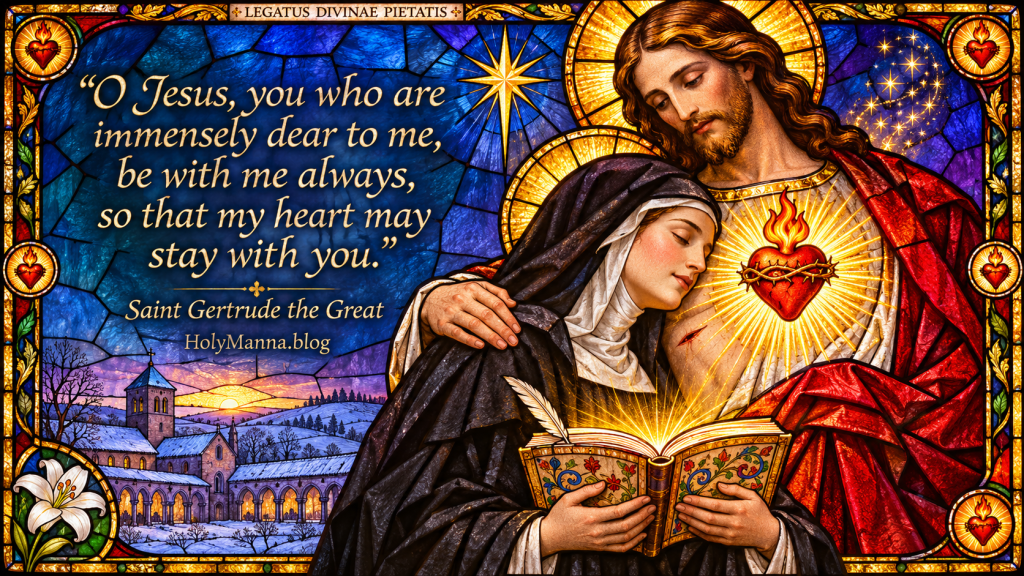
The Nun Who Heard the Heartbeat of God
Every year on November 16th, the Church remembers a woman who spent her entire life, from the age of five until her last breath, inside the walls of a single monastery in medieval Germany, and who nevertheless became one of the most influential spiritual voices of the Middle Ages. Saint Gertrude the Great, also known as Gertrude of Helfta, is the only woman in the history of the Church to bear the title of the Great. Pope Benedict XVI, who devoted an entire catechesis to her in 2010, explained that she earned it because of “her cultural and evangelical stature,” and called her “an exceptional woman, endowed with special natural talents and extraordinary gifts of grace, the most profound humility and ardent zeal for her neighbor’s salvation.”
Gertrude is remembered for three things above all. She was one of the earliest and most tender apostles of devotion to the Heart of Jesus, nearly 400 years before the apparitions to Saint Margaret Mary Alacoque. She was a passionate intercessor for the souls in purgatory. And she left the Church a book, The Herald of Divine Love, which Saint Teresa of Ávila loved so much that she chose Gertrude as her model and guide. The Church also honors Gertrude as the patroness of the West Indies, a title granted at the petition of the King of Spain.
What makes Gertrude so compelling is how ordinary her outward life looked. She was not a foundress, not an abbess, not a martyr, and not a reformer. She was a Benedictine nun who studied hard, prayed the Divine Office, got sick a lot, and wrote. The Catechism teaches that the Sacred Heart of Jesus is the chief sign of the love with which Christ “has loved us all with a human heart” (CCC 478). Gertrude’s whole story is the story of a human heart learning to rest against that one.
The Child Who Grew Up in a Cloister
Gertrude was born on January 6th, 1256, the Feast of the Epiphany, and that is nearly all that can be said with confidence about her beginnings. Her parents’ names are lost. Her birthplace is unknown; many sources name the town of Eisleben, but her own writings make clear that she did not come from that neighborhood. She implies in her book that her parents were long dead by the time she wrote, so she may have entered the monastery as an orphan. Whatever the circumstances, in 1261, at the age of five, a small girl was handed over to the nuns of the monastery of Saint Mary at Helfta, near Eisleben in Saxony, and she never left.
Helfta in those years was one of the most remarkable religious houses in Europe. It followed the Rule of Saint Benedict with many Cistercian customs, which is why sources still describe it as both Benedictine and Cistercian; the 2004 Roman Martyrology itself calls it “the Cistercian monastery of Helfta.” Under its abbess, Gertrude of Hackeborn, the community became a powerhouse of learning and mystical prayer. The abbess should not be confused with the saint; she was never canonized, but because the two women shared a name and a monastery, Saint Gertrude the Great is often wrongly painted holding an abbess’s crosier. The little girl was placed in the care of Saint Mechtilde, who ran the monastery school, and the bond between them lasted for life. Gertrude later wrote that the Lord Himself explained why she had been uprooted so young: “I have chosen you for my abode because I am pleased that all that is lovable in you is my work.” She received a complete liberal education in the trivium and quadrivium, read the classical authors, wrote Latin with real grace, and was, by every account, brilliant. Her biographer, a fellow nun who knew her well, admits that in her youth she was quick, strong, decisive, and impulsive, and so absorbed in her studies that the sisters simply called her the grammarian.
Then, in Advent of 1280, something cracked. Gertrude began to feel a deep disgust with the vanity of her pursuits, and she recognized that she had been wearing the habit of a nun while her heart was somewhere else. She accused herself of “such mental blindness” that she would have been capable of doing whatever she pleased without remorse. The Church teaches that “Christ’s call to conversion continues to resound in the lives of Christians,” and that this “second conversion is an uninterrupted task for the whole Church” (CCC 1428). Gertrude was about to live that teaching in a single evening.
On January 27th, 1281, a few days before the Feast of the Presentation, Gertrude was standing in the dormitory after Compline. She bowed to an older sister as the Rule required, and when she raised her head she saw Christ standing before her in the form of a beautiful youth. In her own account in Book II of The Herald of Divine Love, she records that He told her tenderly that her salvation was near, and said: “I will save you and deliver you; do not fear.” Then she saw His hand, and in it she recognized the wounds of the Cross. She was twenty-five years old. Her biographer summed up what happened next in one famous line: from that hour Gertrude “from being a grammarian became a theologian.” She set aside Virgil and Cicero for Scripture, the Fathers, and the great theologians, and she brought to them the same fierce intelligence she had always had. The Catechism quotes Saint Jerome’s warning that “ignorance of the Scriptures is ignorance of Christ” (CCC 133), and Gertrude spent the rest of her life making sure she would never be ignorant of Him again.
The Hidden Life of a Mystic
The Catholic Encyclopedia is emphatic that there were “no abrupt phases, no sudden conversion from sin to holiness” in Gertrude’s life. Her sin, as she saw it, was that her love of learning had become a wall between her and the One she had been given to as a child.
After 1281, the visions never stopped, and they unfolded almost entirely within the rhythm of the liturgy, during the Divine Office, Mass, and Communion. Benedict XVI stressed that her spirituality was biblical, liturgical, patristic, and Benedictine through and through, with “a highly personal hallmark and great skill in communicating.” She received what the tradition calls invisible stigmata, and she wrote of “the profound and salutary wound of love” with which Christ had marked her heart. Here the Catechism gives the right lens for private revelation: such revelations “do not belong, however, to the deposit of faith,” and their role is not to improve Christ’s Revelation “but to help live more fully by it in a certain period of history” (CCC 67). That is exactly how the Church has always read Gertrude.
The vision that made her famous came on the Feast of Saint John the Evangelist, December 27th. Gertrude found herself resting her head near the wound in the side of Christ, and she heard His Heart beating. Saint John, who had leaned on the Lord’s breast at the Last Supper, was present, and Gertrude asked him why he had never written a word about those heartbeats in his Gospel. John answered, in her account, that his task had been to write of the Eternal Word made flesh, and that “the sweet sound of those heartbeats has been reserved for modern times, so that, hearing them, our aging and lukewarm world may be renewed in the love of God.” More than 700 years later, Pope Francis quoted those very words in his encyclical Dilexit Nos, naming Gertrude and Mechtilde among the most intimate confidants of the Heart of Jesus. In another vision, Gertrude perceived two distinct pulsations of that Heart, one working the conversion of sinners and the other the sanctification of the just. Centuries before the Church’s formal feast of the Sacred Heart, a nun in Saxony was already listening to it beat.
For Gertrude, the Heart of Jesus was the symbol of the love that led the Word to take flesh, to institute the Eucharist, and to die on the Cross, and she approached Communion as the center of her life. The Church calls the Eucharist “the source and summit of the Christian life” (CCC 1324), and Gertrude’s visions overflow with that conviction.
Her gifts were not only interior. The Catholic Encyclopedia states plainly that Gertrude “had the gift of miracles as well as that of prophecy.” Her biographer, writing in Book I of the Herald shortly after her death, records that she foretold the election of Adolf of Nassau as King of the Romans in 1292, that she obtained favorable weather through prayer, and that she calmed a storm. These accounts come from a contemporary who lived alongside her, but they cannot be independently verified, and Gertrude herself begged God that the wonders of her life would have no outward show.
Benedict XVI observed that Gertrude turned everything she received into an apostolate, writing to make the truths of faith clear to theologians and ordinary believers alike, and serving the Church with such confidence that her biographer called her “a firm pillar… a very powerful champion of justice and truth.” She copied manuscripts, translated Scripture for sisters who could not read Latin, counseled anyone who came to her, and comforted the dying. In 1289, at Christ’s command and against her own reluctance, she began to write down the graces she had received, and the result was Book II of The Herald of Divine Love, one of the great classics of Western mysticism and the only part of the five-book work written in her own hand. Her other surviving work, the Spiritual Exercises, walks a soul from the grace of baptism to the preparation for death, and in the seventh exercise she wrote a prayer that sums up her entire life: “O Jesus, you who are immensely dear to me, be with me always, so that my heart may stay with you.”
Thorns, Scruples, and a Body That Kept Failing
Gertrude was never persecuted, never imprisoned, and never martyred. Her hardships were the quieter kind, the kind most people actually face. The Catechism teaches that “the way of perfection passes by way of the Cross. There is no holiness without renunciation and spiritual battle” (CCC 2015). Gertrude’s cross had three arms.
The first was her own temperament. Her biographer and the Catholic Encyclopedia both describe a sensitive and impetuous nature that she had to spend a lifetime conquering. The tower of “vanity and curiosity” that she asked Christ to tear down in her was the pride of a gifted young woman who knew she was the smartest person in the room. Her conversion did not erase her personality. It redirected it, and the redirection took years of interior work, scruples, and self-reproach. The second was misunderstanding from the very sisters she loved. Book IV of the Herald records an episode in which Gertrude, caught up in a vision during community prayer, was unable to move, and was then blamed for disobedience to the Rule. The accusation wounded her, and she begged the Lord to let her remain free to obey even in the middle of His visits; from then on, she always was. Religious life, as the Catechism describes it, is a consecration “to the good of the whole Church” (CCC 916), and Gertrude’s obedience within her community was the proof of her visions.
The third was her body. Gertrude was sick for much of her adult life, and her final years were marked by a long and painful illness. She lost the two people who had shaped her most: Abbess Gertrude of Hackeborn, who died in 1291 or 1292 depending on the source, and Saint Mechtilde, her teacher and dearest friend, who died on November 19th, 1298, with Gertrude at her side. The Catechism says that illness “can also make a person more mature, helping him discern in his life what is not essential so that he can turn toward that which is” (CCC 1501). It was during her sickness that she set down the full account of her conversion and the graces that followed, so that others might benefit after she was gone.
She died at Helfta on November 17th, in either 1301 or 1302; the authoritative sources disagree on the year, with 1302 the more commonly accepted date today. She was forty-five or forty-six years old. Book V of the Herald, compiled by her sisters, tells the story that as death approached, the Blessed Virgin came to assist her, and that one of the nuns saw Gertrude’s soul pass straight into the Heart of Jesus, which opened to receive it. That account is a tradition preserved by the community that loved her, and it cannot be verified.
A Voice That Outlived Its Monastery
Gertrude’s story after death is unusual among the saints, because for a long time there was almost nothing to show for it. Her burial place is unknown. When the community moved to New Helfta within Eisleben’s walls in 1346, the bodies of Gertrude and Mechtilde most likely remained at the old site, but there is no record of any translation of her relics and no shrine over her tomb. What survived was her book, and barely that: only five manuscripts of the Herald exist, the earliest from 1412, and only two are complete.
Helfta itself was devastated in 1342, sacked in the Peasants’ War of 1525, and suppressed in 1545 in the wake of the Reformation; Eisleben, after all, was the birthplace of Martin Luther. The monastery lay in ruin for 450 years, until Cistercian nuns from Seligenthal in Bavaria refounded it on August 13th, 1999. Monastic prayer is offered on Gertrude’s ground again today.
Her influence, meanwhile, had spread far beyond Saxony. In the sixteenth century the Herald was printed and found its way to Spain, where Saint Teresa of Ávila chose Gertrude as her model and guide; Francisco Suárez, Saint Francis de Sales, Father Faber, and Dom Guéranger all recommended her writings. The Church gradually caught up with her readers. A liturgical Office in her honor was approved in 1606, and in 1677 her name was inscribed in the Roman Martyrology under Pope Innocent XI, an equivalent canonization, since no formal process was ever held. Many online sources wrongly attribute that 1677 act to Clement XII, who was not pope until 1730; what Clement XII actually did, in 1738, was extend her feast to the universal Church. Pope Benedict XIV later gave her the title of the Great, partly to distinguish her from the abbess of the same name and partly in recognition of the depth of her teaching. The old Martyrology praised her as “illustrious for the gift of revelations.” The 2004 edition describes her as one who, “totally converted to God, entered the Cistercian monastery of Helfta near Eisleben in Germany, where she admirably travelled the way of perfection, consecrating herself to prayer and contemplation of the crucified Christ.”
Her feast was first kept on November 17th, the day of her death, then moved to November 15th, and finally settled on November 16th in the calendar reform of 1969 as an optional memorial; Benedictine communities still keep November 17th. The Collect for her Mass prays: “O God, who prepared a delightful dwelling for yourself in the heart of the Virgin Saint Gertrude, graciously bring light, through her intercession, to the darkness of our hearts.”
The most visible sign of her reach is her patronage of the West Indies, granted at the petition of the King of Spain. Sources name King Philip IV and the year 1609, which cannot both be right, since Philip IV did not take the throne until 1621; the patronage itself, however, is well documented. In Peru her feast is celebrated with great solemnity, and in New Mexico the town of Mora was founded as Santa Gertrudis de lo de Mora and still has a parish bearing her name.
And then there is the prayer. Catholics everywhere know the short prayer attributed to her for the souls in purgatory: “Eternal Father, I offer You the Most Precious Blood of Your Divine Son, Jesus, in union with the Masses said throughout the world today, for all the Holy Souls in Purgatory, for sinners everywhere, for sinners in the universal Church, those in my own home and within my family. Amen.” The prayer is beautiful and entirely in keeping with the Church’s teaching that “from the beginning the Church has honored the memory of the dead and offered prayers in suffrage for them, above all the Eucharistic sacrifice” (CCC 1032). But honesty requires a caution. The prayer does not appear in Gertrude’s surviving writings, and the claim often printed beneath it, that Our Lord promised it would release 1,000 souls from purgatory each time it is said, appears nowhere in her works at all. The Holy See under Pope Leo XIII condemned leaflets promising fixed numbers of souls freed by particular prayers. What Gertrude actually taught is richer than any arithmetic. Her writings record visions of souls freed from purgatory through prayer and rising to heaven like sparks of light. The Catechism teaches that those who die in God’s friendship but still imperfectly purified “undergo purification, so as to achieve the holiness necessary to enter the joy of heaven” (CCC 1030), and Gertrude spent her life helping them get there.
Her greatest honors came from the papacy itself. In 2010 Benedict XVI made her the subject of a full catechesis, holding her up as proof that “friendship with Jesus lies at the heart of a happy life.” In 2024 Pope Francis put her words about the heartbeats of Christ into the Church’s encyclical on the Sacred Heart. A nun who asked that her graces be hidden has been quoted by two popes in fifteen years.
Learning to Listen for the Heartbeat
Gertrude was raised inside the Church from the age of five, surrounded by holy women, praying the Office every day, and she still spent twenty years with a heart that was somewhere else. Is it possible to be inside the walls of the faith, doing everything right on the outside, and still be the grammarian instead of the theologian? Gertrude would say yes, because she lived it. The remedy she found was not to try harder but to let Christ find her where she stood, in a dormitory, after night prayer, bowing to an older sister out of habit.
The first lesson of her life is that conversion is for people who are already Christians. The Catechism calls this second conversion “an uninterrupted task for the whole Church” (CCC 1428), and Gertrude shows what it looks like: not a lightning strike that erases the past, but a reorientation of gifts that were already there. Her intelligence did not go away; it was baptized. What talent, habit, or passion in your life is currently pointed at vanity and curiosity, and what would it look like if it were pointed at Christ instead?
The second lesson is that intimacy with God is built in the ordinary rhythms of prayer. Gertrude showed up to the same prayers every day for forty years, and the Lord met her there. Saint Teresa, who loved Gertrude, defined contemplative prayer as “a close sharing between friends; it means taking time frequently to be alone with him who we know loves us” (CCC 2709). When was the last time you took time, not to ask God for something, but simply to be alone with Him as a friend? A practical step is to pick one fixed point in the day and keep it as faithfully as a nun keeps Compline, even when nothing seems to happen.
The third lesson is Gertrude’s great theme: the Heart of Jesus. She heard it beat, and she was told that the sound had been saved for a world grown cold. It is hard to argue that the world has warmed up since 1281. The Church teaches that Christ “has loved us all with a human heart” (CCC 478), and Gertrude’s whole vocation was to make people believe that. Do you actually believe that Jesus loves you with a human heart, with feeling, with preference, with the kind of tenderness Gertrude felt when she rested her head against His side? Spend a few minutes before the tabernacle, or before a crucifix at home, and instead of talking, listen.
The fourth lesson is her solidarity with the suffering, living and dead. Gertrude served the world through intercession, and she took the souls in purgatory as her particular responsibility. Who in your own family, living or dead, needs your prayer this week, and what is stopping you from offering a Mass for them? Praying for the dead is one of the most concrete ways to live the communion of saints, in which those in heaven “do not cease to intercede with the Father for us” (CCC 956) and the living can help the dead on their way.
The final lesson is humility about gifts. Gertrude asked God to hide her miracles so the sisters would not be distracted, and she wrote her book only when commanded. In a culture that monetizes every spiritual experience, there is something bracing about a saint who treated extraordinary graces as a reason for deeper obedience to the ordinary Rule. If God gave you a gift tomorrow, would your first instinct be to share it or to serve with it?
Engage With Us!
Saint Gertrude spent her life listening for the Heart of Jesus and teaching others to hear it too. Share your thoughts and reflections in the comments below, and consider these questions as you pray with her this week:
- Gertrude was inside the monastery for twenty years before her conversion. In what area of your faith have you been going through the motions, and what would it take to let Christ find you there?
- The Lord told Gertrude that the sound of His heartbeat was reserved for a world grown cold. Where do you see that coldness in your own life or community, and how might devotion to the Sacred Heart warm it?
- Gertrude turned her intellect from secular studies to Scripture and theology. What is one book of the Bible or section of the Catechism you could commit to reading slowly over the next month?
- Gertrude asked God to hide her miracles so that others would not be distracted. How do you handle recognition for the good you do, and what would it look like to let it be hidden?
- Gertrude took the souls in purgatory as her particular responsibility. Who among your deceased family and friends will you pray for, or have a Mass offered for, before her feast next year?
Saint Gertrude the Great was never a bishop, a foundress, or a martyr. She was a nun who studied, got sick, prayed the Office, and let Jesus teach her how to love Him back. That is a path open to everyone. Go to Mass this week and listen for the heartbeat she heard. Pray for someone who has died. And do all of it the way Gertrude did, with the love and mercy that Jesus taught us, so that your own heart may become, as the Church prays on her feast, a delightful dwelling for God.
Saint Gertrude the Great, pray for us!
Follow us on YouTube, TikTok, Instagram and Facebook for more insights and reflections on living a faith-filled life.


Leave a Reply