Monday of the Thirty-third Week in Ordinary Time – Lectionary: 497
When Love Grows Cold and Jesus Passes By
There is a particular ache in being told that everything is being done right and that something is still missing. The readings for Monday, November 16th, Monday of the Thirty-third Week in Ordinary Time, Lectionary 497, open with exactly that kind of conversation. The Church, in these final two weeks of the liturgical year, turns to The Book of Revelation, and the first voice heard is the Risen Lord speaking to Ephesus, a church with a résumé any parish would envy. It works hard. It endures. It can spot a false teacher a mile away. And yet Jesus says, “you have lost the love you had at first.”
The central theme uniting today’s readings is returning to first love, and the three texts form a kind of spiritual diagnosis and cure. Revelation names the problem: a faith that has kept its structure but cooled at the center. Psalm 1 describes the remedy as a way of life, the blessed one who delights in the Lord and stays rooted like a tree beside running water. The Gospel of Luke then shows what that first love actually looks like in a human being. A blind beggar outside Jericho, with no works to boast of and no endurance to point to, hears that Jesus is passing by and simply refuses to stop calling out until the Lord stands still.
The background matters. Ephesus was the great city of Roman Asia, evangelized by Saint Paul, shepherded by Timothy, and, by early tradition, the home of Saint John in his old age. Jericho was the oasis town on the pilgrim road to Jerusalem, and Jesus is walking through it toward his Passion. In both places the Lord is present, and the question is the same. Is anyone still crying out for him?
First Reading — Revelation 1:1-4; 2:1-5
A Letter from the Risen Lord to a Church That Did Everything Right
The Book of Revelation was written, by early tradition, near the end of the reign of the Emperor Domitian, around the year 95, by John in exile on Patmos. Saint Irenaeus placed the vision “towards the end of Domitian’s reign,” and the Church has generally followed that dating. The book is addressed to 7 real churches in the Roman province of Asia, and Pope Benedict XVI, in his General Audience of August 23rd, 2006, taught that it should be read against the backdrop of those communities’ dramatic experience of persecution from outside and strain from within.
Ephesus comes first for good reason. It was the provincial capital, a major port, and home to the Temple of Artemis, one of the 7 wonders of the ancient world. Saint Paul spent roughly 3 years there, as The Acts of the Apostles records, and left Timothy to lead the community. This was a church with a pedigree. It has works, endurance, and sound doctrine, and it has misplaced the love that gave all of it meaning.
Revelation 1:1-4; 2:1-5
The revelation of Jesus Christ, which God gave to him,
to show his servants what must happen soon.
He made it known by sending his angel to his servant John,
who gives witness to the word of God
and to the testimony of Jesus Christ by reporting what he saw.
Blessed is the one who reads aloud
and blessed are those who listen to this prophetic message
and heed what is written in it, for the appointed time is near.John, to the seven churches in Asia: grace to you and peace
from him who is and who was and who is to come,
and from the seven spirits before his throne.I heard the Lord saying to me:
“To the angel of the Church in Ephesus, write this:“‘The one who holds the seven stars in his right hand
and walks in the midst of the seven gold lampstands says this:
“I know your works, your labor, and your endurance,
and that you cannot tolerate the wicked;
you have tested those who call themselves Apostles but are not,
and discovered that they are impostors.
Moreover, you have endurance and have suffered for my name,
and you have not grown weary.
Yet I hold this against you:
you have lost the love you had at first.
Realize how far you have fallen.
Repent, and do the works you did at first.
Otherwise, I will come to you
and remove your lampstand from its place, unless you repent.”’”
Detailed Exegesis
Revelation 1:1
“The revelation of Jesus Christ, which God gave to him, to show his servants what must happen soon. He made it known by sending his angel to his servant John.”
The Greek word for revelation is apokalypsis, an unveiling. The book belongs to Jesus Christ, received from the Father and handed down through an angel to John. Everything in the Christian life is received, not invented. CCC 2642 describes this book as carried along by the songs of the heavenly liturgy, which is why the Church reads it at Mass.
Revelation 1:2
“Who gives witness to the word of God and to the testimony of Jesus Christ by reporting what he saw.”
John calls himself a witness, the word that gives the Church the term martyr. He is not speculating; he is reporting an encounter with the living Christ.
Revelation 1:3
“Blessed is the one who reads aloud and blessed are those who listen to this prophetic message and heed what is written in it, for the appointed time is near.”
This is the first of 7 beatitudes in Revelation, and it describes a liturgy: one reader, a listening congregation, and a blessing for those who heed. The scene is a first-century Mass. The word “near” carries the same urgency Jesus brought when he announced that the Kingdom of God is at hand.
Revelation 1:4
“John, to the seven churches in Asia: grace to you and peace from him who is and who was and who is to come, and from the seven spirits before his throne.”
The greeting echoes the divine name revealed at the burning bush, now embracing past, present, and future. The Fathers read the 7 spirits as the fullness of the Holy Spirit, the sevenfold gifts of Isaiah 11.
Revelation 2:1
“To the angel of the Church in Ephesus, write this: ‘The one who holds the seven stars in his right hand and walks in the midst of the seven gold lampstands says this:’”
The stars are the angels of the churches and the lampstands are the churches, as the Lord explains in Revelation 1:20. Christ holds his churches securely and also walks among them. He knows the state of every community because he is present in each one.
Revelation 2:2
“I know your works, your labor, and your endurance, and that you cannot tolerate the wicked; you have tested those who call themselves Apostles but are not, and discovered that they are impostors.”
The praise is real. Ephesus works hard, holds on under pressure, and guards the deposit of faith. Saint Paul had warned the Ephesian elders that wolves would come among them, and this church took the warning seriously.
Revelation 2:3
“Moreover, you have endurance and have suffered for my name, and you have not grown weary.”
Endurance is named twice in two verses. These Christians have paid a price for the name of Jesus and kept going. By every outward measure, this is a healthy, orthodox, persevering church.
Revelation 2:4
“Yet I hold this against you: you have lost the love you had at first.”
Here is the wound the Lord names. The Greek says they have left their first love, not that it was taken from them. Whether this means love for Christ or love for one another, the truest reading is both, since the two cannot be separated. The prophets used the same language of a bride’s early devotion in Jeremiah 2:2, and the Lord speaks here as a Bridegroom who remembers how things used to be.
Revelation 2:5
“Realize how far you have fallen. Repent, and do the works you did at first. Otherwise, I will come to you and remove your lampstand from its place, unless you repent.”
The cure comes in three commands: remember, repent, and return to the first works. The warning is sobering, because a lampstand exists to carry a flame, and a church can be orthodox and busy and still lose its light. Ephesus today is a ruin. The call to repent is mercy offered before it is too late.
Teachings
The Church reads this passage as a call addressed to the whole Body. CCC 1429 teaches: “The second conversion also has a communitarian dimension, as is clear in the Lord’s call to a whole Church: ‘Repent!’” The footnote points directly to Revelation 2:5. CCC 1431 describes what that repentance involves: “Interior repentance is a radical reorientation of our whole life, a return, a conversion to God with all our heart, an end of sin, a turning away from evil, with repugnance toward the evil actions we have committed.”
The particular sin of Ephesus has a name in CCC 2094, which lists the ways love of God can be wounded: “lukewarmness is hesitation or negligence in responding to divine love; it can imply refusal to give oneself up to the prompting of charity.” Pope Francis, preaching at Santa Marta on April 24th, 2015, urged believers to ask for the grace of memory, to recall the day of their first encounter with Christ, precisely so that they would never hear the Lord’s complaint to Ephesus.
Reflection
The letter to Ephesus describes a very respectable kind of failure. It is possible to go to Mass every Sunday, hold every doctrine the Church teaches, serve on the parish council, and defend the faith online, and still have a heart that has gone quiet toward Jesus. The Lord does not dismiss those works. He simply asks where the love went.
One practical step this week is to do what Pope Francis suggested and remember. When did your faith first feel alive? What did you pray for then? Whom did you love more generously? Write down the honest answer, then pick one of those first works and do it again, even before the feeling returns. Love is rekindled by acting like it is still there.
What would Jesus praise about your faith right now, and what would he hold against it?
Responsorial Psalm — Psalm 1:1-4, 6
The Doorway to the Psalter and the Two Roads
Psalm 1 has no title and no author listed because it was placed at the head of the Psalter as a doorway. Whoever enters the 150 psalms passes through this one first, and it sets the terms for everything that follows. It belongs to the wisdom tradition and is built on the ancient image of the two ways, the path of life and the path of death, which Moses laid before Israel in Deuteronomy 30 and which Jeremiah restated in Jeremiah 17:5-8, with the same picture of a tree planted beside water.
The psalm fits today’s theme because it describes first love once it has become a habit. The blessed one is not praised for works or endurance, the things Ephesus had. He is praised for delight. He loves the law of the Lord, turns it over day and night, and stays rooted and fruitful. The response, drawn from the Lord’s promise to Ephesus, ties the psalm to the first reading: the one who is victorious will eat from the tree of life.
Psalm 1:1-4, 6
R. (Rev. 2:17) Those who are victorious I will feed from the tree of life.
Blessed the man who follows not
the counsel of the wicked
Nor walks in the way of sinners,
nor sits in the company of the insolent,
But delights in the law of the LORD
and meditates on his law day and night.
R. Those who are victorious I will feed from the tree of life.
He is like a tree
planted near running water,
That yields its fruit in due season,
and whose leaves never fade.
Whatever he does, prospers.
R. Those who are victorious I will feed from the tree of life.
Not so the wicked, not so;
they are like chaff which the wind drives away.
For the LORD watches over the way of the just,
but the way of the wicked vanishes.
R. Those who are victorious I will feed from the tree of life.
Detailed Exegesis
Psalm 1:1
“Blessed the man who follows not the counsel of the wicked nor walks in the way of sinners, nor sits in the company of the insolent.”
The Hebrew word translated “blessed” is ashrei, a cry of congratulation. Saint Augustine noticed the three verbs and read them as a descent: “For he ‘went away,’ when he drew back from God. He ‘stood,’ when he took pleasure in sin.” Sitting comes last, when sin has become a settled home. Augustine also taught that the blessed man is first of all Christ himself, the one man who never took the first step down that road.
Psalm 1:2
“But delights in the law of the LORD and meditates on his law day and night.”
The contrast is not between rules and freedom but between two kinds of joy. The blessed one delights in God’s word and meditates on it, a word that in Hebrew means to murmur or mutter, the sound of someone reading Scripture softly under the breath. This is the daily practice of a heart in love.
Psalm 1:3
“He is like a tree planted near running water, that yields its fruit in due season, and whose leaves never fade. Whatever he does, prospers.”
The tree does not strain to produce fruit. It is planted, it drinks, and fruit comes in its season. Augustine read this tree as Wisdom himself, who took on human nature for the sake of salvation, and taught that the fruit and the leaves stand for deeds and words. Jesus later used the same image in John 15: the branch that remains in the vine bears much fruit.
Psalm 1:4
“Not so the wicked, not so; they are like chaff which the wind drives away.”
Chaff is the husk left behind at threshing time, thrown into the air with the grain so that the wind can carry it off. It weighs nothing and has no roots. A life not planted in God may look busy, but it has nothing to hold it in place when the wind comes.
Psalm 1:6
“For the LORD watches over the way of the just, but the way of the wicked vanishes.”
The verb “watches over” is the language of a shepherd keeping his eye on a flock. The way of the just is known by God personally. The other path simply vanishes, because it was never going anywhere.
Teachings
The Church has kept the two-ways teaching alive from the very beginning. CCC 1696 states: “The way of Christ ‘leads to life’; a contrary way ‘leads to destruction.’ The Gospel parable of the two ways remains ever present in the catechesis of the Church; it shows the importance of moral decisions for our salvation.” The Catechism there quotes the Didache, a first-century manual that opens with the words, “There are two ways, the one of life, the other of death; but between the two, there is a great difference.”
On the psalm’s call to meditate day and night, CCC 2708 teaches: “Meditation engages thought, imagination, emotion, and desire. This mobilization of faculties is necessary in order to deepen our convictions of faith, prompt the conversion of our heart, and strengthen our will to follow Christ.” And CCC 133, quoting Saint Jerome, gives the reason the psalmist’s delight matters so much: “Ignorance of the Scriptures is ignorance of Christ.”
Reflection
Trees do not grow by trying harder. They grow by being planted in the right place and staying there. The psalm’s invitation is to put daily roots down into Scripture, not as homework but as delight. Ten minutes with the day’s Gospel before the phone comes out will do more over a year than any burst of effort.
Which stream are you planted beside right now? When the wind of a hard week blows, does your life hold, or does it scatter like chaff?
Holy Gospel — Luke 18:35-43
The Beggar Who Saw What the Crowd Could Not
Jericho sits in the Jordan valley about 15 miles from Jerusalem, more than 800 feet below sea level, a green oasis city with palm groves and a winter palace built by Herod the Great. Passover pilgrims passed through it on the way up to Jerusalem, and Jesus is making that journey now. Saint Luke places this healing right after the third prediction of the Passion, which ends with the stark note that the disciples “understood nothing of this.” The Twelve are blind to what lies ahead. Then a man who is physically blind sees exactly who Jesus is.
Saint Matthew records two blind men healed as Jesus left Jericho, and Saint Mark names one of them Bartimaeus, while Luke speaks of one man as Jesus approached the city. Saint Ambrose and Saint Augustine both discussed the difference, and Augustine suggested there may have been more than one healing. This is the last healing miracle in Luke before Jerusalem, and it shows first love in its rawest form: a cry that will not be silenced.
Luke 18:35-43
As Jesus approached Jericho
a blind man was sitting by the roadside begging,
and hearing a crowd going by, he inquired what was happening.
They told him,
“Jesus of Nazareth is passing by.”
He shouted, “Jesus, Son of David, have pity on me!”
The people walking in front rebuked him,
telling him to be silent,
but he kept calling out all the more,
“Son of David, have pity on me!”
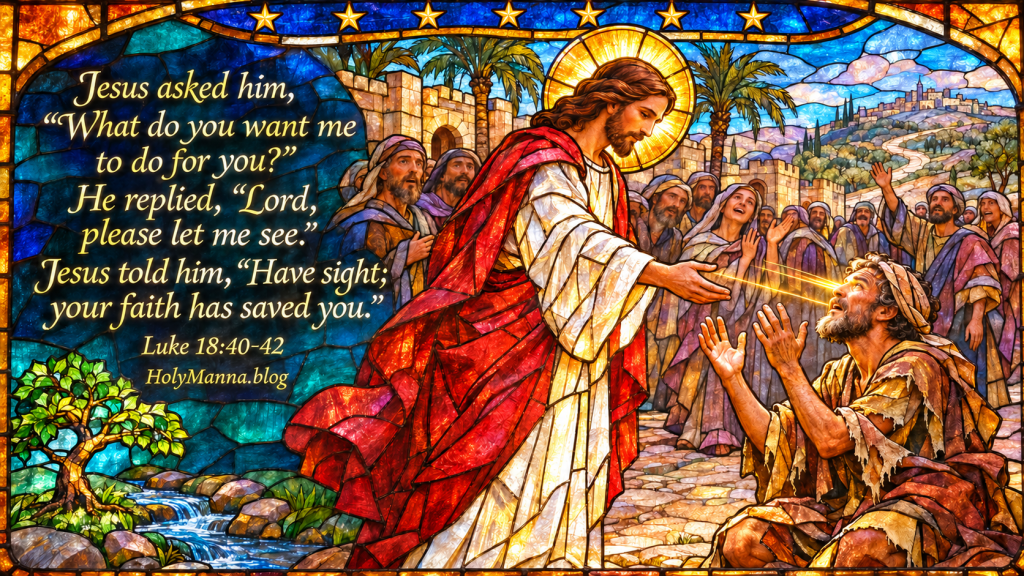
Then Jesus stopped and ordered that he be brought to him;
and when he came near, Jesus asked him,
“What do you want me to do for you?”
He replied, “Lord, please let me see.”
Jesus told him, “Have sight; your faith has saved you.”
He immediately received his sight
and followed him, giving glory to God.
When they saw this, all the people gave praise to God.
Detailed Exegesis
Luke 18:35
“As Jesus approached Jericho a blind man was sitting by the roadside begging.”
Saint Gregory the Great, in his Homily 2 on the Gospels, preached that the name Jericho means “moon,” and that in Scripture the waning moon stands for the frailty of mortal flesh. So when the Creator draws near to Jericho, wounded humanity is about to receive its light back. The man is sitting, begging, and blind, the picture of a soul that cannot move toward God on its own.
Luke 18:36
“And hearing a crowd going by, he inquired what was happening.”
He cannot see, so he listens. For anyone whose faith feels dark, the first step is simply to notice the movement of God nearby and to ask what is happening.
Luke 18:37
“They told him, ‘Jesus of Nazareth is passing by.’”
The crowd gives Jesus a geographical label, accurate and incomplete. Saint Augustine, in Sermon 88, taught that Jesus is always passing by, in the Gospel and in the sacraments, and that until the end of the world there will be blind men by the road who must decide whether to call out.
Luke 18:38
“He shouted, ‘Jesus, Son of David, have pity on me!’”
The crowd said Nazareth; the blind man says Son of David. This is the first time in Luke’s Gospel that anyone publicly calls Jesus by this messianic title, the heir of the promise made to David in 2 Samuel 7. Saint Cyril of Alexandria, in his Sermon 126 on Luke, marveled that the man approached Jesus not as a mere healer but “as to the Omnipotent God.” A beggar who cannot see has clearer vision than the crowd.
Luke 18:39
“The people walking in front rebuked him, telling him to be silent, but he kept calling out all the more, ‘Son of David, have pity on me!’”
The ones leading the procession try to shut him up. Augustine warned in the same sermon that this crowd is still with the Church, in the form of lukewarm believers who discourage anyone trying to live the Gospel seriously. Cyril asked his listeners to wonder at “the constancy wherewith he confessed Him.” Pope Francis, in his General Audience of May 6th, 2020, called this “that beautiful stubbornness of those who seek a grace.”
Luke 18:40
“Then Jesus stopped and ordered that he be brought to him; and when he came near, Jesus asked him,”
Gregory the Great drew out the beauty of this moment with a single line: “to pass by is of man, to stand is of God.” The Lord who was passing by stops. The cry of faith has halted the procession to Jerusalem.
Luke 18:41
“‘What do you want me to do for you?’ He replied, ‘Lord, please let me see.’”
Jesus knows the answer, but he asks, because he wants the man to name his desire. Saint Ambrose noted that the question was asked so that the crowd would see the man’s faith for themselves. The answer, “Lord, please let me see,” is one of the shortest and best prayers in the Gospel.
Luke 18:42
“Jesus told him, ‘Have sight; your faith has saved you.’”
Cyril pointed out that Jesus heals by command, on his own authority, a quiet sign of his divinity. The word “saved” is larger than “healed.” The man receives his eyes and something more.
Luke 18:43
“He immediately received his sight and followed him, giving glory to God. When they saw this, all the people gave praise to God.”
Gregory the Great observed that the one who sees also follows, because he now practices the good he understands. The man does not go home. He joins the road to Jerusalem, and the crowd that tried to silence him ends up praising God.
Teachings
The Church has turned this blind man’s cry into one of its oldest prayers. CCC 2616 teaches: “The urgent request of the blind men, ‘Have mercy on us, Son of David’ or ‘Jesus, Son of David, have mercy on me!’ has been renewed in the traditional prayer to Jesus known as the Jesus Prayer: ‘Lord Jesus Christ, Son of God, have mercy on me, a sinner!’ Healing infirmities or forgiving sins, Jesus always responds to a prayer offered in faith.” CCC 2667 adds that this invocation “combines the Christological hymn of Philippians 2:6-11 with the cry of the publican and the blind men begging for light. By it the heart is opened to human wretchedness and the Savior’s mercy.”
The posture behind the prayer is described in CCC 2559: “He who humbles himself will be exalted; humility is the foundation of prayer.” And CCC 548 explains why the miracle matters beyond the one man healed: “The signs worked by Jesus attest that the Father has sent him. They invite belief in him. To those who turn to him in faith, he grants what they ask.”
Reflection
The blind man had none of what Ephesus had, no works, no endurance, and no track record. He had a need, a voice, and a refusal to be quiet. That is first love in its purest form, and it is available to anyone. The Jesus Prayer can be said on a commute, in a waiting room, or in the two minutes before a hard conversation: “Lord Jesus Christ, Son of God, have mercy on me, a sinner.”
Consider also who is doing the rebuking. Sometimes the voice telling you to be quiet about faith is a coworker or a friend, and sometimes it is an interior voice that says the prayer is too simple or the need too embarrassing. The Gospel’s answer is to cry out all the more.
What would you say if Jesus stopped on the road today and asked what you want him to do for you? Who or what has been telling you to keep quiet?
The Lord Who Stops for the One Who Calls
Today’s readings tell one story in three movements. A church that has everything except warmth hears the Risen Lord say, remember, repent, and return to the first works. A psalm describes the person who has kept that first love alive, delighting in God’s word and standing rooted like a tree by running water while everything rootless blows away. Then a blind beggar at Jericho shows what it looks like when lived: a man with nothing but a cry, calling the Messiah by his true name, refusing every voice that tells him to be quiet, until the Lord who was passing by stands still and asks what he wants.
The crowd in Luke’s Gospel knew who was passing by. They had the right name and the right facts. The blind man had the right love. That is the difference between Ephesus at its best and Ephesus as it had become, and it is the difference the Lord looks for in every heart that comes to Mass this week.
The invitation is simple and urgent. Remember when faith was first alive. Return to the stream and put down roots in the word of God every day. And when Jesus passes by, in the Eucharist, in the confessional, in the quiet of an ordinary morning, do what the beggar did. Call out, keep calling out, and ask for sight. The Lord who holds the seven stars in his right hand still walks among his churches, and he still stops for anyone who means it.
Engage With Us!
The conversation does not have to end here. Share your reflections in the comments below, because someone reading may need exactly the encouragement of hearing how these readings landed in your life.
- In Revelation 2:1-5, the Lord praises the church at Ephesus for its works, endurance, and vigilance, then tells it that it has lost the love it had at first. What were the first works of your own faith, and which one could you take up again this week?
- Psalm 1:1-4, 6 contrasts the tree planted near running water with the chaff the wind drives away. What daily habit keeps you rooted, and where in your routine could meditation on Scripture find a regular place?
- In Luke 18:35-43, the blind man cries out to the Son of David and refuses to be silenced by the crowd. When have you felt pressure to quiet your faith, and what helped you keep calling out?
- Taken together, these readings call for a return to first love through a faith that cries out and stays rooted. If Jesus stopped on the road and asked what you want him to do for you, what would you honestly say?
Living a life of faith is not about the longest résumé of works. It is about keeping the fire lit and calling out to the one who is always passing by. Do everything this week with the love and mercy Jesus taught, and expect him to stop.
Sacred Heart of Jesus, we trust in You!
Immaculate Heart of Mary, pray for us!
Saint Michael the Archangel, defend us in battle!
Follow us on YouTube, TikTok, Instagram and Facebook for more insights and reflections on living a faith-filled life.


Leave a Reply