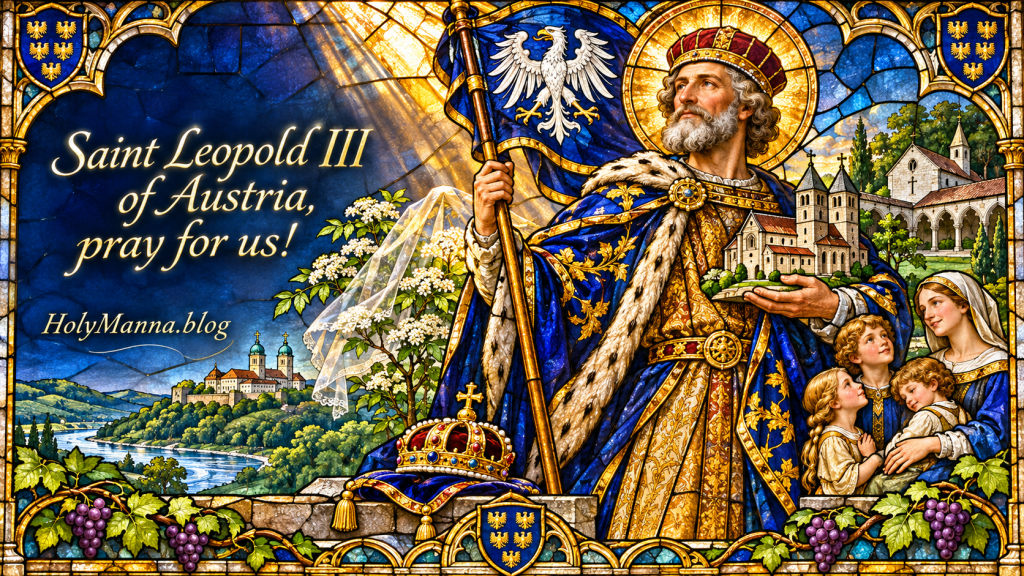
A Ruler His Own People Called Holy
Most saints are remembered because they left the world behind. Saint Leopold III of Austria is remembered because he stayed in it. He was a husband, the father of a very large family, and the ruler of a frontier province for forty years. He never founded a religious order or wrote a treatise. What he did was govern justly, build monasteries, raise children who became bishops and dukes, and turn down the most powerful throne in Europe when it was offered to him. His own subjects began calling him the Pious within a generation of his death, and the Church confirmed that judgment when Pope Innocent VIII canonized him on January 6th, 1485.
Leopold’s memorial falls on November 15th, the anniversary of his death in 1136. The Roman Martyrology remembers him simply: At Klosterneuburg, near Vienna in Austria, St. Leopold, margrave of that province of Austria. Since 1663 he has been the patron saint of Austria, of the city of Vienna, of Lower Austria, and, together with Saint Florian, of Upper Austria. Popular devotion also invokes him as a patron of large families, of step-parents, and of parents who have lost a child, which fits his life well, though these are devotional rather than formal designations.
A twelfth-century margrave still matters to a Catholic today because Leopold shows that holiness is not reserved for monks and martyrs. The Catechism teaches that all Christians in any state or walk of life are called to the fullness of Christian life and to the perfection of charity (CCC 2013). For anyone trying to be a saint at a desk, in a marriage, or in a position of responsibility, he is a friend worth knowing.
Raised in a House That Chose the Pope
Leopold was born in 1073, most likely at Babenberg Castle in Gars am Kamp in what is now Lower Austria. Some older sources place his birth at Melk, and the New Catholic Encyclopedia gives a date of around 1075, so the exact year and place remain uncertain. His father was Margrave Leopold II, called the Fair, and his mother was Ida, probably of the Formbach-Ratelnberg family. The Babenbergs had governed the Austrian March, the eastern frontier of the Holy Roman Empire facing Hungary, since 976.
Leopold’s childhood was shaped by the great conflict of his age. The Investiture Controversy pitted Pope Saint Gregory VII against Emperor Henry IV over who had the right to appoint bishops, and beneath that question lay a deeper one about whether the Church would be free at all. Leopold’s father at first sided with the Emperor. Then, under the influence of his wife Ida and of the exiled reforming bishop Saint Altmann of Passau, he changed sides, declaring for the Pope at Tulln in 1081. Henry IV deposed him, and in 1082 Leopold II lost the Battle of Mailberg, keeping his lands only with difficulty.
The young Leopold grew up in that household, watching his parents pay a real price for loyalty to Rome. He was educated under the influence of Saint Altmann himself, who spent his exile in Austria insisting that bishops be chosen by the Church rather than bought from princes. The Catechism describes the relationship Altmann fought for when it teaches that the Church is not to be confused in any way with the political community and that she is both the sign and the safeguard of the transcendent character of the human person (CCC 2245). Leopold absorbed that lesson early, and it shaped how he would rule.
He succeeded his father as margrave in 1095, at about twenty-two years of age, and held the office for the next forty-one years. His conversion, if it can be called that, was not a dramatic turn from sin but a steady deepening of a faith received at home. The Catechism speaks of this kind of growth when it says that Christ’s call to conversion continues to resound in the lives of Christians and that this second conversion is an uninterrupted task for the whole Church (CCC 1428).
A Household of Faith and Three Monasteries
Leopold married twice. His first wife, whose name is not securely recorded, died in 1105. A son, Adalbert, has traditionally been attributed to this marriage, though a 2013 genetic study of the Babenberg remains suggests he may have been a son of the second.
In 1106 Leopold married Agnes, daughter of Emperor Henry IV, sister of the new Emperor Henry V, and widow of Duke Frederick I of Swabia. Agnes was already the mother of the future King Conrad III and the grandmother of Frederick Barbarossa; by Leopold she became the mother of a second dynasty. Tradition holds that they had eighteen children together, of whom seven died in infancy, though the exact number cannot be confirmed and historians can name about eleven. Among them were Leopold IV, who succeeded his father; Henry II Jasomirgott, who became the first Duke of Austria; Conrad, who became Bishop of Passau and then Archbishop of Salzburg; and Otto, who entered the Cistercians, became Abbot of Morimond and Bishop of Freising, and wrote one of the greatest historical works of the Middle Ages. Otto of Freising is honored by the Church as Blessed.
That household was itself a kind of monastery. The Catechism calls the Christian family the domestic church and says that in it the father of the family, the mother, children, and all members of the family exercise the priesthood of the baptized in a privileged way (CCC 1656 to 1657). It also teaches that parents have the first responsibility for the education of their children (CCC 2223). A family that produces two bishops, one of them a Blessed, and that buries seven small children in faith is a family where the Gospel is being lived at the kitchen table.
The margrave’s public rule matched his private life. Butler’s Lives of the Saints records that he was affable and charitable, that he labored to lighten the burdens of his subjects, and that he gave generously to the poor while punishing crime with an eye to justice and public safety. The nickname his people gave him, the Good, was not a court flattery; it was earned over four decades. Under Leopold the towns along the Danube flourished, Krems received a mint, and toward the end of his reign Vienna came under direct Babenberg rule, laying the foundation for its later role as an imperial capital. Leopold styled himself princeps terrae, prince of the land, a title that expressed his sense that Austria was becoming a real country rather than a military district.
The Catechism describes the vocation Leopold was living when it says that those who exercise authority should do so as a service and quotes Our Lord: Whoever would be great among you must be your servant (CCC 2235, citing Matthew 20:26). It defines the common good a ruler exists to serve as the sum total of social conditions which allow people, either as groups or as individuals, to reach their fulfillment more fully and more easily (CCC 1906). Peace, justice, growing towns, and honest coinage are exactly those conditions.
Leopold’s most lasting work, however, was religious. In the first years of his second marriage he founded a church and a community of canons at Klosterneuburg, on the hills above the Danube just north of Vienna, next to the castle he had made his residence. The sources give dates from 1106 to 1114 for the foundation because it unfolded in stages: a first endowment, a richer one in 1113 and 1114 when the great church was begun, and in 1133 the handing over of the house to the Augustinian Canons Regular, who serve it to this day. The abbey church was consecrated on September 29th, 1136, only weeks before Leopold’s death.
In 1133, at the urging of his son Otto, who was then a young Cistercian monk, Leopold founded Heiligenkreuz in the Vienna Woods, the first Cistercian abbey in Austria and one of the few monasteries in the world continuously inhabited since its foundation. Some sources give 1135 or 1136 for Heiligenkreuz, but 1133 is the better-attested date. In 1136 he renewed the Benedictine foundation of Kleinmariazell. He also placed Melk and Klosterneuburg directly under the protection of the Holy See, a concrete way of keeping them free from lay interference.
No miracles are reliably recorded from Leopold’s lifetime. His contemporaries remembered him not as a wonder-worker but as a just man, and the Church canonized him as a confessor. The quiet miracle of his life was to be a prince who let the Church’s moral judgment govern his governing.
The Weight of Politics and the Crown He Refused
Leopold was no plaster saint, and the Church has never pretended otherwise. His hardest trials were political, and his conduct in them was human.
As a young ruler he tried to stay neutral in the continuing struggle between Pope and Emperor. He restored some Church properties his family had taken but remained formally loyal to Henry IV, the same emperor who had deposed his father. Then in October 1105 he made a decision that still troubles historians. When Henry IV’s own son rebelled against him, Leopold abandoned the old emperor and went over to the young Henry V. The future emperor had promised him the hand of his sister Agnes, and the marriage followed in 1106. Whether Leopold acted out of principle, ambition, or a shrewd reading of the wind, the sources do not say. What is certain is that the marriage bound the Babenbergs to the imperial house and strengthened Austria immeasurably.
Leopold’s loyalty to the Church, however, proved durable. He took part in the Concordat of Worms in 1122, the settlement by which Henry V finally gave up the right to invest bishops with ring and crozier. The New Catholic Encyclopedia records that Pope Innocent II later honored him with the title Son of Saint Peter for his fidelity to Rome during the Investiture struggle. The Catechism explains why that struggle mattered: It is a part of the Church’s mission to pass moral judgments even in matters related to politics, whenever the fundamental rights of man or the salvation of souls requires it (CCC 2246). A Church whose bishops were appointed by emperors could not pass such judgments freely.
Leopold also bore the burdens of a frontier lord. Butler notes that he defeated King Stephen II of Hungary in a border war while governing a land still being Christianized, work Butler calls slow and difficult. At home he and Agnes buried seven children. A fifteenth-century painting in the great Babenberg family tree at Klosterneuburg shows the saint holding two of his small dead sons. Any parent who has stood at a child’s grave knows that this was the heaviest cross of all.
Then came the test that defines his memory. In May 1125 Emperor Henry V died without a son. Leopold, the late emperor’s brother-in-law and the ruler of a prosperous and peaceful land, was one of the leading candidates to succeed him. Catholic sources agree that the crown was within his reach and that he declined it. Lothair of Supplinburg was elected instead. Leopold went home to Austria and spent the remaining eleven years of his life finishing his churches.
The sources do not preserve his reasons, and it is better to say so than to invent a speech for him. Some historians suggest he was already in his fifties and preferred to secure his own land rather than gamble on a divided empire. The Catholic tradition saw a humility that preferred the duty God had given to the glory men offered. Both may be true at once. The fruit is certain: Austria had peace, the monasteries were finished, and the Church gained a saint rather than a mediocre emperor.
Our Lord’s question hangs over that decision: What profit would there be for one to gain the whole world and forfeit his life? (Matthew 16:26). The Catechism teaches that Jesus enjoins his disciples to prefer him to everything and everyone (CCC 2544). Leopold was called to hold his margraviate loosely, and when the greatest prize in Christendom was held out to him, he showed that he did.
Leopold was not martyred. He died on November 15th, 1136, at about sixty-three years of age. The abbey of Klosterneuburg records that he died probably in a hunting accident, and other Austrian sources agree, though the popular lives are silent on the cause and it cannot be stated as certain. He was buried in the chapel that now bears his name at Klosterneuburg, in the church he had seen consecrated seven weeks earlier. Agnes survived him by seven years and was buried beside him.
The Tomb That Became a Pilgrimage
Leopold’s reputation for holiness did not wait for Rome. By about 1180, less than fifty years after his death, Austrian writers were calling him the Pious. A cult at his tomb is documented by 1194. Pilgrims came in such numbers that in 1323 the canons compiled a register of prayers answered at his grave, and in 1326 the Pope granted an indulgence to those who made the pilgrimage.
The cause for his canonization was a long one. Duke Rudolf IV presented the miracles and answered prayers to Pope Innocent VI in 1358 and asked for Leopold’s canonization. The Great Western Schism intervened and the cause stalled for a century. Emperor Frederick III revived it, the Austrian diet formally petitioned Rome in 1461, and after a process that was repeatedly interrupted, Pope Innocent VIII canonized Leopold on January 6th, 1485, the feast of the Epiphany, with the bull Sacrosanctam matrem ecclesiam. Printed copies of that bull survive at Klosterneuburg, Oxford, and Harvard. Leopold was first celebrated liturgically in Vienna on May 4th, 1486, and on February 15th, 1506, his relics were solemnly raised in the presence of Emperor Maximilian I.
The Catechism explains what the Church does in such an act: By canonizing some of the faithful, i.e., by solemnly proclaiming that they practiced heroic virtue and lived in fidelity to God’s grace, the Church recognizes the power of the Spirit of holiness within her and sustains the hope of believers by proposing the saints to them as models and intercessors (CCC 828).
Several miracle stories from Leopold’s tomb were gathered by the Jesuit Father Francis Xavier Weninger in his nineteenth-century Lives of the Saints. One tells of a poor woman crushed by debts who prayed at the saint’s grave and found her debts paid. Another tells of a prisoner who had made a vow to Saint Leopold and broken it; he was miraculously freed, imprisoned a second time when he failed to keep his promise, and freed again when he repented. A third tells of a man who had lost his hearing and was cured at the tomb, only to go deaf again after neglecting a promise he had made, and to be cured a second time when he kept it. These stories cannot be verified today and are offered as the devotional tradition of the pilgrims of Klosterneuburg. Butler’s Lives records simply that many miracles were attested.
The most famous story attached to Saint Leopold is the story of the veil. It was first written down in the fourteenth century, more than two hundred years after the events it describes. In 1106, shortly after their wedding, Leopold and Agnes stood on the balcony of their castle on the hill now called the Leopoldsberg. A sudden gust of wind tore Agnes’s bridal veil, a fine Byzantine fabric, from her head and carried it away over the forest toward the Danube. Leopold knelt and vowed that wherever the veil was found, he would build a monastery in honor of Our Lady. Nine years later, while hunting in the woods below the castle, his dogs began barking at a flowering elder bush. Caught in its branches, perfectly intact after nine winters, hung the veil. In a later version of the story, the Blessed Virgin herself appeared above the elder with the Christ Child in her arms. Leopold took the veil as a sign and founded Klosterneuburg on that spot. This story cannot be verified, and the dates of the foundation suggest it grew up afterward to explain a decision Leopold had made for other reasons. Yet the abbey still treasures a Byzantine veil as the veil of Agnes, and in 1710 Matthias Steinl built the great Veil Monstrance, the largest Baroque monstrance in Austria, to tell the story in gold and silver.
Leopold’s relics remain at Klosterneuburg. His skull rests in an embroidered reliquary that leaves the forehead exposed and is crowned with an archducal crown. Since 1616 the abbey has also guarded the Austrian Archducal Hat, the crown of the Habsburg lands, which could be removed from the saint’s tomb only for the ceremony of hereditary homage.
In 1663, during the reign of his namesake Emperor Leopold I, Saint Leopold was declared the patron of Austria in place of the Irish pilgrim Saint Koloman. His feast, called Leopoldi, remains a legal holiday in Vienna and Lower Austria. Every year around November 15th the town of Klosterneuburg celebrates the Leopoldifest with a pontifical Mass in the abbey church, a great market, new wine, and the beloved custom of Fasslrutschen, in which pilgrims and visitors slide down the side of the Thousand-Bucket Barrel of 1704 in the abbey cellar. As boys in the choir of Saint Stephen’s Cathedral, Joseph and Michael Haydn sang at Klosterneuburg on Leopold’s feast, and in 1805 Michael Haydn composed the Missa sub titulo Sancti Leopoldi in his honor. Nine centuries after his death, the margrave who refused a crown is still shaping the culture of the land he loved.
Holiness in the Place Where You Already Stand
Saint Leopold’s life carries a quiet but demanding message: God is not waiting for you to become someone else before He makes you a saint. Leopold did not leave his wife, children, or responsibilities to find God; he found God in them. The Catechism teaches that the laity are called to work for the sanctification of the world from within as a leaven (CCC 898). Leopold was leaven in a frontier province, and the bread rose.
Consider first his fidelity in ordinary duty. Forty years of governing, judging, and building is not thrilling biography, but it is the stuff of holiness. Saint Paul tells the Colossians: Whatever you do, do from the heart, as for the Lord and not for others (Colossians 3:23). Where in your own life are you tempted to think that your daily work is too ordinary to matter to God, and what would change if you did it tomorrow as for the Lord?
Consider next his refusal of the crown. Leopold was offered the greatest honor his world could give and chose the smaller, harder, truer vocation he already had. Most people are never offered an empire, but everyone is offered smaller crowns: a promotion that would cost a family its father, or a comfortable compromise that would cost a conscience its peace. The Catechism says that the Beatitudes reveal an order of happiness and grace, of beauty and peace (CCC 1717). Is there a crown in your life right now that you need to decline in order to remain faithful to the vocation God has actually given you?
Consider his family. Eighteen children, seven small graves, two sons at the altar, and a marriage that lasted thirty years. Leopold and Agnes raised a holy family through grief and politics and war, not in ideal circumstances. The Catechism teaches that the home is the first school of Christian life (CCC 1657). What is one concrete way you could make your own home, or the home you hope to have, more of a school of Christian life this week?
Consider finally his building. Leopold poured his wealth into churches and monasteries that have been praying without interruption for nine hundred years. Few people can found an abbey, but everyone can build something that will outlast them: a habit of daily prayer in a household, or a friendship that leads someone back to the sacraments. The Catechism teaches that giving alms to the poor is one of the chief witnesses to fraternal charity (CCC 2447). What are you building right now that will still be standing, in this world or the next, long after you are gone?
A practical way to walk with Saint Leopold this week is to take one responsibility you usually resent, whether a chore, a meeting, a bill, or a difficult relative, and offer it deliberately to God each morning as your own small margraviate. Pray for those in public office, that they may govern as servants. And if you are a parent, or hope to be one, ask Saint Leopold and Agnes to pray for your children, living and dead, as they once prayed for theirs.
Engage With Us!
Saint Leopold shows that a crown refused can be worth more than a crown worn, and that the surest road to heaven often runs straight through the duties already at hand. Share your thoughts and reflections in the comments below. How does his story speak to your own vocation? Here are some questions to help the conversation along.
- Leopold’s father paid a heavy price for choosing the Pope over the Emperor, and Leopold grew up in the shadow of that choice. What sacrifices made by your parents or grandparents for the faith have shaped you, and how do you honor them?
- In 1125 Leopold declined the imperial crown and went home to finish building his churches. What is one ambition, however good in itself, that you may need to set aside so that you can be faithful to what God has already entrusted to you?
- Leopold and Agnes buried seven children and still raised a household that gave the Church a Blessed and two bishops. How have you seen grief and faith coexist in a family, and what did that teach you about hope?
- The towns and monasteries Leopold built are still standing and still praying nine centuries later. What are you building, in your home, parish, or workplace, that could still be bearing fruit long after you are gone?
- The pilgrims of Klosterneuburg told stories of prayers answered only when a promise to the saint was kept. Is there a promise you have made to God that you have let slide, and what would it take to keep it this week?
Saint Leopold never left the world to find God, because he had learned that God was already waiting for him in his marriage, his children, his people, and his daily work. The same is true for you. Whatever your margraviate looks like, whether it is a classroom, a cubicle, a kitchen, or a hospital ward, govern it with justice, build in it something that will last, and hold every crown the world offers loosely enough to let it go. Do everything with the love and mercy that Jesus taught us, and trust that the One who made a saint of a frontier prince can make one of you.
Saint Leopold of Austria, pray for us!
Follow us on YouTube, TikTok, Instagram and Facebook for more insights and reflections on living a faith-filled life.


Leave a Reply